
Daily Updates
Just for a change and on the off chance that we will be able to obtain some useful information by doing so, we’ll now take a look at some long-term monthly charts. The blue line on each of these charts is the 12-month moving average.
The first two long-term charts show the S&P500 Index and the US$ gold price. We have put the gold chart immediately below the S&P500 chart to illustrate that secular trends in the gold and equity markets are linked. For example, gold’s current secular bull market is linked to the S&P500’s current secular bear market. To put it another way, gold is currently in a secular bull market BECAUSE equities are in a secular bear market. The implication is that gold will remain in a secular bull market until the S&P500 becomes under-valued based on traditional valuation metrics.

Not surprisingly, gold ran into resistance as it approached previous key support at $1,750. Coming back to the top of its previous consolidating level between $1,675-$1,700 is healthy and okay in the face of the latest European soap opera segment.
……I concur with much of this article HERE.
Ed Note: 7 Billion Consuming Resources – Population hist a Milestone on Halloween
Canada One of the Best Investments in US Oil Security
The biggest mistake people are making right now is believing the United States will break free from its oil dependence.
Now, we’re not going to shortchange the drilling frenzy taking place; after all, there are more than 2,000 oil and gas rigs operating across the United States.
Whether or not you share the “Drill, Baby, Drill” attitude, it’s happening right now. I’ve even been told on occasion that with all this drilling, we’ll soon be back on top.
But despite our best efforts, we’ve only managed to increase our domestic crude production to 5.6 million barrels per day. That’s it.
Do we really expect production to grow another 12 million barrels per day?
Because that’s how much it would take to finally rid ourselves of our need for foreign oil. Even when you add in U.S. peak production (9.6 million barrels per day — the most we’ve ever produced), it still wouldn’t be enough.
But there are other places the U.S. can turn to satisfy our addiction. They have everything to do with the phrase “friendly oil” that’s casually being tossed around the political stage.
Beyond the OPEC
If you’re looking to bet on a horse, you don’t pick the one with a broken leg. Whenever the OPEC enters the picture, that’s exactly what I see.
The day will come when its members won’t be able to hide the effects of Peak Oil.
We saw a hint of this after learning about Saudi spare capacity over the summer…
When 1.7 million barrels of light, sweet Libyan crude was disrupted, the Saudis stepped up to the plate, assuring us they would increase production. We soon discovered the oil was of a much poorer quality — European and Asian refiners couldn’t handle the heavy, sour oil that filled the gap.
And keep in mind that Saudi Arabia is heavily dependent on its giant oil fields for production. I’ve mentioned before that more than 90% of Saudi oil production is from just seven oil fields. The same goes for the OPEC’s other leading producers, including Iraq and Kuwait. The three of them account for nearly 20% of our daily imports.
What will happen when those giant fields share the same fate as Mexico’s Cantarell field?
It’s no wonder Uncle Sam is looking elsewhere for its crude imports…
And two of those bets just so happen to be in the Western Hemisphere.
The Friendly Frontiers
The first should need no introduction.
Canada is easily our largest source for oil, shipping us more than 2.6 million barrels every day. Soon, that amount will top 3 million barrels per day — and our neighbors to the north will continue to be our leading supplier for decades.
By 2035, nearly 80% of all Canadian production will come from the oil sands. I’ve talked before about the fundamental shift taking place in the oil sands industry right now. More importantly, it’s this kind of in-situ technology that will satisfy our future oil needs.
But before we start counting our barrels, it’s important to realize this oil won’t come without a fight.
We’re not the ones injecting billions of investment dollars into Canadian projects…
As the debate over the Keystone XL pipeline reaches a feverish pitch, China has made her intentions loud and clear.
Nearly a dozen companies — including Sinopec — have spent more than $100 million helping Enbridge get approval for its Northern Gateway pipeline, which would ship oil sands production across the Pacific.
Perhaps it’s time we take a lesson in energy security from the Chinese…
Brazil’s Offshore Future
Although the discovery is relatively new, the Tupi oil field will turn Brazil in a major exporter.
Since its announcement by Brazil in 2006, the field has been re-christened the Lula oil field in honor of Brazil’s wildly popular leader, President Luiz Inacio Lula da Silva.
As many as 8 billion barrels of recoverable oil and gas lie in the pre-salt region, which is producing about 130,000 barrels per day. Within three years, output could top half a million barrels per day, nearly doubling the country’s current crude production of 2.1 million barrels per day.
Although Brazil is still a relatively minor source of oil for the United States, it’s quickly shaping up to be one of the best offshore bets today:

Their outlook gets even better. As you can see, Brazil is expected to account for 40% of non-OPEC growth to 2035:

The oil won’t be cheap, that’s for certain…
Petrobras (PBR) is planning to invest $224 billion over the next two years to develop the field.
That’s enough cash to drill nearly 60,000 new wells in the Bakken.
If you want to find a new way to invest in our future oil supply, it doesn’t get much better than this.
Until next time,
Keith Kohl
Editor, Energy and Capital
Energy and Capital, Copyright © 2011, Angel Publishing LLC. All rights reserved. Privacy Policy | Site Map | FAQ | Contact | Home
Energy and Capital is not personalized investment advice. Our employees strive to give smart, stimulating commentary, but are not licensed to address or give advice on individual investment situations. Nothing you receive from Energy and Capital should be considered personal investment advice. Any investments recommended by Energy and Capital should only be made after consulting with your investment advisor and only after reviewing the prospectus or financial statements of the company. All investments carry risk of significant loss.
As a general rule, the most successful man in life is the man who has the best information
As demand for food rises, so does the requirement for crop nutrients.
Potash has unique characteristics:
High-quality, economically viable deposits are rare
Major offshore markets have little or no indigenous production capability
Barriers to entering the business are significant
Potash has been historically under applied relative to nitrogen and phosphate
Limited new operational capability is expected
Higher crop yields are needed in order to feed today’s global population of seven billion so strong fertilizer prices are sustainable. Over the next fifty years, as we add another 4.5 billion people to the world’s population, global demand for food will increase almost 70% if population growth predictions are correct.
The sheer amount of people being born every year, the loss of arable land and the change of diet among a newly prosperous, urban population in developing countries are the most important factors stoking the rise in global food demand.
A rising income means more money in the household budget. The new middle class consumers forgo plant based calories in favor of adding more protein from meat and dairy products to their diets. It takes up to eight kilograms of grain to produce one pound of beef – less for pork, chicken, milk or eggs – between 2kg and 6kg. As meat consumption soars, more grain is needed to feed more livestock.
In 1995, the Chinese ate an average of 25kg of meat per person, by 2007, the Chinese were consuming 53kg of meat per person.
Enlarging and diversifying the meat supply is a first step for every developing country.
The Protein Ladder:
5.Grain fed beef
4.Grass fed beef
3.Milk, other dairy products
2.Pork
1.Chicken and eggs
Rice, beans and bread
In 1980, the world ate 133 million tonnes of meat and drank 342 million tonnes of milk. By 2002, consumption had increased to 239 million tonnes of meat and 487 million tonnes of milk. The United Nations Food and Agriculture Organization (FAO) estimates that by 2030 global annual consumption of meat will stand at 373 million tonnes and 736 million tonnes of milk.
The more people there are on this planet and the more Asians, and others, decide they want a western style diet the more grains/oilseeds are needed to feed them. And many of those very same grains are needed to raise the animal protein, the beef, pork and chicken they want.
Potash Corporation of Saskatchewan Inc. (NYSE:POT), the world’s largest fertilizer producer by market value, doubled its third quarter earnings, reporting 94 cents per share or $826 million compared to 38 cents per share or $343 million a year ago. During the first nine-months of 2011, the company’s earnings have doubled from $1.39 per share during the same period last year to $2.73 per share today. Net income of US$826 million was the second highest Q3 profit in the company’s history – gross margin reached US$1.1-billion. Potash production was 1.9 million tonnes, a third quarter record for Potash Corp.
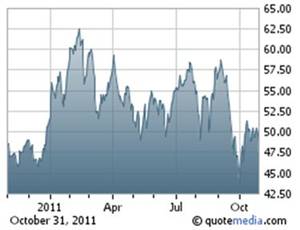
The company said demand was strong from both North American and international customers.
“Crop prices remained at historically high levels [in the third quarter] and farmers continued to strive for increased production to capitalize on the economic opportunity in agriculture. As a result, demand for our potash, phosphate and nitrogen products remained strong.” Bill Doyle chief executive of Potash Corp.
While total shipments from the global potash industry will rise to between 58 and 60 million tons in 2012, up from Potash Corp.’s forecast of 57 million for 2011, Mr. Doyle predicted a very tight potash market in 2012, saying the industry continues to face capacity constraints and will struggle to keep up with demand.
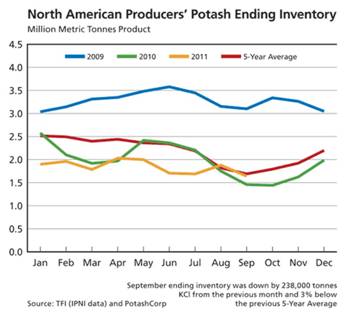
The cost of fertilizer as a percentage of corn revenue is 13%, 18% is the norm.
Global grain stocks remain at extremely low levels. Potash Corp. said at the beginning of the year that it would take two years of record harvests to get inventories back to comfortable levels, 2011 has been referred to as a lost year.
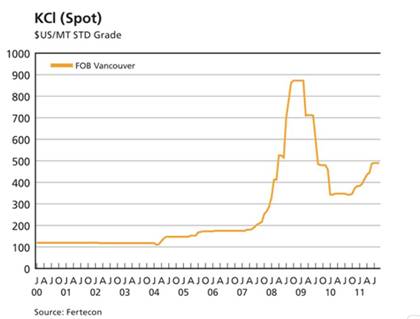
According to figures compiled by Bloomberg potash prices averaged 27 percent higher in the third quarter compared with a year earlier.
“Global potash prices have surged in 2011, driven by a tight global supply/demand balance, and with producers heavily committed through year-end, we view current price levels as being sustainable.” Don Carson, analyst, Susquehanna Financial Group
WESTERN POTASH CORP. DELIVERS ROBUST PREFEASIBILITY STUDY AT MILESTONE
Western Potash Corp. TSX – WPX has received an independent positive prefeasibility study from AMEC Americas Ltd. on its 100-per-cent-owned Milestone property in Southern Saskatchewan. AMEC is a leading international engineering and project management company that currently manages multiple potash expansion projects in Saskatchewan with a capital value of several billion dollars.
AMEC was chosen to carry out the Study because of their technical expertise as engineers and EPCM contractors, as well as their experience in potash mine construction, potash processing and their expertise in producing potash feasibility studies.
This Study confirms that the Milestone Project shows significant positive economics and that the asset is of sufficient size and grade to support primary and secondary solution mining for more than forty years at a production rate of 2.8Mt/yr. The Milestone Project hosts a potash resource which consists of 64 million tonnes of Measured Resource (contained KCl), 180 million tonnes of Indicated Resource, and 701 million tonnes of Inferred Resource. The Study was based on, and supported by, the NI43-101 Technical Report “Updated Technical Report Concerning Mineral Resource Estimates Subsurface Mineral Lease KLSA 008 Saskatchewan”, dated June 8, 2011 and filed on SEDAR on June 10, 2011.
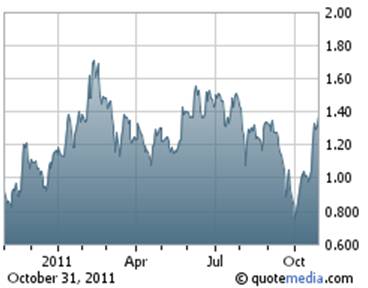
An assessment of project economics was also included in the Study. Assuming a discount rate of 10%, the resulting project Net Present Value is $4.14B CAD, while the Internal Rate of Return is 22.7 %. The economics were modeled using pricing based on a CRU market report. This report provided average yearly potash price estimates for the period from 2015 through 2025. The average for those years, equating to $US 511/t, was used for the 2025 to 2055 period. The economic model assumes a flat US$ exchange rate, CAPEX based on 100% equity, and tax and royalties calculated using a flat rate of $28.90/t CAD. A complete list of the assumptions used in this model can be found in Table 1. Since the analysis is based on a cash flow estimate, it could be expected that actual financial results may vary from these predictions.
Table 1: Model Assumptions
Target Annual Production rate: 2.8 Mt/yr
Life of Mine: 40 years
Years of Construction: 3
Construction Start-up: 2013
Mining Start-up :2016
Years to Full Secondary Production: 6
Long Term Potash Price (FOB Gate): $511/tonne USD
Assumed Exchange Rate: US$/CAD$ 1.00
Taxes and Royalties: $28.90/tonne CAD
Sustaining CAPEX Rate %: 2.0%
Base Case: 100% Equity
OPEX: $62.35 tonne CAD
Initial CAPEX:$2.458 Billion CAD
Port CAPEX: $300 Million CAD
Total Initial CAPEX: $2.758 Billion CAD
NPV (10): $4.14 Billion CAD
IRR: 22.7%
Payback Period: 5 Years
The Study includes all facilities required to operate a potash solution mine, including a cavern and well field layout, a two-train multiple effect evaporization-crystallization plant, a dry processing plant, product storage, load out and all other necessary site infrastructure. This design was detailed to a sufficient level to allow the capital cost estimate to be upgraded to AACE “Class 4” standard. The annual production rate can be expanded to a higher annual production rate, achievable through a higher level of capital expenditure.
This Study was intended to provide a high degree of project definition, building on the Scoping Study completed in 2010. The Prefeasibility Study commenced with the completion of tradeoff studies where important design options were investigated. Ultimately a single plant design was identified, which was carried through the Study.
Agapito Associates, Inc. was contracted by the Company to complete the Solution Mining Design for the Study, which included a solution mining plan and schedule, well field design, cavern layout and recovery modeling, and subsidence analysis. AAI’s experience includes work for Intrepid Potash Inc. in the US, Rio Tinto and Vale at the PRC project in Argentina, and work for several prospective potash projects located in Saskatchewan.
Capital and operating cost estimates were generated with a target accuracy of Aplus or minus 20%, typical for this level of Study. The initial CAPEX estimate for the plant is $2.758B CAD, including allowances for port infrastructure, water supply pipeline, and off site railway. An allowance of $300M CAD has been included for port infrastructure which was excluded from the Company’s Scoping Study completed in 2010. Removing this allowance for port from the current Study results in an approximate 2% reduction in initial CAPEX when compared to the Company’s Scoping Study.
Construction is assumed to take place over a three year period, with production beginning in project year three. Full primary and secondary production will be achieved over a six year ramp up period.
The Project unit operating costs were estimated to be $62.35/tonne CAD at full production capacity. These operating costs include estimates for labour, maintenance, power, natural gas, water, consumables, diesel, and uncapitalized well field operations. Operating costs do not include taxes, royalties, or the costs associated with transportation to port and ship loading. Sustaining capital has been projected to remain flat at 0.5% of replacement cost for the first 10 years of operations. Sustaining capital ramps up from 0.5% to 2.0% of replacement cost between years 14 and 23 of the Project.
The Study resulted in significant advancement of the level of definition of the project. The Milestone Project remains economically very strong with no known limitations that may prevent a successful and profitable project outcome. The Study recommends immediate commencement of a Feasibility Study which will adhere to the AACE “Class 3” classification for projects.
“The PFS confirms the compelling opportunity that the Milestone project represents for the Company and the Province of Saskatchewan to develop a world class potash mining operation. In addition to the 40 year scope of mining contemplated in the PFS, the known resource is sufficient to support ongoing mining for an additional 40 years and beyond. We are pleased with the on time and on budget delivery as well as the thorough analysis of the available options considered for project optimization. The coordinated efforts of the internal and external teams are to be complimented for their work in delivering a comprehensive report, a critical step as the Company continues the process of de-risking the Milestone asset.” Patricio Varas, Western Potash CEO and President
NORTHERN FINANCIAL ANNOUNCES ITS WHOLLY-OWNED SUBSIDIARY, NORTHERN SECURITIES INC., INITIATES COVERAGE ON WESTERN POTASH CORP.
Northern Financial Corp.’s wholly owned subsidiary, Northern Securities Inc., has initiated research coverage on Western Potash Corp. with a buy rating and a 12-month target price of $2.40.
Conclusion
Potash, and Western Potash Corp. TSX.V – WPX in particular, should be on every investors radar screen. Is it on yours?
If not, maybe it should be.
Richard (Rick) Mills
rick@aheadoftheherd.com
www.aheadoftheherd.com
If you’re interested in learning more about the junior resource sector, bio-tech and technology sectors please come and visit us at www.aheadoftheherd.com
Site membership and our AOTH newsletter are free. No credit card or personal information is asked for.
***
Richard is host of Aheadoftheherd.com and invests in the junior resource sector. His articles have been published on over 300 websites, including: Wall Street Journal, SafeHaven, Market Oracle, USAToday, National Post, Stockhouse, Lewrockwell, Uranium Miner, Casey Research, 24hgold, Vancouver Sun, SilverBearCafe, Infomine, Huffington Post, Mineweb, 321Gold, Kitco, Gold-Eagle, The Gold/Energy Reports, Calgary Herald, Resource Investor, Mining.com, Forbes, FNArena, Uraniumseek, and Financial Sense.
***
Legal Notice / Disclaimer
This document is not and should not be construed as an offer to sell or the solicitation of an offer to purchase or subscribe for any investment. Richard Mills has based this document on information obtained from sources he believes to be reliable but which has not been independently verified; Richard Mills makes no guarantee, representation or warranty and accepts no responsibility or liability as to its accuracy or completeness. Expressions of opinion are those of Richard Mills only and are subject to change without notice. Richard Mills assumes no warranty, liability or guarantee for the current relevance, correctness or completeness of any information provided within this Report and will not be held liable for the consequence of reliance upon any opinion or statement contained herein or any omission. Furthermore, I, Richard Mills, assume no liability for any direct or indirect loss or damage or, in particular, for lost profit, which you may incur as a result of the use and existence of the information provided within this Report.
Richard Mills does not own any shares of Western Potash Corp. TSX – WPX
Western Potash Corp. TSX – WPX is an advertiser on Richards website aheadoftheherd.co

-
I know Mike is a very solid investor and respect his opinions very much. So if he says pay attention to this or that - I will.
~ Dale G.
-
I've started managing my own investments so view Michael's site as a one-stop shop from which to get information and perspectives.
~ Dave E.
-
Michael offers easy reading, honest, common sense information that anyone can use in a practical manner.
~ der_al.
-
A sane voice in a scrambled investment world.
~ Ed R.
Inside Edge Pro Contributors

Greg Weldon

Josef Schachter

Tyler Bollhorn

Ryan Irvine

Paul Beattie

Martin Straith

Patrick Ceresna

Mark Leibovit

James Thorne

Victor Adair