
Daily Updates
Catching Argentinian Disease
In this issue:
Catching Argentinian Disease?
The Ascent of Money
The Independence of the Fed Threatened
A Few Quick Thoughts on the Dollar, GDP, and the Recession
Uruguay, Philadelphia, Orlando, and then…
I have been in South America this week, speaking nine times in five days, interspersed with lots of meetings. The conversation kept coming back to the prospects for the dollar, but I was just as interested in talking with money managers and business people who had experienced the hyperinflation of Argentina and Brazil. How could such a thing happen? As it turned out, I was reading a rather remarkable book that addressed that question. There are those who believe that the United States is headed for hyperinflation because of our large and growing government fiscal deficit and massive future liabilities (as much as $56 trillion) for Medicare and Social Security.
This week, we will look at the Argentinian experience and ask ourselves whether “it” – hyperinflation – can happen here.
The Ascent of Money
I will be quoting from Niall Ferguson’s recent book, The Ascent of Money. I cannot recommend this book too highly. In fact, I rank it up with my all-time favorite book on economic history, Against the Gods, by the late (and sorely missed) Peter Bernstein. There are very few books I read twice. There are too many books and not enough time. This book I will have to read at least three times, and soon, and I have a lot of underlines and mark-ups in it already.
If there were one book I could require every member of the Congress to read, it would be this one. As I read it, I am struck again and again by how fragile and yet resilient our economic systems are. Fragile in the sense that governmental policy mistakes, no matter how well-intentioned, can destroy the wealth of a nation, and resilient in that it doesn’t happen more often.
In his introduction Ferguson writes, “The first step towards understanding the complexities of the financial institutions and terminology is to find out where they came from. Only understand the origins of an institution or instrument and you will find its present day roles much easier to grasp.”
As is often said, those who do not understand history are doomed to repeat it. If you want to understand what is happening in the economy, what the consequences of our choices could be, then I strongly suggest you get The Ascent of Money. It is easy to read, engaging, full of moments where you are led to pull together different ideas into an “Aha!” Ferguson is a brilliant writer and historian, and we are lucky to have this book at a time when it is sorely needed. (order it at Amazon.com)
As I have been writing, the United States in particular, and the developed world in general, are faced with a series of very unpleasant, if not downright bad choices. The time for good choices was ten years ago. Now we face the prospect of painful decisions, no matter what we do. It is not a matter of pain or no pain, of somehow avoiding the consequences of our bad decisions, it is simply deciding how much pain we will take and when, or allowing the pain to build up to a climactic event. Today we look at what I think would be the worst choice of all.
Catching Argentinian Disease
At the beginning of the 20th century, Argentina was the seventh richest nation on earth. It’s very name means “silver.” “As rich as an Argentine” was a byword. Even after falling from the heights through a series of bad decisions, the country was still so wealthy that, in 1946 when new president Juan Peron first visited the central bank, he could remark that “There was so much gold you could barely walk through the corridors.”
Argentina had actually defaulted on its debt in the late 19th century, not once but twice! But still they managed to avoid destroying the currency and devastating the country. But in 1989, after years of massive budget deficits that were financed with borrowing from abroad and Argentinian citizens, the country was left with so much debt and no one was willing to lend it any more money, that the leaders felt compelled to resort to the printing press.
My Uruguayan friend and Latin American partner, Enrique Fynn, tells me of his experience of going to Buenos Aires and buying a pack of cigarettes one evening. He went into the store the next morning for another pack, and the price had doubled. He came back that evening and the price had doubled again (thankfully for his health, he has quit!). There were no prices on any items in the grocery stores. There was a man with a microphone who would announce the prices of various items, often increasing the price every few hours by 30% or more.
Workers would get their pay in cash and rush to the store to buy anything, as by the end of the week their pay would be worthless. Of course, shelves were empty. The US dollar was king, and could purchase things at amazing prices. I heard stories that were truly compelling. (It made me wish I had gone shopping in Buenos Aires at the time!)
Interestingly, the dollar is still the real medium of exchange. I was told by several people that if you want to buy a house for half a million dollars, you bring the physical cash to the closing. One person counts the money and the other checks the paperwork and title. Argentina has the second largest hoard of physical dollars in the world, only exceeded by Russia. Is it any wonder they are concerned with the value of the dollar?
Let’s look at some quotes from Ferguson (emphasis mine):
“The economic history of Argentina in the twentieth century is an object lesson that all the resources in the world can be set at nought by financial mismanagement… To understand Argentina’s economic decline, it is once again necessary to see that inflation was a political as much as a monetary phenomenon…
“To put it simply, there was no significant group with an interest in price stability…
“Inflation is a monetary phenomenon, as Milton Friedman said. But hyperinflation is always and everywhere a political phenomenon, in the sense that it cannot occur without a fundamental malfunction of a country’s political economy.”
Look at the chart below. Using realistic assumptions, It suggests that the annual US government fiscal deficit will approach $2 trillion in 2019. How can we come up with what looks to be about $15 trillion over the next ten years? The Argentinian answer was to print the money.
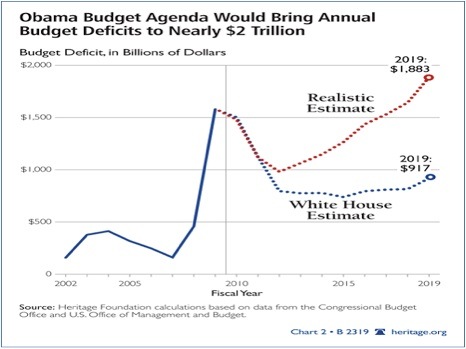
In the US, the short answer is that unless the US consumers become a massive saving machine, to the tune of 8% or more of GDP and rising each year, and willingly put their savings into US government debt, it’s not going to happen. So sometime in the coming years, interest rates are likely to start to rise in order to compensate bond investors for what they perceive as risk. That will bring us to some very difficult and painful choices.
As I wrote a few weeks ago, this scenario could be averted IF the Obama administration produced a credible plan to lower the deficit over time and stuck to it. But today’s thought process is about what happens if they don’t.
Ferguson pointed out in the quotes above that hyperinflation is always and everywhere a political decision. Governments have to choose to print money. In theory and in practice, what would happen if the Fed decided to accommodate a politicized US government that wanted to spend money on favorite projects and support groups, maybe even deserving programs like health care or defense or pensions or Social Security? Money they could not borrow?
Then Peter Schiff and like-minded thinkers would be right. Once you start down that path, it is hard to stop short of the brink. Brazil got to 100% inflation per month and has really lowered that level over time, but it is not easy.
In such a scenario, you want to own hard assets. Gold. Foreign currencies. Stocks. Almost anything other than the currency that is being printed.
I was asked at almost every speech about that scenario. In Latin America, hyperinflation is not a theoretical issue; it has been reality. More than one person commented on that no one in US economics schools studies hyperinflation. It is required material in Latin America. For many Latin Americans, the dollar has been their safe haven. And now they are worried, with good reason.
For the record, I do not think the US will experience hyperinflation as long as the Fed maintains its independence. Read the speeches from various Fed governors and regional presidents. These are strong personalities, and they understand that going down that path ends in massive tears. Bernanke warned just a few weeks ago that the government needs to get serious about the fiscal deficit. Watch the rhetoric from the Fed heat up after his reconfirmation and the confirmation of two new governors in the first quarter.
The Fed has committed to buy a fixed amount of government debt in its quantitative easing program. That commitment will be finished by the end of the first quarter (if I remember correctly). Then comes the tricky part.
I have been writing for a long time that the main force in the economy right now is deflation. The Fed will fight deflation tooth and nail. But they don’t have to buy government debt to fight deflation. They can buy mortgage securities, credit card securities, commercial paper, etc. That will have the effect of easing without encouraging the government to run massive deficits. And such debts are naturally self-liquidating, while government debt is not, at least not in the same way.
I believe the Fed will maintain its independence. Not to do so is to court economic disaster of the first order. These are bright and serious men and women. They get it.
The Independence of the Fed Threatened
The risk is that something changes to compromise their independence. And sadly, there is some risk. Let me quote my fishing buddy friend David Kotok:
“It’s now official. The proposed legislation to reform America’s financial service supervision includes granting the Secretary of the Treasury a veto over Section 13(3) emergency action by the Federal Reserve Board of Governors. If this becomes law, it will be a sad day for the independence of America’s central bank.
“The Secretary of the Treasury, a very senior cabinet position, is appointed by the President and meets with the President in the Oval Office weekly. The governors of the Federal Reserve Board are also appointed by the President. Both cabinet officers and Federal Reserve governors are confirmed by the US Senate. There are supposed to be seven governors; politics has purposefully limited this to five throughout the three-year financial crisis period.
“The Federal Reserve governors are supposed to serve staggered 14-year terms with all seven seats filled. Instead, we have been governed by the present five-member, politically configured board.
“The original seven-governor construction was designed to insulate them from political pressure, for very good reasons. Decades of monetary history throughout the world have disclosed what happens when political influence on a central bank intensifies. The Weimar Republic and Zimbabwe are evidence of the worst inflationary effects of politics. The Great Depression in the US and the nearly two-decade deflationary recession in Japan demonstrate that monetary policy is not only inflation-prone. When central banks are under political influence you can get fire or you can get ice.
“In Japan, the central bank contends with two members of the cabinet sitting in on its deliberations. There is no way to know how much of the last 15 years of deflation and recession is attributable to the inside political pressures placed on the governors of the Bank of Japan. But there is evidence to suggest political influence, especially when you observe how little the Bank of Japan has engaged in asset expansion during this crisis.”
This is the nose of the camel under the tent. Starting down this road is very worrisome indeed. I find it appalling that Tim Geithner and Larry Summers went along with this. This is a very clear attempt by the political class to put political pressure on the Fed. I hope the Fed responds with vigor. I can tell you that the officials of whom I am aware will not take kindly to pressure. And that might be an understatement.
(Yes, I am aware of the problems of the Fed being able to decide whom to bail out and why. It is not a perfect world. But better the Fed than Congress.)
All that being said, if the Fed starts to increase its buying of government debt above its initial commitment, then my “optimistic” scenario of a very rough economic patch, which I have been outlining the past few months, is far too rose-colored. I do not think it will happen, but I can guarantee you, I and a lot of other people will be watching.
A Few Quick Thoughts on the Dollar, GDP, and the Recession
Just a few quick notes. When world trade collapsed, so did the need for US dollars, which is what the world uses to transact business. The data looks like world trade is finding a bottom and maybe even recovering somewhat. That means there will be the need for more dollars. And since everybody and their mother are short the dollar, there could be a vicious snap-back rally. I am still bearish the US dollar (and the yen and the euro and the pound) over the long term, but there is the potential for a real rally here.
And my friend Mish Shedlock commented on the US GDP report, which said the US GDP rose 3.5%:
“Today the market is cheering over what is actually an ugly report. A misguided Cash-for-Clunkers added a one-time contribution of 1.66 percentage points to GDP. Auto sales have since collapsed so all the program did is move some demand forward. Government spending increased at 7.9 percent in the third quarter which is certainly nothing to cheer about. Personal income decreased $15.5 billion (0.5 percent), while real disposable personal income decreased 3.4 percent, in contrast to an increase of 3.8 percent last quarter. Those are horrible numbers. The savings rate is down, which no doubt has misguided economists cheering, but people spending more than they make is one of the things that got us into trouble. The only bright spot I can find is exports. However, even there we must not get too excited as imports rose much more.”
John Williams notes that one-time stimulus or inventory items represented 92% of the reported quarterly growth. The nature of the stimulus-related gains was that they tended to steal business activity from the future. The months ahead are the future. Accordingly, fourth-quarter quarterly GDP change will likely turn negative, again. (The King Report)
And David Rosenberg writes: “Only economists see the recession as being over; the man on the street sees it a little differently, perhaps less enthused by the fact that a lower rate of inventory destocking is arithmetically underpinning GDP growth at this time. Put simply, a Wall Street Journal/NBC News poll just found that 58% of the public believe the economic recession still has a ways to go — and that is up from 52% in September and means that the private investor, unlike the hedge fund manager, is not interested in adding risk to the portfolio even after a 60% surge in the equity market.
“Only 29% of those polled believe the economy has hit bottom — imagine having that psychology with nearly zero interest rates, a bloated Fed balance sheet and unprecedented fiscal deficits (poll was taken from October 23-25). Nearly two in three (64%) said the rally in the stock market (still a bear market rally — not the onset of a new bull market) has not swayed their view (or ours for that matter).”
Uruguay, Philadelphia, Orlando, and then…
I am finishing this letter in Montevideo, Uruguay. I have been in Buenos Aires, Sao Paulo, and Rio de Janeiro this week. I must say that Rio is beautiful, very green and lush with marvelous beaches, which I sadly only got to drive past. I will come again. I fly back Sunday and am home for a week, then speaking trips to Philadelphia and Orlando. Then my schedule only shows a few days in New York in early December for Festivus with the gang from Minyanville, and Europe in January. I am sure other things will come up, but I am looking forward to being home for awhile.
My friends at International Living have been writing about Uruguay, and I was really looking forward to visiting the country. I have spent a few days with partner Enrique Fynn in this delightful place. Turns out it is the Switzerland of South America. Reasonable bank secrecy laws, and trades zones where you are not taxed on any business you do outside of Uruguay. Many international companies set up their headquarters here. Beautiful beaches, friendly people, and the charm of a small country, plus what will be a brand new airport in a few weeks, which can get you several times a day to any part of the region, directly to Europe, and one hop away from any major city in the world. You can learn more about the country, and other countries you may want to live in or have a second home in, by subscribing to International Living.
One of the laugh lines I use in my speeches down here is that if the Fed actually does start to monetize the debt, I will have to move to Uruguay. I could make worse choices.
Have a great week. I think this weekend I will switch it up from the heavy reading I have been doing and find some science fiction. Reality is way too scary.
Your ready to be in his own bed analyst,
John Mauldin
John@FrontLineThoughts.com
John Mauldin is the President of Millennium Wave Advisors, LLC (MWA) which is an investment advisory firm registered with multiple states. John Mauldin is a registered representative of Millennium Wave Securities, LLC, (MWS) an NASD registered broker-dealer. MWS is also a Commodity Pool Operator (CPO) and a Commodity Trading Advisor (CTA) registered with the CFTC, as well as an Introducing Broker (IB). Millennium Wave Investments is a dba of MWA LLC and MWS LLC. All material presented herein is believed to be reliable but we cannot attest to its accuracy. Investment recommendations may change and readers are urged to check with their investment counselors before making any investment decisions.
Opinions expressed in these reports may change without prior notice. John Mauldin and/or the staffs at Millennium Wave Advisors, LLC may or may not have investments in any funds cited above.
When the leaders from the 20 most powerful countries in the world (including China) met last month, they left with a pledge to work toward rebalancing global economies.
That means countries running large trade deficits, like the U.S., would save more, consume less, and produce more … and export-driven economies, like China, would spend more and export less.
That’s a lofty goal. Even lip service to some. To me, it’s a statement that speaks directly to China. It’s “code” that China needs to stop manipulating its currency.
Lopsided trade was a key driver in the asset price bubbles over the past few years and the continuation of these imbalances are a recipe for another rendevous with global recession.
That’s why the G-20, the IMF, the OECD — all of the major institutions and central banks of the world — are talking about the importance of repairing imbalances.
And, again, it all boils down to China …
China’s Currency Policy
Gives it a Distinct Advantage
While most of China’s major economic competitors around the world have seen their currencies climb against the dollar by 20 percent, 30 percent, 40 percent … even 50 percent in the last eight months … the Chinese yuan has been virtually unchanged.
That’s because China controls the value of its currency. And that creates a major advantage for Beijing in the competition for world exports. It’s a primary reason China has been able to achieve such a rapid rise in global economic power.
China’s currency policies have long been a problem for the United States. Cheap Chinese goods and cheap credit fueled a consumption binge for U.S. consumers and a massive trade deficit.
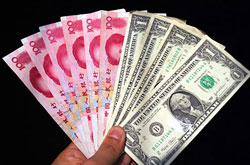
While other world currencies have climbed against the dollar, the Chinese yuan has been virtually unchanged.
Prior to the financial crisis, the U.S. was on its own to convince China to adopt a more “flexible currency regime” … i.e. stop keeping its currency artificially weak.
The results were modestly successful — only after the U.S. Congress threatened to impose a tariff on Chinese imports! China allowed its currency to appreciate by 17 percent against the dollar between 2005 and 2008.
But since the financial crisis, China has returned to a peg against the greenback. Its authority to determine the value of its own currency and to stockpile U.S. dollars through one-way trade has put China in a position of strength against the rest of the world.
That’s why when the rest of the world was in recession, China was still churning out growth and is now outperforming in the early global economic recovery phase.
Look, it’s no secret that China has the most undervalued currency in the world. In fact, the Chinese yuan would have to appreciate more than 40 percent against the U.S. dollar to bring the exchange rate in line with economic fundamentals.
To make matters worse, a weakening dollar and recovering global appetite for risk has sent world currencies soaring over the past eight months. But Chinese currency has been weakening along with the dollar, an effective devaluation against its Asian trading competitors.
Because of this currency advantage, China has been winning even more share of the world export market.
And countries that need healthy exports to work their way out of recession are losing out. That’s why over the course of the last few weeks we’ve seen South Korea, Taiwan, the Philippines, Thailand, Indonesia and Hong Kong all intervene to weaken their currencies.
Meanwhile, Major Developed Economies
Are Losing Out, Too. So …
The China currency issue will likely become a major global point of contention.
Remember, to put the world back on a sustainable path to growth, the G-20 pledged to …
Work toward repairing global trade imbalances,
Avoid protectionism,
And avoid competitive currency devaluations.
All three of these key issues have a lot to do with China’s currency policies.
In an indirect way, the world is telling China to stop manipulating its currency and to work on creating a more balanced economy by cultivating domestic demand.
If China continues to manufacture a weak currency, dump cheap products on the rest of the world, and stockpile currency reserves, points number 2 and 3 will grow in scale and frequency.
That’s a major threat for the global economy.
For now, traders are beginning to make bets that China will placate the rest of the world with some appreciation in its currency. But not much.
The chart below shows the U.S. dollar vs. the Chinese yuan. The red line shows a Beijing-manipulated exchange rate while the blue line indicates the market’s expectations for where the exchange rate will be in twelve months:
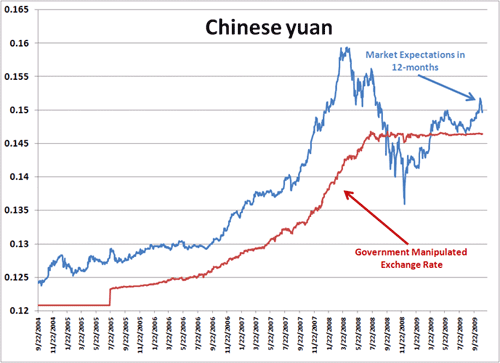
The fundamental equilibrium exchange rate suggests the yuan is 40 percent undervalued.
As you can see with the red line, China started allowing its currency to appreciate in 2005, at the rate of about 6 percent a year. But in 2008 that gradual strengthening of the yuan came to an abrupt halt.
Now the market expects the yuan to start trading higher again from the dynamics I mentioned above, but only 2 percent by this time next year.
This won’t be nearly enough to keep its counterparts at bay.
I’m looking for this discussion on China’s currency to heat up. And the potential political fallout could cause quite a stir for the global economy and currencies.
Regards,
Bryan
Bryan Rich is an accomplished currency specialist with more than 12-years of experience in trading, research, and consulting in the global foreign exchange markets. He is President of Logic Fund Management, a currency management and consulting firm.
Bryan began his career as a trader for a $600 million family office hedge fund in London. The macro-oriented fund managed assets for a prominent European family, and was one of the largest players in global currency markets in the 1990s. Later, he was a senior trader for a $750 million leading global macro hedge fund located in South Florida. There, he helped manage and trade a multi-billion dollar foreign exchange options portfolio.
His consulting resume includes work for a boutique currency fund in New York, where he developed trading models and strategy for the core investment program of the company. He later joined the company as a partner, based in their Wall Street office.
Bryan has also served for several years in a management and consulting role for the Weiss Group, performing in a variety of analytical areas across its economic research, money management, ratings, and institutional research divisions.
He has a BA from the University of North Florida and an MBA from Rollins College.
This investment news is brought to you by Money and Markets. Money and Markets is a free daily investment newsletter from Martin D. Weiss and Weiss Research analysts offering the latest investing news and financial insights for the stock market, including tips and advice on investing in gold, energy and oil. Dr. Weiss is a leader in the fields of investing, interest rates, financial safety and economic forecasting. To view archives or subscribe, visit http://www.moneyandmarkets.com.
Home foreclosures have leapt into the hundreds of thousands…
….and experts predict that it will be worse next year. These foreclosed homes go to the banks. They tend to put banks in the real estate business, which is the last thing the banks want. So the banks sell or dump foreclosed homes at whatever price the market will bring.
My test of values in homes is as follows (it costs you 10% a year to carry a home) — when you can buy a home and immediately rent it out and make a profit on you original purchase plus expenses, that house is a value. Right now, real estate is hated. Too many people have lost their life savings in real estate. But the fact is that many foreclosed homes are now selling below the cost of replacement. And as commodity prices rise, this disparity will grow.
My conclusion is that many homes foreclosed by the banks and purchased from the banks are bargains. Today’s disaster may be tomorrow’s winner.
Stocks– Without a strong November and December, this decade will be the worst decade in stock market history. The decade from Jan. 1930 to Dec. 1939 showed a net loss of -1.7%. From Jan. 2000 to the present the S&P 500 has lost 13.8%. It will take a big November and December to take the current decade out of the “worst in history” class (statistics courtesy of InvestTech Research).

Sundry items — Without a strong November and December, this decade will be the worst decade in stock market history. The decade from Jan. 1930 to Dec. 1939 showed a net loss of -1.7%. From Jan. 2000 to the present the S&P 500 has lost 13.8%. It will take a big November and December to take the current decade out of the “worst in history” class (statistics courtesy of InvestTech Research).
By 2040 senior citizens will comprise 40% of the US population. Japan has 40,000 individuals over 100. (fish and very little meat?)/
The US has the highest fertility rate of any developed nation — 2.1, partly due to immigration groups. In the US unmarried women now give birth to four out of every ten kids.
More people in the US live alone than at any other time in US history. Now that women are working, many would rather live alone than with an “unsatisfactory” mate. Women no longer need a husband to support them. And many don’t want one.
How big is Russia? Russia is 17,075,000 square km. The US is 9,372,000 sq.km. China is 9,561,000 sq. km. about the same as the US. Brazil is 8,512,000 sq. km. Saudi Arabia is 2,200,000 sq. km.
Headline article in the current Newsweek magazine — “Working Women Are Poised To Become the Biggest Economic Engine the World Has Ever known. . . The vast majority of new income growth will go to women, due to a narrowing wage gap and rising female employment. . . . Women already control $12 trillion of the world’s $18.4 trillion in annual consumer spending. And that proportion will likely rise.”
Russell Comment — Follow the money. Subscribers know that I believe this century will be known as “the world rise and empowerment of women.” Women are so important to a nation’s welfare that pressure will now come to all undeveloped nations who “keep women down.” The state of civilization can be judged by how a nation treats its women. Women all over the world (including African women) are rising and fighting for equality. Even Saudi Arabia is giving in to what I call the “women force.” I, Russell, have four daughters, so of course I’ve always been an advocate for women’s rights.
In thinking over the weekend, it occurred to me (light bulb turns on) that everyone has a THEME that, in some ways, dominates and directs their lives. That theme is the driving force, the core of a lifetime’s desire, that runs through every person’s life. After pondering over the idea for hours, it occurred to me that my own theme is “staying alive.” I was born struggling to stay alive. That theme colored my life. My fascination with Cacti fits into my theme. Cacti are the ultimate survival plants. The stock market — learning to read the stock market gives one the advantage of possibly knowing what lies ahead. The theme of staying alive has entered into everything I do. It’s the reason why, in investing, I’m so careful to avoid taking the big loss. “He who sells and runs away, lives to invest another day.” If you invest intelligently and systematically over the years and avoid the big loss, you’ll probably end up at least prosperous.
You might think about a theme in your own life. Is your theme success, domination, making money, leadership, happiness, conquest, curiosity, helping others, adventure? Ask the average person what the theme of their life is, and they’ll look puzzled. They never thought about their life having a theme. Every person has a theme in their life. It’s worth knowing what that theme is. If you’re honest with yourself, you can identify your theme.
A brief excerpt of the lengthy daily internet comment by Richard Russell of Dow theory Letters. One of the best values anywhere in the financial world at only a $300 subscription to get his report daily for a year. HERE to subscribe.
The 84 yr. old writes a market comment daily since the internet age began. In recent years, he began strongly advocated buying gold coins in the late 1990’s below $300. His position before the recent crash was cash and gold.
There is little in markets he has not seen. Mr. Russell gained wide recognition via a series of over 30 Dow Theory and technical articles that he wrote for Barron’s during the late-’50s through the ’90s. Russell was the first (in 1960) to recommend gold stocks. He called the top of the 1949-’66 bull market. And almost to the day he called the bottom of the great 1972-’74 bear market, and the beginning of the great bull market which started in December 1974. He loaded up on bonds in the early 80’s when US Treasuries where yielding 18%.
Home foreclosures have leapt into the hundreds of thousands… ….and experts predict that it will be worse next year. These foreclosed homes go to the banks. They tend to put banks in the real estate business, which is the last thing the banks want. So the banks sell or dump foreclosed homes at whatever price the market will bring.
My test of values in homes is as follows (it costs you 10% a year to carry a home) — when you can buy a home and immediately rent it out and make a profit on you original purchase plus expenses, that house is a value. Right now, real estate is hated. Too many people have lost their life savings in real estate. But the fact is that many foreclosed homes are now selling below the cost of replacement. And as commodity prices rise, this disparity will grow.
My conclusion is that many homes foreclosed by the banks and purchased from the banks are bargains. Today’s disaster may be tomorrow’s winner.
Stocks– Without a strong November and December, this decade will be the worst decade in stock market history. The decade from Jan. 1930 to Dec. 1939 showed a net loss of -1.7%. From Jan. 2000 to the present the S&P 500 has lost 13.8%. It will take a big November and December to take the current decade out of the “worst in history” class (statistics courtesy of InvestTech Research).
Sundry items — Without a strong November and December, this decade will be the worst decade in stock market history. The decade from Jan. 1930 to Dec. 1939 showed a net loss of -1.7%. From Jan. 2000 to the present the S&P 500 has lost 13.8%. It will take a big November and December to take the current decade out of the “worst in history” class (statistics courtesy of InvestTech Research).
By 2040 senior citizens will comprise 40% of the US population. Japan has 40,000 individuals over 100. (fish and very little meat?)/
The US has the highest fertility rate of any developed nation — 2.1, partly due to immigration groups. In the US unmarried women now give birth to four out of every ten kids.
More people in the US live alone than at any other time in US history. Now that women are working, many would rather live alone than with an “unsatisfactory” mate. Women no longer need a husband to support them. And many don’t want one.
How big is Russia? Russia is 17,075,000 square km. The US is 9,372,000 sq.km. China is 9,561,000 sq. km. about the same as the US. Brazil is 8,512,000 sq. km. Saudi Arabia is 2,200,000 sq. km.
Headline article in the current Newsweek magazine — “Working Women Are Poised To Become the Biggest Economic Engine the World Has Ever known. . . The vast majority of new income growth will go to women, due to a narrowing wage gap and rising female employment. . . . Women already control $12 trillion of the world’s $18.4 trillion in annual consumer spending. And that proportion will likely rise.”
Russell Comment — Follow the money. Subscribers know that I believe this century will be known as “the world rise and empowerment of women.” Women are so important to a nation’s welfare that pressure will now come to all undeveloped nations who “keep women down.” The state of civilization can be judged by how a nation treats its women. Women all over the world (including African women) are rising and fighting for equality. Even Saudi Arabia is giving in to what I call the “women force.” I, Russell, have four daughters, so of course I’ve always been an advocate for women’s rights.
In thinking over the weekend, it occurred to me (light bulb turns on) that everyone has a THEME that, in some ways, dominates and directs their lives. That theme is the driving force, the core of a lifetime’s desire, that runs through every person’s life. After pondering over the idea for hours, it occurred to me that my own theme is “staying alive.” I was born struggling to stay alive. That theme colored my life. My fascination with Cacti fits into my theme. Cacti are the ultimate survival plants. The stock market — learning to read the stock market gives one the advantage of possibly knowing what lies ahead. The theme of staying alive has entered into everything I do. It’s the reason why, in investing, I’m so careful to avoid taking the big loss. “He who sells and runs away, lives to invest another day.” If you invest intelligently and systematically over the years and avoid the big loss, you’ll probably end up at least prosperous.
You might think about a theme in your own life. Is your theme success, domination, making money, leadership, happiness, conquest, curiosity, helping others, adventure? Ask the average person what the theme of their life is, and they’ll look puzzled. They never thought about their life having a theme. Every person has a theme in their life. It’s worth knowing what that theme is. If you’re honest with yourself, you can identify your theme.
A brief excerpt of the lengthy daily internet comment by Richard Russell of Dow theory Letters. One of the best values anywhere in the financial world at only a $300 subscription to get his report daily for a year. HERE to subscribe.
The 84 yr. old writes a market comment daily since the internet age began. In recent years, he began strongly advocated buying gold coins in the late 1990’s below $300. His position before the recent crash was cash and gold.
There is little in markets he has not seen. Mr. Russell gained wide recognition via a series of over 30 Dow Theory and technical articles that he wrote for Barron’s during the late-’50s through the ’90s. Russell was the first (in 1960) to recommend gold stocks. He called the top of the 1949-’66 bull market. And almost to the day he called the bottom of the great 1972-’74 bear market, and the beginning of the great bull market which started in December 1974. He loaded up on bonds in the early 80’s when US Treasuries where yielding 18%.
Over the past two years, the federal government and the Federal Reserve have dispersed trillions of public dollars, run up enormous deficits, and kept interest rates at zero. In just about any economic textbook, this combination of policies would be described as the perfect recipe for inflation. Yet, with the exception of the usual increases in health care and education, prices by and large are not rising. Many have concluded that our economic leadership has simply outsmarted the textbooks.
The benign CPI figures are serving as a rallying point behind which the financial talking-heads are forming a parade of optimism. The low CPI is their ‘proof’ that inflation is not a pressing concern. This view is two dimensional.
Inflation is classically described simply as an increase in the money supply. Although these changes will impact price levels, it doesn’t necessarily follow that prices will rise when inflation is high. Instead, inflation may merely result in stable prices at a time when prices would otherwise be falling.
In the popular mentality, however, inflation is simply defined as prices rising. After decades of steadily rising prices, people seem to have forgotten that prices sometimes fall. In light of the bursting of a number of record-breaking, government-fueled asset bubbles, prices should be declining across the board (as they did in the Great Depression). The fact that prices are stable, or have even rallied in some sectors, indicates that inflation is already spreading across the economy.
After falling to just 6,547 in the months after the crash, the Dow has rallied past the 10,000 mark. This should strike even novice investors as unjustified. Jobs are still being lost, a massive healthcare entitlement and carbon tax are winding through Congress, and no one with at least one foot in the real world has a palpable sense of imminent recovery. Corporate earnings have fallen far behind the rally in shares prices, stretching valuation multiples to pre-crash levels.
While not quite as frothy, home prices are now moving up for all the wrong reasons. The seminal Case-Shiller Index of home prices is now up for the fourth month in a row. The index’s designer, Professor Robert Shiller, has stated recently that the current upward trajectory is unsustainable. In fact, the levels are still above the 50 and 100 year trend lines.
In the worst economic climate since the Great Depression, and after the largest housing bust on memory, single-family home prices should be falling well below the trend lines. But with a doubling of the monetary base and special interest programs like the homebuyers’ tax credit, home prices have stabilized and even increased in some markets. That’s the work of inflation.
With GDP growth now returning to positive territory, many inflation hawks ask why inflation has yet to truly manifest. The explanation can be found in the difference between monetary base and money supply.
The latest $1.9 trillion injection of government money was composed of some $900 billion of stimulus, of which only about 20 percent has been distributed. However, in its attempts to stabilize the financial system, the government has already spent some $1 trillion of TARP-type funds.
The TARP money, financed by an increase in the monetary base, has been provided to the banks at zero cost. And for the first time ever, the Fed is paying interest on bank reserves. Therefore, the banks can loan money to the Fed and to the government, via Treasury securities, at an interest rate spread of some 3 to 4 percent without risk. Given these incentives, it makes no sense to loan to anybody else. So, despite a massive increase in the monetary base, credit remains tight and price levels flat.
However, if the Fed stops paying interest on bank reserves or otherwise ‘persuades’ the banks to lend, the $1 trillion will be leveraged up by the banks and spewed out into the economy. Fractional reserve banking will transform a $1 trillion monetary base injection into a $9 trillion increase in money supply. When that happens, prices for everything will go through the roof.
So for now, inflation is like a ninja stalking our economy. It’s lurking in the shadows but can’t easily be seen. But once its strikes, it will be fast and deadly.
John Browne is the Senior Market Strategist for Euro Pacific Capital, Inc. Mr. Browne is a distinguished former member of Britain’s Parliament who served on the Treasury Select Committee, as Chairman of the Conservative Small Business Committee, and as a close associate of then-Prime Minister Margaret Thatcher. Among his many notable assignments, John served as a principal advisor to Mrs. Thatcher’s government on issues related to the Soviet Union, and was the first to convince Thatcher of the growing stature of then Agriculture Minister Mikhail Gorbachev. As a partial result of Browne’s advocacy, Thatcher famously pronounced that Gorbachev was a man the West “could do business with.” A graduate of the Royal Military Academy Sandhurst, Britain’s version of West Point and retired British army major, John served as a pilot, parachutist, and communications specialist in the elite Grenadiers of the Royal Guard.
In addition to careers in British politics and the military, John has a significant background, spanning some 37 years, in finance and business. After graduating from the Harvard Business School, John joined the New York firm of Morgan Stanley & Co as an investment banker. He has also worked with such firms as Barclays Bank and Citigroup. During his career he has served on the boards of numerous banks and international corporations, with a special interest in venture capital. He is a frequent guest on CNBC’s Kudlow & Co. and a former contributing editor and columnist of NewsMax Media’s Financial Intelligence Report and Moneynews.com. He holds FINRA series 7 license.
-
I know Mike is a very solid investor and respect his opinions very much. So if he says pay attention to this or that - I will.
~ Dale G.
-
I've started managing my own investments so view Michael's site as a one-stop shop from which to get information and perspectives.
~ Dave E.
-
Michael offers easy reading, honest, common sense information that anyone can use in a practical manner.
~ der_al.
-
A sane voice in a scrambled investment world.
~ Ed R.
Inside Edge Pro Contributors

Greg Weldon

Josef Schachter

Tyler Bollhorn

Ryan Irvine

Paul Beattie

Martin Straith

Patrick Ceresna

Mark Leibovit

James Thorne

Victor Adair