
Daily Updates
It might not exactly be news that Robert Prechter, the famous follower of the Elliott Wave theory, is bearish on the U.S. stock market.
That’s because he has been playing the equity market from the short side for quite some time now.
But what is news is that, earlier this week, he became even more aggressively bearish than usual: He is now recommending that traders allocate 200% of their stock trading portfolios to shorting the stock market.
What should be your response to Prechter’s latest advice?
There is no easy answer, unfortunately.
…..read more HERE.
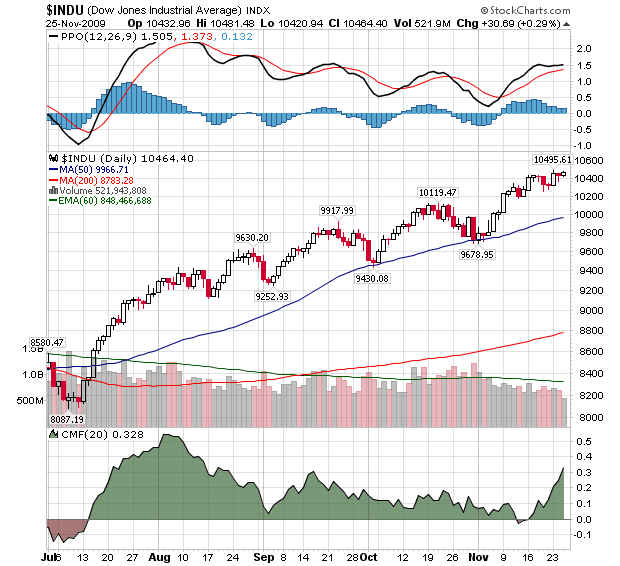
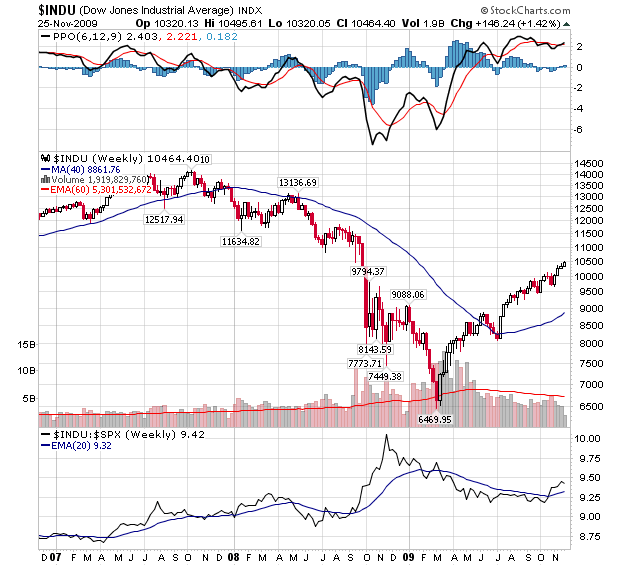
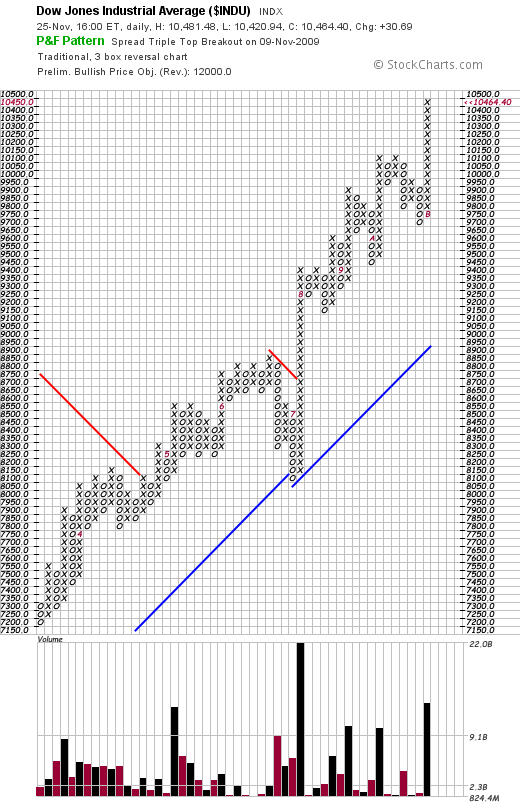
Dow Daily, Weekly and Point and Figure Chart Below:
…..read more HERE.
Canadian house prices have soared in the past decade and, despite the hiccup at the start of the recession, low interest rates have helped prices to continue to increase. Scotiabank economists said in a report that the run up in prices needed to be watched carefully because it could develop into a bubble. However, they said conditions did not warrant an interest rate increase just yet and that the pace of price increases would likely cool in about two to four years.
…..read more HERE
What Does the Fed Fear, Then?
Why are Fed members continually reiterating the current zero percent interest rate policy?
Why are they assuring us that this policy will continue “for an extended period?”
What are they afraid of?
Do they see or know something we don’t?
Ed Note: Yes, and it involves Real Estate
…..read more HERE.
Volume in the credit default swap market for rich countries has soared and so have credit spreads, according to a recent Financial Times story, while volume in emerging markets CDS has stagnated. In other words, traders are betting against the governments with high budget deficits, like Britain and the United States, as well as against those with high debt levels, like Japan and Italy.
So is there really a substantial chance of a big rich-country default, and what would it look like if it happened?
It’s not obvious which of the “Rich Four” countries would go first.
Japan, for instance, has the highest debt. But Japanese consumers are such great savers that they essentially owe almost all of the debt to themselves.
The country needs fiscal discipline and higher interest rates (to reward Japanese savers properly), but there’s a decent chance Japan will get both, in which case default is unlikely.
Italy has high debt – at about 120% of gross domestic product (GDP) – and not much discipline of any kind. On the other hand…..
….read more HERE.
Today’s Outside the Box comes to us from England. My European partner Niels Jensen from time to time sends me some of the best letters he reads from the hedge fund world. He is an excellent filter for me, and this week’s Outside the Box offering is no exception. Below is the November commentary from Eclectica fund manager Hugh Hendry. He challenges the current preoccupation with the falling dollar and China, and posits what would happen if that thinking is wrong? It offers some very thought-provoking ideas.
“The power to become habituated to his surroundings is a marked characteristic of mankind.”
John Maynard Keynes
The Economic Consequences of the Peace, 1921
….read full article HERE.
Momentum: Force or speed of movement. Impetus of a process, such as an idea, or course of events.
That’s how the dictionary defines the word “momentum.”
We’ve all seen what can happen when an index, sector, or stock catches momentum – either to the upside or downside. However, momentum waves don’t move uniformly. They can bounce up and down in an upward trend, gradually making new highs and higher lows, or they can fall into a downward trend.
While the momentum concept is nothing new, the introduction of the online momentum day-trader in 1996 has kicked it up several notches and helped create unprecedented volatility in the markets.
And being able to nail down stable, predictable, repeated price patterns gave birth to a wave of momentum-based traders. Individuals could suddenly thrash Wall Street, with some “Joe the Plumber” day-traders becoming millionaires by raking in 458% on Qualcomm (Nasdaq: QCOM), or 608% in Yahoo! (Nasdaq: YHOO) in just six months in 1999.
Of course, the consistent returns of momentum investors baffled “efficiency theory” economists and stuffy Nobel Laureates who claimed that the markets move randomly like bacteria in a Petri dish, not that stocks in upward momentum price patterns are more likely than other stocks to keep rising.
But they’re wrong. The key is to find a momentum model that works. And here it is…
Beat the Market With Momentum
In short, momentum investing is holding a fast-rising stock for a few days, weeks, or months.
It’s a strategy where an investor tries to capitalize on a stock’s trend (be it on the long or short side) in hopes of riding the move further. And it’s less risky than momentum day-trading, where you’re “in-at-dawn” and “out-in-the-afternoon,” as long as you follow the rules below.
Momentum trading is most powerful when cash on the sidelines starts to pour into the market once it’s fully recovered from a crash. For instance, it was particularly profitable from 1996 through 2000 – nine years after the 1987 crash. And the recovery from the 2000 crash was much faster, as momentum investors racked up startling returns from 2003 to 2007, using the guidelines that I’m about to explain…
Five Common Characteristics of the Perfect “Momentum” Stock
The beauty of momentum stocks is that there are very simple ways to find them…
~ Momentum Alert Factor #1: Rising Trend
One of the key traits of a good momentum stock is a rising stock price for a few weeks.
The Momentum Alert solution: Target stocks in a recently rapid rising up-trend.
~ Momentum Alert Factor #2: Institutional Ownership
The real forces behind stock market momentum are the big institutional players, mutual funds and hedge funds that trade in and out of stocks slowly, compared to the momentum players.
Take Columbia-trained New York University adjunct professor, Max Holmes, who gobbled up one-fifth of Playboy Enterprises Inc. (NYSE: PLA) total outstanding shares over the summer through his Plainfield Asset Management hedge fund.
The Momentum Alert solution: When large investment houses buy and hold huge blocks of shares, it exerts heavy upward pressure. So look for strong institutional ownership that has been recently increasing.
~ Momentum Alert Factor #3: Earnings Surprises
Academic studies of a phenomenon called the “post-earnings announcement drift” have shown that you should search out companies that have beaten analysts’ earnings expectations. This is because these stocks are the most likely candidates for stellar momentum-based returns over the course of a few weeks or months.
A great example is Intuitive Surgical (Nasdaq: ISRG). Its recent earnings climbed by 12% on a 19% increase in revenue, with annual sales about to surpass $1 billion. We expect future earnings surprises because Japan, the world’s second-largest economy, is closer to giving the go-ahead to sell the company’s surgical robots there.
The Momentum Alert solution: Look for companies that are surpassing analysts’ earnings expectations.
~ Momentum Alert Factor #4: Brace for Price Reversals (Know When to Fold)
The same studies I mentioned above also show that momentum stocks can unexpectedly reverse into a downtrend. For this reason, you should never buy and hold a momentum stock.
Instead, use a moving-average as an exit signal (I recommend five days for the fast moving-average and 20 days for the slow one). If you see the fast moving-average drop below the slow moving-average, get out immediately.
Learn the lesson from ITT Educational (NYSE: ESI) here, which reported a 50% jump in third-quarter profits on a 33% increase in sales. But when the fast moving-average closed below the slow line shortly thereafter, it was a sign to get out of the stock before it took a dive.
The Momentum Alert solution: Watch for a crossover where the fast moving-average crosses below a slow moving-average.
~ Momentum Alert Factor #5: Use Trailing-Stops
A big problem with momentum stocks is that they often drop like a rock after reversing. For that reason, you should always place a trailing-stop 25% below your entry price. This doesn’t mean you’ll necessarily exit there; you’ll most likely sell on the moving average exit signal.
The Momentum Alert solution: Stops protect you from heavy losses and take the emotion out of the sell decision.
The Single Best Way to Invest in Momentum
You can spot likely momentum suspects by visiting the Wall Street Journal’s NYSE Biggest Percentage Gainers list.
online.wsj.com/mdc/public/page/2_3021-gainnyse-gainer.html
For over 10 years, Investment U has been a trusted source for investment ideas and investing education. To receive our daily letter sign up HERE.
You can learn more by visiting our homepage at InvestmentU.com.
-
I know Mike is a very solid investor and respect his opinions very much. So if he says pay attention to this or that - I will.
~ Dale G.
-
I've started managing my own investments so view Michael's site as a one-stop shop from which to get information and perspectives.
~ Dave E.
-
Michael offers easy reading, honest, common sense information that anyone can use in a practical manner.
~ der_al.
-
A sane voice in a scrambled investment world.
~ Ed R.
Inside Edge Pro Contributors

Greg Weldon

Josef Schachter

Tyler Bollhorn

Ryan Irvine

Paul Beattie

Martin Straith

Patrick Ceresna

Mark Leibovit

James Thorne

Victor Adair