
Daily Updates
Ed Note: a small selection of the 41 Charts Analysed on Don Vialoux’s Tuesday Morning comment HERE.
The Bottom Line
The seasonal trade in the Canadian Energy sector is approaching. Be prepared to enter the trade when short term technical indicators turn positive. Possible Exchange Traded Fund candidates for the trade include iShares TSX Energy Index (XEG), Claymore Oil Sand Sector (CLO), BMO TSX Equally Weighted Oil Index (ZEO) and Horizons BetaPro TSX Bull + ETF (HEU)
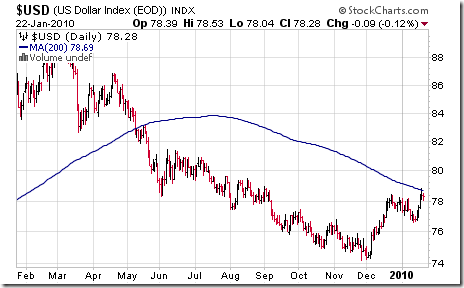
The U.S. Dollar weakened and the Euro strengthened in anticipation of a bail out of Greece by European central banks. Commodities priced in U.S. Dollars including copper, gold, silver, platinum and crude oil are trading higher. Short term momentum indicators for the U.S. Dollar are rolling over from an overbought level.
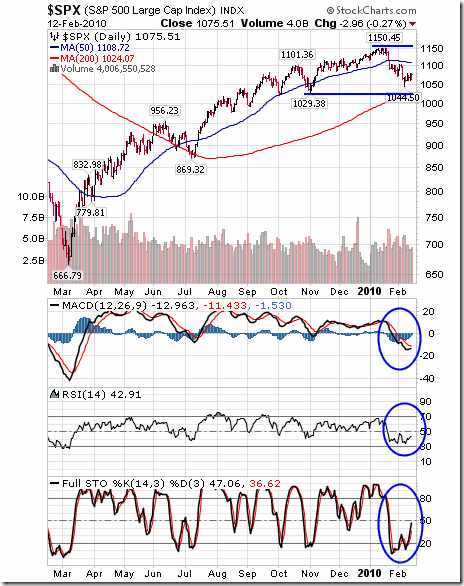
The S&P 500 Index added 9.32 points (0.87%) last week. Intermediate trend remain up. Resistance has formed at 1,150.45. Support at 1,029.38 held. The Index bounced last week from just above its 200 day moving average currently at 1,024.07. Short term momentum indicators have bottomed. Stochastics rose above the 20% level (A Stochastics buy signal) and RSI is recovering from just above the 30% level. MACD has bottomed at a short term oversold level and is about to trigger a MACD buy signal on a cross over of its moving averages. Seasonal influences remain positive.
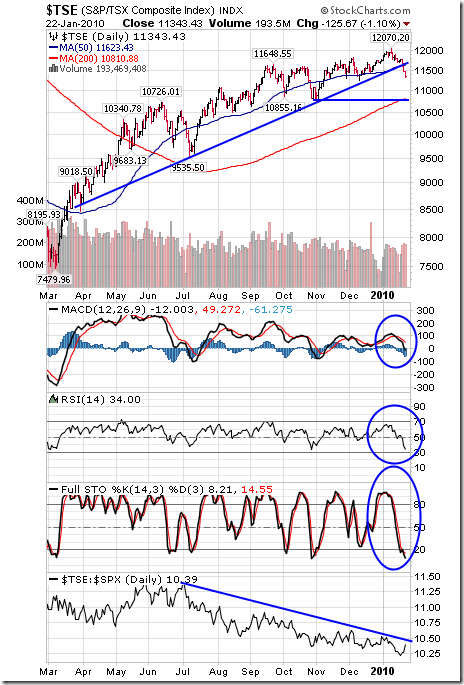
The TSX Composite Index gained 246.69 points (2.20%) last week. Intermediate trend remains up. Resistance has formed at 12,070.20. Support held at 10,915.86. The Index bounced nicely from its 200 day moving average currently at 10,963.86. Short term momentum indicators have bottomed. Stochastics already have recovered to an overbought level, but continues to trend higher. RSI continues to recover from below the 30% level. MACD recorded a buy signal on Thursday. Strength relative to the S&P 500 Index has turned positive. Seasonal influences remain positive.
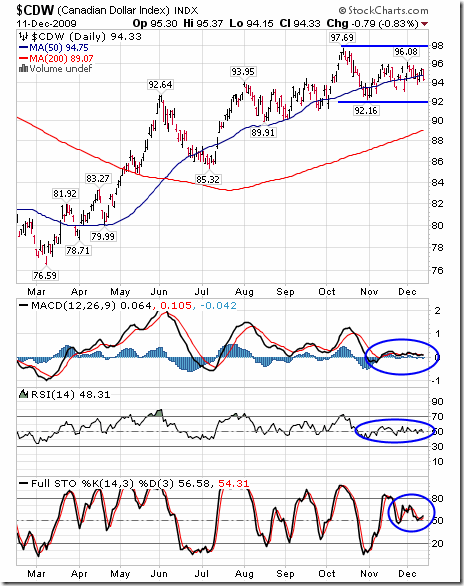
The Canadian Dollar improved 1.78 cents U.S. last week. It bounced nicely from near support and its 200 day moving average at 92.16. On Friday, the Canadian Dollar closed above its 50 day moving average. Resistance is at 97.79. Short term momentum indicators have bottomed. Stochastics already have recovered to a short term overbought level, but continue to move higher. RSI is recovering from just above the 30% level. A MACD Buy signal was recorded on Thursday.
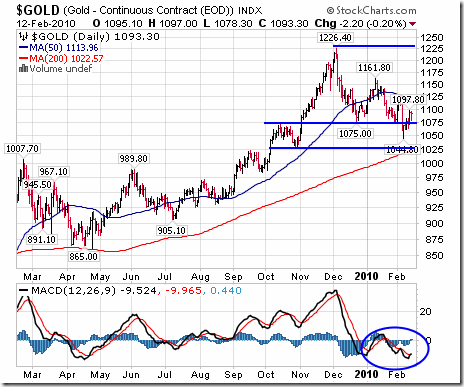
Gold added $27.70 (2.60%) last week despite no change in the U.S. Dollar. Short term momentum indictors have bottomed. A MACD buy signal was recorded on Friday. A word of caution! Seasonal influences currently are random.
41 Charts Analysed on Don Vialoux’s Tuesday Morning comment HERE.
Don Vialoux has 37 years of experience in the Investment Industry. He is a past president of the Canadian Society of Technical Analysts (www.csta.org) and a former technical analyst at RBC Investments. Don earned his Chartered Market Technician (CMT) designation from the Market Technician Association in 1995. His CMT paper entitled “Seasonality in Canadian Equity Markets” was published in the Spring-Summer 1996 edition of the MTA Journal. Don also has extensive experience with Exchange Traded Funds (also know as Index Participation Units) as well as conservative option strategies. In 1990 he wrote a report that was released in the International Federation of Technical Analyst Journal entitled “Profiting from a Combination of Technical and Fundamental Analysis”. The report introduced ” The Eight Phases of the Stock Market Cycle”, an investment concept that continues to identify profitable entry and exit points for North American equity markets. He is currently a member of the Toronto Society of Fundamental Analyst’s Derivatives Committee. Now he is the author of a daily letter on equity markets available free on the internet. The reports can be accessed daily right here at www.dvtechtalk.com.
Posted by Peter Grandich at 10:33 PM on Monday, February 15th, 2010
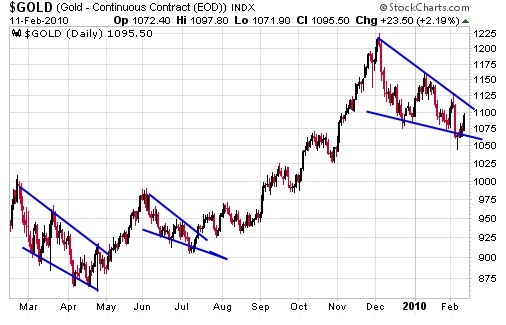
The technical picture for gold has improved dramatically. A breakout from a falling wedge is one of the best technical patterns for bulls and it appears we’re on the verge here in gold.
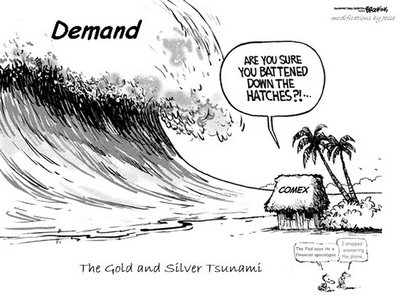
Physical demand has been very strong during this “paper” correction. The commercials on the CrimeNex (Comex) have aggressively covered in the last two weeks and once again have fleeced the speculators for the umpteen time. Two consecutive closes above $1,125 should put the correction fully behind us. I continue to believe there are “two” gold markets; the physical market worldwide and the paper market on the CrimeNex. The days are numbered for the paper “hangers” as real demand for gold continues to grow despite an overwhelming number of gold perma bears and chicken bulls that dominate the financial services industry and the media. I can’t wait to hear their latest excuses when we go to new highs later this year.
On Major Moves, Grandich has been very right and not only saved many investors fortunes, but expanded them dramatically. On November 3, 2007 at the MoneyTalks Survival Conference, Peter Grandich of the Grandich Letter warned that “an unprecedented economic tsunami will hit American beginning in 2008”. Peter advised publicly to short the US market two days from the top in October, 2007 and stayed short until the last week of October, 2008. He began to buy stocks in March 7th, 2009. He also bought oil and oil related investments near the lows after the dive from $147.
….go to visit Peter’s Website.
The January market dip was focused on profits taking. Good results in various sectors brought selling, but not sell-offs. It is evidence that caution still reigns at the start of the new decade and isn’t really saying much else, for now. It does indicate wealth preservation after the ‘08 Crunch is, and likely will continue to be, the focus of “Boomers” who are nearing the end of their working lives. How long they are good with clipping low interest coupons is the next question on the table.
It took a while for this sentiment to make its way into the copper space, but the red metal’s price is now giving ground after having an extraordinary 10 month run. The 40 cent price decline has been quick, but is only an 11% drop from the peak early in January. There has been about a 3% gain to LME stockpiles since the price decline began in earnest. It is too soon to make much of this, but we still think it likely copper will move through support in the high $2s and could test the $2.50 area.
A price decline to that level would be near 30% and could generate headlines about both copper bubbles and the peril to the broader economy. It would be a larger % than we thought was needed to test the market, but so far we have just seen froth blown off the market top; the mid $2s was the expected pull back when we got concerned about copper moving above $3.
The froth built in part due to the weak greenback, and it was US$ strengthening that finally tugged copper prices lower. That and speculators shifting away from the metal on some impressive gains. The US$ strength was generated by further moves to tighten lending in China and fear of sovereign defaults in Euroland. Currency fluctuations will continue influencing copper’s price for the next while. Has this been a bubble?
Price and supply gains in tandem do fit the basic definition. However, we wouldn’t call the current LME stockpiles in the 15 days of supply range a major “oversupply” even though they represent the largest margin we have seen for about a decade. Copper’s broad mine supply is typically well balanced to demand, and barring a major supply disruption it will take a while to eat through the excess stocks. But, we are talking about a short run phenomenon. “Bubble” is getting bandied about a lot lately. It should be reserved for markets in which supply excess built over a long period, and that will take a long time to repair because of systemic damage.
We have enough after-bubble markets to deal with that we don’t need see more in normal market overreach. We may not be quite ready to jump into copper’s deep end just now, but the enthusiasm for its market has simply been because it is healthy.
In fact, amidst the concern about what direction the global economy is taking, a rare drama is unfolding in metal’s smelting arena. Codelco and BHP have both recently negotiated lower charges from East Asian copper smelters, low enough in fact to render the smelters marginal. It has usually been the smelters that dictate charges, so this is the tail wagging the dog.
The combination of a near term smelting overbuild in China and a mid term concern by all smelters about a lack of mine supply is at play here. For those of you who glaze over when we talk about century old trends, or even millennia old trends (ok, one of us just joined the glazing), it is just this sort of shift that we are looking for.
While the supply concerns are most prominent in the copper subsector, they do apply to other metals. The bottom line impact for HRA readers is that smelting companies are seeking out direct links to deposits. This will be a growing source of funding projects, and mean more take-overs in due course. It will also mean more focus on that part of the sector from us going forward.
Gold is rebounding nicely, in line with shifting sentiment for the greenback. The down tick in this market has also been about profits taking, at least in part. That currency traders going long the Dollar was able to cap gold more quickly than it did copper is still the most interesting bit of news to come from the recent trading.
How the next while plays out is still subject to diverse opinion, as it should be during such a major shift global of economic weightings. The US$ is still being viewed as both a safe haven by some even while others focus more on the need for the greenback to soften longer term so the US can generate a positive trade flow. Every bit of good economic stat has bond traders weighing whether it results from commerce or stimulus at work, and pondering whether the appetite for low interest T- bills can continue.
Conspiracy theories abound about “someone” holding the equity markets up. We find this ironic; the US Treasury is quite happy to see equity markets pull back and drive buyers into the Treasury market.
Debt troubles in Europe continue to generate currency swings and talk of (of course) a gold bubble. Default in Euroland would lift the USD, but bears should remember gold is a popular reserve asset lately too. The endgame could be better for bullion than most expect even in a default scenario.
We doubt a comfortable trend line will be obvious for a while yet. The one assumption gaining currency is that China’s growth is central to sorting out the way ahead, and that some concern about its rapid rise in bank borrowing is warranted. Even while reminding again that this borrowing is from domestic savings, we have to agree. So apparently do Chinese officials.
A recent musing we heard spoke about a “hard landing” in China, but even this bearish stance meant a growth rate of only 6%. Not reason to drop the wheels in our book, but still a caution since it speaks to the difficulty of what to focus on during the major shift that is underway. That shift is accelerating, and this means uncertainty that will continue to roil markets. This lack of clarity as much as anything else should keep gold on an uptrend. We are certainly looking at base metal players, but gold will remain our main focus for the time being.
O-Rings Impact
Through yon window breaks… one of two LiveCity prefab venues springing up to entertain Winter Olympic visitors to Vancouver. Through other panes is the corridor linking the two sites, along which regular eating and drinking venues are gearing up to run 24-7. Two of the seven road arteries that service downtown, and run past stadium and arena, have already been shut down. A third will be closed this coming week. Ticket holders have been told to show up 2 hours early.
The city is asking downtown workers to stay home if they can, or at least to keep cars off of the road. Most who watch the markets would find that easy enough to do even though they tend to travel outside of the main traffic flow times for the most part at any rate. This is not, however, being pointed out to complain.
Vancouver is blessed. To the beauty of its natural setting and the calm of its denizens are added links that have helped shelter it from the worst of the economic storm that has battered many cities on its side of the dateline. The city benefits richly from the flow of global commerce. And yet Vancouver seems underwhelmed by the Olympic flow heading its way.
It seems, unfortunately, that security overrides the spirit of youthful competition in the post modern age. That does not sit well with a very open city. The month just ended is the warmest January on record, which is adding a degree of concern despite its impacting only one venue for which snow is being motored in. More chaff for the naysayers in a city that also respects individuality and the right to express opinions. The naysayers won’t, however, be in charge midmonth.
After the gloom and doom of the past few years the world could use a party. We hope the XXI Winter Olympics provides a blow-out one. Once the willing have donned their party clothes we expect Vancouver to shift into event mode. We will be doing some of that ourselves.
HRA is not putting a gone for lunch sign on the door, nor will the city. But the record volumes the Venture exchange has continued to rack up could ebb some, at least during highlight events. That could make for some interesting trading in our end of the pond. Worth keeping in mind, during the intermissions. Good luck & bon chance.
Ω
From the February 2010 HRA Journal
David Coffin & Eric Coffin, HRA Advisories
Gain access to potential gains of hundreds or even thousands of percent! From March to June 2009, HRA introduced four new gold explorers to subscribers. Those four companies have generated an average gain of 205%, to date! For more information on HRA Advisories, and to sign up for our free list, please visit: www.hraadvisory.com
The celebrated demographics forecaster Harry S. Dent Jr forecasts a stock market crash by the end of February in his New York Times Bestseller ‘The Great Depression Ahead: How to prosper in the debt crisis of 2010-12′.
From around 10,000 today he has two scenarios for the Dow Jones in 2010: one, a fall to 3,300-4,600 in a broad crash also taking down real estate and commodities, including gold and oil; second, for the Dow to go even lower to 2,200-3,500.
…..read more HERE
Is gold beginning to break with the dollar again?
Gold has been recovering a little despite continuing dollar strength against the Euro and some other currencies.
LONDON – The U.S. dollar has had a reasonably strong week – at least against many other currencies, notably the Euro which has been hit by economic mayhem in Greece and worries about the rest of the PIIGS countries which, in addition to Greece, constitute Portugal, Italy, Ireland and Spain. This is not to mention some of the recent East European members of the Euro club which may be in even more difficulty. All these are running huge deficits and their plight could, some feel, lead to the destruction of the Euro. While this is unlikely, the stronger Euro nations, notably Germany and France, seem to be decidedly lukewarm in bailing out their less fortunate cousins in the Euro zone.
Gold opened higher again this morning, while the dollar was virtually unchanged ahead of what may be a light day of trading anyway as it is the Presidents Day holiday in the U.S. The $1100 gold price level has been breached again on the upwards path and it remains to be seen whether further upward momentum develops or not.
….read more HERE
-
I know Mike is a very solid investor and respect his opinions very much. So if he says pay attention to this or that - I will.
~ Dale G.
-
I've started managing my own investments so view Michael's site as a one-stop shop from which to get information and perspectives.
~ Dave E.
-
Michael offers easy reading, honest, common sense information that anyone can use in a practical manner.
~ der_al.
-
A sane voice in a scrambled investment world.
~ Ed R.
Inside Edge Pro Contributors

Greg Weldon

Josef Schachter

Tyler Bollhorn

Ryan Irvine

Paul Beattie

Martin Straith

Patrick Ceresna

Mark Leibovit

James Thorne

Victor Adair