
Daily Updates
“We’ve been enjoying historically low interest rates for the last decade … even more so in the last two years. You know the party is going to end at some point. And I’m beginning to suspect the end will come sooner rather than later.”
Wall Street is obsessed with interest rates. Many consumers are, too, especially anyone who wants to buy a home or car.
There’s a good reason for this: Debt — or you might call it “leverage” — is the lubricant that keeps the financial markets moving. Imagine a car without oil … it would soon grind to halt. The same is true of the modern economy.
We’ve been enjoying historically low interest rates for the last decade … even more so in the last two years. You know the party is going to end at some point. And I’m beginning to suspect the end will come sooner rather than later.
Whenever rates move back up, you won’t have to just sit still and accept it. Exchange-traded funds (ETFs) give you many ways to protect your principal and profit from rising rates. Today I’ll tell you about three of them …
Rising Rate Protection ETF #1:
iShares 1-3 Year Treasury ETF (SHY)
A cardinal rule of debt is that overstretched, low-income borrowers pay higher interest rates. And right now no one is more burdened with debt than the U.S. government.
But there’s a twist: The U.S. is a global superpower that controls the world’s reserve currency. So we’ve been able to delay the inevitable, although we can’t do this forever.
When rates do go up, the first domino to fall will be long-term bonds: Treasury debt maturing in ten years or more. This means you can expect a stampede into the short end of the maturity scale. Then the shortest-term Treasury paper will go up in value simply because so many people will want to own it.
SHY is an ETF tailor-made for this scenario. It holds Treasury debt that matures in the 1-3 year range. This is a “sweet spot” for investors: Long enough to give you some time, but short enough to avoid long-term forecasting errors.
Could SHY get hurt if short-term rates go up? Absolutely. However, I still think this ETF will outperform long-term bonds over the next few years, all things considered. So take a look at SHY for money that you need to keep safe.
Rising Rate Protection ETF #2:
ProShares UltraShort 7-10 Year Treasury (PST)
When interest rates go up, bond prices go down. That’s because newly-issued bonds will pay higher rates than older ones, which makes the old ones worth less.
The longer the maturity, the more the price is affected by rising rates. And the change can be significant for bonds in the 7-10 year range. That’s where an inverse ETF like PST can help. PST could rise as much as 10 percent for each 1 percent jump in the 10-year Treasury rate.
PST does this by shorting Treasury bonds. And while that can work for short-term trades, it’s not a very good long-term strategy …
You see, when you sell bonds short you become indirectly responsible for making interest payments to the bondholders. Moreover, PST employs 2x leverage, so you are effectively paying interest twice.
The best opportunity for making money with PST is to own it for no more than a few weeks when 10-year interest rates are going up. If you hang on after rates level off, you could actually lose ground and your profits will eventually disappear because of the interest payments.
Rising Rate Protection ETF #3:
Direxion Daily 30-Year Treasury Bear 3x Shares (TMV)
If you believe long-term rates are headed up, and soon, TMV could be your ticket to major profits. It’s an inverse ETF that tracks 30-year bond prices with 3x leverage.
Suppose, for instance, interest rates spike higher and the 30-year bond price index falls 5 percent in a day … you can expect TMV to rise 15 percent on that same day. Yowza!
This leverage could also be a ticket to major losses. For example, if your timing is off, even by a few days, you could get your head handed to you. That’s why leveraged ETFs are intended only for the most aggressive investors.
Another thing to consider is the “Daily” part of the name. Leverage in TMV and similar ETFs is reset every day. Over time, this means the leverage factor on your shares could be much more than 300 percent — or much less. I explained how this works in more detail in my Understanding Leveraged ETFs column last year.
Am I telling you not to buy TMV? No, not at all. I’m just telling you to be very, very careful when trading leveraged and inverse ETFs. I don’t want you to learn this lesson the hard way. TMV can be a great tool when used correctly — and at the right time.
When will rates go up? I don’t know. All kind of factors influence the bond market. That’s why you need to start educating yourself now to get familiar with the alternatives that are available. Because whenever the time comes, you want to be ready to make the most of it!
Best wishes,
Ron
Ron Rowland is president and a founder of Capital Cities Asset Management. Mr. Rowland is widely regarded as a leading ETF and mutual fund advisor as well as a sector rotation strategist. In addition to his roles of President and Chief Investment Officer of CCAM, he is Executive Editor and Publisher of the All Star Fund Trader, a highly regarded investment newsletter in its 18th year of publication.
As a former mutual fund manager from 2000 to 2002, Ron was a pioneer in using ETFs inside of mutual funds. He also served as the manager of a hedge fund from Aug. ‘93 to Dec. ‘94. His formal education includes a BS in Electrical and Computer Engineering from the University of Cincinnati in 1978 with additional studies in the same field at the University of Texas from 1978-1981.
This investment news is brought to you by Money and Markets. Money and Markets is a free daily investment newsletter from Martin D. Weiss and Weiss Research analysts offering the latest investing news and financial insights for the stock market, including tips and advice on investing in gold, energy and oil. Dr. Weiss is a leader in the fields of investing, interest rates, financial safety and economic forecasting. To view archives or subscribe, visit http://www.moneyandmarkets.com.
Dick Arms has spent nearly half a century following, trading and writing about Stock Markets. Best known for his Arms Index, or TRIN, his other major contributions to Wall Street methodology include Equivolume Charting, Ease of Movement, Volume Adjusted moving averages, Volume Cyclicality, and a number of volume based indicators. These tools are revealed and explained in his six books, the most recent titled Stop and Make Money.
Dick has received many of the highest awards in Technical Analysis, including the Market Technicians Association award for lifetime achievement. He has been inducted into the Traders Hall of Fame. Located in Albuquerque, New Mexico, Dick advises a select group of institutions with his weekly letter and personal consultation package, priced at $8000 per year.
….read his 6 page comment and view his charts HERE
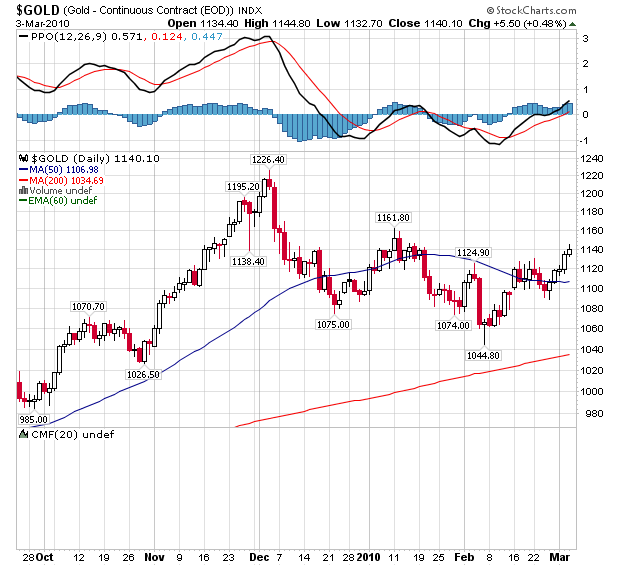
Chalk up Another Win for the Gold Bulls!
Those of us who have been expecting gold to break out above the $1125 level, and who have maintained our long positions despite warnings from the negative nabobs who are still calling for gold to drop below $1000.00, are now watching the gold bears frantically cover their short positions.
Thankfully we were able to convince our subscribers to pay no attention to the bears and to hold onto gold and silver bullion and mining stocks since the fundamentals are clearly in our favor.
Here are some charts that helped us to disregard the urgings of those who predicted lower gold prices. Charts courtesy Stockcharts.com

….read more of Peter DeGraaf’s comment plus Charts HERE
This brief comment below from the Legendary Trader Dennis Gartman. For subscription information for the 5 page plus Daily Gartman Letter L.C. contact – Tel: 757 238 9346 Fax: 757 238 9546 or E-mail: dennis@thegartmanletter.com or HERE to subscribe at his website
COMMODITY PRICES ARE AGAIN FIRMER, moving higher as the US dollar moves lower. Knees are jerking all around the world, apparently… and in tandem too we might reasonably add. Grains were and are strong; energy is and was strong; the precious metals were strong, but are giving back just a bit of that strength this morning… and all are celebrating the sudden shift in Greece toward fiscal probity! We’ve our doubts about the latter of course, but for the moment the market hasn’t.
We remain bullish of gold, and yet again we feel the need to note for the record that we are not gold bugs here at TGL. We do not believe that the world is going to virtual hell-in a-hand basket… although we are dismayed about what is taking place here in the US regarding the non-payment of mortgages and the loss of character that that engenders”
We do, however, believe that at the margin the central banks in the emerging world are becoming less and less supportive of the EUR particularly and the US dollar secondarily, and are at that margin buying gold”
Charts via MoneyTalks

Quotable
“After a 0.5% point contribution to Q3 GDP the Q4 Eurozone GDP report showed that inventories made a zero contribution. There was also a zero contribution from household consumption as well as government consumption expenditure with investment contributing a negative 0.2% points. The 0.1% growth for Q4 was largely led by exports which contributed 0.6% points but still less than the 1.1% contribution made during Q3 while imports made a less negative contribution of -0.3% percentage points compared to -1.0% in Q4.
Overall the data does little to inspire confidence that the “recovery” is self-sustainable and is reason enough to expect that the ECB will be very cautious in signaling that monetary tightening (refi rate hike) is the next natural step from a normalization of money markets. While we continue to see the ECB on hold this year there is the risk that they could be on hold until H2 2011. We will wait to see how the normalization goes but at this stage we are biased toward the lower for longer view on ECB rates.” – Divyang Shah, Reuters
FX Trading – A Full Opening Act … to Keep Traders’ Blood Flowing
February US Nonfarm payrolls are reported tomorrow. Typically it’s a snooze-fest in the markets for the 24 hours or so leading up to that report.
But the week’s been full of data points to give traders reason to stay awake.
…..read more HERE
BULLISH SENTIMENT GETS MORE BULLISH
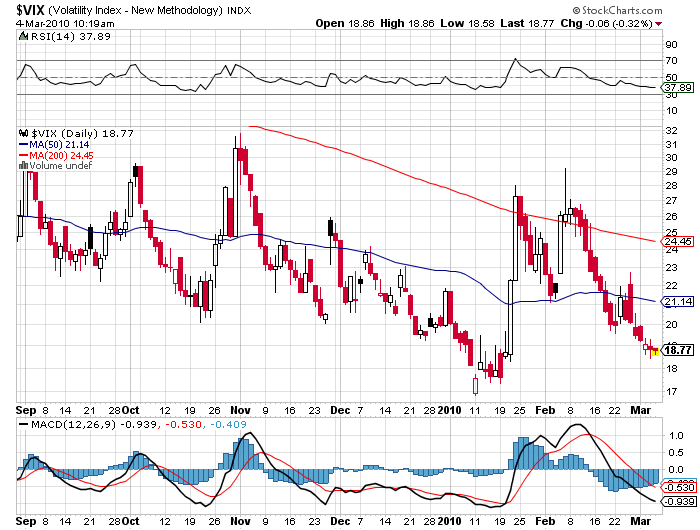
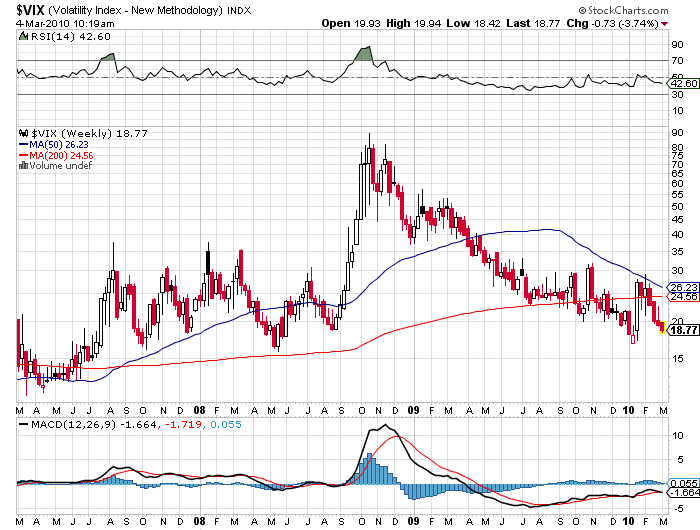
The latest Investors Intelligence poll shows that the bulls are at 42.1%, up from 41.1% last week; and the bear camp was trimmed back to 22.7% from 23.3%. So the widening in the bull/bear spread is a modest negative for those who are constructive on the market. All the more so with the VIX index now south of 19. Complacency reigns.
…..read more HERE (headlines from this mornings comment below)
IN THIS ISSUE OF BREAKFAST WITH DAVE
• While you were sleeping —equity markets are a little wobbly overnight; it looks like Greece is going to try and solve its problem on its own
• U.S. employment backdrop still challenging — the U.S. economy is currently about12 million jobs shy of being at full employment and it will likely take 5 to 10 years to getback to the prior pre-recession peak in the employment-population ratio
• ISM services — nice headline, but breadth was awful
• Is Japan a sleeper? Japan’s economy has strung together a series of positive data releases
• U.S. consumer still in a funk …
• … and so is housing in the U.S. — the renewed downturn in home prices may be weighing on consumer sentiment
• Bullish sentiment gets more bullish
• Someone out there likes bonds!
• Fiscal follies — did you know that the structural deficit-to-GDP ratio is actually higher in the U.S. and the U.K. than it is in Greece and Spain?
…..read more HERE
-
I know Mike is a very solid investor and respect his opinions very much. So if he says pay attention to this or that - I will.
~ Dale G.
-
I've started managing my own investments so view Michael's site as a one-stop shop from which to get information and perspectives.
~ Dave E.
-
Michael offers easy reading, honest, common sense information that anyone can use in a practical manner.
~ der_al.
-
A sane voice in a scrambled investment world.
~ Ed R.
Inside Edge Pro Contributors

Greg Weldon

Josef Schachter

Tyler Bollhorn

Ryan Irvine

Paul Beattie

Martin Straith

Patrick Ceresna

Mark Leibovit

James Thorne

Victor Adair