
Daily Updates
“In our continuing coverage of what could be the largest fraud in history we interviewed Jim Rickards the day after the release of the Harvey and Lenny Organ and Adrian Douglas blockbuster to get his opinion not only on the ScotiaMocatta vault news but also regarding the whistleblower interview with Andrew Maguire and Adrian Douglas that involves the LBMA. He also discusses how gold could go to $20,000 an ounce.”
Interviewed by Eric King of King World News, Jim Rickards, has been a direct participant in many of the most significant financial events over the past 30 years including the 1981 release of hostages from Iran and was also the principal negotiator for the government sponsored bailout of LTCM.
Jim Rickards says:
— Far more claims to gold have been sold than can be delivered upon.
— To save the dollar the United States will be forced back on a gold standard with convertibility and gold revalued to $5,500 per ounce.
— China’s need for gold to back its own currency and hedge its U.S. debt exposure is massive but the metal isn’t available even as the Chinese government is commandeering the output of Chinese mines.
— And gold owners should keep their metal in vaults not operated or controlled by banks, since keeping gold in bank vaults negates gold’s purpose as a wealth preserver outside the banking system, which is vulnerable to a run on gold banks.
It’s a great interview, 30 minutes long, and you can find it at HERE
“Jim Rickards – senior managing director of the Omnis Inc. consulting firm in McLean, Virginia, clients include private investment funds, investment banks and government directorates in national security and defense. He is an advisor to the Committee on Foreign Investment in the United States and Support Group of the Director of National Intelligence and recently testified before Congress on the causes of the financial crisis. In this exclusive interview with King World News last Thursday April 8th, Jim gave us his expert analysis on these incredible unfolding events.”
With most agreeing that a rate hike from the Bank of Canada is imminent, the talk now turns to the exact timing and extent of the central bank’s policy changes.
…..read more HERE
“The riskiest markets are probably those judged safest by the analysts. The safest are those thought to be risky.”
….read the entire article HERE
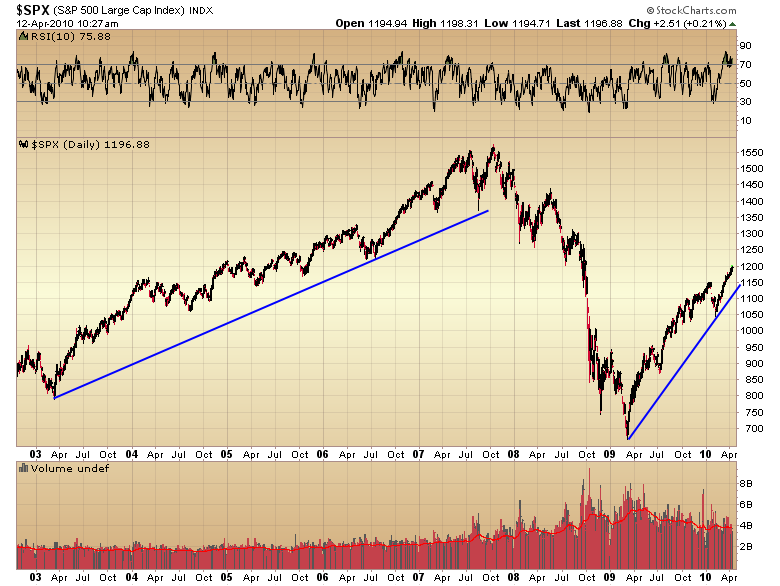
Compare the angle of assent of this cyclical bull to the last one. (go HERE for the full article with 6 larger Charts)
As long as a country is willing to sacrifice its currency there is no amount of deflationary pressure that can’t be printed away.
However, no amount of printing can erase the underlying problems. And those problems are going to persist until they are cleansed from the system. In his mad attempt to avoid the mistakes of the depression Bernanke is going to create a whole new type depression. This time the depression will materialize as a hyper-inflationary storm.
What the powers that be fail to understand is that we are going to suffer a depression that is unavoidable when a credit bubble forms and pops. All we are doing is choosing the form of the depression. In this case the memory of the deflationary depression in the 30’s has sent us down the other track into the beginnings of a hyperinflationary state.
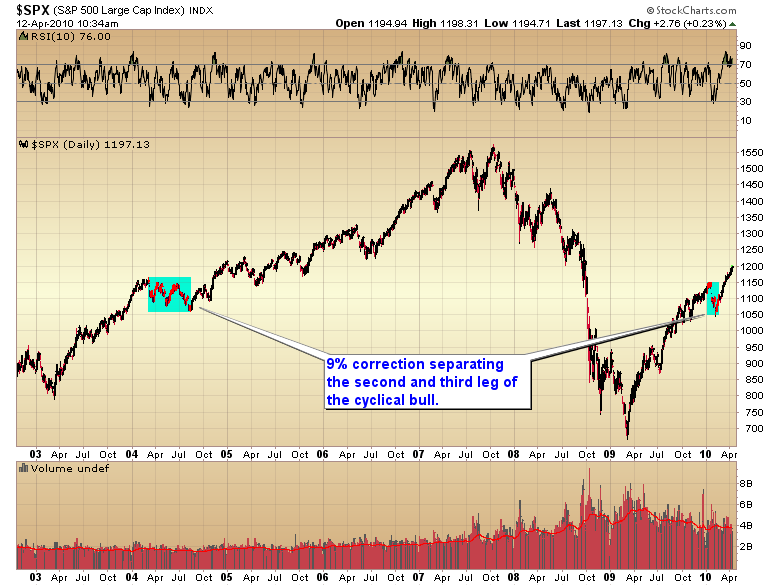
Going back to our charts you can see that the February correction separated the second leg of the bull from the third and almost exactly matched the `04 correction in magnitude if not in time. Remember everything is unfolding faster this time.
Dear Mr Russell,
You have mentioned that bond yields will likely rise – and rise faster than expected.
However, other key analysts like David Rosenberg have pointed out that as the US baby boomers start shifting their wealth into bonds (from equities and real estate), this will drive yields down in next 3-10 years.
Any comments on this factor? Thanks in advance.
Russell response (Update 04/13 @ 3:08pm PST)
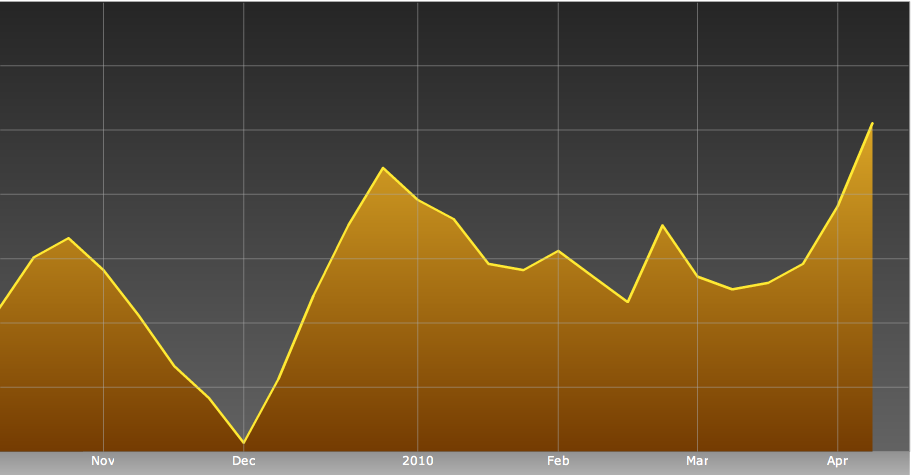
— David Rosenberg is an excellent analyst. But his thesis that bonds are headed higher because of baby boomers desire for yield is a very risky and theoretical scenario. Personally, I prefer to follow the market, which means the charts. The chart below (from the Chart Store) tells an entirely different story (I showed this chart just before the bond market cracked. Here we see a huge head-and-shoulders BOTTOM pattern with an upside breakout, which means that interest rates are now heading higher. Please show this chart to Mr. Rosenberg.

Russell vs Rosenberg 04/12/2010
From Russell
— it’s saying, “Enough.”. Lower bond prices mean rising rates. With the long-Treasury bond breaking down, higher rates should first hit the housing market, where the rate for a 30-year fixed mortgage has climbed half a point since December, hitting 5.31% last week. Just as the increase in interest rates accelerates, the Fed has halted its emergency $11.25 trillion program to buy mortgage debt, which places ever further pressure on rates.
Russell comment in four words, “The fun is over.”
Chart via Money Talks (source HERE)
Home sellers now face what I believe will be at least a 20-year bear market in bonds. How so, Russell? From the early 1980s to 2010, the US economy has enjoyed a 30-year bull market in bonds resulting in consistently lower rates. This was a huge force behind the real estate boom. Today’s home owners and would-be sellers don’t realize it, but we are still in a bear market for housing. Interest rates have put a cap on housing prices. I see it here in La Jolla. Sellers of houses are holding out for peak and ridiculous prices, not wanting to lose money from their purchase price at the top. Potential buyers don’t have the cash or the credit to take out mortgages. The next phase — sellers will finally “get it.” The housing bonanza is over, and the price and market value of homes will be heading down.
If there are any surprises in the mix, here’s what I think they may be: Rates will move up FASTER than many think possible. Second surprise — cash is going to be loved and WANTED. But I’ve been telling my subscribers that for years.
x- From Richard Russell – Dow Theory Letters. Richard has made his subscribers fortunes. One of the best values anywhere in the financial world at only a $300 subscription to get his DAILY report for a year. HERE to subscribe. Amongst his achievements Richard was in cash before the 2008/2009 Crash and he has been Bullish Gold since below $300
SETTING THE RECORD STRAIGHT ON THE BOND DEBATE
From David Rosenberg
“You really have to have a read of “Yield Views Couldn’t Differ More” on page B1 of the weekend WSJ. It pits Jim Caron, a good pal and former Merrill rates- strategist colleague against Goldman Sach’s Jan Hatzius, a former formidable competitor and I would argue runs one of the best, if not the best, economics houses on Wall Street. Jim is bond bearish, Jan is bond bullish. The world pretty well knows my view (Ed Note: see below). The article talked more about supply than it did about inflation, which is the much more critical ingredient in any simulation of interest rate determination.
The “Current Yield” column in Barrons also runs with the bond-bear theme (“Next, a Sharp Jump in T-Yields”). This time, and again, it focuses on the Morgan Stanley forecast of a 5.5% peak in the yield of the 10-year note. We are told in the article to throw away the econometric models of the past and rely solely on the supply backdrop. Again, this logic defies how bonds rallied through most of the Reagan years despite all the bond supply used to spend the Russians out of submission in terms of military expenditure. We are also told that the consensus is underestimating the recovery — another reason to be bearish on bonds. “
One reason why interest rates cannot rise (Ed Note: emphasis mine) is because if they do, there will never be a sustained improvement in the pace of economic activity, especially housing. One reason why interest rates cannot rise is because if they do, there will never be a sustained improvement in the pace of economic activity. Housing is the classic leading indicator, and the most interest-sensitive sector, and until it revives, it seems highly unlikely that bond yields will rise on any sustained basis or that the Fed will embark on a path towards higher policy rates. For a truly sombre assessment on the prospects for a housing recovery, see what Robert Shiller has to say on page 5 of the Sunday NYT biz section. (“Don’t Bet The Farm on the Housing Recovery”).
….read David’s whole report HERE.
….read David’s whole report HERE.
-
I know Mike is a very solid investor and respect his opinions very much. So if he says pay attention to this or that - I will.
~ Dale G.
-
I've started managing my own investments so view Michael's site as a one-stop shop from which to get information and perspectives.
~ Dave E.
-
Michael offers easy reading, honest, common sense information that anyone can use in a practical manner.
~ der_al.
-
A sane voice in a scrambled investment world.
~ Ed R.
Inside Edge Pro Contributors

Greg Weldon

Josef Schachter

Tyler Bollhorn

Ryan Irvine

Paul Beattie

Martin Straith

Patrick Ceresna

Mark Leibovit

James Thorne

Victor Adair