
Daily Updates
“Special offer from Mark Leibovit for Money Talks only: The intense analysis of Gold in the 10-12 page The VR Gold Letter is right now 75% off for the first month or $29.95 (regularly $125.00 a month). The weekly VR Gold Letter focuses on Gold and Gold shares.Go HERE and use the Money Talks promo code CBC12210
Mark has “not flashed a TIMER DIGEST ‘Sell’ signal: The timing is good to take a trial subscription ( CLICK HERE) to be in position if a signal comes.

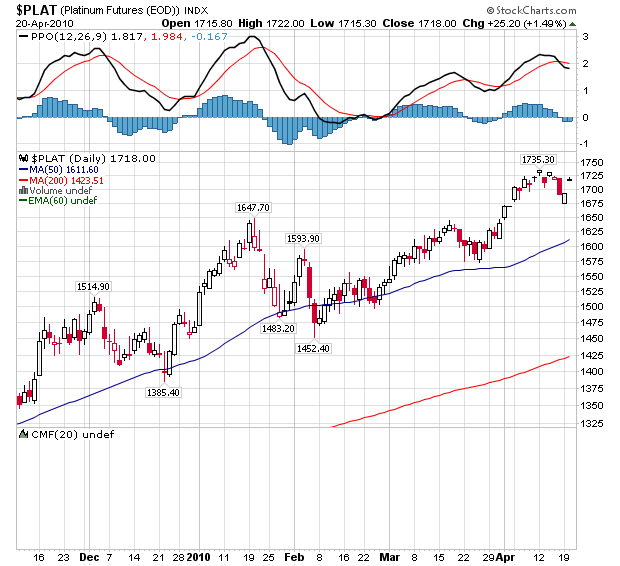
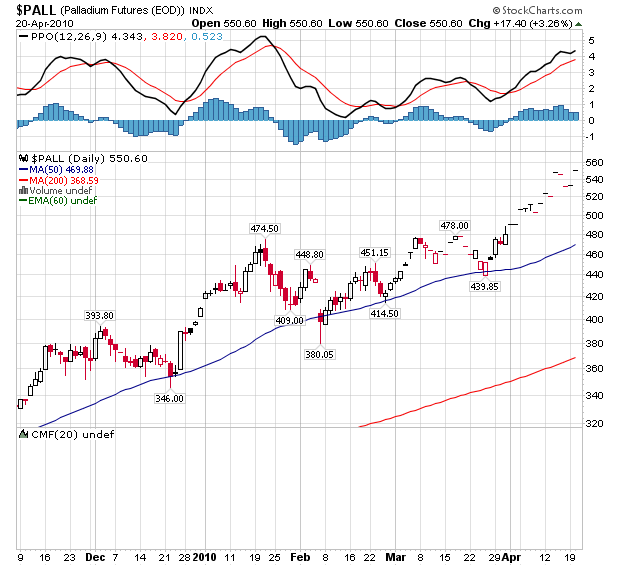
Precious metals rallied, especially platinum and palladium, but finished the session well below their highs. Nevertheless, metals are back in rally mode as traders buy insurance in the face of so many uncertainties, including Greece, Goldman Sachs, the Dollar, and the volcano. Gold gained 5.20 to 1140.40 but had traded as high as 1147.40. Silver was up 0.10 to 17.82 but was as high as 18.06. Platinum jumped 20 to 1715 (platinum futures posted their highest close in two years) while palladium rallied 14 to 550 and hit a new two-year high of 557.”
“I did not switch to a TIMER DIGEST ‘Sell’ signal for Gold. I am giving Gold and other metals the benefit of the doubt because I believe there is a case that for at least Gold we could experience inter-market divergence and Gold could become a refuge, despite the blatant manipulation of the ‘paper’ market by the government. Whether I do decide to flip to a ‘Sell’ signal for Gold or not, I think it is unwise to sell your physical Gold. The upside is far too great and the overall 20 year up-cycle is wind at our back during uncertain times.”


Here is the link to the VR Gold Letter:
www.vrgoldletter.com
If you are a Platinum or Silver subscriber, special discount rates are offered ($50 and $70, respectively, versus $125.00 per month). Please contact my office for details: mark.vrtrader@gmail.com or 928-282-1275.
Recently, I’ve issued several warnings. Chief among them …
– That investors everywhere are waking up to their leaders as being nothing more than emperors with no clothes. Reckless spenders with not a single clue of what they’re doing and full of false hopes.
I also warned …
– That our Federal Reserve, not to mention other central banks around the world, would remain hell bent on devaluing the U.S. dollar.
– That savvy investors everywhere were starting to seek out the best private assets and asset markets, in what I call “moveable wealth.”
It’s now just about a month since I issued these warnings. And in a short, 30-day span, they are panning out — in spades.
– Riots are breaking out in Greece, Portugal, and Ireland. Greece, despite any bailouts, is flat broke. So is Italy. Spain. And the U.S. of A.
Meanwhile …
– On at least two occasions in the past month, Fed Chief Ben Bernanke has confirmed that he’s going to keep interest rates as low as possible, for as long as possible, even indicating that there may be no rate hike until late 2011.
– At the same time, Bernanke is continuing to ramp up the digital printing presses clearly concerned, that no matter how low he keeps short-term interest rates, it may not be enough to sustain the U.S. — or the global economy for that matter — on life support.
As you read this right now, more funny money, more unbacked pieces of paper that float around the world as a bunch of IOUs are flooding the system.
So it’s no surprise to us savvy, will-not-be-fooled, real wealth investors that …
– Gold has rocketed higher yet again, leaping to $1,162 on April 9 — and within mere inches of giving me the biggest buy signal for gold since it closed above $725 in July 2006, and where I warned that the $1,000 price level would soon be hit. Likewise …
– The price of oil has also rocketed higher to as high as $87.09, a 6.75% increase in just over a month.
And naturally, also as I predicted, gold and oil are not the only markets exploding higher.
– Palladium has jumped as high as $552.00, a two-year high. Platinum has exploded to an 18-month high at $1,743.00.
– Copper is now trading at $3.60 a pound.
– Even silver is zooming higher, reaching $18.50 an ounce as I write this column.
What’s more, the Dow Jones Industrials and the bluest of the blue chips in Asian stock markets are also following my forecasts, with the Dow now above 11,000 and China, India and other Asian stock markets also ripping higher.
Why all this bullish action in the markets?
Is it really that the U.S. and global economy
are picking back up? Or, is it some other
mysterious force at work?
Yes, there’s no doubt that there’s some bottom-bouncing going on in the U.S. economy. But that’s all it is, bottom-bouncing.
On the other side of the world, there are indeed explosive growth areas, namely China and India.
But there’s much more going on in the markets today. There’s another force driving many markets higher that almost no one understands.
In fact, I consider it so important that I will tell you this …
What’s happening right now in the markets is a major
turning point in the dollar and the world’s monetary system.
There will be massive losses for those who fail to understand what’s really happening and are unprepared for what’s coming.
Yet, on the other hand, there will be equally massive profit potential for those who do.
I want to be absolutely sure that you’re in the latter camp, that you understand what’s happening, and can, therefore, protect your wealth — and grow your money over and over again in the years ahead.
So let me now explain further …
First, despite the massive debt problems in Portugal, Italy, Greece and Spain … despite the problems in Europe — the U.S. dollar’s rally against the euro has been feeble at best, and now, the dollar is turning back down in the foreign exchange markets.
Second, Singapore has just revalued its currency higher against the dollar, for the first time ever.
How does a country like Singapore push the value of its currency higher against the dollar?
Simple. It starts selling its U.S. dollar reserves and buying up more of its own currency.
Third, President Obama, Treasury Secretary Geithner, and most definitely, Fed Chairman Ben Bernanke — have all been pressuring China to push its currency higher. Which is the same thing as saying the dollar needs to go lower.
And that means that huge portions of China’s 2.4 trillion stash of U.S. dollars will soon have to be sold to boost the value of the yuan.
My friends, in other words, what the markets are telling you is that …
Phase Two of the Dollar Devaluation
I’ve Been Telling You About Is Here
That’s largely why you’re seeing almost all tangible assets, natural resources, starting to soar again.
It’s why gold is now hovering at $1,160 an ounce … ready to begin its ascent to at least $1,300 … then to $1,500 … and then, to my minimum target of $2,300 an ounce.
I want to show you something else about debt, the dollar, and gold right now. Positive proof that basically, the bigger the debts, the weaker the dollar, and naturally, the higher the price of gold goes.
Consider the following …
– In 1947, the official national debt was $247 billion. Each U.S. dollar was worth 1/35th of an ounce of gold.
– In 1973, the official national debt was $469 billion. It then took $43.25 to buy an ounce of gold. Or put another way, the dollar was worth 1/43.25th of an ounce of gold.
– In 1980, the national debt was $930 billion. The price of gold reached $850 an ounce. In other words, the dollar was worth 1/850th of an ounce of gold.
- Today, our official national debt is a whopping $12.78 trillion. That’s …
- Thirteen times greater than it was in 1980.
- Twenty-seven times larger than our 1973 national debt.
- And nearly FIFTY-TWO TIMES larger than our national debt in 1947.
So simple math tells you the following …
If gold were to match the growth in national debt since 1947, it would have to trade at $1,820 an ounce (gold’s price of $35 in 1947 times 52 = $1,820)
If gold were to match the growth in national debt since 1980, it would have to trade at $11,050 an ounce (gold’s price of $850 in 1980 times 13 = $11,050)
It’s hardly surprising when you look at those numbers that gold has much more to go on the upside. Even more so when you consider that the debt figures above do not include another approximately $122 trillion of unfunded liabilities.
All along I’ve been warning you that a dollar devaluation is part of Bernanke’s grand strategy, his secret debt solution to the mountain of patently unpayable debts that we have in this country.
My view: We are now in Phase Two of the Dollar Devaluation.
Hence, I consider it absolutely essential that all subscribers make sure they have some gold!
You can buy gold via the SPDR Gold Trust ETF (GLD) … and a nice mix of gold miners through a mutual fund such as U.S. Global Investors World Precious Minerals Fund (UNWPX).
But you should also get invested in other hard assets and vehicles that can protect your money — and help you profit — from the dollar devaluation. There are loads of them, and I cover them all in my Real Wealth Report. A one year membership is a mere $99. Hop on board now!
Best wishes,
Larry
This investment news is brought to you by Uncommon Wisdom. Uncommon Wisdom is a free daily investment newsletter from Weiss Research analysts offering the latest investing news and financial insights for the stock market, precious metals, natural resources, Asian and South American markets. From time to time, the authors of Uncommon Wisdom also cover other topics they feel can contribute to making you healthy, wealthy and wise. To view archives or subscribe, visit http://www.uncommonwisdomdaily.com.
Don’t Wait for May to Go Away
An old stock market “saw” states, “Sell in May and go away,” emphasizing that the worst part of the year for stock performance is the months between May and November. To be sure, a $10,000 investment in the DJIA purchased in November and sold in April grows to ~$480,000, while the same strategy employed between May – October shows a loss of ~$328 (study: between 1950 –
2003) . . . thus, “sell in May and go away.” Obviously we have modified that old axiom this morning given our statement – “Don’t wait for May to go away!” Nevertheless, despite having beentoo soon’ly cautious since S&P 1150 – 1160, which is tantamount to being wrong, we are “stepping up” our cautionary counsel this week.
…..read more HERE
1. Increase your equity-equivalent exposure through commodity stocks, emphasizing the mining stocks at the expense of agricultural and oil & gas stocks.
2. Canadian investors who use TSX-linked equity products should, nevertheless, increase their total exposure to commodity equities to reflect the better global outlook.
3. American investors who use S&P-linked products to participate in a strengthening global outlook are underweight commodity exposure and should adjust exposure upward accordingly.
4. Big Oil stocks are a blend of commodity companies and industrial companies. They dominate the raw materials section of the S&P, giving investors a false sense they have good commodity exposure. Underweight integrated oil companies in commodity portfolios
5. The accounting wheeze that equates six units of natgas to one of crude oil makes Big Oil in general and most oil and gas producers look like better commodityinvestments than their true product mix would justify. Overweight oil production and underweight gas production.
6. The oil sands companies are moving from open pit mining to Steam- Assisted Gravity Drainage (SAGD) production methods, using natgas as fuel for melting the bitumen. Result: they are long oil and short natgas, which is a splendid strategy for investors. This week’s Sinopec purchase of Conoco Phillips’ 9% interest in Syncrude confirms the strategic value of that treasure trove that fashionable Greens love to deride. Continue to overweight the oil sands companies.
7. The combined strength of the KRE and BKX is more than mildly reassuring. We believe investors should feel quite safe in their equity commitments as long as that relative strength holds. The test may come when Bernanke withdraws the heroin, but most economists think that remains far off. This is a good time to emphasize cyclical equities within US portfolios—and to add to commodity exposure.
8. Within agricultural stock portfolios, emphasize the equipment and logistics companies. Reduce exposure modestly to grain production, and increase it to production of meat, poultry, pork and beef.
9. Gold and silver have held up well in the face of strength in the dollar. Remain overweighted in the precious metals. The royalty and streaming stocks offer special attractions, because relatively few investors understand the companies’ beautiful business models, and the excellent execution of those models by shrewd managements.
10. Within global bond portfolios, continue to emphasize Canadian bonds. Within US bond portfolios, emphasize inflation-hedged TIPs. Within retail portfolios holding high exposure to cyclical stocks, hold some long-duration bonds as a hedge against a double-dip after the heroin is withdrawn.
Published by:
Coxe Advisors LLP.
190 South LaSalle Street, 4th Floor
Chicago, Illinois USA 60603
Distributed by BMO Capital Markets
Quotable
“Predicting the future is always a crap shoot, no matter how hard economic modelers try to convince you otherwise. Getting a grasp on the here and now is generally easier.”
“Not this time. Rarely have so many observers looked at the U.S. economy and come to such diametrically opposed conclusions. We’re either entering the Promised Land or staring into an abyss”.
“Even the business cycle gurus at the National Bureau of Economic Research came up short when they convened on April 8. Members of the Business Cycle Dating Committee met, talked and decided any determination of a cyclical trough to the recession that started in December 2007 would be ‘premature”. – Caroline Baum
FX Trading – Long rates go lower!
Is bond worry all wet? I got caught up in the expectation of a surge in long bond yields, which hasn’t materialized. Being in the deflationary camp, it was a dumb assessment on my part. I think the perennial bond worry-warts have it very wrong again. For sustenance on our deflation view we turn to Van Hoisington and Lacy Hunt.
Hoisington and Hunt are the best there has been for many years on bonds. They toil away quietly at Hoisington Investment Management Company, based in Austin, Texas. No fanfare from this crew, just excellent analysis on the long-term trend of the…..
…..read pages 2-5 and view charts HERE.
-
I know Mike is a very solid investor and respect his opinions very much. So if he says pay attention to this or that - I will.
~ Dale G.
-
I've started managing my own investments so view Michael's site as a one-stop shop from which to get information and perspectives.
~ Dave E.
-
Michael offers easy reading, honest, common sense information that anyone can use in a practical manner.
~ der_al.
-
A sane voice in a scrambled investment world.
~ Ed R.
Inside Edge Pro Contributors

Greg Weldon

Josef Schachter

Tyler Bollhorn

Ryan Irvine

Paul Beattie

Martin Straith

Patrick Ceresna

Mark Leibovit

James Thorne

Victor Adair