
Daily Updates
In case you haven’t noticed, most of the world’s stock markets took a hard fall the last few weeks. Exchange traded funds (ETFs) got walloped, too.
Is the selling over? Perhaps.
But even if we see a strong economic recovery, it doesn’t mean stocks are ready to come roaring back.
Nevertheless, the stock market will find a bottom sooner or later. And I think it’s a good idea to keep your eyes on ETFs to buy when they’re down. Just as markets can get irrationally exuberant, they can also get unduly pessimistic. This gives you an opportunity for profit.
A couple of weeks ago I talked about Greece, Europe and ETFs and some of the bargains that could become available once that part of the world hits rock bottom. Today I’m going to tell you about some beaten-down sector ETFs you may want to add to your watch list.
Beaten-Down ETF #1:
Market Vectors Solar Energy (KWT)
Beaten-Down ETF #2:
Claymore/MAC Global Solar Energy (TAN)
Back when crude oil was trading above $100 a barrel (at one point to almost $150!), solar energy stocks were hot, hot, hot. While reality may not have matched the hype in some cases, there was good reason to be bullish. The world was running out of oil — or so they thought.
Unfortunately for some sectors, the worldwide economic downturn has pushed old-fashioned fossil fuel prices down sharply. Consequently, the potential savings, present and future, are not nearly so great now.
ETFs that focus on this niche have been burned the last few months. Both KWT and TAN are off more than 45 percent since early January and 77 percent from their levels of two years ago. They may fall even more. But the values are starting to look tempting even to a momentum-oriented guy like me.
Beaten-Down ETF #3:
First Trust ISE Global Wind Energy (FAN)
Beaten-Down ETF #4:
Market Vectors Nuclear Energy (NLR)
Beaten-Down ETF #5:
Market Vectors Global Alternative Energy (GEX)
Beaten-Down ETF #6:
PowerShares WilderHill Clean Energy (PBW)
Beaten-Down ETF #7:
PowerShares Global Wind Energy (PWND)
Solar isn’t the only alternative energy source. There’s also wind, nuclear, geothermal, and various other technologies in development. Several ETFs try to cover this group, and some have gotten trounced!
FAN and PWND, for example, have lost a third of their value since early January. They’ve fallen for the same reason as the solar ETFs mentioned above.
Another factor: For the most part, the pure-play stocks in alternative energy are small-cap companies. This means they’re more volatile even in the best of times. When buyers go on strike, speculative small-cap stocks get slaughtered. And so do the ETFs that hold them.
Beaten-Down ETF #8:
Market Vectors Steel (SLX)
Steelmaking is a brutally competitive industry. At one time the U.S. was the global leader, but times have changed. A big reason is the astonishing growth in Asia, particularly China. All those shiny new buildings, roads and airports need a lot of steel parts.
The downside, of course, is that demand for steel tends to decline once the infrastructure is in place. And recession only aggravates the problem.
Another issue is that places like China are now developing their own steel manufacturing base. That means less need for imports — and bad news for the foreign companies that supplied those imports.
Many of these companies can be found in the SLX portfolio. No wonder, then, that SLX is off more than 28 percent in the past eight weeks. My guess is that steel will be a little slower to come back than many other sectors, but we could still see a big bounce in SLX at some point.
Beaten-Down ETF #9:
Market Vectors Agribusiness (MOO)
If any business is recession-proof, you might think it would be food. We all need to eat.
Indeed, but we have choices about what we eat and where it comes from and how it is produced. The choices people make can have a big impact on this sector. Companies like fertilizer makers, farm equipment manufacturers, and food distributors can be just as volatile as anything else.
MOO shares dropped from the $47 area as recently as January to a low near $36 earlier this month — losing more than 21 percent of their value. This same ETF traded down below $20 in 2008, so it could easily decline further. At some point, though, I think MOO will be a great buy.
Keep Your Eyes Open!
Please be clear: I am NOT recommending anyone buy any of these ETFs right now. I don’t know where the bottom is, but my best guess is we haven’t seen it yet.
My point is that these are some interesting sector ETFs that have fallen hard. Whenever they come back, the upside could be substantial. So add these tickers to your watch list and wait for your chance.
Best wishes,
Ron
This investment news is brought to you by Money and Markets. Money and Markets is a free daily investment newsletter from Martin D. Weiss and Weiss Research analysts offering the latest investing news and financial insights for the stock market, including tips and advice on investing in gold, energy and oil. Dr. Weiss is a leader in the fields of investing, interest rates, financial safety and economic forecasting. To view archives or subscribe, visit http://www.moneyandmarkets.com.
It’s been an exciting week for traders as volatility levels are through the roof and the broad market is moving up and down like a yoyo. You cannot take your eyes off the screen if you have a large amount of money invested as you can quickly find yourself with a large profit or loss in the matter of minutes….
Although we have seen stocks jump around the past few days precious metals have held strong with very little volatility. This is because of the economic fears looming for the US and other countries of possible financial collapse. This fear is helping to boost gold and silver prices because they are seen as the safe haven. Also we are seeing money move in the US dollar because the country is still seen as a leader in many ways helping to boost the US dollar.
Below are a couple charts on Gold and Silver ETF’s showing the end of last years rally and the correction in prices which are now looking to setting up for another leg higher.
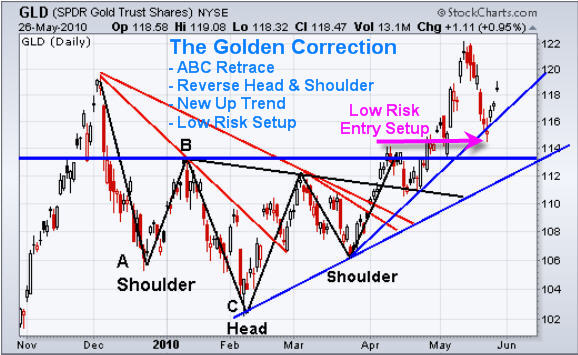
GLD – Gold ETF Trading Vehicle – Daily Chart
I called this chart “The Golden Correction” because it literally is. We saw prices rally late in 2009 finishing off with a parabolic spike which we know is not sustainable and almost always results in a VERY sharp drop. This correction unfolded as planned with an ABC retrace which shakes out weak positions. We then we saw a reverse head & shoulders pattern form which again also shakes out weak positions. Once the neckline was broken from the reverse H & S the new up trend was started providing a couple trading opportunities for us along the way. The most recent low risk entry point can be seen on the chart as gold prices dropped back to a key support level.
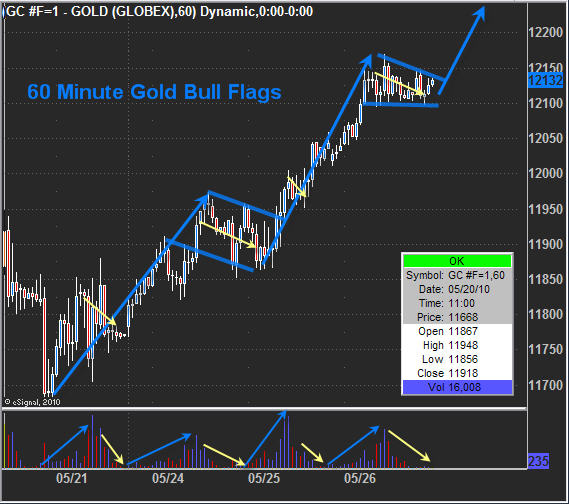
Gold Futures Price – 60 Minute Day Trading Chart
Gold has been showing some very bullish price action the past week forming several mini bull flags with confirming volume levels. I think we should see gold pop another $5-10 bucks in the very near future if not continue higher for several days.
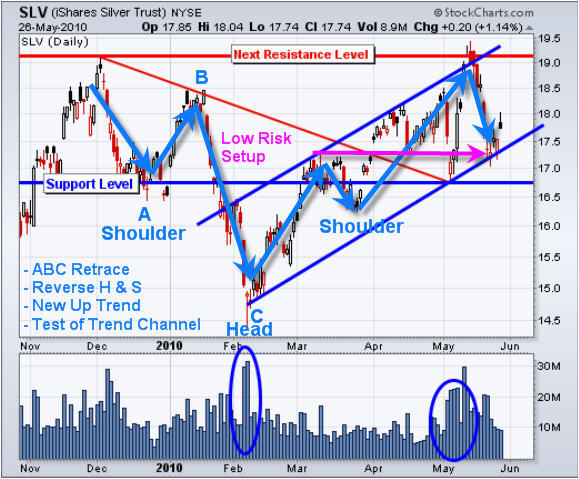
SLV – Silver ETF Trading Vehicle – Daily Chart
Silver formed much of the same patterns as gold but with much more volatility. Also silver has yet to break the 2009 high which is surprising but with a large part of silver being use for industrial purposes it does make sense as the economy is not as strong as it was thought to be in 2009. Silver carries much more risk when trading because it has more random moves and increased volatility.
Mid-Week Precious Metals Trading Conclusion:
In short, gold and silver are in an uptrend and looking strong. Both are currently trading at short term resistance levels on the daily chart which has caused them to stop moving up today (Wednesday May 26th) but on an intraday basis they look solid and could break though these resistance levels.
That being said buying way up here adds a lot more risk because a good chunk of the move has already been made and if prices do roll over and start heading back down the next support level is several percentage points away for placing a protective stop with the proper amount of wiggle room.
If Trading Gold, Silver and Index Futures and ETFs interested you check out my trading services at www.TheGoldAndOilGuy.com
Chris Vermeulen
Sign up and get FREE Technical Trading Charts HERE (scroll to the Bottom)
Quotable
“A liberal is someone who feels a great debt to his fellow man, which debt he proposes to pay off with your money.” – G. Gordon Liddy
FX Trading – Jim, are you talking your BRIC book?
Talk about talking your book! I read this in the Financial Times this morning:
“Jim O’Neil of Goldman Sachs says policy crisis in the eurozone is unlikely to be a source of global financial market contagion. ‘Nearly 70 per cent of the eurozone economy is made up of three countries—France, Germany and Italy—and unless sovereign debt crisis derails their economies, it is tough to see how the eurozone could weaken sufficiently.’”
Question: Jim; did you recently get hit by a BRIC upside your head? Or maybe the question should be: How do you define contagion? Jeez Louise!
Where does one even begin with that type inanity, from a person who is far from inane? Yo Jim! Germany, that little country holding it all together over there; well, they send about 50% of their exports to the eurozone each year. If demand craters precisely because austerity works, staving off sovereign default, Germany will have to find some other customers very fast. Danger Will Robinson, danger! Back to short-term Treasuries and gold!
…….read more HERE
Ed Note: Two articles below, one by Roubini and on very critical of him.
Charlie Rose Talks to Nouriel Roubini
In 2006, economist Nouriel Roubini famously predicted a global recession. His new book, Crisis Economics, addresses the consequences
What have we learned from these crises of capitalism?
The first lesson is that crises are not “black swan” events, using the terminology of my friend Nassim Taleb. They’re not just random outcomes. They are the result of a buildup of financial and policy vulnerability and mistakes—excessive risk-taking, leverage, debt, and so on. The first chapter of my book is called “The White Swan” because these events are predictable. But generation after generation, we seem to forget the past. When there’s a bubble, there’s euphoria. There’s irrational exuberance. Consumers can use their homes like ATM machines. Governments and policymakers are happy because they get reelected. Wall Street makes billions of dollars of profits. Everybody’s delusional.
…..read the whole interview with Nouriel Roubini in Businessweek HERE
Nouriel Roubini: From Macroeconomic Visionary to Reflexive Crank
by Tom Brown
As the cycle turns higher, Nouriel Roubini is returning to his role as a reflexive, tendentious crank. Dr. Doom was in classic form in BusinessWeek last week in his interview with Charlie Rose. Some highlights, along with some comments from yours truly. [Emphasis added]:
What happened to all the toxic assets?
Some of them have been written down, but the policy response has been pray and delay. Many banks are still carrying these assets and loans on their books at face value of a hundred cents on the dollar.
He can’t really believe this. No sane person can. The real estate crackup began in earnest in 2007. Since then, lenders have had to generate audited financial reports three times—for 2007, 2008, and 2009. Does Roubini believe there’s some kind of conspiracy among lenders, auditors, and regulators that’s allowing banks to keep their distressed assets marked at par all this time? That’s not just mistaken, it’s delusional.
How long will [mortgage borrowers] be under water?
A long time. Prices for homes have fallen by 30 percent from the peak. Prices of commercial real estate have fallen by 40 percent. They may be stabilizing, but prices are not going to go up 30 percent or 40 percent anytime soon. Therefore many of these bad assets have negative equity, meaning the value of the assets is lower than the value of the mortgage or the debt on it. People are going to walk away from their homes.
Are “going to” walk away? Er, Nouriel, the housing bust has been going on for awhile now. Borrowers have already defaulted in large numbers. For years. It’s been in all the papers! At this point, home prices don’t need to rise for defaults to slow, they just need to stop falling—which Roubini himself admits is happening.
Aren’t [underwater borrowers unilaterally defaulting] now?
They’re doing it increasingly. People refer to it as jingle mail. You put the keys in an envelope, send it back to your banker. It’s happening on a massive scale. Especially in the U.S., if you walk away from your home when the value is below the value of your mortgage, they cannot go after you to recoup the difference between the two.
Roubini’s blowing smoke! No one disputes unilateral default has been going on for awhile. But borrowers are now suddenly “doing it increasingly” and “on a massive scale?” Really? Data please. Unilateral defaults are very tough for an outsider to identify. We’ve looked for statistics on them for months, and haven’t been able to come up with reliable numbers. For all anyone knows, those “jingle mail” stories are mostly an urban myth. If anything, unilateral default could be on the decline as borrowers realize lenders are tending to put off foreclosure rather than try to dispose of properties in a crowded market, and prefer borrowers stay in their houses in the meantime and maintain them. Oh, and depending on the state, lenders can go after defaulted borrowers for any deficit balance.
Other than raising interest rates, what should the government do?
You need tighter supervision and regulation. The Dodd bill is not enough. Institutions that are too big to fail are becoming even bigger. [For example,] JPMorgan took over WaMu and Bear Stearns. So if they’re too big to fail, they’re too big. We should break them up. They’re also becoming increasingly too big to be bailed out…
Roubini seems weirdly obsessed by the big banks. If he doesn’t want to out-and-out nationalize them, he wants to break ‘em up. I’m no fan of size in the banking business, either, but this notion that systemic risk would somehow be reduced if, say, JPMorgan Chase were broken up into its constituent parts is plain crazy. The company’s derivatives unit, for example, would be “systemically important” whether it’s a unit of mighty Morgan or if it were a standalone boutique. (Roubini is right that the Dodd bill is useless, however.)
Nouriel Roubini has been broadly wrong about the economy, the financial system, and the stock market for–how long has it been now?–the past 18 months or so. I hope he stays negative. And when Charlie Rose and CNBC stop calling, we’ll know it will be time to worry.
Tom Brown became one of the most respected Wall Street analysts of financial-services stocks in the 1980s and 1990s, working at Smith Barney, PaineWebber and Donaldson Lufkin & Jenrette. In 1998, he joined hedge-fund manager Julian Robertson, heading Tiger Management’s North American financial-services group. In 2000, he formed Second Curve Capital, a $550-million-in-assets hedge fund that invests exclusively in financial-services stocks. Brown’s original fund, Second Curve Partners, has generated a 20% yearly return, net of fees, since its May 2000 start.
Visit his site: www.Bankstocks.com
From the Legendary Trader Dennis Gartman. For subscription information for the 5 page plus Daily Gartman Letter L.C. contact – Tel: 757 238 9346 Fax: 757 238 9546 or E-mail: dennis@thegartmanletter.com or HERE to subscribe at his website
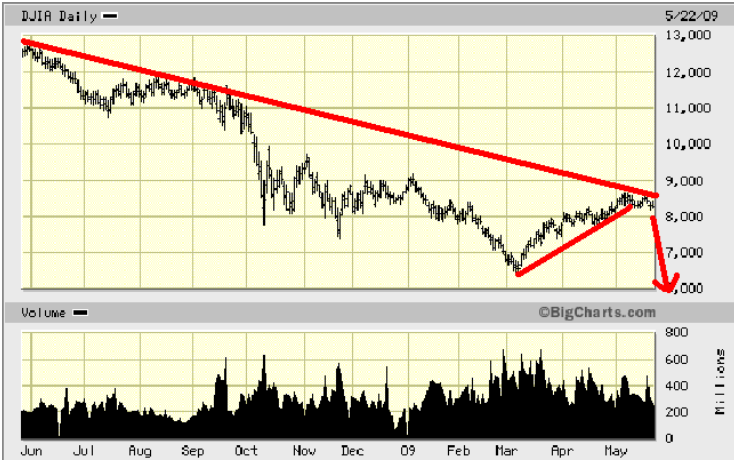
NEARBY WTI CRUDE OIL: A $22/barrel Break Is Really A Bit Much, Isn’t It?: One gets the sense that the worst to the downside is behind us… or at least we hope it is.
“We continue to strongly urge that those who must trade equities do so by being long of very low beta, defensive stocks and short of higher beta, aggressive stocks instead. Owning the low end retailers while being short of high end “tech” seems reasonable to us, or being long of the low end retailers and purveyors of very basic personal products such as cereals and soap while short of jewelry and high end clothing also seem
reasonable”
-
I know Mike is a very solid investor and respect his opinions very much. So if he says pay attention to this or that - I will.
~ Dale G.
-
I've started managing my own investments so view Michael's site as a one-stop shop from which to get information and perspectives.
~ Dave E.
-
Michael offers easy reading, honest, common sense information that anyone can use in a practical manner.
~ der_al.
-
A sane voice in a scrambled investment world.
~ Ed R.
Inside Edge Pro Contributors

Greg Weldon

Josef Schachter

Tyler Bollhorn

Ryan Irvine

Paul Beattie

Martin Straith

Patrick Ceresna

Mark Leibovit

James Thorne

Victor Adair