
Daily Updates
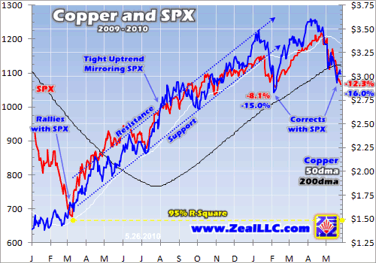
AS GOES COPPER, SO GO EQUITIES?: This wonderful chart, by our friend Adam Hamilton of www.zealllc.com, tells a terrific story of correlation… perhaps not cause, but certainly of correlation. Since March of ’09, when the bull market in equities began, copper and equities have travelled the same path. They are on that same path still! – From the Legendary Trader Dennis Gartman. For subscription information for the 5 page plus Daily Gartman Letter L.C. contact – Tel: 757 238 9346 Fax: 757 238 9546 or E-mail: dennis@thegartmanletter.com or HERE to subscribe at his website
Copper: SPX Usurps Stockpiles
From boring industrial metal to commodities superstar, copper’s wild bull market has been full of excitement. Its huge 475% run from its 2003 low to 2008 high made investors fortunes. Its subsequent panic-driven 69% plunge was catastrophic. And then copper’s resilient 183% post-panic recovery to its recent April high has been breathtaking.
Futures traders, hedge-fund managers, and stock investors have endured extreme highs and lows across this bull. And quite often they’re left scratching their heads wondering what’s going to happen next. But as any seasoned copper trader well knows, this base metal’s only certainty is acute volatility. When it comes to analysis, forecasting, or your best educated guess as to copper’s future direction, be prepared to circumstantially adapt.
From a strategic perspective, copper’s secular bull is driven by foundational economic fundamentals that will keep it alive for many more years to come. But things get a little trickier when we look at copper’s tactical price movements. Naturally technical, sentimental, and shorter-term fundamental indicators serve as logical price drivers. But as we’ve seen one should not rely on any single indicator.
……read the rest of this 2269 word article with charts HERE
The Bottom Line
Look for the recovery in North American equity markets to continue this week. However, strength offers an opportunity to reduce equity positions. Special situations exist, most notably in the biotech and medical device sectors.
Read more and view all 45 Charts HERE
5 of 45 Charts Below:
The VIX Index fell 20% last week. Short term momentum indicators are overbought and have started to trend down. This is a bullish intermediate indicator for equity markets.

Silver gained $0.76 per ounce (4.30%) last week. Short term momentum indicators are in neutral territory.
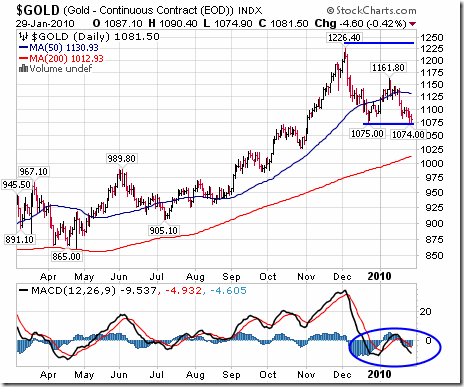
The Canadian Dollar added 0.50 cents U.S. last week. Nice recovery from long term support at 92.16 and intermediate support near 93.15! Short term momentum indicators are oversold: Stochastics have recovered above the 20% level, RSI have improved above the 30% level and MACD is close to recording a positive cross over from an oversold level. Look for the Canadian Dollar to move higher this week if the Bank of Canada raises the overnight rate.
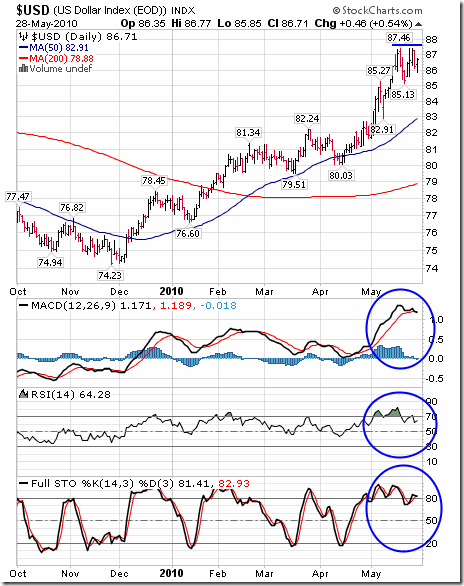
The TSX Composite Index added 150.09 points (1.30%) last week. Intermediate trend is up. Resistance is at 12,321.76. The Index bounced back above its 200 day moving average last week. Short term momentum indicators have bottomed: Stochastics have recovered from the 20% level. RSI recovered from the 30% level. MACD is close to completing a positive cross over from an oversold level. Strength relative to the S&P 500 Index remains positive. Upside potential is to its 50 day moving average currently at 11,997.11.
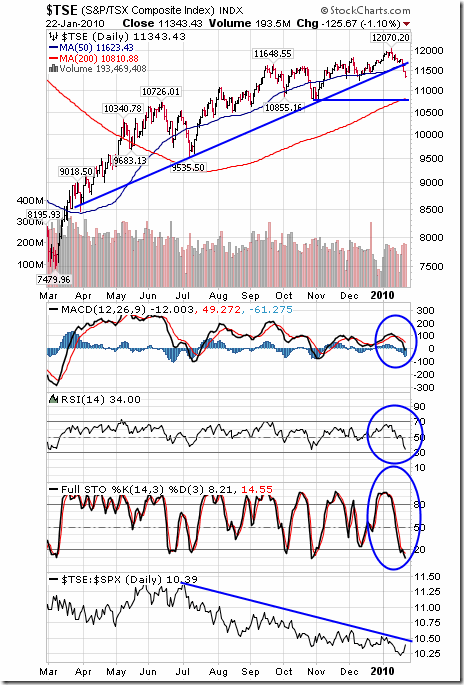
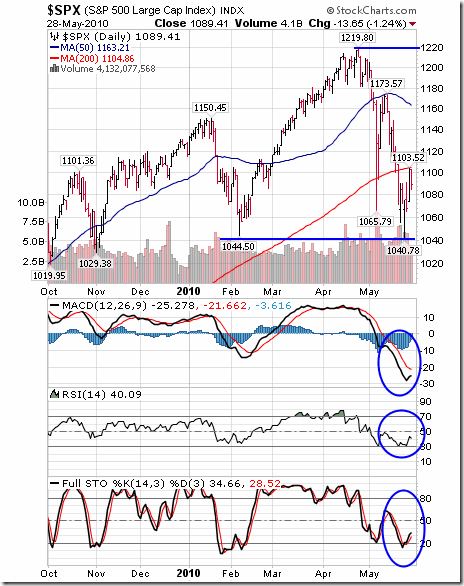
The S&P 500 Index added 1.72 points (0.16%) last week. Intermediate trend remains up. Resistance is at 1,219.80. The Index briefly broke support at 1,044.50, but recovered strongly. Short term momentum indicators are bottoming: Stochastics and RSI recorded buy signals. MACD is close to recording a buy signal. Upside potential is to its 50 day moving average currently at 1,163.21.
Read more and view all 45 Charts HERE
U.S. health-care devices offer safety
Look for lots of good news from the health care equipment and supplies sector during the next few weeks. The sector is a classic defensive play designed to protect your portfolio during the volatile summer months. It benefits from a series of positive influences around this timeframe as investors turn back to basics. The focus is on the shares of companies that are considered to be necessities including the health care, staples and utilities sectors. All offer products and services that remain in demand regardless of economic conditions.
…..read more HERE
Roger Wiegand: EU Bailout Just Delays Inevitable
Replacing most of Europe’s colorful notes and various coins less than a decade ago, the euro is on the brink of extinction, according to Trader Tracks’ Roger Wiegand, sharing news and views of Euroland’s critical condition with Gold Report readers in this exclusive interview. Roger says the euro at $1.20 is the “line in the sand where big trouble will start. . .and that’s dangerously close.” On the other side of the world, he sees China doing well now, but doesn’t pin his hopes on China as the engine for global economic growth as so many others do. In fact, he says things there are “fraying a bit on the edges.” So, is there a white horse waiting in the wings to lead the world back to economic good health? Read on. . .
The Gold Report: You put a rather provocative quotation in a recent Trader Tracks. It says: “The destruction of a currency does not follow a straight, predictable course. . .like a cancer, the disease breaks out anew because inflation cannot be cured through monetary and fiscal measures alone; it requires a fundamental change in social and political attitudes and this change usually does not occur until complete monetary chaos forces a change.” The quotation credit reads, “G. Carl Wiegand, ‘The Great Inflation: Germany,’ 1923.” Two questions: First, is Carl Wiegand among your ancestors?
Roger Wiegand: He’s not. I found that particular quote in a book, Golden Insights. It was written by James U. Blanchard III out of his Gold Newsletter of many years ago. He’d put together a collection of his favorite quotes, and that particular quote was among them. I thought it intriguing that the quotation came from someone with my surname, and it was a very interesting quote.
TGR: Very interesting indeed, and it leads right into the second question: What do you think of Carl Wiegand’s observation in light of the euro’s troubles and what’s happening in the European Union now?
RW: I think the statement was very appropriate for what’s going on in Europe today. We’ve been doing a lot of writing on this lately, and based on latest information Germany has become the engine of Europe. Its share of the huge Euroland rescue package will come to between $154 billion and $185 billion in loan guarantees. It’s going to be mostly German money and savings that was going to have to do it—their credit.
Chopper Ben (Federal Reserve Chairman Ben Bernanke), Timmy the G (Treasury Secretary Timothy F. Geithner) and the New York banksters turned up the heat and the German Parliament approved that ridiculous package in mid-May, contrary to Chancellor Angela Merkel’s urging lawmakers to reject the whole deal. They think they can blunder through to help the euro. They cannot. Germany goes down with the rest. I think the German people are very angry about this. They don’t want to be Europe’s paymaster.
I said back in 2003 that Euroland (i.e., the European Union); the European Central Bank and the euro would fail. Now it’s coming true. It’s in writing, seven years ago. I said that because I thought it was ridiculous idea for a group of countries with major cultural differences and languages, disparate economies that don’t match up at all, with their abilities to buy and sell and obtain credit being so different. There was no way to achieve parity to reach a point where they could participate as equal members. Germany is expected to save all its neighbors and it cannot.
TGR: Do you expect to see the return of guilders and schillings, pesetas, francs and marks as one outcome from all of this?
RW: Yep. Absolutely. It won’t happen overnight. It would be too much of a big changeover at once. There may be a “mini-euro,” a higher-quality currency probably established by Germany, running alongside the current euro. I contend that Germany will be the first to bail out of the European Union and abandon the euro. I have said numerous times that the German mark probably would come back, run in parallel with the euro, and eventually the euro would just be cancelled out as a currency in Germany and they would use the old marks.
TGR: And then other former European currencies might follow?
RW: They very well could. The survivors who still remain in the European Central Bank with the euro may, in fact, try to keep it together. But without the German credit, and with all the problems they’re going to face, I really don’t understand how it can keep going. The debt is just overwhelming. Basically, Italy, Portugal, Spain and Greece are pretty much broke; they have no hope of paying their debt. To my understanding, Spain’s debts are 24 times larger than Greece’s. That’s a pretty big mountain to climb. So yes, I suspect that what would happen is if Germany drops out and they go back to their own old currency, the rest of the countries will, too.
TGR: Despite the vote in the German parliament, do you project that Greece and potentially Spain and Portugal will ultimately default on their sovereign debts?
RW: I think they will. There’s no way Greece can pay anything back. They have nothing going for them. They have a tourism industry, but very little manufacturing. I saw a comment the other day that said Greece hadn’t balanced a budget since 1893 or 1898. How in the world they managed that is beyond me.
TGR: So, suppose Greece defaults. And then assume, with Spain and Portugal teetering on the edge, the euro then plummets dramatically unless they start to inflate their way out of it. At what point does everyone abandon the euro and move to safer currencies? Say the U.S. dollar?
RW: There are two big numbers to watch. First would be the euro at $1.20, and that’s dangerously close. Everybody considers $1.20 the line in the sand where big trouble will start; it’s a major, major support number. The other number would be when the euro is at parity with the U.S. dollar, which would be 20 points lower. Keep in mind that one point with the euro is $1,250 the same as the Swiss franc, in currency trading. So, those are the key numbers.
TGR: What happens if the euro goes below that $1.20?
RW: Everything starts coming apart. Keep in mind, too, the euro and the U.S. dollar are supposedly the two reserve currencies of the world, with the U.S. dollar being dominant at about 80% to 85% of all reserves. The euro has a much smaller position, but it is a pretty big deal. Not all of the European population lives in Euroland, of course, and the Swiss and the Brits (the UK) still use francs and sterling—but also remember that Europe has 850 million people in contrast to 330 million in the U.S.
The Swiss franc, incidentally, trades almost point-for-point with the euro because Eurolanders surround the Swiss. The Swiss don’t want a large disparity between the two currencies to mess up export/import, in comparing prices, and in a variety of domestic things.
TGR: Speaking of import/export, let’s turn for a few minutes to the other side of the world. Many people have pinned hopes on China as the savior that would lead us from the depths of recession back into the promised land of global growth. You’re commentaries have been suggesting China’s bubble is about to burst and dash these hopes. What signals do you see that lead to your conclusion?
RW: China’s GDP is in a race to the moon, running between 8% and 11%, which is beyond the pale. It’s just too far out. It’s growing too fast. A major sell-off in the SSE—the Shanghai Composite Index—was one warning sign. It did come back, but it told us that things are fraying a bit on the edges.
Then, in the first quarter of 2010, Hong Kong real estate went up 23%—23% in four months, and it’s even higher now. I spent 25 years in real estate, and I know that is not sustainable. You can’t have prices rising that quickly. They’ve got a bubble; there’s no question about it. Some of the prices they’re paying for properties are just staggering. The last time we saw that was in 1989 in Japan, and we know what happened in Japan in 1989. The market just crashed.
As you know, the Chinese government is a command-and-control operation. Actually, they’ve been doing a pretty good job, but it’s so large and they’re a fairly new at being capitalists (along with being communists). To cool down the real estate situation, they’ve been tightening credit; no longer offering financing for third homes, for instance. They’re requiring more money on down payments for first and second homes.
Another factor that is making it difficult for the Chinese economy is the fact that the United States has broken down to the extent that it has. American consumers are no longer using homes as ATMs for the purchase of Chinese products. Not so long ago, 25% of all exports leaving China went to the U.S. A good portion of that is gone now.
Many have said that organic growth within China could sustain its increasing GDP, because 100 Chinese cities each have populations of more than a million people. That’s true, but how high is high? Trees don’t grow to the sky.
I am not the only one anticipating problems in China, either. Earlier this month in a Bloomberg TV interview in Hong Kong, Gloom, Boom & Doom Report publisher Marc Faber said that it’s likely to crash sometime in the next nine to 12 months.
TGR: If China’s growth has in fact peaked—and is about to turn south—is anyone waiting in the wings to lead the world back toward global good health?
RW: Three countries that I can see that are the strongest as of this date are Canada, Germany and China.
TGR: Didn’t we just rule China out?
RW: Major market shifts can take longer than we expect. China is doing exceedingly well right now. They’ve got a tremendous amount of cash, which they’re trying to offload, the biggest portion being U.S. dollars and U.S. bonds. They’re desperately trying to get rid of that paper and trade for hard goods. That would be crude oil, oil-related service companies, stocks in good companies, properties, copper mines, gold mines, silver mines and base metal mines.
They’re shopping in Venezuela for oil and oil services. They’ve got three big new oil-related operations in Nigeria. They’ve been buying oil properties in Libya. They’ve made some deals in Peru and Chile, and they’re working on a couple more in Australia. The list goes on.
TGR: Okay. On to Germany and Canada.
RW: Germany’s got a big overload and we know what their problems are. We just reviewed that. As for Canada, the major thing is that they avoided getting involved in a lot of the risky trading and debt that their American counterparts did. Canada has five large banks; that’s pretty much it, and they were prevented by law and rule from engaging in that kind of trading in derivatives. It kept them out of trouble, and they’re in pretty good shape.
TGR: So Canada may be the knight on the white horse.
RW: That’s the way I view it, and that’s what we’ve been talking about in our letter. In our speeches in Canada at the shows and conferences, we’ve said numerous times that the Canadian economy is the best of all. The banks are in the best condition. The currency is very sound and rising. Canada’s primary negative is a manufacturing slowdown in Ontario and Quebec. This is minor, though, compared to the great things Canada has going for it in commodity-related markets and finance.
TGR: Moving south, we’re hearing and reading that the employment situation in the U.S. is improving, but you have a different view. In Trader Tracks, you’ve indicated a current jobless rate at 24% and forecast it rising to 35% within three years. What makes your outlook so grim?
RW: Why am I grim and at odds with the happy Pollyanna people in Washington? We have two different sets of numbers. Those numbers pretty much track mine at John Williams’ shadowstats.com—and he worked in the government and consequently worked on that data. I follow a simple rule of thumb: take the official unemployment number and multiply times two. That pretty much matches up with what John says. In other words, if Washington says that nationwide unemployment is at 9.9%, multiply times two and round it up to 20%. John’s report a week or so ago was about 22%.
TGR: Okay, it’s not the facts that are changing so much as the figures that go with the facts.
RW: That’s correct.
TGR: You’ve also said you expect major market mayhem before the end of July. Could you describe more specifically what you see, and tell us why?
RW: I am not alone in my forecast. Many others are saying the same thing. Stocks are up about 80% from March of 2009. It’s gotten very peaky. The markets have normal technical shifts. The Lehman meltdown in 2008 hit the market so hard that for 30 to 60 days, nothing seemed to behave normally on the trading cycles and calendar. I expected it to self-correct, but it has not. That period just fell off the trading calendar. Consequently, the old “sell in May and go away” shifted to July.
Our next short-term call is that the big funds will have pushed the market up, sold into strength, taken their profits and be out of the way by Memorial Day weekend. Then the selling begins. It will continue at a very heavy rate probably for one to two months. Six negative events are converging this month and next. First is housing. We can expect another three to five years of falling prices. Some Alt-A loans—not subprime but those based on slightly blemished credits—are going to fail and foreclose. One report said there will be two million of these.
Number two: commercial real estate has hit the wall. Vacancies are climbing. A few months ago, General Growth Properties, the owner of 158 malls, filed for bankruptcy for about $28 billion. That’s in a breakup in court right now. Good shopping centers in the U.S. are in trouble. I have never seen a big mall close, but some people have told me they have seen two of them. That’s a major event in my view. So, commercial real estate, REITs, and the life insurance companies that gave them all the money will take a big hit as related group.
TGR: A lot of shoes dropping here.
RW: We’re just at number three, the auto business. The only thing that propped it up was all the free cash from the government, “cash for clunkers” and some of the other programs. The spring auto sales that will be reported after Memorial Day won’t be good.
The next hit’s coming when the banks have to report about what’s happening with credit cards on their financial statements. Look for $40 billion in credit card debt to be written off in June and July. That’s not my forecast; I think it may have come from prominent banking analyst Meredith Whitney. That’s number four.
That brings us to number five. Remember the TARP plan, which bailed out the big New York banks? All these banks have done was to gather in cash from the taxpayers, rearrange the balance sheets—the deck chairs on the Titanic—and then march forward saying everything was super duper. And it’s not. I saw Meredith Whitney on a TV show a couple of weeks ago, saying that the bad loans they’re still holding are four times worse than what got them in trouble the last time. That does not bode well.
And finally, number six was the big surprise—what’s going on in Euroland.
TGR: Yikes. Harmonic convergence turned upside down.
RW: Yes. Arch Crawford—publisher of Crawford Perspectives and Wall Street’s best-known astrologer, according to Barron’s—has mentioned the date of July 26. He said it’s the worst day astrologically and technologically that he can see on charts in 10,000 years. I asked him at a conference how bad that was and he said, “It’s so bad I can’t imagine what could happen”—you know, World War III, Iran invasion, complete systemic economic crash, or whatever. I am not of the view that something like that will happen, although it could. We don’t know. I just think we’ll have a long, slow sink in the mud, and this is going to be a very hard recession-depression that will continue for another three to five years. So, it’s going to be tough, but keep in mind the fact that in the 1930s, as bad as it was, three out of four people still had a job—so 75% were employed.
TGR: A glimmer of hope. Let’s talk about some companies. Your latest Trader Tracks lists a number of companies in the news lately for one reason or another, and our readers would certainly appreciate your viewpoint on some of the developments they’ve read about. We saw a broad spectrum of companies represented in there—from rare earths to precious metals. Can you talk about some of the companies you’re following?
RW: Sure. I find Rare Element Resources Ltd. (TSX.V:RES) attractive because they’re safely located in the United States; they’ve got some rich deposits; in their reserves they have the basic rare elements the U.S. defense industry needs to operate. They must have those minerals. As you know, 90% of those kinds of minerals are located in China. The U.S. Department of Defense is probably a little uneasy about that. There really aren’t that many companies for that particular field, but we find that Rare Element is one of the top selections. And we also like them simply because of where they are, what they have, and what’s moving forward in their business plan.
TGR: It was clear in Trader Tracks that you were pretty stoked about Newmont Mining Corporation (NYSE:NEM) being involved with Bear Lodge in Wyoming, but within the last couple of weeks, Rare Element announced that Newmont won’t be exercising its option on a 65% interest in the gold and base metals at the Sundance Venture on that property. Also, all of Newmont’s 327 wholly owned claims outside the venture will transfer to Rare Element. What’s the significance of this development, in your view?
RW: I suspect the project turned out to be too small for Newmont. Some of these really big operators—Barrick Gold Corporation (NYSE:ABX; TSX:ABX), AngloGold Ashanti Ltd. (NYSE:AU; JSE:ANG; ASX:AGG; LSE:AGD), BHP Billiton Limited (NYSE:BHP; PKSHEETS:BHPLF), Rio Tinto (LSE:RIO; NYSE:RTP; AUS:RIO), Newmont, etc.—have to operate on such a scale that it’s difficult for them to find a project with the reserves necessary to really warrant the large investment they put in up front. They’d prefer to be involved with projects with sufficient reserves to pay out for 40 or 50 years. I’m not sure, but with the Rare Element project, I think Newmont was just looking for a bigger deal. You know, they go worldwide looking for bigger deals.
TGR: Turning to silver briefly . . . any juniors that you’ve got an eye on?
RW: We like First Majestic Silver Corp. (TSX:FR; OTCQX:FRMSF). Its income keeps going straight up in a steady line and they keep finding more and more silver. It’s among the companies I call junior intermediates. They have done well; they’re good managers. It’s easy to cut through reserves pretty quickly, so one thing they have to do with these mines when they start to run and operate at higher volumes is to keep the reserves coming. First Majestic has done well, in that they keep adding to reserves. So, we like First Majestic.
TGR: How about in the gold arena?
RW: There’s Eastmain Resources Inc. (TSX:ER). We know the management; we know the geologists; we know what they’re doing. One thing I’d emphasize about Eastmain is that they’re in Quebec, and that’s probably one of the best mining-friendly locations anywhere in the world. They give them tax breaks. They have trained employees; they’ve got geologists. They have shipping; they’ve got rail. They have all the ingredients to run a good mine, and if you’ve got management as good as we see in Eastmain, expect their drilling program to be successful. We think they’re going to find some fine deposits, and considering the infrastructure in Quebec—water, power grid, roads and so on—things bode well for the stock.
TGR: In light of what you said about Quebec, any other companies there you’d like to mention?
RW: Clifton Star Resources Inc. (TSX.V:CFO) has done exceedingly well. We have been in and out of its stock several times, and it’s been very good to us—numbers in the neighborhood of 30% to 40%, 70%, maybe 140%. A big shareholder sold out recently, taking huge profits, but the stock is solid. They’ve got a fantastic partner; they’re exceedingly well capitalized; they’ve got $4 million to $5 million worth of ore mined, in a pile on the ground. It just has to be reprocessed. So, it’s a good opportunity; it’s a good company.
TGR: Any other comments on companies in good locations?
RW: Pediment Gold Corp. (TSX:PEZ; OTCBB:PEZGF; FSE:P5E) comes to mind, although at this point I have to say at this point I’m not up to snuff on Pediment’s news. We know the management, though, and I am going to meet with their president and geologist to get caught up on the latest things when we’re in Vancouver at the June 6-7 conference. Again, though, this is a company with smart management in a good location. They’re operating in a rather mountainous region, which makes it more expensive and difficult. But these are smart people. They know what they’re doing, and they’ve got the capital. We think they’re going to do quite well.
TGR: That’s the World Resource Investment Conference?
RW: Yes. In fact, I’m scheduled for a keynote speech on the second day, covering several topics—taxes, devaluation and the divergence between gold and silver and the shift of precious metal shares away from the general stock market. I’m also running a short workshop on my business, Trader Tracks. And finally, I’ll be delivering a speech that isn’t on the agenda, speaking on behalf of Endeavour Silver Corp. (NYSE:EXK; DBF:EJD; TSX:EDR), which is another one of the companies I follow.
TGR: Have a great time in Vancouver, Roger, and as always, thanks so much for your thought-provoking commentary.
Want to read more exclusive Gold Report interviews like this? Sign up for our free e-newsletter, and you’ll learn when new articles have been published. To see a list of recent interviews with industry analysts and commentators, visit our Expert Insights page.
Roger Wiegand—aka Traderrog—produces Trader Tracks to provide investors with short-term buy and sell recommendations and give them insights into political and economic factors that drive markets. An insatiable reader, he digests a variety of domestic and international publications, with the economic, political, monetary and market news and commentary woven into his opinions and analyses. After 25 years in real estate, Roger has devoted intensive research time to the precious metals, currency, energy and financial market for more than 18 years now. His varied background—which also includes graphics, writing, editing, sales, marketing, commercial printing, consulting and trading—helps shape the view he shares. In addition to Trader Tracks, Roger pounds out a weekly “Rog’s Corner-After The Bell” column for Jay Taylor’s Gold, Energy & Tech Stocks newsletter. For other essays, visit websites such as Kitco and, of course, The Gold Report. Roger is a frequent speaker at The Cambridge House Resource Conferences, the latest in the string being the World Resource Investment Conference at Vancouver coming up June 6–7. Visit Roger and Jay’s website at webeatthestreet.com. Tel: 718-457-1426 Claudio Bassi, Manager cbassi@miningstocks.com.
Stockscores.com Perspectives for the week ending May 21, 2010
In this week’s issue:
Weekly Commentary
Strategy of the Week
Important Notice – the company that hosts the Stockscores websites will be moving to a new location this weekend. This will mean that the Stockscores.com and Trading Desk websites will be down from just after the close on Friday until before the open on Monday. We apologize for any inconvenience.

The market is made up of people. People run the companies that we trade, people trade the market and people program the computers that do the analysis. The most important thing about the stock market is people. Therefore, the first thing you need to analyze when trading stocks are the people.
I often say that it is more important to study human psychology that finance if you want to succeed in the stock market. People behave in fairly predictable ways and you can make money if you understand the relationship between human emotion and stock pricing.
Think about the emotional cycles that people go through as they move through their day to day life. What happens when someone is given bad news? They might fight back at first and then deny the presence of the bad news. They might hope it is not so bad before they finally give in to it and work toward accepting it. If you work through a stock chart you can see these phases in a sell off like the one we saw over the past few weeks. Continued below…..
Most people sell at the bottoms of steep downward trends because it takes them that long to accept the news. Of course, this is usually just before the market bottoms out and starts to recover.
It would be much better to move right to acceptance when the bad news hits with a plan to get back in when everyone else is working on acceptance (and after prices have dropped significantly).
Now, what about upward trends? Optimism and greed have a cycle too. We tend to doubt good things at first despite evidence to the contrary. People want to see proof before they open themselves up to good feelings. This is because we mostly want to avoid the pain of disappointment. It is not fun to get your hopes up and then have them crushed.
The result is that most people do not buy in to upward trends until they are well under way. We are full of doubt until the market offers us proof. However, by the time the proof shows up, it is usually too late. These investors end up paying a premium because they got in to the trend too late.
The lesson is to not approach the market with a fear of pain. Do not be reckless, but if things are starting to look good, take advantage with the knowledge that the pain you will feel early in a trend that fails is much less than the pain you feel if a well established trend fails. The higher stocks rise, the harder they fall.
Do you want to beat the market? Stop worrying about what companies are doing and start focusing on what people think about what they are doing. Take some basic knowledge of human psychology and try to figure out the emotional cycle from the stock chart. This process is much more effective than studying balance sheets and income statements. After all, stock prices will only go because people are willing to pay more.

As the Stockscores site will be down over the weekend, we are unable to display charts so there are no feature stocks for this weekend’s newsletter. I believe the market has bottomed but I expect we are destined for some range bound trading in the months to come with some short up and down moves along the way. Trade with extra discipline right now. Having the patience to wait for quality trading opportunities will be rewarded.
- Get the StockSchool Pro Free

DisnatDirect named the number one Canadian brokerage for Traders by Surviscor! Open and Fund a brokerage account with DisnatDirect and receive the StockSchool Pro home study course free, including special Pro level access through the DisnatDirect client website. Offer only available to Canadian residents. For information, click HERE
- Get the StockSchool Pro Free
References
Get the Stockscore on any of over 20,000 North American stocks.
Background on the theories used by Stockscores.
Strategies that can help you find new opportunities.
Scan the market using extensive filter criteria.
Build a portfolio of stocks and view a slide show of their charts.
See which sectors are leading the market, and their components.
Click HERE for the Speaker Lineup and to Purchase the video if you want to learn from some of the worlds best traders including Tyler Bollhorn.

Tyler Bollhorn started trading the stock market with $3,000 in capital, some borrowed from his credit card, when he was just 19 years old. As he worked through the Business program at the University of Calgary, he constantly followed the market and traded stocks. Upon graduation, he could not shake his addiction to the market, and so he continued to trade and study the market by day, while working as a DJ at night. From his 600 square foot basement suite that he shared with his brother, Mr. Bollhorn pursued his dream of making his living buying and selling stocks.
Slowly, he began to learn how the market works, and more importantly, how to consistently make money from it. He realized that the stock market is not fair, and that a small group of people make most of the money while the general public suffers. Eventually, he found some of the key ingredients to success, and turned $30,000 in to half a million dollars in only 3 months. His career as a stock trader had finally flourished.
Much of Mr Bollhorn’s work was pioneering, so he had to create his own tools to identify opportunities. With a vision of making the research process simpler and more effective, he created the Stockscores Approach to trading, and partnered with Stockgroup in the creation of the Stockscores.com web site. He found that he enjoyed teaching others how the market works almost as much as trading it, and he has since taught hundreds of traders how to apply the Stockscores Approach to the market.
Disclaimer
This is not an investment advisory, and should not be used to make investment decisions. Information in Stockscores Perspectives is often opinionated and should be considered for information purposes only. No stock exchange anywhere has approved or disapproved of the information contained herein. There is no express or implied solicitation to buy or sell securities. The writers and editors of Perspectives may have positions in the stocks discussed above and may trade in the stocks mentioned. Don’t consider buying or selling any stock without conducting your own due diligence.
-
I know Mike is a very solid investor and respect his opinions very much. So if he says pay attention to this or that - I will.
~ Dale G.
-
I've started managing my own investments so view Michael's site as a one-stop shop from which to get information and perspectives.
~ Dave E.
-
Michael offers easy reading, honest, common sense information that anyone can use in a practical manner.
~ der_al.
-
A sane voice in a scrambled investment world.
~ Ed R.
Inside Edge Pro Contributors

Greg Weldon

Josef Schachter

Tyler Bollhorn

Ryan Irvine

Paul Beattie

Martin Straith

Patrick Ceresna

Mark Leibovit

James Thorne

Victor Adair