
Daily Updates
Ed Note: Closest thing to Good News in a While ,Cartoon notwithstanding
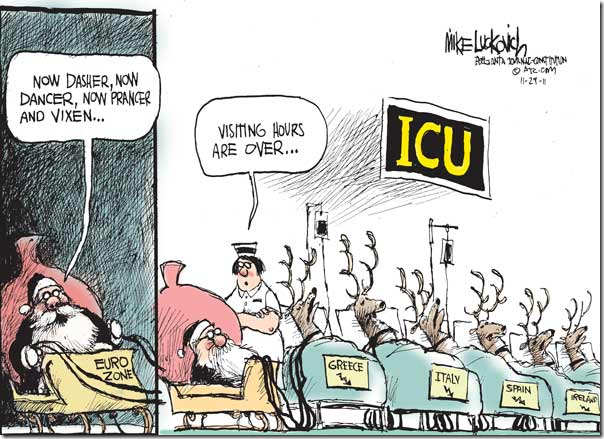
Could Prove Contagious
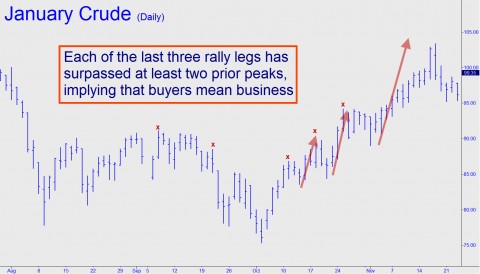
Because securities markets sometimes do crazy things for stretches of days, weeks or even months, Rick’s Picks seldom attempts to reconcile seemingly contradictory forecasts for trading vehicles that are related, such as crude oil and gold (more on these two in a moment). Nor do we seek to explain the ups and downs of stocks, bonds and commodities by connecting their frequently nutty behavior to events in the even nuttier world. That futile task we leave to The New York Times, The Wall Street Journal and their ilk, since they are in the business of selling news as something that matters greatly, particularly to investors. It is with the foregoing in mind that we came to contemplate a seeming fork in the road for crude oil and gold. On the charts, the former looks like it’s about to blast off, while the latter seems bent on screwing the pooch for the remainder of 2011. We said as much in the headline that topped yesterday’s commentary: Doomed Rally in Stocks Could Cap Gold’s Surge. Doomed may have been too strong a word – we did write a column for a Hearst paper for a few years, remember – but bulls could hardly have been encouraged by the egg the broad averages laid yesterday after having rallied nearly 300 points the day before.
If We Were Laying Odds…
….read the rest HERE
Ed Note: This excerpt is from the Great Richard Russell who also penned the Red Alert that Michael Campbell wanted everyone to read.
I recently viewed the great History Channel series “The Last Days of WWII.” In one scene a group of Americans were surrounded by Germans. One of the Americans was wounded badly and cried out in pain in a loud voice. The sergeant came over and whispered in his ear “Keep it up you fool and we’ll be discovered. TAKE THE PAIN, TAKE THE PAIN.” That phrase echoed in my mind over and over again. “Take the pain.” That’s what American population and pols have been unwilling to do. To undo 60 years of inflation, they refuse to take the pain. We’ve refused to take the pain ever since WWII. A great group of bubbles has been created since WWII. But they are starting to pop one by one. The biggest bubble of all, the debt of the US. That debt must be addressed. To address that debt and all of the debt that has enveloped the US we must absolutely take the pain. Which is why I label this site, “Take the pain.”
That’s what nobody wants to do, and the politicians serve the people by keeping money flowing to avoid the pain. Question: Why is it that you never see compounding and debt mentioned in the same sentence? Answer: Because it is a poisonous combination due to the new trillions that have been pumped into the US economy. Based on the massive amount of money pumped into the US economy inflation should start to appear in 1-2 years. With inflation comes higher interest rates. Rates are synthetically low today but by 2013 they will be rising along with inflation. This is when the compounding of the debt starts.
The US National debt is at 16 trillion, 40 percent of the debt matures in one year or less. The average maturity of all US debt is 4.3 years. All this debt has been rolled over at historically low interest rates. This is going to change. As inflation accelerates, rates move higher. The entire tax-take of the US is now 2 trillion. This is a tiny amount compared to the cost of interest on the national debt. In other words, the US will have to borrow huge amounts of money in order to stay solvent. The national deficit is increasing annually by more than 1.5 trillion per year. Thus the tax-take doesn’t begin to cover the interest on the debt. Within a few years a massive amount of money that is pumped into the economy by the Feds will set off inflation. With inflation, interest rates will rise.
Remember the entire federal debt must be rolled over every few years. It will roll over and compound with rising interest rates, a death knell for the US economy and the dollar. As the process continues, the exploding and compounding national debt will crush everything in its path. The dollar will collapse, and the US will no longer be able to borrow the money needed to cover its interest and expenses. The stock market is not going to wait for these events to materialize. It will start discounting the trouble way before it happens. I see any rallies (as the one we’re seeing today) as oversold bounces and they should be sold into.
The preferred position is no stocks, gold, and 10 ounce silver bars with some cash for practical purposes. We are headed for uncharted waters and in time all central bank created currencies will be crushed. Gold is the only currency that is not someone else’s liability, and it should be accumulated.
In the end, the problem is neither the US population nor its politicians are willing to take the pain. There are no free lunches, and there are no corrections with out pain. The pain is set in stone. It’s appearing now in unemployment and loss of purchasing power and spreading poverty.
1. Gold continues to do battle with the dollar bugs at the $1700 marker. The action in the $1530-$1920 price block is really the battle for $2000 gold, and there are some significant similarities with the battle for $1000 gold.
2. Who would have thought the decline into the lows of 2008 would form the head of a massive head and shoulders continuation pattern, one that would power gold 90% above the $1000 platform, to a mind boggling $1900 an ounce?
3. Maintain a mindset of mild confusion, so you are prepared to handle whatever the next legs of the crisis bring, rather than trying to predict your way through it. This crisis, and the role of gold in it, is only just beginning.
4. What will the current battle zone end up looking like, technically, and how high will it propel the price of gold? The answer is unknown.
5. What is known is that substantial patience and professionalism are required for victory, in your personal battle for gold $2000.
6. The main difference between the battle for $2000 and the battle for $1000 is the decline of 2007-2008 was probably akin to a battle with financial terrorists, while the current battle is more like a battle withfinancial cancer.
7. I’ve termed this battle the “gulag”, and it is very clear that only those with the very largest amounts of intestinal fortitude are going to survive, let alone prosper. 2008’s financial war heroes are tough. 2011’s financial cancer heroes are just as tough, and probably tougher.
8. Because most of the gold community are heavily invested in juniors, the battlefield is extremely bloody. The junior mining charts look like a wasteland. Many of our mining stock soldiers are dead or comatose.
9. I believe the “reinvigoration number” is GDXJ $50. Without that price, it will be difficult for many companies to continue to raise cash. Do I think it happens? Yes.
10. Let’s take a look at the action on the gold battlefield, and look for signs of possible coming victory against the dollar bugs. Click thisgold battlezone chart now. Note the action of MACD around the zero line, where we are now.

11. When price is hammered, but then an MACD crossover buy signal occurs, this indicator will often go back onto a sell signal just above the zero line, but only briefly before crossing back into a buy signal. That may be what is happening here.
12. In September, team “seasonal” was taken to the woodshed by the dollar bugs. Gold typically rallies very strongly in September, but it didn’t happen this year. Instead, the dollar bugs beat on gold. That failure of one of the favourite seasonal plays has spooked gold investors.
13. Seasonally, mid-November through year-end is another very powerful time for gold. It’s important that you use the seasonal indicators professionally. Buy decline in price, not “it’s supposed to rally now, because the calendar says so” theories.
14. You can see the gold price moving back and forth around the amber HSR (horizontal support/resistance) line I’ve highlighted near $1700 on the chart. Gold for February delivery traded at under $1680 last week, after declining about $120 from the $1800 area.
15. Without weakness in advance of a seasonal play, it is financial suicide to wade in with anything but wild gambling money. You got that weakness last week, into that amber HSR line, and below it. If we get a good jobs report number this week, and I think we will surprise on the upside, then gold could really start to rally.
16. Jobs report day isn’t necessarily negative for gold. Volatility grows as the time draws near for the report to be issued, but an upside surprise coming during gold’s strongest season can spark enormous price moves to the upside.
17. Click this stock market chart now. While the situation in Europe disintegrates, the Dow seems resilient. It is discounting that news. Are the stock market’s power players looking ahead, at potential money printing and QE3? I think so, and crash season for the stock market is over.

18. When it comes to the Dow, the bottom line is that team shorty pants needs to stand down, before they are mowed down, and a move over 12,250 on the Dow could be hugely bullish for gold stocks.
19. I believe a sea change in financial markets is at hand. Waves of institutional liquidity may be about to flow into markets that are really a value player’s cornucopia! Wheat is down 40% in a year, uranium is through the floor, natural gas is in a coma, and silver has been down almost 50%. The list goes on, and for the institutional value player, it is a shopping list.
20. Institutions place large amounts of capital at the start of the year. That’s just four weeks away, and these prices on high quality assets are too good for many institutional money managers to pass up.
21. Throw in the possibility of substantial greasing of the liquidity wheels by the Fed and the ECB, and an immense “risk on” move could be at hand.
22. Click this short but key GDXJ video update now. This technical set-up is apparent on a multitude of junior gold stocks, and seems to confirm my view that massive institutional liquidity flows are near at hand.
23. $50 on GDXJ is the number required to breathe life back into the gold community, and you’ll get it! When you do, learn from the lessons of this crisis, and cut back on the trading of gold juniors.
24. Don’t buy your own feelings and label them analysis. When junior stock prices rise, you need to stand down from the madness of flip trading them. Don’t use mine reports to justify chasing massive bouts of price strength. Prepare now to fight the greed demon, because he will return, and much sooner than any you think is possible! The senior and intermediate gold stocks look very good here as well. As I sign off this morning and hit the price gridlines, click this GDX blastoff video now. Thanks!
Special Offer For Website Readers: Send me an email tofreereports4@gracelandupdates.com“>freereports4@gracelandupdates.com and I’ll rush you my free “Nuke The Dollar Bugs Now!” report! Get in 3 big junior uranium companies and uranium itself, so you are poised for profits from what appears to be a coming massive rush of institutional liquidity into the “risk on” trade, one that is likely just four weeks away! Thanks!
I was in Bangkok while the floods were raging. I also visited Cambodia. The floods were in the news there as well. Though it did not affect Phnom Penh, where I was, the remote villages were dealing with a lot of water.
That’s the curious thing about water. There always seems to be either too much of it or not enough. What follows is another look at my favorite commodity and the opportunities of investing in it.
At breakfast at the Raffles in Phnom Penh, I read a story about how Levi Strauss is trying to minimize its water use. A pair of blue jeans will consume over 900 gallons of water in its lifetime. That includes everything from the water to irrigate the cotton crop to multiple washings of the jeans.
The pressure is mounting on Levi, and other companies, to reduce their water footprint. Miners, food companies, tobacco companies and beverage makers all face pressure to use less water. In many places where they operate — such as India or China or Africa — fresh water is in short supply. This forces a re-examination of everything — from favoring drought-resistant crops to creating new ways to sanitize things.
Companies are also looking to use all of this to their advantage in marketing. Imagine idyllic farms in India with a smiling farmer using new efficient irrigation methods financed by Levi Strauss. However it may reflect reality, such an ad would appeal to the feel-good consumers of today.
The one part of the story that caught my eye was on a 15-acre cotton farm some 90 miles west of Mumbai. The farmer uses drip irrigation, a method of delivering water and fertilizer piped through veins spread over his fields. It’s vastly more efficient than flood plain irrigation, as the water gets right where it needs to go. There are also fewer weeds and less need for power, a not small consideration in a country in which periodic blackouts, however brief, are as common as flies. The farmer reports his water use is down 70% since using drip irrigation.
A group called the Better Cotton Initiative installed the irrigation equipment. The founders are a group of organizations and retailers, including Gap, Ikea and Adidas. Ikea hopes to use only “better cotton” by 2015. Adidas promises to do so by 2018. You can see how this is appealing to the companies.
There was a time when US companies didn’t really want to know what went on in their factories overseas. That time has passed, probably for the better. In an age when any competitive edge can be a difference-maker, why not try to gain an edge in customers’ minds this way and do some good for the world in the process?
The market is saying it approves. Early research indicates customers like to think they are changing the world for the better. Products that meet that need will enjoy an edge over those that don’t.
Given all of this, I think it is a profitable exercise to think about what kinds of companies benefit in such a world. What kinds of companies enable such a world? As it turns out, there are plenty of them.
Water is a $500 billion industry. You could break that into two giant buckets.
The first is water infrastructure. These include the water utilities — some 250,000 of them globally. These are necessary assets of vital importance wherever they are. They absorb a steady amount of spending that tends to be pretty resilient, regardless of what’s going on in the economy. Population growth drives the creation of new utilities every year. See the chart below on US water and sewer construction spending.
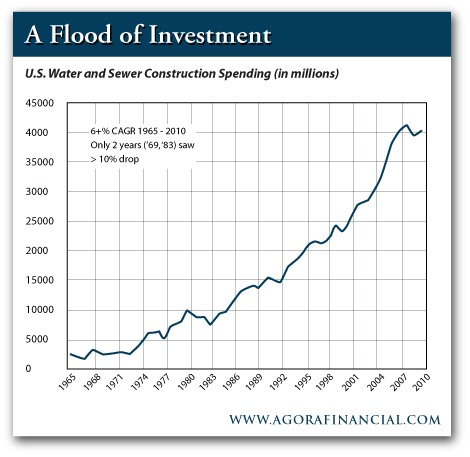
If anything, we’ve underinvested in these facilities over time, leading to leaky pipes and contaminated water. There will be a lot of pressure here to gain efficiencies.
The second big bucket is applied water. You can think of this as irrigation and industrial water uses (such as those used in the manufacturing process). Irrigation is a big one, representing some 70% of applied water use.
Emerging markets play a big role in all of this. Just over the next five years, China alone will spend nearly $50 billion on water, mostly on water treatment systems and flood control projects. In India, there are plans for 30-plus power plants by 2017 — all of which will use heavy amounts of water for cooling. India also has large irrigation projects on the docket, which will divert rivers and soak parched farmland. In Africa, where mining companies are busy cracking open the earth to get at much-sought goodies, there will be a great need to manage the water use of these projects.
As you can see, water touches almost everything — from energy and mining to basic food production and manufacturing. You want to talk about shale gas and the great revolution in American energy? Well, water management is going to play a big role there — testing it, filtering it, recycling it. You want to talk about feeding 9 billion people by 2050? We’re going to need to manage our water assets more intelligently. You want to talk about technology? New smart phones, computers and lifesaving drugs? All of the companies that make these things use tremendous amounts of water. And they need the water to be pure and meet strict standards.
The beauty of water as an investment theme is that “inevitables” power these trends. There is really no way to get around it. If you think about the pressures applied by population growth and urbanization, you can readily see how important efficiency and sustainability will be.
You don’t have to get a lot of things right, either. You don’t need to know what the world’s favored energy source will be in the future — coal, natural gas, nuclear or alternative energy — it doesn’t matter. They all use water, and lots of it.
Water was the key theme that kicked off my Mayer’s Special Situations newsletter in the summer of 2006. The original Blue Gold Portfolio unveiled five stocks with exposure to powerful trends emerging in water — the need to purify it, preserve it and move it. That portfolio delivered an 87% return in its first year and has been a solid winner ever since. We’ve added names since then and over time have sold off some or watched them get bought out. Now only two stocks remain, both part of the original set.
Water remains one of my most favorite investment sectors.
Regards,
Chris Mayer
Chris Mayer is managing editor of the Capital and Crisis and Mayer’s Special Situations newsletters. Graduating magna cum laude with a degree in finance and an MBA from the University of Maryland, he began his business career as a corporate banker. Mayer left the banking industry after ten years and signed on with Agora Financial. His book, Invest Like a Dealmaker, Secrets of a Former Banking Insider, documents his ability to analyze macro issues and micro investment opportunities to produce an exceptional long-term track record of winning ideas.
Special Report: How Will Your Life Change If The U.S. Gov’t Can’t Borrow Another Dollar? Complete political and social unrest could be just the beginning. You owe it to your family’s safety and security to watch this urgent video report right now. There might not be much time for you to act… Don’t wait, watch now.
Read more: Water – Still Blue Gold http://dailyreckoning.com/water-still-blue-gold/#ixzz1f6tIPSs8
-
I know Mike is a very solid investor and respect his opinions very much. So if he says pay attention to this or that - I will.
~ Dale G.
-
I've started managing my own investments so view Michael's site as a one-stop shop from which to get information and perspectives.
~ Dave E.
-
Michael offers easy reading, honest, common sense information that anyone can use in a practical manner.
~ der_al.
-
A sane voice in a scrambled investment world.
~ Ed R.
Inside Edge Pro Contributors

Greg Weldon

Josef Schachter

Tyler Bollhorn

Ryan Irvine

Paul Beattie

Martin Straith

Patrick Ceresna

Mark Leibovit

James Thorne

Victor Adair