
Daily Updates
I’d love to tell you that last week’s coordinated central bank action would help Europe solve its financial crisis once and for all. And that last week’s upside market action was the real McCoy.
But the simple truth of the matter is that Europe’s crisis is far from over … and virtually all markets remain vulnerable to additional sell-offs, some of which will be very frightening.
I’ll get to the markets in a minute. First, some important observations I think you need to be aware of.
Last week’s coordinated central bank intervention did absolutely nothing to solve Europe’s financial crisis. It did not address the cause.
It did not change the European Central Bank’s (ECB) policies of refraining from bailing out member states. It did not change Germany’s Chancellor Angela Merkel’s mind that bankrupt European nations must be crushed into a depression in order to pay off their debts. And more.
In short, it did absolutely nothing to solve the problem. All it did was provide some short-term liquidity for Europe’s financial institutions, many of which are bordering on collapse.
In other words, it addressed symptoms, not causes.
This is why Moody’s Investors Service, the ratings agency, has warned about the growing risk of sovereign defaults in the euro area.
It’s why Belgian bonds have been downgraded. It’s why Portuguese and Hungarian bonds have become “Junk.” It’s why Greece’s one-year bond yield has gone up more than 300%.
It’s why Spain is reportedly seeking a bailout from the International Monetary Fund (IMF). And why Italy is still struggling with a debt load of $2.1 trillion, equivalent to 120% of its gross domestic product — and two-year interest rates that have shot up from 4.63% last month to more than 7% now.
And it’s also why there is a possibility that Austria and even France might lose their triple-A rating status.
And if you think that the IMF may end up solving Europe’s crisis, think again. The IMF just does not have the money. Not even close. Most of the IMF’s major shareholders are broke. Especially the United States.
Only China and Germany have the ability to lend money to Europe through the IMF. Germany won’t. And China won’t lend money to Europe directly or indirectly via the IMF either.
And to top it off, the IMF cannot print money. So there is simply no way it can solve Europe’s sovereign debt crisis.
The bottom line is this: As I’ve said all along, one or more countries will end up defaulting and leaving the euro.
The November 26 issue of The Economist summarizes what defaults in Europe and a breakup of the euro will mean …
“The prospect that one country might break its ties to the euro, voluntarily or not, would cause widespread bank runs in other weak economies. Depositors would rush to get their savings out of the country to pre-empt a forced conversion to a new, weaker currency.
“Governments would have to impose limits on bank withdrawals or close banks temporarily. Capital controls and even travel restrictions would be needed to stanch the bleeding of money from the economy. Such restrictions would slow the circulation of money around the economy, deepening the recession.”
Will it get that bad? Very possible. So the next big question is why wouldn’t that send gold and other natural resources higher?
My answer: In the long run, it probably will. Not based solely on Europe, though. It will send tangible asset prices through the roof when it becomes abundantly clear that the United States is just as bankrupt as Europe is.
But that time is not yet here. In the meantime, very real and high odds remain that …
One, the worsening problems in Europe will cause most investors and most money to either flee to the sidelines or park their money in more-liquid investments such as pure cash and U.S. Treasury securities.
Two, additional liquidity problems will arise that even the central banks won’t be able to address, causing more asset liquidation by investors.
And …
Three, there is a very real chance that you will see the IMF and some European countries start selling gold to free up cash.
You heard that here first. And as hard as it is to believe, especially when other central banks are buying gold — you need to understand how politicians and central bankers think about gold.
To them, gold is a dinosaur — at best, another asset class. It is not money. So if it has to be sold to free up money, then so be it.
Whether you like it or not, agree or disagree, that’s how most central banks and governments view gold these days.
Technically and cyclically, as I said at the outset, there have been no trend changes in any of the key markets I follow …
 As long as the Dow Industrials remain below 12,498, at a minimum, on a closing basis, it is poised to head much lower.
As long as gold remains below $1,830 on a closing basis, it too will remain poised for much lower prices.
As long as silver remains below $38.88, it also remains vulnerable, very vulnerable, to a major sell-off.
The euro remains in a very bearish mode.
And crude oil, despite its recent strength, remains poised for a major decline as well.
I wish, again, I could tell you otherwise. But I can’t and I always call them as I see them. Bottom line: If you acted on any of my recent suggestions in the above markets, stick with them!
Best wishes, as always …
Larry
P.S. All of the above is why I believe it is now more important than ever that you take the necessary steps to get your wealth protected and in a position to grow. It’s not hard to do.
In fact, if you’re not a Real Wealth Report member, I’ve made it easy for you to get started — with six free profit guides that I have waiting for you.
All you have to do is //www.gliq.com/cgi-bin/click?weiss_uwd+94201-5+UWD942+vgbb@shaw.ca+%20%20%20%20%20%20%20%20+4692149+5+4422655“>click here and make sure you watch my latest video in its entirety. It’s only about 35 minutes long.
I think your money deserves 35 minutes of your time, don’t you?
I repeat, //www.gliq.com/cgi-bin/click?weiss_uwd+94201-5+UWD942+vgbb@shaw.ca+%20%20%20%20%20%20%20%20+4692149+5+4422655“>view the video now by clicking here.
Technical, fundamental and seasonal influences point to another volatile period for equity markets around the world this week. An optimal opportunity to enter/add to positions appeared early last week. Preferred strategy has changed to buy/accumulate economically sensitive sectors on weakness (particularly sectors that benefit from seasonal influences).
The TSX Composite Index gained 613.04 points (5.35%) last week. Intermediate trend is down. Resistance is at 12,542.58. The Index moved above its 50 day moving average. Short term momentum indicators are recovering from oversold levels. Stochastics already are overbought, but have yet to show signs of peaking. Strength relative to the S&P 500 Index has turned from positive to neutral mainly because of strength in the Canadian Dollar relative to the U.S. Dollar.

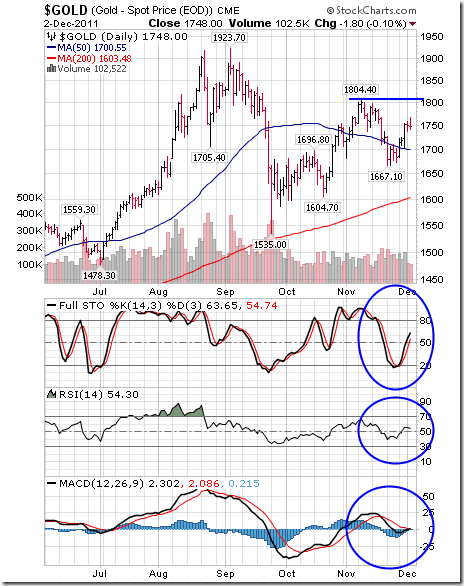
Gold added $65.10 per ounce (3.87%) last week in response to weakness in the U.S. Dollar. It moved above its 50 day moving average. Resistance is at 1,804.40. Short term momentum indicators are recovering from oversold levels.
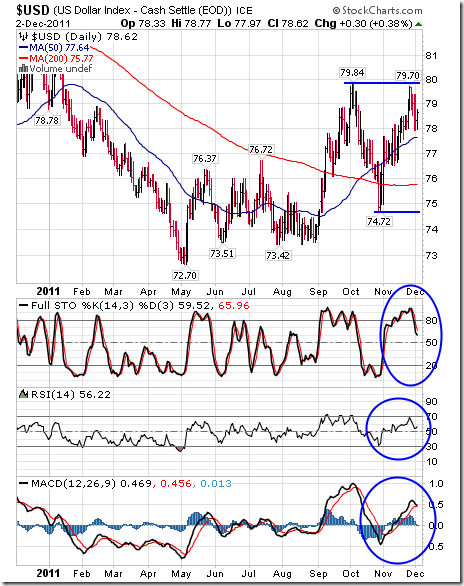
The U.S. Dollar slipped 1.07 last week. Intermediate trend is up. Resistance is at 79.84. The Dollar remains above its 50 and 200 day moving averages. Short term momentum indicators are overbought and have started to roll over.
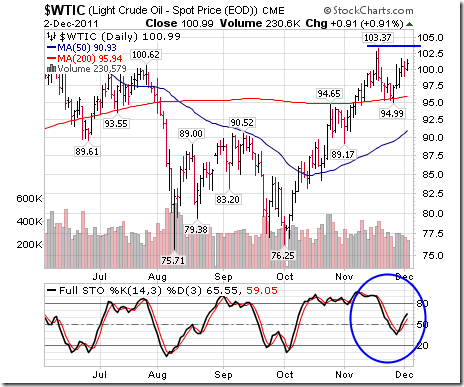
Crude oil added $3.69 (3.79%) last week. Intermediate trend is up. Nice bounce from near its 200 day moving average at $95.94. Resistance is at $103. 37. Momentum indicators are neutral.
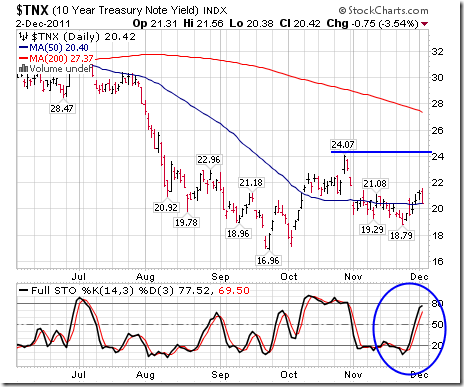
The yield on 10 year Treasuries increased 7.5 basis points last week. The “flight to quality” trade is reversing. In addition, a switch from fixed income securities into equities has become evident. Yield moved above its 50 day moving average. Short term momentum indicators are recovering
…read much more and view more charts HERE

How safe is the Dollar
- The love affair with the safe haven status of the dollar continues, and in the short term that benefits the dollar. In the longer term, this “safe haven” theory will fail. The dollar should be a short term trading tool for investors, but avoided as a store of wealth
- The dollar proxy chart I’m using this week is UUP-NYSE, an ETF that gives insight to the volume trading patterns on the dollar. Technical indicator divergences are apparent, and volume is weak. In the short term, anything can happen. In the longer term, these divergences are trend changers.
- One key piece of data I use to illustrate the major trend of a market is the 29O day moving average (290dma). I like to use this longer term average rather than the popular 200dma. What my current analysis tells me is that the dollar is up, but the 290dma trend is decidedly to the downside.
- I do see the possibility of the double top I’ve referenced over the past few months, or even a slight new high coming in the dollar. Focus your market purchases not towards the dollar going up, but towards buying hard assets that could still be negatively affected by a stronger dollar, in the short term.
Bank Of America Blood Bank Chart

- My longer term technical work continues to point to lower prices for bank stocks and the dollar. The MACD indicator is hinting at a rally for now. From my warning on Aug 29, this stock has lost nearly one third of its value. That occurred while the S&P rose more than 5%! More losses look to be coming to the bank stocks in the next several months. It’s very difficult for the dollar to mount a sustained trend to the upside, while the banks are in great trouble.
- I do see a decent stock market rally continuing into 2012, so the bank stocks decline might pause for a few weeks. Bank of America’s price is far stretched from the 290MA and due for a bounce. My suggestion is to use any bank stocks bounce to exit from the dollar, and enter into more ownership of gold and gold stocks.

Analysis
- The best investments in the future are not likely to be government paper. Around the world, government debt is out of control, and that means stocks and commodities are the better long term play. Gold should be at the top of your list of investments to own.
- Various indicators I track point towards significant pessimism on gold, although the action by central bankers on Wednesday has provided some relief. The fear for the majority of investors is based in the growing volatility in most markets. I see tremendous risk in government investment products into the future. Personally, I am moving some assets out of government retirement funds, eating the tax, and increasing my physical bullion positions.
- Note the clear movement of the gold price into my super highway channel now. The demand and supply trend lines are becoming better defined.

- My sentiment indicators haven’t been this favourable for gold since it was trading at $1000 per ounce. As gold is off less than 10% from its all-time highs, this is extremely bullish. Cynicism reins in the gold market, and that is good news, because sentiment analysis works best when market participants are disillusioned. This is the situation now for gold.

- The above chart shows the superior long term performance of the precious metals sector compared to the dollar. Note the bottom window that shows the terrible performance of the US dollar over a 3 year period of time, versus the solid performance of the metals market assets over the same timeframe.

- My analysis continues to conclude that the “fear factor” is enormous in gold stocks. I use a number of tools to determine bull/bear sentiment. These readings indicate there is currently a lot of money on the sidelines, waiting to enter the market.
- One thing that I see helping gold stocks make a strong rally from now into late January is general stock market strength.
- I have been forecasting Gold $2000 by year end/early January, 2012. The exact time is less important than understanding that a huge rally in gold bullion seems at hand now. Couple that probability with a rally in the S&P500 over the next 45-60 days, and you get the possibility of what is best termed a gold stocks rock and roll concert.
- The target of the head and shoulders pattern is close to $100 for GDX.

- In the shorter term, I see $63.50 retaken. That move should be followed by a move up to the $65.50 area. Gold seniors offered a nice volume move on Wednesday, as price exploded to the upside. I took some trading profits off the table yesterday, which is my strategy for capital preservation. Selling a bit doesn’t mean I think gold stocks are headed lower. Some profits just have to be booked as the price goes higher. My volume analysis on the above chart is predictinghigher prices.

- My trading targets from last week on the above GDXJ SF60 trading charts are close to acquired. From here I look for a pause, followed by a run to the important $33.50 price target.

- Silver looks very close to resuming its outperformance of all precious metals sectors. Note the bullish flag pattern that is now taking place on the chart. Silver, like stocks, commodities, and gold equities, is very close to having a very large MACD buy signal flash on the weekly chart. Note the rising histograms. Bullish!
| Dec 2, 2011 Super Force Signals special offer for 321Gold Readers: Send an email to trading@superforcesignals.com“>trading@superforcesignals.com and I’ll send you 3 of my next Super Force Surge Signals, as I send them to paid subscribers, to you for free. Thank-you! |
The SuperForce Proprietary SURGE index SIGNALS:
25 Surge Index Buy or 25 Surge Index Sell: Solid Power.
50 Surge Index Buy or 50 Surge Index Sell: Stronger Power.
75 Surge Index Buy or 75 Surge Index Sell: Maximum Power.
100 Surge Index Buy or 100 Surge Index Sell: “Over The Top” Power.
Stay alert for our surge signals, sent by email to subscribers, for both the daily charts on Super Force Signals at www.superforcesignals.com and for the 60 minute charts at www.superforce60.com
About Super Force Signals:
Our Surge Index Signals are created thru our proprietary blend of the highest quality technical analysis and many years of successful business building. We are two business owners with excellent synergy. We understand risk and reward. Our subscribers are generally successfully business owners, people like yourself with speculative funds, looking for serious management of your risk and reward in the market.
Frank Johnson: Executive Editor, Macro Risk Manager.
Morris Hubbartt: Chief Market Analyst, Trading Risk Specialist.
website: www.superforcesignals.com
email: trading@superforcesignals.com“>trading@superforcesignals.com
email: trading@superforce60.com“>trading@superforce60.com
Super Force Signals
422 Richards Street, Suite #300
Vancouver, BC V6B 2Z4
Canada
Stocks, Euro Stumble As Conservatives Push To End IMF Bailout. As rumors and chatter circulate across trading desks, European equity and credit markets are starting to lose their giddiness. European sovereigns are leaking back wider and financials starting to underperform and it is being noted that, as reported by The Hill, that conservatives say they will try to block the IMF from bailing out Italy and Spain. Pointing to the huge bill this could leave at US taxpayer’s feet.
With every IMF bailout rumor, there always is just one snag. A rather substantial one at that: US congressional approval for expanded IMF bailout capabilities.
Whoa! The Dow rose almost 500 points yesterday. Whoopee! Hallelujah!
It was like the Second Coming on Wall Street. As if He walked across the East River…and announced it Himself:
“The fix is in.”
But it was not the sacred that spoke yesterday. It was the profane. The world’s central banks, to be precise. They got together. More like a meeting of mobsters than a gathering of the gods. They made it clear.
You want money? You want cash? You want something you can take to the bank? Well, you’ve got it!
“A move by the world’s central banks to lower the cost of borrowing exhilarated investors Wednesday,” the Associated Press reports, “sending the Dow Jones industrial average soaring 490 points and easing fears of a global credit crisis similar to the one that followed the 2008 collapse of Lehman Brothers.”
It was the Dow’s biggest gain since March 2009.
Large US banks were among the top performers, jumping as much as 7 percent. Markets in Europe surged, too, with Germany’s DAX index climbing 5 percent.
Wednesday’s action by the banks of Europe, the US, Britain, Canada, Japan and Switzerland represented an extraordinary coordinated effort.
But amid the market’s excitement, many doubts loomed. Some analysts cautioned that the banks’ move did nothing to provide a permanent fix to the problems facing heavily indebted European nations such as Italy and Greece. It only buys time for political leaders.
“It is a short-term solution,” said Jack Ablin, chief investment officer at Harris Private Bank. “The bottom line on any central bank action is that it papers over the problems, buys time and in some respects takes pressure from politicians… If nothing’s done in a week, this market gain will disappear.”
Banks stocks soared as fears about an imminent disaster in the European financial system ebbed.
But wait.
What has really happened? The central bankers have given out the word that they’ll print up as much money as necessary. So what’s new? Haven’t they been doing that all along? What is lending at zero interest rate? What is buying the government’s debt? What is taking the toxic bonds off the banks and brokerage houses?
What is really new? Not much.
You remember our advice, dear reader? Sell stocks on rallies. Well…what are you waiting for?
And if we were speculators we’d be selling stocks…even stocks we didn’t own. Because we have here an opportunity. The market is rising on hope, not on reality. And today, it might rise a bit more…
…until it finally realizes that there is no really good reason to be so bullish.
Stocks are bits of businesses. And businesses do not make more money just because the central banks print money. If this were not so, a few years ago, Zimbabwe’s companies would have been the most profitable on earth. Under the leadership of Gideon Gono, the central bank of Zimbabwe was printing up trillion-dollar notes and handing them out all over town. Trouble was, you couldn’t even buy a cup of coffee with them. In fact, you couldn’t buy a cup of coffee anyway…the whole economy was in such disarray nobody could get any coffee. Or anything else.
That was at the end. At the beginning money-printing works miracles.
But businesses do not operate in the realm of the mysterious or the sacred. They are remarkably down-to-earth undertakings. They’re real enterprises with real revenues and real expenses. They make money by selling goods and services. And, taken all together, they only make as much money as the economy itself allows. In other words, it’s not possible for all the businesses to do better than the economy that supports them.
So, now we can ask you a question: will the economies of the world’s countries do better, now that the central banks have announced they will print more money?
Or will they do worse?
It’s hard to say. But by our reckoning, the world is in the grip of a major correction. Among the things the correction is likely to correct is the money system…in which central banks have the power to create “money” out of thin air.
Would the correction correct something that didn’t need correction? If central bankers refused to print money there would be no need to correct them, would there? So this latest announcement just confirms what we thought all along.
Printing money is easier than raising taxes. It is also easier than borrowing…especially when lenders get wary. All that stands in the way is the integrity of the central bankers themselves.
Looks like that just gave way…
Bill Bonner
for The Daily Reckoning
Bill Bonner
Since founding Agora Inc. in 1979, Bill Bonner has found success and garnered camaraderie in numerous communities and industries. A man of many talents, his entrepreneurial savvy, unique writings, philanthropic undertakings, and preservationist activities have all been recognized and awarded by some of America’s most respected authorities. Along with Addison Wiggin, his friend and colleague, Bill has written two New York Times best-selling books, Financial Reckoning Day and Empire of Debt. Both works have been critically acclaimed internationally. With political journalist Lila Rajiva, he wrote his third New York Times best-selling book, Mobs, Messiahs and Markets, which offers concrete advice on how to avoid the public spectacle of modern finance. Since 1999, Bill has been a daily contributor and the driving force behind The Daily Reckoning. Dice Have No Memory: Big Bets & Bad Economics from Paris to the Pampas, the newest book from Bill Bonner, is the definitive compendium of Bill’s daily reckonings from more than a decade: 1999-2010.
Read more: Bill Bonner | Daily Reckoning http://dailyreckoning.com/author/bbonner/#ixzz1fOGMfTyj
-
I know Mike is a very solid investor and respect his opinions very much. So if he says pay attention to this or that - I will.
~ Dale G.
-
I've started managing my own investments so view Michael's site as a one-stop shop from which to get information and perspectives.
~ Dave E.
-
Michael offers easy reading, honest, common sense information that anyone can use in a practical manner.
~ der_al.
-
A sane voice in a scrambled investment world.
~ Ed R.
Inside Edge Pro Contributors

Greg Weldon

Josef Schachter

Tyler Bollhorn

Ryan Irvine

Paul Beattie

Martin Straith

Patrick Ceresna

Mark Leibovit

James Thorne

Victor Adair