
Daily Updates
FIVE powerful new forces about to converge on the financial markets at virtually the same time.
You’re keenly aware of Force #1 — the far-reaching consequences of the mid-term elections, now only eight days away.
And you probably also know about Force #2 — a new round of mass money printing by the Fed likely to be announced just nine days from today.
This morning, we want to bring you up to date with three MORE forces, ALL of which could add great power and momentum to the market trends we’ve been forecasting here.
Force #3
G-20 Nations Have Just
FAILED to End Currency Wars!
It just happened this weekend. So we won’t know for sure how U.S. markets will react until they open a couple of hours from now. But for anyone expecting a major accord, it’s bound to be very disappointing.
We warned about the currency wars many months ago. We told you that governments would battle each other to see who could devalue their currencies the most. Plus, we said that, until the entire system could be thoroughly revamped, every effort to end the currency wars was doomed to fail.
That’s precisely what’s happened this weekend at the G-20 meeting in South Korea: Despite a massive effort by the U.S. and some of its allies, the only thing the ministers could agree to was a vague, toothless promise to TRY to avoid currency wars.
Meanwhile …
• Emerging market countries, which see themselves as the primary victims of the currency wars, pushed for — and have just gotten — more voting power in the International Monetary Fund at the very same G-20 meeting where the U.S. failed to get its way.
• Not ONE single nation at the G-20 conference agreed to give up its right to devalue or hold down its currency as much as it wants, using any means at its disposal.
• Even as the “currency peace talks” were still ongoing at the G-20 meetings, major countries such as Japan, Brazil, and South Korea continued to take steps to devalue their currencies — or at least hold them down.
• Most revealing of all, two of the most powerful countries — China and Germany — attacked the U.S. as the number one culprit in the currency devaluations. By running its money printing presses, they argued, the U.S. Federal Reserve is doing precisely what the Americans are telling everyone else NOT to do — wantonly devaluing its own currency!
This is definitely NOT the “currency stabilization pact” that markets were hoping for last week. Quite the contrary, it opens the gauntlet to a whole new round of currency battles in the weeks ahead.
The last time we saw currency turmoil of this magnitude was before the Plaza Accord of 1985. In the months that followed …
Gold exploded higher, soaring more than 75% from $284.25 in February 1985 to $499.75 in 1987.
U.S. Treasury bond prices plummeted, sending long-term interest rates from 7.12% in July 1986 to 10.25% in 1987.
The double whammy of a plunging U.S. dollar and soaring long-term interest rates precipitated the stock market crash of 1987.
Today, China has the largest trade surplus in the world … as well as the largest stash of dollar reserves.
And today, the U.S. is in a recession that makes the early 1980s look like a Sunday walk in the park.
So despite sharp intermediate rallies, the pressures for a dollar decline — whether driven by the markets or by some kind of global agreement — are even more powerful today. Specifically …
If the currency wars continue, the U.S. will CONTINUE to devalue its dollar even more. And …
If some kind of an agreement is reached in the days and weeks ahead, it will be because the U.S. has succeeded in getting China to push its currency higher.
That could have an impact on markets similar to what we saw after the 1985 Plaza Accord, also sending the dollar lower.
Result: Gold will soar; bond markets will plunge; and the U.S. stock market could also get hit hard.
Force #4
World’s Largest Bond Fund Is
Not Waiting Around. It’s Already
Dumping U.S. Treasury Bonds!
According to a recent Bloomberg news release, Pacific Investment Management Co.’s (PIMCO) $252 billion Total Return Fund, the world’s biggest bond fund, is slashing its exposure to U.S. Treasury bonds.
It has cut its investments in U.S. government debt to 33% of assets, from 63% of assets in June.
In other words, one of the largest players in the bond market has now dumped almost HALF of its U.S. government debt holdings.
But PIMCO is not alone!
Instead, PIMCO’s a trendsetter among bond funds all over the world — not only for mutual funds and hedge funds, but also for sovereign governments.
Among them, China and Germany clearly see the handwriting on. That’s why they berated the U.S. at this weekend’s G-20 meetings. And that’s also why they are likely to dump U.S. bonds in increasing quantities.
Force #5
Corporate Insiders Selling SIX TIMES
As Many Shares As They’re Buying
In the 30 days ended October 18, corporate insiders dumped more than 205 million shares of their stock, compared to purchases totaling a mere 32.4 million — a ratio of more than six to one.
Moreover, in terms of market value, their sales add up to almost $3.5 BILLION, versus only $236 million in buys — $14.83 in stock sold for every dollar bought.
Does this necessarily mean the stock market will plunge tomorrow? No. But there’s no question that U.S. stocks are overpriced given the wobbly American economy.
And there’s no question that the U.S. stock market indices are vulnerable to fears of austerity in the wake of the upcoming elections … any disappointment in the Fed’s November 3rd announcements … any further failures by the G-20 … any plunge in the bond market … or any sustained large selling by insiders.
What You Should Be Doing NOW …
First, if you own long-term bonds of any kind, sell them. Don’t wait. That includes municipal bonds and corporate bonds. A plunge in U.S. Treasury bonds would be felt throughout virtually all bond markets.
Second, greatly reduce your exposure to U.S. stocks — especially those that do not benefit from a falling dollar.
Third, build a solid, diversified portfolio of investments that have consistently gone up when the dollar has fallen — not only obvious dollar hedges like precious metals, but also select natural resources, foreign currencies, and emerging markets. Among our favorites: gold, agricultural commodities, the Australian dollar, Brazil ETFs and others.
Fourth, the five powerful forces we’ve covered here this morning create amazing opportunities. But they’re also volatile and sometimes difficult to predict. So you can’t simply buy, hold, and forget about it.
But remember: Tomorrow is your last day to see Weiss Research’s newest presentation before it goes offline and before Monty makes his big moves this week. You don’t have to register. If you turn up your computer speakers and click here, it will come up on your screen without further ado.
Best wishes,
Larry
The never ending parade of stock scandals seems to continue unabated, the stock lending scam being only the most recent. As history has shown us — from Mexico to Orange County to analyst banking crisis to Derivatives to etc., when the Street comes aknockin, best for you to hide your wallets.
For reasons we are all too familiar with, many of you rubes have no choice but to deal with the sharpies from the finance division of America. Whether its floating a bond issue to build a new bridge or hospital, managing a pension fund, or simply handling cash flow, for county, city and state execs, non-profit organizations, and private companies, you will eventually “get serviced” by Wall Street.
Those of you who have to interact with the sharks should learn the following rules HERE
A 5 chart sampling and the Bottom Line taken from the comment plus 45 Charts Don Vialoux analyses in this great Monday comment HERE
The Bottom Line
Use weakness into October and November as an opportunity to acquire attractive equities and ETFs. Please be patient and wait until technical indicators are showing signs of bottoming following a short term correction. Preferred selections are economically sensitive sectors such as China, technology, consumer discretionary, materials, Canadian financial services, lumber and industrials. More information on the Industrial sector is offered below.
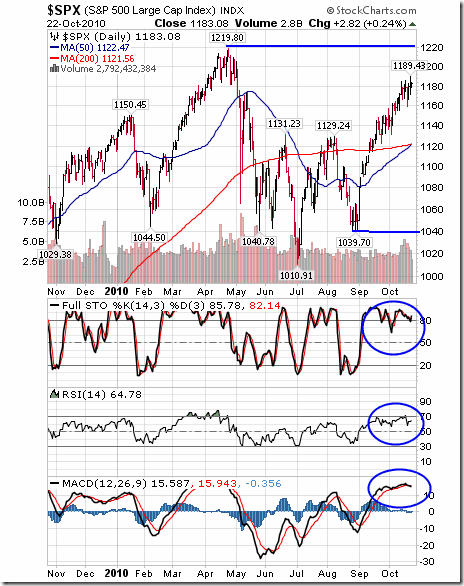
The S&P 500 Index added 6.89 points (0.59%) last week. Intermediate trend remains up. Support is at 1,039.70. Resistance is at 1,219.80. The Index remains above its 50 and 200 day moving averages. Short term momentum indicators are overbought, have peaked and are rolling over. Intermediate downside risk is to its 50 and 200 day moving averages currently at 1,122.
The TSX Composite Index slipped 7.89 points (0.06%) last week. Intermediate trend remains up. Support is at 11,065.53. Resistance may be forming at 12,710.19 set on Wednesday October 13th. Short term momentum indicators are overbought, have peaked and are starting to roll over. Strength relative to the S&P 500 Index is mixed, but is showing early signs of turning negative. Intermediate downside risk during a correction is to its 50 day moving average currently at 12,149.74.

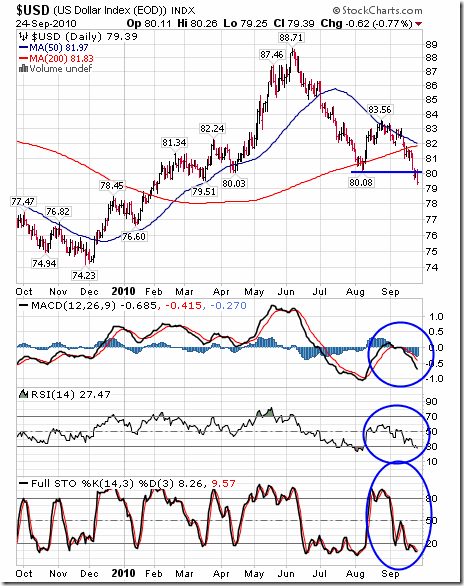
The U.S. Dollar Index advanced 0.47 last week. The outside reversal pattern completed on October 15th remains intact and implies continuation of a short term recovery. Short term momentum indicators are trending higher and confirmed significance of the pattern. A recovery to its breakdown level at 80.08 is a reasonable upside move within an intermediate downtrend.
Gold dropped $40.50 U.S. per ounce last week. Resistance may be forming at $1,387.10. Short term momentum indicators are overbought and are trending lower. Short term downside risk is to its 50 day moving average currently at $1,285.69.

Crude oil was virtually unchanged last week. It has declined 3.5% since its high on October 7th. Short term momentum indicators are overbought and are trending lower. ‘Tis the season for crude oil to move lower until January!

The 5 chart sampling and the Bottom Line taken from the comment plus 45 Charts Don Vialoux analyses in this great Monday comment HERE
Dare to be Different
Stockscores.com Perspectives for the week ending October 24, 2010
In this week’s issue:
Weekly Commentary
Strategy of the Week
Stocks That Meet The Featured Strategy

You cannot expect to do well in the market if you look at investing in a normal way. By definition, being average is doing what most other people do and since investing is largely a psychological game, doing what other people do is only natural. Average results come from normal people acting in normal ways.
To beat the market, you have to be different.
Not necessarily in a straight jacket bouncing off padded walls different, just a little off. Here are 10 things that may help you be a better investor, some ways to think differently from the crowd in that pursuit to achieve market dominance.
1. Do not think about making money, think about losing money – the first step toward success is accepting that losing is part of trading. You will not be right all of the time, you cannot always trade your way out of a bad situation. There will be times when you simply have to walk away with a loss. The key is to keeping the losses small and manageable. When the market proves you wrong, take the loss.
2. Do not think you can average down to win – it is a logical idea, add more to a losing position with the expectation that the market must eventually go your way. Many times this strategy will work but, when it does not work, the loss may be insurmountable. The market does not eventually have to go your way.
3. Do not think that your success is entitled – you may make a great trade, pick a really great stock and have a feeling like you really have the market figured out. Forget your gloating, no one ever has the market figured out. We must always remember that we have to work as smart for the next trade as we did for the last.
(continued below)
- Get the StockSchool Pro Free


Open and Fund a brokerage account with DisnatDirect and receive the StockSchool Pro home study course free, including special Pro level access through the DisnatDirect client website. Offer only available to Canadian residents. For information, click HERE
4. Do not think that talent is required – making money in any trading endeavor is a small part technical skill and a big part emotional management. Learn to limit losses, let winners run and be selective with what you trade. Emotional mastery is more important than stock picking skill.
5. Do not think that you can tell the market what to do – the market does not care about you, it does not know that you want to make a profit. You are the slave, the market is your master. Be obedient and do what the market tells you to.
6. Do not think you are competing against other traders – trading success comes to those who overcome themselves, it is you and your persistent desire to break trading rules that is the ultimate adversary. What others are doing is of little consequence, only you can react to the market and achieve your success.
7. Do not think that Fear and Greed can ever be positive – in life, fear can keep us from harm, greed can give us the motivation to work hard. In the market, these two emotional forces will lead to losses. If your decisions are governed by either or both you will most certainly find that your money escapes you.
8. Do not think you will remember everything you learn – every trade provides a lesson, some valuable education on what to do and what not to do. However, it is likely that your lessons will contradict one another and lead you to forget many of them. Write down the knowledge that you accumulate, return to this trading journal so that you can retain some value from the lessons taught by the market. Remember, the market is cruel, it gives the test first and the lesson after.
9. Do not think that being right will lead to profits – you may be exactly right about what the fundamentals are and what they are worth. However, timing is everything, if your expectations for the future are ill timed, you may find yourself losing more than you can tolerate. Remember, the market can be wrong longer than you can be liquid.
10. Do not think you can overcome the laws of probability – traders tend to be gamblers when they face a loss and risk averse when the have a potential for gain. They would rather lock in a sure profit and gamble against a probable loss even if the expected value of doing so is irrational. Trading is a probability game, each decision should be made on the basis of the best expected value and not what feels best.

Once again, I ran my favorite position trading market scan this week, the Stockscores Simple strategy. It produced quite a few candidates this week since the stock market continues to move higher in an upward trend. I inspected the charts of the stocks that were filtered and found a couple that are worth considering:

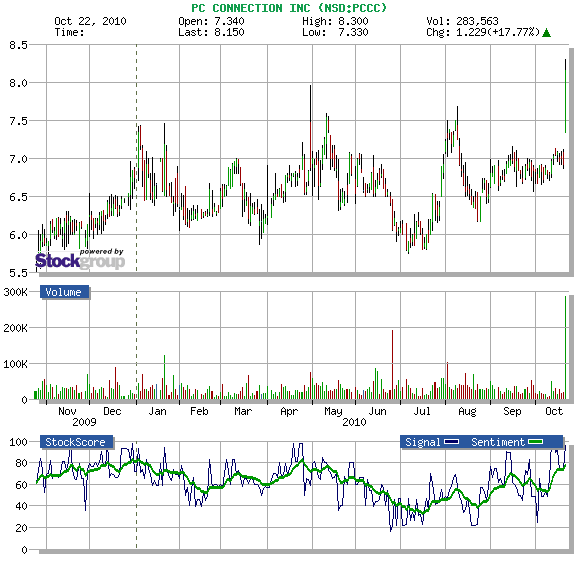
1. PCCC
PCCC is breaking out from a lengthy period of sideways trading and it did so with abnormal trading volume. The break was pretty substantial so it could pull back before it tries to go higher. Support at $6.85.
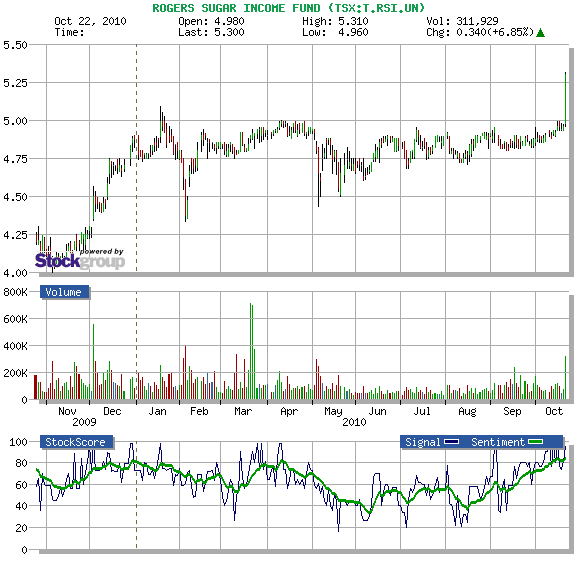
2. T.RSI.UN
I featured T.RSI.UN to the readers of my daily newsletter on Friday at $5.10. It closed at $5.30 and looks like it could continue higher in the weeks to come. It also pays a yield of about 9%. Support at $4.89.
References
Get the Stockscore on any of over 20,000 North American stocks.
Background on the theories used by Stockscores.
Strategies that can help you find new opportunities.
Scan the market using extensive filter criteria.
Build a portfolio of stocks and view a slide show of their charts.
See which sectors are leading the market, and their components.
We invite you to try our new website, Tradescores.com. Make simulated trades to improve your skills and gauge your talent. Tradescores.com is the place where traders meet and compete. Go to Tradescores and compete for these prizes:
1st – $5000 in gold coins courtesy of Border Gold
2nd – $2500 rough cut diamond courtesy of Indicator Minerals
3rd – $750 earring and cufflink set courtesy of Teck Corp
4th – $500 in silver coins courtesy of Endeavour Silver
Random draw Grand Prize – $10,000 West Coast Fishing trip courtesy of WestCoast Fishing Club
Random draw Weekly – 2 silver coins
Random draw Bi-weekly from profitable trades – 1- 10oz silver coin courtesy of Silver Wheaton

Tyler Bollhorn started trading the stock market with $3,000 in capital, some borrowed from his credit card, when he was just 19 years old. As he worked through the Business program at the University of Calgary, he constantly followed the market and traded stocks. Upon graduation, he could not shake his addiction to the market, and so he continued to trade and study the market by day, while working as a DJ at night. From his 600 square foot basement suite that he shared with his brother, Mr. Bollhorn pursued his dream of making his living buying and selling stocks.
Slowly, he began to learn how the market works, and more importantly, how to consistently make money from it. He realized that the stock market is not fair, and that a small group of people make most of the money while the general public suffers. Eventually, he found some of the key ingredients to success, and turned $30,000 in to half a million dollars in only 3 months. His career as a stock trader had finally flourished.
Much of Mr Bollhorn’s work was pioneering, so he had to create his own tools to identify opportunities. With a vision of making the research process simpler and more effective, he created the Stockscores Approach to trading, and partnered with Stockgroup in the creation of the Stockscores.com web site. He found that he enjoyed teaching others how the market works almost as much as trading it, and he has since taught hundreds of traders how to apply the Stockscores Approach to the market.
Disclaimer
This is not an investment advisory, and should not be used to make investment decisions. Information in Stockscores Perspectives is often opinionated and should be considered for information purposes only. No stock exchange anywhere has approved or disapproved of the information contained herein. There is no express or implied solicitation to buy or sell securities. The writers and editors of Perspectives may have positions in the stocks discussed above and may trade in the stocks mentioned. Don’t consider buying or selling any stock without conducting your own due diligence.
10/20/10 [Ed. Note: The following is an extract from the October edition of Dr. Faber’s indispensable monthly newsletter, The Gloom, Boom and Doom Report.]
No matter what central bankers and the cheerleading, mostly useless academics who surround them pronounce in their self-created aura of infinite academic “delicacy and refinement”, under the auspices of the Fed they will do precisely one thing: print, print, and print. Sadly, as Mignon McLaughlin observed, “The know-nothings are, unfortunately, seldom the do-nothings.”
I should like to emphasize once again that the US Fed will continue to monetize massively on any sign of either further economic weakness or a more meaningful (10% or so) financial and property market decline.
In the world I described above, the increased supply of dollars will flow somewhere.
Recently, CNBC interviewed 81-year-old Bernie Marcus, one of the founding partners of Home Depot. (He was CEO between 1979 and 1997.) Marcus, who is a self-made man and completely level-headed and without arrogance of any sort, described how he and Arthur Blank (the other co- founder) struggled when they opened their first store in 1979, in Atlanta.
For example, at 10 pm on his 50th birthday, he said, he was still in the store, moving boxes around without air-conditioning, because they needed to save money. He then said that he doesn’t mix with “important people”, such as Jeff Immelt of GE, and smooth-talking bankers and academics; instead, he talks daily with small businessmen, which is what he was when he started his business. He then cited several examples of people who run small businesses and who had told him how difficult business conditions were. He suggested that, like the king in a fairytale, Mr. Obama should dress up at night like a pauper and go out and talk to business people. According to Marcus, King Obama would then realize how unpopular he is and how destructive his economic policies have been for small businesses. He also suggested that the academics at the Fed and in the administration should, for once in their lives, go out and work, instead of sitting in big glass office towers and having no clue about what is ailing the economy.
Marcus then emphasized that none of the small businessmen he talked to had any plans to hire staff, because they felt there was far too much uncertainty about what kinds of regulations and laws Congress and the administration would come up with next. All his business friends and customers had told him that Obamacare would be a complete disaster for them. (It imposes on small businesses enormous non-medical tax compliance. It will require them to mail IRS 1099 tax forms to every vendor from whom they make purchases of more than US$600 in a year, with duplicate forms going to the IRS. Obamacare will also fund 16,000 new IRS agents…) Asked what he would suggest as a solution, Marcus, who looks much younger than his age and is still very alert, responded that the US would be greatly helped if Congress went on a holiday for two years, as this would prevent the government from doing even more economic damage.
I have mentioned on previous occasions the critical views of other businessmen, such as Lee Iacocca (formerly of Chrysler) and Paul Otellini (CEO of Intel). Like Marcus, their view is that regulation is stifling capital spending and any employment gains in the US. But, whereas the “Otellinis” of this world are more in touch with large corporations, Marcus – whose philosophy is: “Whatever it takes” – is cultivating relationships with a vast number of ordinary people who run their privately owned businesses and have sales of from half a million to 100 million dollars.
Marcus was also very critical of the various financial bailouts (unlike the self-serving and hypocritical Charles Munger). But one point he made was particularly interesting. He said that the business people he talked to had access to credit; that banks were willing to lend them money! But they had no interest in borrowing funds given the current regulatory uncertainties. I should mention that Marcus is the antithesis of economic policy decision makers and academics who imagine themselves to be of infinite delicacy and refinement and suffer from “a narrowing of the mind” – not because they travel, but because they have never in their lives worked in a real business. But, obviously, he knows what he is talking about. (Home Depot now employs over 300,000 people.)
Now, does anyone really think that, under the conditions Marcus has described, the Fed’s increase in the quantity of money will flow into US employment and real wage gains? As Marcus likes to say, “You must be kidding!”
The money flows will continue to boost employment in emerging economies, along with their wages and asset prices.
The best way to visualize this process is to think of a huge money-printing machine in the US that produces an unlimited quantity of dollars. Most of these dollars flow to the corporate sector, financial institutions, and wealthy individuals. A large proportion of these dollars is then transferred to emerging economies through the US trade deficit and investment flows, and boosts economic activity and increases wealth in emerging economies relative to the US.
Some of these dollars then find their way back to the US and support Treasury bond prices. But since fewer dollars find their way back to the US than exit the country, the dollar has a weakening tendency against emerging market currencies and, especially, against hard assets whose supply is extremely limited compared to the money that the money machine keeps spitting out.
Regards,
Dr. Marc Faber
for The Daily Reckoning
Dr. Marc Faber, an Asian-equities sleuth and the orginal bear on Japan, is the editor of The Gloom, Boom and Doom Report. Dr. Faber has been headquartered in Hong Kong for nearly 20 years, during which time he has specialized in Asian markets and advised major clients seeking down-and-out bargains with deep hidden value -unknown to the average investing public – and immense upside potential. Dr. Faber is the author of the bestseller Tomorrow’s Gold .
-
I know Mike is a very solid investor and respect his opinions very much. So if he says pay attention to this or that - I will.
~ Dale G.
-
I've started managing my own investments so view Michael's site as a one-stop shop from which to get information and perspectives.
~ Dave E.
-
Michael offers easy reading, honest, common sense information that anyone can use in a practical manner.
~ der_al.
-
A sane voice in a scrambled investment world.
~ Ed R.
Inside Edge Pro Contributors

Greg Weldon

Josef Schachter

Tyler Bollhorn

Ryan Irvine

Paul Beattie

Martin Straith

Patrick Ceresna

Mark Leibovit

James Thorne

Victor Adair