
Daily Updates
…
U.S. Stock Market – I feel most comfortable with my bear suit on. I never liked being in the same ballpark with the “Don’t Worry, Be Happy” crowd. Switzerland is a nice place to visit but being neutral is like kissing your sister. It’s too early to say yes with any certainty but I feel really good about my belief a top in the market ended up coinciding with Election Day and the “official” beginning of QE2.
Open Letter to Ben Bernanke
The following is the text of an open letter to Federal Reserve Chairman Ben Bernanke signed by several economists, along with investors and political strategists, most of them close to Republicans:
We believe the Federal Reserve’s large-scale asset purchase plan (so-called “quantitative easing”) should be reconsidered and discontinued. We do not believe such a plan is necessary or advisable under current circumstances. The planned asset purchases risk currency debasement and inflation, and we do not think they will achieve the Fed’s objective of promoting employment.
We subscribe to your statement in the Washington Post on November 4 that “the Federal Reserve cannot solve all the economy’s problems on its own.” In this case, we think improvements in tax, spending and regulatory policies must take precedence in a national growth program, not further monetary stimulus.
We disagree with the view that inflation needs to be pushed higher, and worry that another round of asset purchases, with interest rates still near zero over a year into the recovery, will distort financial markets and greatly complicate future Fed efforts to normalize monetary policy.
The Fed’s purchase program has also met broad opposition from other central banks and we share their concerns that quantitative easing by the Fed is neither warranted nor helpful in addressing either U.S. or global economic problems.
….go HERE to see signee’s
“Let’s take a look at gold (I’m using GLD as a proxy for gold). We see the big break in gold that occurred on Friday, but so far GLD has respected that long rising trendline. The trendline will hold as long as GLD remains above 132.
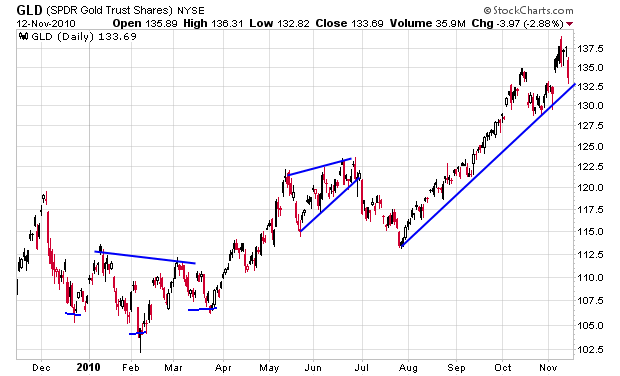
” Richard Russell has made his subscribers fortunes. One of the best values anywhere in the financial world at only a $300 subscription to get his DAILY report for a year. HERE to subscribe.
Why gold is a bad investment
by Market Watch
Precious metal lures susceptible buyers into a Midas crush. Gold does not always glitter, but you wouldn’t know that from surging worldwide interest that has turned the yellow metal red-hot.
Gold has become highly prized bling, as anxious and astute buyers alike, from hedge-fund players to central bankers, flock to the “currency of fear.” Gold at around $1,400 an ounce is almost double what it commanded two years ago, and gold’s price is up almost 25% so far this year alone.
It’s been a great ride. Except gold is a bad investment.
Gold’s feverish run has made a lot of people a lot of money, and though the rally has taken a breather in the last few days, there’s no shortage of flag-waving supporters who claim gold is on a march to $1,600, $1,800, $2,000 and beyond. After all, gold is still well below its 1980 peak, when it was worth around $2,300 an ounce in today’s dollars.
Certainly there are reasons to own gold in a diversified portfolio. Yet gold isn’t like a stock or a bond. It offers no income, no dividend, no earnings. It is considered a store of value, an alternative currency that’s safe beyond reproach, but it is not cash in the bank, or even the mattress. Gold has no untapped intrinsic value; it is worth only what people are willing to pay for it. And lately, many people have been only too willing.
“Gold is going up because people are buying it, and people are buying it because it’s going up,” said Leonard Kaplan, president of Prospector Asset Management in Evanston, Ill., and a longtime gold trader.
Golden fleece
….continue reading “Why gold is a bad investment”and view charts HERE
….great analysis of the “Why gold is a bad investment” article HERE
As you remember, dear reader, we decided to hoist our old, tattered “Crash Alert” flag up last week. About mid-week, as we recall.
Not that we had any inside information. Mr. Market doesn’t talk to us directly. We just read the papers – just like everyone else.
But what we noticed last week was that the Fed had given stocks, bonds commodities, and gold the biggest push in recorded history…$600 billion was coming into the market. It was long. It was going to stay long. And if it didn’t do the job…there was plenty more where that came from.
Plenty more. Because this money came from nowhere. And if you can get money out of nowhere…you can get a lot of it.
In effect, Ben Bernanke gave the market the Mother of All Puts. Stocks go down? Put them to the Fed. They’ll buy anything.
Yes, Mr. Bernanke is trying to give “risk on” investors a put – protecting them from the downside by adding more and more money. No, investors are not sure this plan is really going to do them any good. The stock market went up only very briefly on the day following Mr. Bernanke’s announcement. Then, there was no follow-through.
All very well to get hot and bothered speculating on the fall of the dollar (and the rise of everything else). But there is something so desperate and foolhardy in Mr. Bernanke’s money-printing, it just doesn’t feel right. It feels more like something a banana republic would do.
A New York Times article last week compared the US to a Banana Republic. It pointed out that the rich have gotten a lot richer than the poor. A pity. The author – Nicholas Kristof – missed the point completely. He thinks he knows how much people should earn and believes the difference in income – in itself – is the problem.
The richest 1 percent of Americans now take home almost 24 percent of income, up from almost 9 percent in 1976. As Timothy Noah of Slate noted in an excellent series on inequality, the United States now arguably has a more unequal distribution of wealth than traditional banana republics like Nicaragua, Venezuela and Guyana.
C.E.O.’s of the largest American companies earned an average of 42 times as much as the average worker in 1980, but 531 times as much in 2001. Perhaps the most astounding statistic is this: From 1980 to 2005, more than four-fifths of the total increase in American incomes went to the richest 1 percent.
At a time of 9.6 percent unemployment, wouldn’t it make more sense to finance a jobs program? For example, the money could be used to avoid laying off teachers and undermining American schools.
Likewise, an obvious priority in the worst economic downturn in 70 years should be to extend unemployment insurance benefits, some of which will be curtailed soon unless Congress renews them. Or there’s the Trade Adjustment Assistance program, which helps train and support workers who have lost their jobs because of foreign trade. It will no longer apply to service workers after Jan. 1, unless Congress intervenes.
So we face a choice. Is our economic priority the jobless, or is it zillionaires?
To me, we’ve reached a banana republic point where our inequality has become both economically unhealthy and morally repugnant.
This is typical. The guy doesn’t bother even to wonder why the rich are so rich. He just knows he doesn’t like it. So he’s calling on the politicians to DO SOMETHING about it! Tax the rich bastards. Give more money to the poor. Redistribute income.
He gives some lame reasons why income redistribution would be a good idea for the economy…
How does he know how much people should earn? Of course, he doesn’t. It’s just a matter of taste. Where you sit determines where you stand. If you’re rich, you probably like the fact that the rich have so much money. If you’re not rich, you probably don’t.
But let’s stick to our point. The US is doing something that usually only banana republics do. The central bank is encouraging speculation. Oh, by the way… Who speculates? Is it the poor? The middle classes? The working stiffs?
No? It’s the speculators, right? The rich, in other words, are the guys who can get money at ultra-low interest rates from the Fed (directly or indirectly) and use it to speculate on say, cotton (up almost 100% this year) or Chinese stocks.
Let’s see, how does that work again? Oh yes… The Fed gives out money to the financial elite…the rich… And then the know-nothing journalists at The New York Times want the feds to redistribute the wealth. Why not just turn off the Fed? No, that would be too simple and too honest.
But back to the Fed. It’s just given the elite a huge wad of cash…and a promise that it will put up more cash, if necessary…
…and yet, stocks did NOT go up much. Something is wrong. That’s why we raised the “Crash Alert” flag. It is as if this market wanted to go down – no matter what the Fed was doing. Or maybe it didn’t trust the Fed. Or maybe investors figured that acting like a banana republic was not really good for stock prices.
Friday, we got a big sell-off…with the Dow down 90 points and gold off $35.
We don’t like the looks of it. So, turn your head upwards a bit. See our “Crash Alert” flag a-fluttering. And get out of all risky investments…
Bill Bonner
for The Daily Reckoning
Since founding Agora Inc. in 1979, Bill Bonner has found success and garnered camaraderie in numerous communities and industries. A man of many talents, his entrepreneurial savvy, unique writings, philanthropic undertakings, and preservationist activities have all been recognized and awarded by some of America’s most respected authorities. Along with Addison Wiggin, his friend and colleague, Bill has written two New York Times best-selling books, Financial Reckoning Day and Empire of Debt. Both works have been critically acclaimed internationally. With political journalist Lila Rajiva, he wrote his third New York Times best-selling book, Mobs, Messiahs and Markets, which offers concrete advice on how to avoid the public spectacle of modern finance. Since 1999, Bill has been a daily contributor and the driving force behind The Daily Reckoning.
-
I know Mike is a very solid investor and respect his opinions very much. So if he says pay attention to this or that - I will.
~ Dale G.
-
I've started managing my own investments so view Michael's site as a one-stop shop from which to get information and perspectives.
~ Dave E.
-
Michael offers easy reading, honest, common sense information that anyone can use in a practical manner.
~ der_al.
-
A sane voice in a scrambled investment world.
~ Ed R.
Inside Edge Pro Contributors

Greg Weldon

Josef Schachter

Tyler Bollhorn

Ryan Irvine

Paul Beattie

Martin Straith

Patrick Ceresna

Mark Leibovit

James Thorne

Victor Adair