
Daily Updates
** Interview took place November 27th/2010**
Michael Levy: I’m taking a look at what you’re saying about commodities. Are we looking for a turn in the commodity markets Bob?
Bob Hoye of Institutional Advisors: I think so Mike because these markets are interesting where you can have a nice up trend, methodical, everything going well and then all of a sudden in a big rush everybody gets on board, various authorities start making positive statements and this one in commodities it had the back up of looking for a positive result on the US election. You had Bernanke at the Federal Reserve renew his vow to depreciate the Dollar. And then you had a G20 meeting they were all exited about. Of course you know this was then in the market and then on the other side of it, you had the price action and some commodites like sugar and cotton which became absolutely outstanding and got steeper and steeper. So then the best way to look at it is the with the CRB index which is a widely followed commodity index. It’s a little more weighted in agricultures than some of the others but it tells you what’s going on. On our technical the CRB index went up a few weeks ago and registered what we called an upside exhaustion. You get that on different price series but it does mean that you’re getting very close to the end of the move.
ML: Is there nobody left to buy?
Bob Hoye: Yes, we had the upside exhaustion. When we registered this for a few days. The last time it registered was in 2008 within a week of the high for the CRB. So that high a few weeks ago we read as a cyclical peak for commodities and that the decline would have a lot to do with the adversity that was coming into the credit markets with the yield curve reversing to steepening and credit spreads widening. That plus we are looking for a stronger dollar that would really do it to the commodities.
ML: A stronger US Dollar?
Bob Hoye: Yes, stronger US Dollar. That happened and here we are now. You’ve got the same technical measure in the market, upside exhaustion, and you have the yield curve has turned from being flat to a steepening mode and that’s a warning. There has been only recently minor change in credit spreads to adversity. So we are looking at similar situation as in 2008.
ML: You mentioned Bernanke’s quote: ‘renewed vow to depreciate the dollar’ yet officials are continually talking about believing in a strong US Dollar. Which is it?
Bob Hoye: They talk about it from both sides now. They started to depreciate the dollar the moment they opened the doors of the Fed in January 1914 and they’ve never quit. What happens is the ability to depreciate the dollar gets priced into wherever the hot action is, the trend gets exhausted and then the hot item goes down. What one wants to look for now is the widening of credit spreads at the longer end like corporate bonds relative to US treasuries. Now we also have the action in the junk bond market which has been absolutely outstanding since the bottom of the market in March of 2009 after the crash. That crash wasn’t just in commodities and stocks that was also in corporate bonds as well and now we’ve got that same reading, an upside exhaustion in junk bond prices.
ML: To clarify does that upside exhaustion in jumk bonds mean a default or just the rising yields?
Bob Hoye: No, upside exhaustion in price just the price of the bonds are going down which means rising yields. The last time we had one of these upside exhaustions it was in 2008 when junk bonds went all down.
ML: Is this upside exhaustion and probable move down going to be as bad or worse than the 2008 move down?
Bob Hoye: It’s going to be bad. When you have a vote of confidence like we’ve had in the prices for commodities and the prices for junk bonds and then you are set up for disappointment. The other thing is that over decades and decades if you take the plot of the CRB commodity index up and down and you plot it against S&P earnings, they go up and down with the commodities. The way that works is that when you’ve got a rise in commodity prices a lot of industry and business has better pricing abilities. When you’ve got falling commodity prices it reflects poor pricing abilities and their loss of pricing power really kills your bottom line. So when you link from commodities to the corporate bond market you see is that if the companies are not making any money they then they are also having problems servicing their debt. Credit rating agencies are watching that and then if they see a company that’s unable to service its debt, then they do a downgrade.
ML: Are you saying that if you are going to be in the corporate bond market that you want to make sure that you’re buying bonds of companies with good strong cash reserves rather than ones who might have huge problems during another crunch?
Bob Hoye: Yes. For example, our idea is that those who have been playing junk bonds have made a huge amount of money. Even some deeply discounted Nortel Bonds in March 2009 were down to $0.15 on the dollar and they have soared up to $0.80 on the dollar recently. which is highly improbable. So our idea now would be to shorten term in corporate bonds, and get out of junk. Go down to some four or five year high grade bonds, AAA stuff.
ML: On the steepening yield curve. Do think the longer term bond interest rates are go ing up?
Bob Hoye: Longer rates are going up. We made the call on the first decline in the treasury prices and now the call is on a decline in prices for corporate bonds. You’ve already got a staggering mess in sovereign debt so I think we’re heading off to perhaps a great bond revulsion where people at trading desks and investors say: “no, I can get burned out there in the longer term.”
ML: The Canadian Dollar traded over $0.99 on yesterday. I heard two different bank analysts forecasst on the same day, one forecast $0.93 during the first part of next year, and the other forecast just over $1.00 in the first part of next year. What do you think a Commodity Currency like the Canadian Dollar will do in the new year?
Bob Hoye: I think the Canadian Dollar will drift down with commodity prices and I think the $0.93 is the natural target.
ML: Would you be a buyer of US Dollars?.
Bob Hoye: Yes.
ML: What about the European debt crisis Bob, and particularly Ireland right now. Do you see any end to the crisisor do you see more down the road?
Bob Hoye: It’s going to be more. Ambrose Evans-Pritchard pictured it in the Telegraph on Friday in a piece saying that Germany is at risk now because if it bails too many people out where are its resources? Tthen also let’s look at the thrifty German tax payer who is now forced into subsidizing the holidays of unthrifty government workers in Spain or Greece. It’s totally insane and I think what happens in a post-bubble contraction is that individuals have to tighten their belts because of less income. Then they take a look at their city or their municipality and say you guys are going to tighten to. Finally they have to look at the state or province, then they have to look at the federal government and this is what will happen. The credit of the land and the world was blown on speculative furies in the peak of 2007 as well as since the recovery since 2009 with all of the so-called stimulus money that goes into banks then into Wall Street.. So somewhere the policy makers have to learn that their remedies don’t work and that if we do more stimulus ti just makes more of a party in Wall Street
ML: Ross Clarke’s Chart Works is part of your Institutional Advisors. I have a piece from your colleague Ross this morning. It’s an update on gold where Ross says:” Even though the US Dollar index has rallied well since November 4th, it is only during the strongest of days that it has put a damper on the gold price”. Ross is talking about the $1,300 to $1,325 range for support in Gold. With the US Dollar now up to its 50 week moving averageswhat are you seeing for gold and the US Dollar in the weeks to come?
Bob Hoye: In a post-bubble contraction the pattern has been that the senior currency becomes chronically strong relative to most commodities most of the time and relative to other currencies most of the time. Why do we remain bullish on gold? Because there are times that the Dollar can be rising slowly relative to other currencies, but the investment demand for gold, and we’ve seen this a few times over the last year, where the investment demand for gold overlooks what currency its in. So there have been times when the price of gold in US Dollars went up even as the US Dollar was firming. When you get a week like we’ve had where you have a rapid move up in the US Dollar then gold is going to get hit. That’s the way it works. We keep track of the real price of gold relative to commodities and it’s a measure of profitability for the gold business. For example if you’ve Gold going up on an inflationary story and you got crude oil going up on an inflationary story the likelihood is crude will be going up faster. Rising energy costs cut into profit margins for miners. So in every post-bubble contraction the real price of gold has to go up, which makes the industry more profitable, production goes up which enhances liquidity because eventually gold gets into the monetary system and starts to re-liquefy the global economy as the normal instruments of credit continue to contract. So we like the gold business in a post-bubble deflation.
ML: In terms of looking for the US Dollar to go higher and gold to go even higher in terms of US Dollars, will buyers of gold in Canadian Dollars, Euro etc. going to see gold go up more in their currencies because their currency is coming down?
Bob Hoye: Yes, but mainly it’s the investment demand for gold because when various commodity gains get burned out, or stocks, or corporate bonds, the safe money will go to the most liquid items. That happens to be the US Treasury Bill, and the other most liquid item is gold. It’s the liquidity that counts. People are buying gold for investment reasonsrather than just buying it as a hedge against the silly US Dollar. We’re in a new world and in a post bubble contraction the price of gold does very well. Look at some of the senior gold share indexes, they’re higher than they were in 2007-2008 and yet if you take a look at the S&P at its recent high, it’s way off of the high of 2007. So this confirms that we’re in a post-bubble contraction because in such conditions you have net declines in the stock market and you have the senior gold stocks going up and down within. After a few years it nets out with gains and so far that’s what’s happening. So that’s another confirmation that we are in a post-bubble contraction rather than in some extended move up for commodities for commodities indexes which as we’ve pointed out momentum wise we’ve seen an upside exhaustion.
ML: So what we can look for is gold going up, gold shares going up, and the stock market taking a hit?
Bob Hoye: Yes.
ML: Always great to talk to Bob Hoye of Institutional Advisors.
FREE Trial HERE…for portfolio managers, CIOs, high net worth individuals and investors who want the benefits of an independent model that has been forecasting the financial markets since 1980.
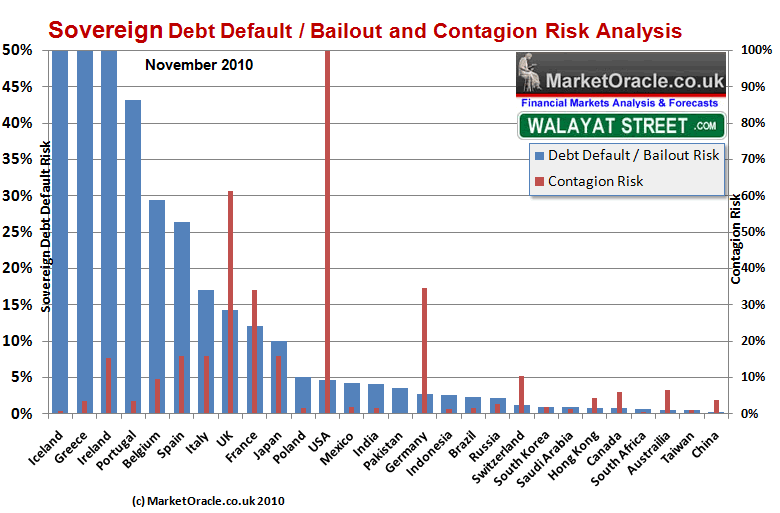
Contagion factor – The most important factor is the contagion factor, where countries approaching default, even if they are subsequently bailed out could still crash the global financial system…..
Some rules I follow to create portfolios that pay nearly double-digit yields and see strong capital appreciation.
Four Ways to Boost Yields and Returns
On average, they’re yielding 7.5%. That’s over three times the yield of the S&P 500. Try getting that amount from a money market or savings account.
But that’s not the half of it. In tandem with those high yields, the capital gains have been great too. Twenty-nine of the thirty securities are showing positive returns. The best performer has gained +104.6%, yet still yields 5.3%.
This isn’t the performance of some secret index or an exclusive hedge-fund’s holdings. It’s what is currently happening within the portfolios of my High-Yield Investing advisory.
What’s the secret to that sort of performance? How can you build a similar portfolio for yourself? Don’t get me wrong — I do an enormous amount of research and watch my holdings and the market like a hawk. But much of the good fortune comes from sticking to a few simple rules that you can use as well.
Over the years, these rules have proven their value in bull and bear markets. The techniques are not complicated. Anyone can follow them and potentially get the same results. So as a little holiday gift to my fellow income investors, I wanted to share with you the four basic rules I follow to build my winning High-Yield Investing portfolios. I’m confident these tips can work for you as well:
Rule #1: Look for High Yields Off the Beaten Path
To find exceptional returns and yields, I frequently venture off the beaten path. Some of the best yields I’ve found have come from assets classes few investors know about. A case in point is Canadian REITs. These REITs delivered exceptional yields this year (some as high as 12%), but many stateside investors have never heard of them.
Other lesser-known securities I look at are exchange-traded bonds, master limited partnerships and income deposit securities. All of these usually yield more than typical common stocks. In addition, they can also be less volatile and hold up better during market downturns.
If you’re not familiar with these securities don’t fret. I have — and will continue to — cover them within Dividend Opportunities. (To read more about Canadian REITs, see my recent article on the topic by clicking here.)
Rule #2: Consider Alternatives to Common Stocks
It is a well-known fact that the vast majority of common stocks simply don’t yield much. The S&P 500’s average yield is only 2.0%.
So when I can’t find the income I want from common stocks I like, I look elsewhere. My first stop is often preferred shares of the same company, which almost always yield more. Say you wanted to invest in General Electric (NYSE: GE). The common shares of General Electric (NYSE: GE) currently yield 3.0%, but you can find preferred shares of GE yielding upwards of 7.0%. You still benefit from the underlying company’s backing, but with a much higher yield.
Similarly, many companies offer exchange-traded bonds. While you don’t get actual ownership of the business as you would with common stock, you will earn a much higher yield and have your principal backed by the underlying company.
Rule #3: Look for Securities Trading Below Par Value
Some of my highest returns have come from buying bonds when they trade below par value. Par value is simply the face value assigned to a stock or bond on the date it was issued. Most exchange-traded bonds (which you can buy just like a share of stock) have a par value of $25 per note.
But sometimes — most recently during the recent market panic — investors indiscriminately dump these bonds, pushing their prices down. By purchasing the bonds at a discount to par, you lock in great opportunities for capital gains in addition to higher-than-normal yields.
A case in point was Delphi Financial Group 8% Senior Notes (which have since been called). I purchased the notes in July 2009 for $19.27 — a -23% discount to par value. During the 16 months I held, I collected $3.00 per note in interest payments while the shares rose to their $25 par value. In total, the notes returned over +45%.
Rule #4: Sell When It’s Time
This rule may seem the most obvious, but it is also the most difficult to follow.
Like everyone else, I hate to admit I was wrong about an investment. But I find it even harder to watch losses mount as a pick falls further. That’s why I’m not afraid to take a loss. I swallowed my pride and closed out several positions for losses during the bear market, and I’m glad I did. Continuing to hold these would have greatly reduced returns on my portfolio.
It may sound like a cliche, but knowing when to sell is just as important as knowing when to buy. A wise investor knows when to cut losses and move on to the next opportunity. If the security in question is falling with the market, I may not be worried. However, if changes in the company’s operations mean it could see rocky times ahead, I don’t want a part of it.
[Note: The rules I’ve shared above should help guide you to higher yields and better returns — they’ve certainly done well for my High-Yield Investing subscribers. I hope you can put them to good use in the coming year. And if you’d like to learn more about High-Yield Investing, including how to access my full portfolios, click here.]
Good Investing!

Carla Pasternak’s Dividend Opportunities
About Carla Pasternak’s Dividend Opportunities
Does the endless string of Wall Street investment fads ever make you feel like you’re missing something?
Well, please take a deep breath and relax. It’s time to forget about
the rocket scientists with their black boxes . . . the PhDs with their Greek formulas . . . and the high priests of Efficient Market Theory.
The most important investment decision you’ll ever make pivots on something far more basic: how you treat the overlooked stepchild of Wall Street, the lowly dividend.
Although little respected and often ignored, more than 100 years of data point to the inescapable conclusion that owning hum-drum dividend-paying stocks . . . and then reinvesting those dividends . . . beats all other investment approaches hands down.
….read more HERE
***Note: ADVANCE TO 1:26 FOR GARTMAN’S COMMENTS
In September of 2009 the home was listed for sale at $5,500,000. Now there must have been something magical about “making” a $1 million gain over two years. But the bubble had burst even in these prime areas. As you can see from the listing history, the home was listed and removed a couple of times to keep the listing “fresh” but no fish were biting. I’m sure there would have been plenty of suckers that would have paid this if we still had Alt-A and option ARMs flooding the market. But those days are over. If we look at the note details, we find a few of the toxic mortgage All-Stars showing up:
-
I know Mike is a very solid investor and respect his opinions very much. So if he says pay attention to this or that - I will.
~ Dale G.
-
I've started managing my own investments so view Michael's site as a one-stop shop from which to get information and perspectives.
~ Dave E.
-
Michael offers easy reading, honest, common sense information that anyone can use in a practical manner.
~ der_al.
-
A sane voice in a scrambled investment world.
~ Ed R.
Inside Edge Pro Contributors

Greg Weldon

Josef Schachter

Tyler Bollhorn

Ryan Irvine

Paul Beattie

Martin Straith

Patrick Ceresna

Mark Leibovit

James Thorne

Victor Adair