
Daily Updates
Joe Foster’s Gold Fund, has delivered 11+ percent compounded returns for 50 years,
While crude oil prices rallied from $50 to $108- plus per barrel- both supply and reserves of crude oil ROSE.
Dow Theory Letters’ veteran Richard Russell is alarmingly ambivalent about another Stock Market Crash. On Friday night, he reported that his favorite indicators were still holding up and that “frankly, it’s difficult to envision a bear market in the face of what my PTI [Proprietary Technical Indicator] is doing.”
But Russell concluded: “The whole current mess reminds me a lot of 1929-30. After the crash of ‘29, the stock market roared higher, even as the economy was simultaneously weakening. When the great post-crash rally died in April 1930, the market turned down with a vengeance, and the Great Depression began. …The market is probably now in the process of forming a complex top. If the market now turns down convincingly, we could see the beginning of Great Depression No. 2.
” Russell is just old enough to remember Great Depression No. 1.
In yesterday’s Dow Theory Letters Richard Russell Posted this:
I assume that most of the common stocks (if any) that my subscribers hold are now under water for the year. The watchword now is CAUTION. The KEY word for the stock market now is DETERIORATION.
In another direction, how do we know that consumers are buying? One way is to examine the charts of the outfits that MOVE the goods. For that I’ve included below the charts of the railroads, UPS and FDX. The rails have broken sharply below their 50-day moving average, and UPS and FDX has broken below both their 50-day and 200-day moving averages.
If the goods and merchandise are bought and being moved, you don’t see it on these three charts. Bennie and the Feds, it’s time to rev up the helicopters.


Source: Richard Russell, author of the world’s longest-running investment letter, Dow Theory Letters went bullish on Gold below $300 in 2002, has stayed bullish and remains L/T bullish to this day:
Richard Russell has made his subscribers fortunes. One of the best values anywhere in the financial world at only a $300 subscription to get his DAILY report for a year. Dow HERE to subscribe.
The Next Financial Crisis Will Be Hellish And It’s On Its Way!
“There is definitely going to be another financial crisis around the corner,” says hedge fund legend Mark Mobius, “because we haven’t solved any of the things that caused the previous crisis.”
We’re raising our alert status for the next financial crisis. We already raised it last week after spreads on U.S. credit default swaps started blowing out. We raised it again after seeing the remarks of Mr. Mobius, chief of the $50 billion emerging markets desk at Templeton Asset Management.
Speaking in Tokyo, he pointed to derivatives, the financial hairball of futures, options, and swaps in which nearly all the world’s major banks are tangled up.
Estimates on the amount of derivatives out there worldwide vary. An oft-heard estimate is $600 trillion. That squares with Mobius’ guess of 10 times the world’s annual GDP. “Are the derivatives regulated?” asks Mobius. “No. Are you still getting growth in derivatives? Yes.”
In other words, something along the lines of securitized mortgages is lurking out there, ready to trigger another crisis as in 2007-08.
What could it be? We’ll offer up a good guess, one the market is discounting.
Seldom does a stock index rise so much, for so little reason, as the Dow did on the open Tuesday morning: 115 Dow points on a rumor that Greece is going to get a second bailout.
Let’s step back for a moment: The Greek crisis is first and foremost about the German and French banks that were foolish enough to lend money to Greece in the first place. What sort of derivative contracts tied to Greek debt are they sitting on? What worldwide mayhem would ensue if Greece didn’t pay back 100 centimes on the euro?
That’s a rhetorical question, since the balance sheets of European banks are even more opaque than American ones. Whatever the actual answer, it’s scary enough that the European Central Bank has refused to entertain any talk about the holders of Greek sovereign debt taking a haircut, even in the form of Greece stretching out its payments.
That was the preferred solution among German leaders. But it seems the ECB is about to get its way. Greece will likely get another bailout – 30 billion euros on top of the 110 billion euro bailout it got a year ago.
It will accomplish nothing. Going deeper into hock is never a good way to get out of debt. And at some point, this exercise in kicking the can has to stop. When it does, you get your next financial crisis.
And what of the derivatives sitting on the balance sheet of the Federal Reserve? Here’s another factor behind our heightened state of alert.
“Through quantitative easing efforts alone,” says Euro Pacific Capital’s Michael Pento, “Ben Bernanke has added $1.8 trillion of longer-term GSE debt and mortgage-backed securities (MBS).”
Think about that for a moment. The Fed’s entire balance sheet totaled around $800 billion before the 2008 crash, nearly all of it Treasuries. Now the Fed holds more than double that amount in mortgage derivatives alone, junk that the banks needed to clear off their own balance sheets.
“As the size of the Fed’s balance sheet ballooned,” continues Mr. Pento, “the dollar amount of capital held at the Fed has remained fairly constant. Today, the Fed has $52.5 billion of capital backing a $2.7 trillion balance sheet.
“Prior to the bursting of the credit bubble, the public was shocked to learn that our biggest investment banks were levered 30-to-1. When asset values fell, those banks were quickly wiped out. But now the Fed is holding many of the same types of assets and is levered 51-to-1! If the value of their portfolio were to fall by just 2%, the Fed itself would be wiped out.”
If It’s the End of an Era in Mortgage Rates… What Now?
After 30 years of a declining trend in mortgage rates, many believe we are about to enter a long term trend of rising rates. We have also experienced a decade of rapidly rising housing prices and there is uncertainty about their future direction. The paradigm is about to change and the strategies that worked in a declining rate environment won’t apply anymore.
If the 30 year downward trend in mortgage rates is about to reverse and the rapid rise in home prices has reached a plateau, does our home ownership strategy have to change?
The mortgage rate paradigm of the last 30 years is about to change and the strategies that worked in a declining rate environment won’t apply anymore. To complicate the issue, new mortgage rules and new mortgage products are constantly changing the landscape. The mortgage consumer today has many choices but for most, there is not enough understanding of those choices to decide what will save them the most money, reduce their risk and give them the flexibility they need.
So, what’s the best move looking ahead? What strategy is going to save me the most money? What do the new mortgage rules mean for me? What options do I need to fit my overall financial plan?
First, the outlook for interest rates; short term and longer term.
CIBC World Markets’ Senior Economist, Benjamin Tal doesn’t see a short term rise in fixed mortgage rates. For those who expect bond yields to become inflated when the QE2 tap is turned off on June 30th, Tal says not to worry, the market is already pricing it in. Just in the last week in fact, fixed mortgage rates have been reduced slightly, following the downward trend in bond yields that have been falling off their recent peak in early April.
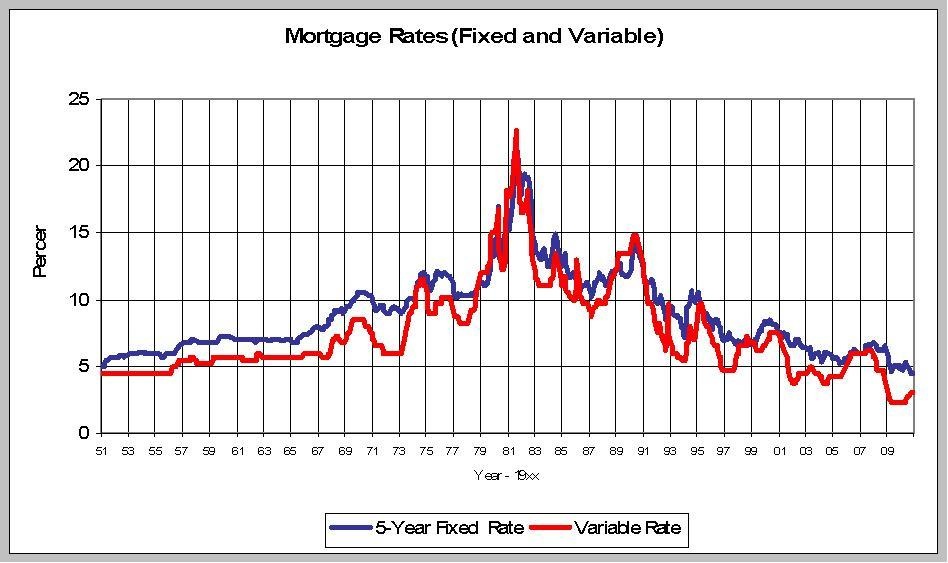
This is not to say that any calls for a rising rate environment are out the window. “Rates Have No Where To Go But Up” is a line scoffed at by anyone who wants take the opposite view. When the average historical fixed mortgage rate over the last 60 years is about 8.9% and you compare it to today’s street rates of about 4.00%, (up slightly off the recent bottom,) common sense would say the risk is to the upside. (See graph below.) When the up-trend will start remains unclear. Benjamin Tal makes the argument that rates may be on a slow road upward since there is nothing to suggest that persistent inflation is waiting in the wings.
As for the prime rate which drives variable mortgage rates, Tal says that we are in an “unusually uncertain market.” When central bankers don’t know what to do in such an uncertain market, they tend to be more conservative. Tal believes the Fed is not even dreaming of raising rates in the next 12 months.
What mortgage strategy is best for me when we have a situation where rates are low but there is risk to the upside? (Which is the reverse of the last 30 years.) We are also uncertain about when the up-trend will begin. What does that do for my mortgage strategy? It depends. I’ve summed up an argument for the short and long term rate outlook, but what do you do with that model? It depends on you. Your situation, your risk tolerance, what stage of the mortgage life-cycle you’re in, your overall financial plan, your cash flow, etc., will determine the strategy that is right for you.
In the most general terms, the biggest decision will be about length of term and the fixed rate vs. variable rate option. Statistics have been analyzed to compare two five-year fixed rate terms to a ten year fixed rate term to determine which would put you ahead financially. In the last 60 years, only 10% of the time did a 10 year fixed rate mortgage save money over the five year fixed, largely because the premium you pay on that extra five years of certainty is expensive. The 10% exception fell in a period just before rates were about to move up rapidly. In addition, my own analysis of the 60 year historic rates has shown that using a variable rate mortgage at any starting point over a 25 year amortization provided savings between 6% and 20% compared to a five year fixed term. The question then becomes, if 1981 were to repeat itself, could you handle the payments and the stress? The good news is that it’s likely to take many years to reach the peak if we were ever to see rates over 20% again. Your income would hopefully have risen considerably by then as well to cover the higher payments. You need to ask yourself what you expect your future earnings to be, how sensitive your disposable income is to a change in mortgage rate and if you expect to upgrade or downsize for your next home or stay in your current home ‘forever’.
Another important factor in choosing your mortgage strategy is the stage of the mortgage life-cycle that you are in. If we assume the uptrend in mortgage rates is about to begin, the following generalities can be made based on a theoretical model of rising, peaking and falling rates similar to what we saw over the last 60 years:
The first time home buyer is often stretching themselves to the limit of what they can afford and therefore are more sensitive to future increases in interest rates. Locking in an interest rate with a longer term is an insurance policy against rising rates but comes with a premium, (a higher rate with higher payments.) A ten year term buys assurance of payments and buys time to allow income to rise should rates at the time of renewal increase mortgage payments significantly.
Established homeowners however, would have seen their wages rise presumably with the kind of inflation we see when interest rates are higher. A future rise in mortgage payments is tempered by a rise in income. Because affordability has improved over the first term or two, the homeowner is less sensitive to changes interest rates. More mortgage options are available with respect to length of term and length of amortization.
Entering the housing market at the beginning stages of an up-trend, could mean never having the opportunity to take advantage of the downward phase of the mortgage rate cycle. By the time your 25 or 30 year amortization has run out, the down trend may not have even begun. A sustained period of falling rates may not be available again for another generation.
For the do-it-yourself types, a customized mortgage solution can be implemented. If you are a borrower who understands your situation, know where you are going, and you like to have control over your financial decisions, there are products available today that allow the borrower to partition the mortgage into multiple mortgages. This does not mean a 1st, a 2nd and a 3rd mortgage. One registered charge on title can be an umbrella over multiple mortgage products much like a self-directed RRSP. You may have heard of the 50/50 type of mortgage that is equal parts fixed and variable to diversify interest rate risk. You can take that several steps further with any mix of fixed & variable, multiple amortizations, multiple terms and (readvanceable) lines of credit all under one charge on the property’s title.
Having said all that, the type of mortgage charge that allows this option has come with some controversy and can cause problems if the pros and cons are not understood ahead of time.
The “Collateral Charge Mortgage” has been around for awhile but only in the last year have any banks changed their policy requiring all of their mortgage products to be registered on the property title as a “collateral charge.” The benefit of the collateral charge mortgage is the ability to have multiple mortgage products attached to the one charge on title instead of requiring one charge per mortgage, each requiring separate legal registration and the legal fees that go with it. The downside to the collateral charge mortgage is most apparent if the borrower wants to change lenders. Even when the term of the collateral charge mortgage expires, the charge on the property’s title needs to be removed and the borrower will be on the hook for the legal fees to do this. (Not cheap at upwards of $1,000.)
Refinance rules changed on March 18, 2011 and there has been much confusion surrounding this change initiated by the federal government through CMHC. The new rule lowers the maximum loan amount for a “refinance.” Prior to the change, borrowers were allowed to refinance their property with a mortgage loan up to 90% of the value of the home. After March 18, 2011, that maximum was lowered to 85%.
Many questions have surfaced since the change, for two reasons.
First, many home owners purchased with only a 5% down payment, i.e. a mortgage that is 95% of the home’s value. You might be asking if you need 15% equity in your home to satisfy the new refinance rule once the mortgage term expires.
The second concern is that in some cases, home values have actually fallen in the past few years and may continue, reducing the homeowner’s equity and putting many of them over the 85% mortgage “Loan-to-Value” threshold for a refinance.
Fortunately, at the end of a mortgage term, a “refinance” is not required. A simple renewal with the current lender, or a transfer or switch to a new lender does not require the borrower to meet the refinance criteria, whether the mortgage is being assigned or a new mortgage is being registered. To be deemed a “refinance” by CMHC, the risk of the loan would have to increase. This usually means an increase in the loan amount, amortization or the percentage of the “loan-to-value” (LTV). If these parameters remain the same and the mortgage remains with a CMHC approved lender, a switch or transfer to another lender can be performed. Where problems arise are in cases where the borrower wishes to break the existing mortgage in favour of a lower rate but their equity is less than 15%. The borrower cannot add the amount of the mortgage penalty to the new mortgage (increasing the loan amount) because it would be deemed a refinance since the LTV is greater than 85% and the loan risk is increasing.
Although CMHC allows borrowers to switch or transfer their insured collateral charge mortgage to another lender, (provided that the conditions mentioned earlier are met,) in many cases the original lender may not allow the borrower to switch to another lender. Lenders are obligated to abide by CMHC’s minimum criteria but they also have the right to impose more restrictive rules on their mortgages. With respect to the refinance rules and collateral charge mortgages, a lender may be leaving the borrower with less choice when they want to change lenders and be penalizing them with legal fees in the process. (Keep in mind that people do refinance every 3.5 years on average. Breaking a 5-year term is not uncommon and will come with a penalty, sometimes very hefty.)
So while a collateral charge mortgage may allow for some very impressive options for customizing your mortgage, borrowers need to be aware of the potential restrictions and expenses should they wish to change lenders. Entering into a collateral charge mortgage may have little or no impact on the end result, but borrowers need to be aware of the differences. As a do-it-yourself type myself, I like having the ability to have multiple components to my mortgage to diversify risk and manage my mortgage cash flow over the life of the mortgage. I also understand however that I may incur additional legal fees or be restricted from changing lenders in the middle of my mortgage term.
With a greater understanding of where we are in the interest rate cycle, where the risks are and what mortgage products are available to fit the external financial environment as well as our own situation, you’ll see your mortgage options and strategies with greater clarity.
About Shea Stoney and Dominion Lending Centres
Shea Stoney is an independent, licensed mortgage broker with Dominion Lending Centres, Canada’s largest network of mortgage brokers. He is committed to furthering the public’s financial literary by providing unbiased, balanced information about mortgages and the Canadian mortgage industry.
-
I know Mike is a very solid investor and respect his opinions very much. So if he says pay attention to this or that - I will.
~ Dale G.
-
I've started managing my own investments so view Michael's site as a one-stop shop from which to get information and perspectives.
~ Dave E.
-
Michael offers easy reading, honest, common sense information that anyone can use in a practical manner.
~ der_al.
-
A sane voice in a scrambled investment world.
~ Ed R.
Inside Edge Pro Contributors

Greg Weldon

Josef Schachter

Tyler Bollhorn

Ryan Irvine

Paul Beattie

Martin Straith

Patrick Ceresna

Mark Leibovit

James Thorne

Victor Adair