
Daily Updates
Are you keeping up with our theme this week, dear reader?
We’re having a hard time ourselves…
First the news, then we’ll come back to… The Lost Century.
Yesterday, the stock market retreated – 80 points on the Dow. Still no clear direction… So let’s return to our story for the week.
So far, this 21st century has been a delightful flop. A washout. At least, for Americans. At least, from an economic point of view.
Here’s the evidence in a nutshell:
There are no more full time jobs in the US today than there were when the century began.
In terms of per capita wealth, Americans are now worse off than they were when the century began.
The value of US houses, for example, is about back where it was when the century began.
And household earnings, adjusted for inflation, are lower.
And America’s industries, businesses, and enterprises too are worth not a penny more today than they were in 2000.
And now…the background.
First, we admit to a keen interest in this sort of thing. Here at The Daily Reckoning, we are connoisseurs of disaster. And no disaster is more delicious than one smothered in a sauce rich in irony.
So, you will recall that when the century began, most people thought it was the most promising period in history – especially in the history of the United States of America.
The Soviet Union had ceased to exist. China had joined the capitalists.
And George W. Bush told the graduating class of the Naval Academy in Annapolis that America was the world’s “only surviving model” for a successful system.
It was so successful, in fact, that Francis Fukuyama thought it signaled an “ end of history.” What more work had history to do? Perfection had already been attained. The US was dynamic and flexible. Its democratic political system could adapt to whatever changes and challenges it confronted. Its capitalistic economic system could push ahead on every front. And its scientists and innovators were discovering new things at a breathtaking rate. History could pack up and go home.
You remember Moore’s Law? It told us that computing power would double every 18 months. And with computers came not just a new world…but a better world. Innovators could innovate faster. They had all the world’s knowledge at our fingertips. There would be no more reason for error…darkness and sin would be banished from planet Earth. We would all be smarter, richer, healthier…for ever, and ever. Amen!
What could go wrong? Well, so far, everything.
For starters, in 2001, a tiny group of fanatics brought down two NY skyscrapers and caused the Pentagon to panic – a very self-serving panic, we should add; defense contractors have made billions in profits out of the Pentagon’s hysteria. Since then, the US has spent $1 trillion fighting ‘terrorism’ – easily the worst military investment in world history. For every single ‘terrorist’ killed, the US spent billions, to say nothing of the soldiers and civilians who died.
Then, the digital revolution was a flop too. An enormous flop. Millions of people may be using the worldwide web…looking at photos of Congressional crotches, for example. And hundreds of people may have become billionaires by selling Internet stocks to the masses. But how much has the Internet contributed to the wealth of nations? Apparently, not a damned thing.
At least, as measured by the results.
Nowhere was the Internet revolution more focused than in the USA. Nowhere did people have higher hopes for it. And nowhere were the results more disappointing. The typical teenager now spends half his life…not just half his waking hours, but more than half a day on some sort of electronic device. Does it make him smarter? Richer? More civilized? More coherent? Not so’s we’ve been able to detect!
Not every technological advance results in an increase in standards of living. Take Twitter, for example. Or nuclear weapons. Or dozens of other innovations and inventions.
The Internet, like TV before it, is a great entertainment device. It is also very useful, improving productivity in a vast number of industries. But it has not speeded up GDP growth or improved living standards.
Great boosts in living standards have been driven by big increases in energy use. The discovery of fire, for example, surely increased standards of living for ancient man…and enabled him to broaden his territory enormously. Human populations increased.
The really big boom came in the 19th century when we learned how to use the earth’s stored-up energy – in coal…and then in oil. GDP growth rates – which had been negligible for thousands of years – soared above 5%. Human population bulged too.
European countries – and their colonies – were on the case first. The use of stored energy allowed them to spurt ahead of their competitors in Asia. Over the course of the 19th and 20th centuries, Europeans came to dominate the world.
Now, the ‘emerging markets’ are catching up. They’re using oil too – lots of it. And they’re registering growth rates above 5%.
Meanwhile, growth rates in the developed world have declined… In real terms, as mentioned above, US growth in the 21st century seems to have fallen back to medieval levels. Why?
Who knows? We will guess that it is a combination of things. Most important, the US is in a period of debt consolidation. After 60 years of credit expansion, it is time to reduce debt. That alone could be responsible for the failure of growth and material progress.
But why was there so much debt? Because the economy failed to produce real growth. After 1973, wages, for example, adjusted for inflation, went nowhere. How could families continue to increase their standards of living? The Fed, the dollar-based monetary system, and the financial industry encouraged households to go into debt.
Will debt be reduced back to 1974 levels? Maybe… If so, it will take another 5 to 10 years…or maybe 20.
What then?
The Great Correction could be a bigger, grander…longer-term phenomenon. Perhaps the boom phase of the energy revolution is behind us. Trains were invented 200 years ago. Automobiles were invented 100 years ago. Aeroplanes came on the scene soon after. Electricity – fired by coal, oil…and later, atomic power – made a big change too. But all the major breakthroughs date back to a century or more. Even atomic power was pioneered a half century ago. Since then, improvements have been incremental…with diminishing rates of return from innovations.
The Internet did nothing to change that. It was not a ‘game changer.’ The game is the same as it has been since the steam engine was first developed, with the big leaps in technology and material progress already behind us.
Regards,
Bill Bonner
for The Daily Reckoning
Since founding Agora Inc. in 1979, Bill Bonner has found success and garnered camaraderie in numerous communities and industries. A man of many talents, his entrepreneurial savvy, unique writings, philanthropic undertakings, and preservationist activities have all been recognized and awarded by some of America’s most respected authorities. Along with Addison Wiggin, his friend and colleague, Bill has written two New York Times best-selling books, Financial Reckoning Day and Empire of Debt. Both works have been critically acclaimed internationally. With political journalist Lila Rajiva, he wrote his third New York Times best-selling book, Mobs, Messiahs and Markets, which offers concrete advice on how to avoid the public spectacle of modern finance. Since 1999, Bill has been a daily contributor and the driving force behind The Daily Reckoning .
Dice Have No Memory: Big Bets & Bad Economics from Paris to the Pampas, the new book from Bill Bonner, is now available for purchase. It is the definitive compendium of Bill’s daily reckonings from more than a decade: 1999-2010. Whether your new to these Daily Reckonings, or one of Bill’s “long suffering” readers, this is one you surely won’t want to miss. Click here to get your copy today.
Newton invented the Gold Standard circa 1700. The Gold Standard undoubtedly ranks as one of his greatest achievements given that it became the backbone of the British Empire.
The pound was “as good as gold”, as the saying went, and the pound banknote was accepted around the globe as a substitute for gold itself – but not always. The paper-pound was willingly accepted until there was a banking or financial crisis, which meant the quality of the currency and the reliability of banks became questioned.
At those moments – which occurred with surprising frequency – there was a rush to gold because of its safe haven attributes. Gold is a tangible asset, and with tangible assets one does not have any risk of default. The value of a tangible asset is not dependent upon a bank or government promise.
Even though paper currency was more convenient to use in commerce than heavy gold coins, during a crisis convenience did not matter. But safety did.
As people frantically converted their paper pounds into tangible gold, a panic inevitably ensued because there never was enough gold to satisfy the redemption demands. Too much paper had been issued, causing losses by those who held this paper, which in many cases became worthless.
These panics served a useful purpose. They acted as a periodic throttle on bank credit expansion and the speculation that follows from easy money policies during the boom times when credit is cheap, plentiful, and available from the banks with few questions asked. Do you recognise a pattern here?
The present financial crisis is not unlike those previous panics recurring throughout monetary history. Even though the pound, euro, dollar and other national currencies are no longer redeemable into gold, these paper currencies can be exchanged for gold 24 hours a day.
People vote with their pocketbooks. In the months since the collapse of Lehman Brothers in September 2008, people everywhere have been exchanging their paper money for physical gold.
This trend that favours physical metal in preference to paper currency is well established. It is one that is likely to continue. The clamour for physical metal will continue until debt is brought under control, and it is here where the Gold Standard is sorely missed. It no longer imposes an essential discipline on bankers who don’t know when to stop lending and politicians who don’t know when to stop spending.
We can learn from the numerous episodes of monetary history in which banks and currencies fail. We can put into practice today the simple strategy that enabled people to successfully weather the financial storm. They did it by owning physical gold and silver. This same time-proven strategy is helping people today.
James Turk is founder and chairman of GoldMoney, which provides a convenient and economical way to buy and sell gold, silver and platinum online using digital gold currency for which he has four US patents.
A headline caught my eye last week, beyond all the ink spent on European debt woes. It read, “Hungry China Shops in Argentina.” China already buys most of Argentina’s soybean exports. And now China’s largest farming company is trying to lock down acreage for more soybeans. It also unveiled a plan to grow wheat, corn, vegetables, fruit and even wine – all for export to China.
The moves in Argentina mirror China’s efforts in other parts of the world to secure food supplies. The simple reason is that China is having more and more problems producing the foodstuffs it needs at home.
The biggest challenge may be finding sources of water.
For months, south and central China have been suffering from drought. In the spring, Beijing sent deep well-drilling teams from all over the country to these parched provinces. The aquifers these regions relied on were dry. They needed to drill deeper. This required more specialized equipment. Hence, Beijing’s order.
Unfortunately, drilling deeper wells is only a short-term fix. Deep-underground aquifers can take hundreds of years to replenish. Tapping these wells is merely a kind of advance on the future. You have to pay it back later when you can’t tap the water anymore.
This is the idea, too, behind “water-based food bubbles.” You tap a nonrenewable water supply that gives you the boost you need to grow food, but as with a financial bubble, it is bound to pop. Then, food production collapses.
Droughts come and go, but they have been more severe in China in recent years. The drought in Shandong was the worst in 200 years. Drought lingered in Sichuan province a few years ago, and it was the worst in a century. And last year, a drought in northern China hurt the corn harvest (and made China a net buyer of corn abroad for the first time).
Drought has also hit areas not normally associated with drought. The Asia News Network reported that through May, rainfall in Taiwan was down 35% compared with the average in the past 30 years. In the western part of the island, rainfall was down 90% in April and May. Taiwan is normally a relatively wet island and good for growing things. Before it became a mini-Japan, Taiwan was a large exporter of oranges, bananas, asparagus and mushrooms. The foundation of its economy was agriculture.
China’s southern and central provinces are normally wetter. Hubei, in the central part of the country, is known as the “land of a thousand lakes” – hundreds of which are now “dead,” meaning you cannot extract water from them. In fact, drought had reduced China’s largest freshwater lake, in Jiangxi, by 80%.
The irony of all this is that earlier this month, the skies opened up over China. Now they have too much rain. As The Wall Street Journal reports:
“The flooding, triggered by heavy rains that started early this month, has caused widespread suffering in more than a dozen provinces and regions, with state media calling it the worst in decades in some areas. In addition to the 175 known deaths, 86 people are missing and some 1.6 million people have been displaced by the flooding, which has caused more than $5 billion in damage as of Monday…”
It has also caused extensive crop damage. Production of grains, fruits and vegetables has fallen by more than 20%. Food prices are soaring. Hundreds of thousands of acres of crops have been destroyed.
We may speculate why China’s weather has been more severe in recent years. But one thing is undeniable, and it takes us back to the story I led off with: China will need to buy more of its food abroad. By importing food, it essentially ups its water needs as well.
Of all the things China demands, food and water would seem to be among the most important and most resilient. I think a recession in China would hurt demand for food. People would not eat as well. They would likely eat less meat. Less meat means fewer grains for livestock. So grain prices are vulnerable to recessions too, just as are oil and copper.
But volumes are fairly steady over time. If you look at long-term grain production, you would see a steady chart moving upward over time. Recessions barely make a dent in the long-term trend. While prices may have swung wildly from time to time, production has marched steadily upwards.
More recently, you can look at production and see an inexorable increase over time. You can also see persistent shortfalls relative to consumption:
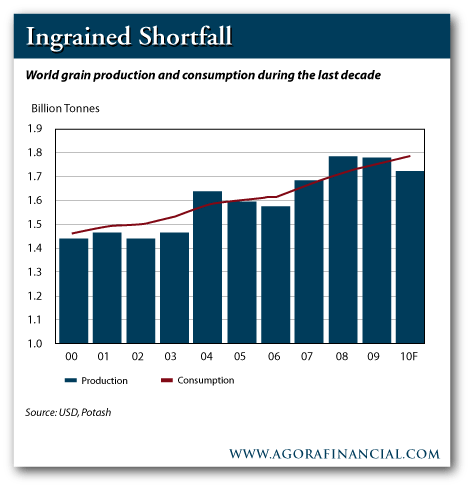
This is partly why inventory levels have been tight and prices have stayed high.
So given the long-term trends, there are some good investable themes around this. The most-volatile ones would be the fertilizer stocks. But there are less-volatile ideas that you can park in a long-term portfolio and not care so much about weather patterns and short-term crop prices.
Just think about all those grains – that chart, going up and to the right. Those grains need to get to market. They need to be cleaned, sorted, packaged, stored and shipped.
That’s one reason I like businesses such as Viterra (VT:tsx) and Alliance Grain Traders (AGT:tsx). These firms do exactly those things. And they do it on a global scale. They have dominant market positions and advanced facilities. Both should prove good long-term investments on the grain trade.
Regards,
Chris Mayer,
for The Daily Reckoning
Chris Mayer is managing editor of the Capital and Crisis and Mayer’s Special Situations newsletters. Graduating magna cum laude with a degree in finance and an MBA from the University of Maryland, he began his business career as a corporate banker. Mayer left the banking industry after ten years and signed on with Agora Financial. His book, Invest Like a Dealmaker, Secrets of a Former Banking Insider, documents his ability to analyze macro issues and micro investment opportunities to produce an exceptional long-term track record of winning ideas.
-
I know Mike is a very solid investor and respect his opinions very much. So if he says pay attention to this or that - I will.
~ Dale G.
-
I've started managing my own investments so view Michael's site as a one-stop shop from which to get information and perspectives.
~ Dave E.
-
Michael offers easy reading, honest, common sense information that anyone can use in a practical manner.
~ der_al.
-
A sane voice in a scrambled investment world.
~ Ed R.
Inside Edge Pro Contributors

Greg Weldon

Josef Schachter

Tyler Bollhorn

Ryan Irvine

Paul Beattie

Martin Straith

Patrick Ceresna

Mark Leibovit

James Thorne

Victor Adair