
Daily Updates
A Great Rant! This Small Business Man gets warmed up a minute in, commenting on the political clowns running the circus who are messing this country up…
Self-professed contrarian and 321Energy Founder Bob Moriarty expects energy and food prices to follow oil on an upward trajectory, fueling more and more turmoil, unrest and violence around the planet, including the Western world. Read on for more insights in this exclusive interview with The Energy Report.
The Energy Report: The markets don’t appear to have slowed for the typical summer doldrums this year. Instead, they seem to be returning to their pre-May highs, testing the 200-day moving averages. What do you think of this rally?
Bob Moriarty: So many factors affect it that it’s really difficult to figure out exactly what the market’s saying. I suspect that much of this rally stems from a belief in QE3 (quantitative easing), and that’s not a particularly good sign.
TER: Didn’t Fed Chair Ben Bernanke indicate in testimony to Congress that QE3 isn’t on the table at this point?
BM: Well, that was on an even day. On even days, he says, “No QE3.” On odd days he says, “Yes, QE3.” The government’s gone crazy. The market is schizoid because it has no idea what will happen. He said some things that would absolutely lead you to believe that QE3 is going to happen, and he’s said other things that indicate it is not going to occur.
It’s not only the U.S. government; it’s the Greeks, the EU (European Union), the Spanish, the Portuguese, the Japanese, the English—everybody’s painted themselves into a corner, and we no longer have good alternatives. We only have bad ones.
TER: With only bad alternatives, why wouldn’t the market reflect that negativity?
BM: That’s what I don’t understand. I think the market’s going to fall out of bed shortly because QE1 and QE2 didn’t add anything to employment. They cost an enormous amount of money and didn’t accomplish anything. So while I believe it would be pretty stupid to do QE3, the fact of the matter is that Bernanke’s totally run out of options that make any sense.
TER: Another thing that doesn’t seem to make sense is that the price of oil has generally been lower than it was six months ago. The last time we spoke about energy you indicated your belief that peak oil happened a few years back. Why then aren’t we seeing higher oil prices?
BM: As for peak oil, it’s no longer a theory; it’s an absolute. We’ve passed peak oil. When oil hit $146/barrel (bbl.) back in 2008, that was based purely on speculation. It wasn’t based on real demand; it was the flavor of the day. At $90 and $100/bbl., oil is pretty expensive. Even though the world is in a depression—and people are starting to recognize that it is a depression—we’ve got pretty expensive oil, and it’s going to continue to go up.
TER: Some argue that oil prices will be mitigated by the fact that as people have to pay more for gas at the pump, they drive less. Plus, we now see the U.S. trying to spark an international effort to release barrels of crude reserves. Would such a release have an effect or would it just be a Band-Aid?
BM: It’s strictly a short-term Band-Aid based on Obama trying to win votes for 2012.
TER: In the peak oil context, then, if oil starts going up, will we see a corresponding decrease in demand?
BM: It means that for the next 20 years the price of energy and food will go up on a continual basis. It’s very dangerous because everything that’s going on in the Middle East is a function of the price of fuel.
TER: How will the toppling of governments during the Arab Spring affect food and energy prices?
BM: In the first place, there is no quid pro quo. One is an analog for the other. The cost of corn and wheat caused the revolutions, but the revolutions aren’t going to affect the price of corn and wheat. It works one way, but not the other way.
TER: Can’t we reduce the rate of increase in food prices by increasing production?
BM: Of course. You can be much more efficient in producing food if you use fertilizer. You get more bang for the buck. But then the increases in energy and food prices will translate into a direct increase in the price of potash.
TER: Potash has been increasing over the last couple of years. Where’s the top?
BM: Well, the earth has seven billion people to feed.
TER: Are you implying that using potash will make food available in places where people are now going hungry?
BM: Here’s what people need to understand. If the price of oil doubles overnight, you can drive less. But what if the price of food doubles overnight? Eat half as much? That will be the source of much turmoil for the next 15 years. We need to match what we’re capable of producing to the number of mouths we have to feed.
TER: Over the years, you’ve always said that eventually it will be food that has people rioting in the streets. That scenario has now started to unfold.
BM: People must have wondered whether I was in touch with reality, but everything that’s happening in the Middle East, and indeed in Europe, is related. The riots in Spain, Greece, England, Italy—those riots are coming to the United States. You’re seeing flash mobs start up now and I think the government’s hiding a lot of the fighting.
TER: You’ve been investing in potash for a couple of years. What prompted you to pick potash as opposed to another form of food production innovation?
BM: There are other areas of food production to invest in and certainly water would be one of them. But I happen to know some good potash companies and I just can’t see how potash could be anything but a really good investment.
One of the best—and it’s a company I’ve been invested in for three years—is Passport Potash Inc. (TSX.V:PPI, OTCQX:PPRTF). It was at $0.10 for the longest time due to some substantial management issues. Those were corrected, and the stock shot up to $1.86. It’s dropped back down to the $0.55–$0.66 range now, which is healthy, and it’s a pretty good investment. Passport Potash has a giant basin out in Arizona, and will be producing potash for years to come.
TER: Given that the U.S. is pretty well-endowed with food, how much higher can it go?
BM: It doesn’t make any difference if the U.S. is endowed with food or not, lots of countries aren’t, and it’s easy enough to ship potash to the growing areas. But it’s interesting that you mention the U.S., because the U.S. always had a tremendous competitive advantage over the rest of the world due to its high percentage of arable land. Ironically however, the U.S. is now actually a net importer of food due to screwed-up government policies.
TER: When did we become a net importer of food?
BM: In the last two or three years.
TER: A recent feature about new immigration laws in some of the states was focusing on the fact that Georgia’s losing immigrant farm workers and can’t replace them. The commentator asked why there’s a farm-worker problem with 10% unemployment in Georgia. They said because “the U.S. people won’t take these jobs.” He summarized that food production, and the jobs that go with it, will go overseas because Americans won’t work in the fields.
BM: That’s true, and U.S. people who are unemployed need to rethink their attitudes. We have 44 million people on food stamps, and at some point, the government isn’t going to be able to feed everybody. We need to reset our goals and start understanding where we are. One of the best things we could do is eliminate the ethanol subsidy. It’s caused revolutions all over the world, and eventually it will destroy the United States. It’s totally stupid, totally insane. It takes 81,000 calories of energy to produce 75,000 calories of ethanol, yet we’re still subsidizing corn.
TER: With the U.S. now a net importer of food and the chances of more food production moving offshore, does it make sense to be looking at potash production overseas as well?
BM: You’re trying to connect things that don’t have a connection. The United States and Canada are among the main potash producers in the world, and everywhere you raise crops for food, you need to increase efficiency. The price of food being where it is now, you can afford potash. The demand will continue to go up, and whether we use it domestically or export it is relatively meaningless.
TER: But isn’t it true that Brazil is trying to produce food and potash operations located there, and thus these operations would have a distinctive advantage?
BM: Yes and no. Verde Potash (TSX.V:NPK) has high-grade deposits there as well as government support. But the big issue in Brazil is the cost of transportation. It’s very expensive, and probably cheaper to dig potash in Arizona and ship it to Brazil than to ship it within Brazil. Brazil lacks infrastructure. Therefore, even though we’ve seen amazing gains in its soybean production, trying to get potash from one place to another is very difficult.
TER: Another commodity you’ve been interested in is uranium. Since the Japanese tragedy, a number of countries have said—or at least implied—that they’re going to reduce their reliance on nuclear energy. How much of an impact would that have on the uranium price?
BM: As far as the disaster in Japan goes, it’s like an iceberg with 90% of the problem below the surface where we don’t see it. I think it’s a lot more serious than anybody wants to admit, and that we’ll end up with tens of millions of people dying of radiation-caused problems. Consequently, I think nuclear is dead for 50 years.
We do need nuclear energy, but at the same time we need safe nuclear energy. With Fukushima, every bad thing that could happen happened, and every bad decision that a country could make was made. When people in Vancouver and Seattle start dying left and right from radiation poisoning, we’ll certainly reevaluate how we feel about nuclear.
TER: So you expect more backlash?
BM: We haven’t seen anything yet. People on the West Coast of the United States inhaled 30 particles of radioactivity a day for two or three months, and one particle can cause lung cancer down the road. It may be shocking how many people ultimately die as a result of that disaster, but it’s going to be 10 or 15 years before we figure it out. I think it’s a disaster of a magnitude that’s never before occurred in history.
TER: Perhaps due in part to the renewed focus on alternative energies in the wake of that disaster, the rare earth sector has commanded quite a bit of attention this past year. Is this sector one that appeals to you?
BM: No. I think it’s a very dangerous place to invest, and a lot of people stand to lose a lot of money. Jim Dines came out two years ago with the glowing recommendation for the rare earth elements and created a monster. While I have a world of respect for Jim Dines—the guy is absolutely brilliant—he’s brought $50 billion worth of investment into a $5 billion industry. While it’s true that China has a stranglehold on rare earths, it’s also true that supply-and-demand does work, and at some point, if the price goes high enough, it will suck the metals out of the ground.
I am a contrarian, and you’re never going to find me believing what everyone else believes. Too many people believe rare earths is a slam-dunk, and every slam-dunk investment I’ve seen in 65 years has been a loser.
Bob Moriarty’s 321energy.com covers oil, natural gas, gasoline, coal, solar, wind and nuclear energy. It’s his second site on the internet; convinced that gold and silver were at their bottoms and wanting to give others a foundation for investing in resource stocks, he and his wife, Barb, launched 321gold.com almost 10 years ago. Both sites feature articles, editorial opinions, pricing figures and updates on the current events affecting both sectors. Before his Internet career, Bob was a Marine F-4B pilot O 1C/G forward air controller with more than 820 missions in Vietnam. A captain at age 22, he was the youngest naval aviator in Vietnam and one of the war’s most highly decorated. He holds 14 international aviation records, and once flew an airplane through the Eiffel Tower’s pillars “just for fun.”
Want to read more exclusive Energy Report interviews like this? Sign up for our free e-newsletter, and you’ll learn when new articles have been published. To see a list of recent interviews with industry analysts and commentators, visit our Exclusive Interviews page.
Michael Campbell: Mark, there is so many factors in play right now and so many potential surprises out there it is very difficult for the normal investor to figure out what is going on. What is it like from the traders point of view?
Mark Leibovit: Well it is exciting Mike. As a commentator said a moment ago, gold is getting expensive for the average investor, an important point and that’s why we talk about silver so much. Silver is poor mans gold, and more speculation can come into silver as gold goes higher. For me as a professional it’s easy, because this is the time of the year to be in gold from a seasonality point of view. Basically Gold is known for a low in the summer and strength through year end, and I wrote about that in my Newsletter a few weeks ago. We said the July rally is underway, thinking we would at least get a July pop that would pull back in August and then take off again. But I think professionals jumped the gun here, everybody was looking to buy the metals later this summer thinking there would be a seasonal pullback in the summer as we normally get and it just exploded here in July. I think it caught a lot by surprise, so in the sense the momentum is really with us it looks pretty good.
Michael: You look at seasonality and major cycles when you do your forecast model every year to help create a map and a blue print for yourself, and then you have to get into what’s going at the moment. So just from a seasonality point of view traditionally I take it that August would have been somewhat weak and then strength building to the end of the year, or it is not that specific and seasonality just called for a summer low and then you start rallying?
Mark: Yes, the problem with the seasonality, and I have lot of respect for it including it in my own model, is that you are using historic data for the last 10 or 20 years as we don’t have hundreds of years of data on seasonality. So we‘re averaging and the last ten years the market has been basically been in an up trend and the 20 years before that in a down trend. So it’s mixed in terms of what the seasonality really is all about. But it’s a generality, you can get contra seasonal moves just as easily as a seasonal, so I am the kind of guy that watches the tape. I look at the volume and what the buyers and sellers are doing today. I look at the sentiment out there, I look at the comment that I just made a moment ago that if everybody looking to buy in August it is probably going to turn now and it is not going to wait for the majority, one of the reasons we had this pop. It doesn’t mean we can’t get a pull back in August Michael, we could get a pull back, maybe there will be some news here some of the moves here will retrace a bit. I would not go out and sell any of your gold, because the winds is really at our back between now and early next year. If you are a trader and you see some sort of sell signal you may want to try to scalp it a little bit. So sure you could still get some type of pull back here and at that moment we will see what happens. I think Monday and Tuesday are pretty critical. I think if gold can’t break through last weeks 1611 midweek on Monday and Tuesday that might be an indication we may get a little bit of a pull back. But lets watch the action, I am long anyway and we’ll see what happens early in the week.
Michael: I just want to high-light something you said. It is certainly it is my approach here, I have talked since 2002 about a 30% core position in precious metals then outside of that you could have trading position. You do such a great job in the VR trader and you write the VR Gold Letter getting specific about whether you are talking short term or long term. You can make daily trades within your service and you state what the longer term trend is for your subscribers. I just want people who are listening to be clear what what term you are talking about, recognize whether the analyst is talking short term or long term core position advice. You just said you are very comfortable looking for strength through the end of the year but and you’ll look at Monday and Tuesday for the short term.
Mark: I have plenty of cowboys out there Michael that are traders and I actually refer to them as the cowboys in the letter who are looking for the action. If I say go buy gold and go home for five years they obviously wouldn’t very interested in my service so when we get these swings along the way we absolutely look at the short term. There are a lot of things happening out here right now fundamentally that could be positive and could impact the market. You do have the Hong Kong Mercantile Exchange that’s just started trading silver on Friday and that could be a big catalyst. You just had the US House of Representatives pass the National Strategic Critical Minerals Policy Act. So a lot of things here that could impact very positively to the upside.
Michael: That brings up the point I that Mark has offered a free complimentary copy of his VR Gold Letter for anyone who wants it. Just go to www.moneytalks.net and on the front page you will see right there and offer to get Mark’s writings about the July Metals Rally.
Mark, I want to come to silver for a second because on July 6th, using the methodology that you use you sent out a bulletin that says that silver had posted a positive volume reversal, your proprietary measure for movements in the market, and it was a positive one. You said look your are looking for rally in silver and obviously that ensued because we came from that $32, $33 mark and touched $40. Where is silver for you right now and we’ll talk short term not long term?
Mark: Well we are right on the cusp here, my personal feeling is it’s ready to break out. Particularly with this development on Friday with the Hong Kong Mercantile Exchange now trading silver. I am little bit on the conspiracy side. I am unhappy with what the COMEX has done here, we’ve heard of a lot of rumors that GATA has been talking about, gata.org for a long time has been saying there is not enough contracts to back the physical silver if you actually ask for delivery on the COMEX. Then I write al lot about the plunge protection team in the US and there was no accident. It might feel they raised margin requirements to try to cut the speculation in silver a few weeks ago and that’s the only time you get government intervening like that. It’s only going to be a temporary and unsuccessful strategy as the world demand is just too great. A classic example has just been the last few weeks where we started selling some of the crude oil strategic reserves in the US that was gobbled up immediately and crude oil ended up going higher anyway, so government intervention here is only going to have very temporary if any impact. Plus this Honk Kong Exchange that’s trading silver, I wouldn’t be surprised to see Silver break out here and move into the low 40s relatively quickly, and of course we just have to take it from there. To take out the 49.74 high that we saw a couple of months ago is very possible here between now and year end and possibly moving to the 60s. So I am in there, I am bullish and I am not worried about it suddenly collapsing into the 20s.
Michael: So again the other way to be playing this is to be buying on dips because you are comfortable longer term on this issue and now?
Mark: Putting your foot in the door, that’s part of the issue. I refer to dollar cost averaging, maybe we could get in the door, get a position in there and you actually hope that it pulls back because of the big 20 year up trend that we are in commodities and the big cycle that we talk about. But if everyday we wait for pullback sometimes there could be a one day pull back and start saying oh well maybe it’ll go another dollar or two and you end up missing the move. So yes at least I would advice listeners if they are not in, at least get in. To buy and take deliver of some physical silver, buy an ETF like Central Fund of Canada CEF which is one of my favorite stocks in which you get a participation in gold and silver. At least don’t sit there and watch it go up.
Michael: I love that you are bringing up this point because I have got a ton of people I know who ask me about silver or gold. The primary mistake they make is they think in terms of all or none. They’ll say I have $10,000 I want to invest and their thinking either I get in or I get out as opposed to the dollar cost averaging you have just described. In a bull market you might want to step in the market because otherwise you will miss the boat. At least take a core position.
Mark: Just get in the game just get in there. Don’t a fool around, the trend is obviously up. I have to tell you this, I got a call from a reporter last week asking me to give all the reasons why a bear move in Gold and Silver is about to begin and I basically responded I am not even going to cooperate with him on this article. They are long term contacts of mine and I just have the sense that the sentiment out there is still negative, that we are climbing this wall of worry. It’s really incredible and its super bullish that reporters are out there looking for a way to talk down the gold and silver markets.
Michael: I had a chance on the air to talk to Peter Grandich last week and Peter was saying one of the tough things to do is when gold hits the final top it will be the toughest time to sell. Just like when things drop it’s the toughest time to buy, just an interesting psychology. If you are in an on going bull market you want to be buying the dips.
Can you give me a quick take on oil?
Mark: I am positive. We had a nice correction from that 114 a barrel in US Western crude oil down to that 89 level, volume came off the low. The government tried to dump oil on the market it was unsuccessful. The big trend is up no question about it, and I think we’re ultimately we are going to work our way up to that 114 level and go through it. It doesn’t mean it’s going to be as dynamic as the silver and gold play but the ETF OIL which I trade is looking pretty good. So I am a bull, it’s not my number one market for trading but the charts are positive.
Michael: I want to come back to gold and silver, what kind of target numbers are you ultimately seeing in the gold and silver?
Mark: This is the shocking numbers that I have been throwing out for long time, ten years ago I wrote 3,000 for gold and that was based on my feeling we are going to see a ten time increase from the 99 low so that’s at least minimum target I see. I think once we get to 2,000 acceleration is really going to begin, the non-believers are really going to jump on board. If you adjust for inflation you can come up with numbers anywhere from 2,500 to 3,000 anyway. I am not saying you can’t go beyond that, I am sure you have read reports where people are talking about all kinds of numbers up to 10,000, it depends whether governments of the world or the US decides to do something intelligent and peg gold to currency which they are not prone to doing to often. But this ultimately what we need if we are going to stabilize the currency, if we are going to have some value. I think that’ s what China is doing by the way, I think this is their strengthen the Won, they are accumulating gold, they are going to back their currency with gold and that’s why they are probably going to ultimately be the preferred currency in the years to come. My bench mark number is a 3,000, maybe the 3,600 level and I don’t know if it ‘s going to take one year or five years to get there. With a 20 year cycle up to the year 2020, I have written about this in the news letter, we have eight or nine year for that happen. I have a funny feeling that it’s going to happen well before that. As far as the silver is concerned, this is really speculative play. I mean Silver can go nuts, I would like to see it take out that 49.75 high and the next target would 57 to 62. Our work tends to be a little incremental so we get projections as we go up. Of course in Silver I read that all kind numbers up to $200 an ounce or more, I don’t know if we could get there or not but if it goes up on increasing volume and I get higher projections A QW then I certainly would join that camp. Right now the bench mar is 3,000 for Gold and 70 – 80 for silver and we’ll take it from there.
Michael: What are you seeing in the stock market?
Mark: We are in this summer doldrums. Until the fall, until August September you could assume a some what choppy market. I don’t know whether you noticed or not the NASDAQ 100, the NDX broke out to a new all time high on Thursday or Friday, so I am waiting for the Dow Transports which is my other big confirming indicator that I write about. If that breaks out the move could be starting earlier as we saw in the metals. The markets could be jumping the gun here and taking off to the upside. Much depends on the legislation in the US Congress on the debt ceiling issues that we are all hearing about and there are all the other fundamental factors out there. Ultimately I think we are going higher but the question is whether we get a little bit of shake out first. Iif we do I think its probably a buying opportunity for the market. Why? Well basically Bernanke has been telling us he is targeting a higher market, he said this in front of congress. We know the QE3 is going to happen in one form or another as long as jobs are where they are at and even though the fundamentals are really lousy out there I think the strategy is to get the market higher in the hope that companies hire people. So I am sort of on the line thinking that a shake out, a little correction in the next month or two with the seasonality issues into September maybe, is possible but I would bet you that the S&P is going to be into new all time highs within the next six to 12 months just because of these factors and an election next year in the US.
Michael: We are so inundated with government that virtually all the analysis you read a huge percentage of analysis on issues is about the politics first and the issues seconds. There is so many example I could turn blue in the face and give them for the next 12 hours. What it does is its create a really interesting dilemma for people and I don’t think they recognize that governments are in a complete bear market right now, the early stages of a bear market. That doesn’t mean the private sector is and what is confusing for people they go look at all this bad news and then look at how the market has performed on the upside. They don’t get that t if you do get the bear market in government it doesn’t mean an uninterrupted private sector but that’s where the funds are flowing and that’s why I think it makes perfect sense to me over time that the stock market cam actually go up against the backdrop of really bad news in government.
Mark: It’s called the wall of worry … that’s what it is and again we have the plunge protection team in there and people laugh at me when I talk about it but you know we found out secretly that Bernanke was giving General Electric and Harley Davidson of all companies money until Bloomberg sued the Federal Reserve to get information. We found this our several months ago. The government is in there, it is funding the private sector as they want the stocks to go up. The last thing they need now is a stock market crash that would that would steal confidence so they are out there and they are aggressive and they will do what they need to do. So it makes no sense, but you know the game plan my not work, maybe stocks are going new highs and there is still a high unemployment. Maybe it won’t work but they’re going to try and see if it works, they are going to give it a shot.
Michael: I think there are very few arrows left in it’s quiver, I mean it’s not like they could lower interest rates by any significant portion. With them having done the sort of the QE1, QE2 programs. in other words printing money a few major times that they need that stock market up for a whole myriad of reasons we don’t have time to go into. That’s certainly the bias and I think Bernanke has also told us this. As you said earlier Mark, he has made it very clear in public statements that they are targeting a higher stock market because that’s the last bullet in the box. If something happened there they don’t really have the means in terms of policy initiatives to really rescue at that point. I think a lot of the work that you have done over the years has been validated by some of the statements, especially over the last six months.
Mark: Well thank you , we’ll keep doing it. A bit contrary opinion and looking at those volume patterns and if something changes of course we’ll report it. Anyway the bottom line is possibly a correction next month or so, but I think the trend’s up with the NASDAQ into new highs on Friday and at least one index needs to paint a real bearish scenario here.
Michael: Thanks as always. Mark Leibovit can be found at www.vrtrader.com and you can also go to www.moneytalks.net, center column. There we also have a Freee Copy of his VR Gold Letter report for anyone that wants it.
About Mark Leibovit:

This Excerpt from Mark Leibovit’s VR Silver Newsletter covering Stocks, Bonds, Gold, US Dollar, Oil CLICK HERE
Marks VRTrader Silver Newletter covers Stock, TSE Stocks, Bonds, Gold, Base Metals, Uranium, Oil and the US Dollar.
More kudos – Mark Leibovit was named the #1 Intermediate Market Timer for the 10 year period ending in 2007; the #1 Intermediate Market Timer for the 3 year period ending in 2007; the #1 Intermediate Market Timer for the 8 year period ending in 2007; and the #8 Intermediate Market Timer for the 5 year period ending in 2007. NO OTHER ANALYST SURVEYED APPEARED IN ALL FOUR CATEGORIES FOR INTERMEDIATE MARKET TIMING AS PUBLISHED IN TIMER DIGEST JANUARY 28, 2008!
For a trial Subscription of The VR Silver Newsletter covering Stocks, Bonds, Gold, US Dollar, Oil CLICK HERE The VR Gold Letter is available to Platinum subscribers for only an additional $20 per month, while for Silver subscribers the price is only an additional $70.00 per month. Prices are going up very shortl, so act now! Separately, the VR Gold Letter retails for $1500 a year! The VR Gold Letter is published WEEKLY. It is 10 to 16 pages jam-packed with commentary and charts. Please call or email us right away. Tel: 928-282-1275. Email: mark.vrtrader@gmail.com
Ed Note: David Morgan’s comments on industrial demand alone for Silver in his interview with Michael Campbell on July 9th/2011 were quite large as you can review in this article – Silver Shortage Imminent.
Here are some additional comments on Silver’s industrial, and Investment demand from Silver Trusts…. very big numbers!
“About 25% of silver demand comes from investors, but they are now driving the bus as they seek a cheaper inflation hedge than gold. The iShares Silver Trust (NYSE: SLV) now holds about 11,000 metric tons of silver in its vaults. Global silver production for 2010 reached nearly 23,000 metric tons, a record high, and about 80% of global demand. The rest comes from recycling.
Global industrial demand for gold is about 10% of total demand. Almost half of gold demand comes from jewellery compared with about 25% of silver demand. Gold demand for investment totals about 40% of the world’s total demand for gold. The SPDR Gold Trust (NYSE: GLD) holds about 1,130 metric tons. Mining contributed about 60% of the world’s gold supply in 2010, with most of the remaining supply coming from recycling.
Because so much more of the silver stock is used for industrial purposes, the price of silver is (or should be) more vulnerable to changes in the business cycle. Currently, however, even as the economy improves only slightly, the price of silver keeps surging.
….read the entire article Will the Silver Rush Kill a Faltering Economy?
The Bottom Line
Technicals, fundamentals and seasonal influences point to another volatile week in equity markets around the world. Preferred strategy is to continue to hold sectors that benefit from favourable seasonal influences (gold, gold equities, biotech, fertilizers) and to continue to hold a “healthy” position in cash equivalents.
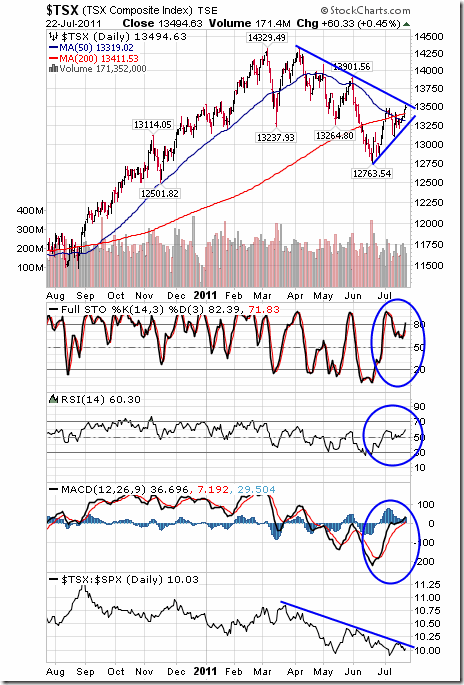
The TSX Composite Index improved 195.09 points (1.47%) last week. Intermediate trend is down. The Index moved nicely above its 50 and 200 day moving averages last week. Short term resistance at 13,474.89 was broken on Friday. Intermediate resistance exists at 13,901.56 and 14,329.49. Strength relative to the S&P 500 Index remains negative. Short term momentum indicators turned higher last week and have returned to overbought levels.
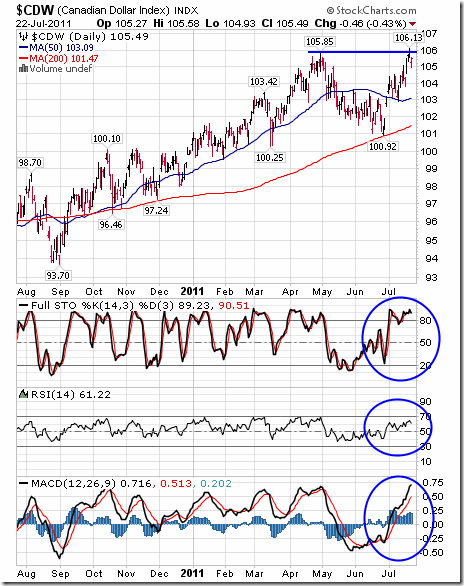
The Canadian Dollar gained 0.59 cents U.S. last week. Its intermediate uptrend was confirmed on a break above resistance at 105.49 cents U.S. Short term momentum indicators are overbought, but have yet to show signs of peaking.
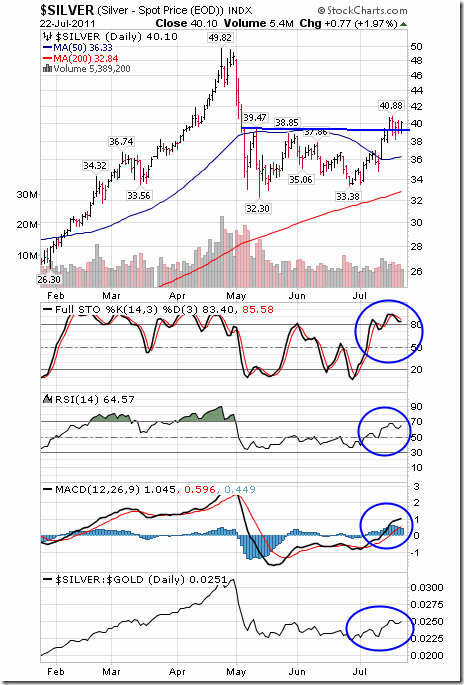
Silver gained $1.03 per ounce (2.64%) last week. It broke resistance at $39.35. Short term momentum indicators are overbought, but have yet to show signs of peaking. Strength relative to gold has turned positive, an encouraging sign for both.
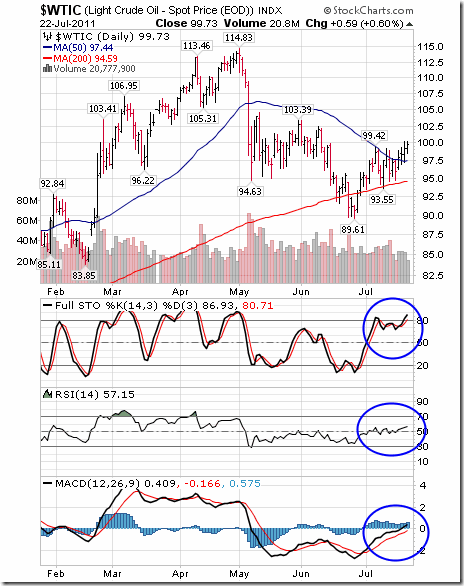
Crude Oil gained $2.49 per barrel (2.56%) last week. Short term momentum indicators are overbought, but continue to trend higher. Crude moved above its 50 day moving average last week.
….read and view more of Don’s last Report with 40+ Charts analysed and links to his EquityClock seasonal charts HERE
-
I know Mike is a very solid investor and respect his opinions very much. So if he says pay attention to this or that - I will.
~ Dale G.
-
I've started managing my own investments so view Michael's site as a one-stop shop from which to get information and perspectives.
~ Dave E.
-
Michael offers easy reading, honest, common sense information that anyone can use in a practical manner.
~ der_al.
-
A sane voice in a scrambled investment world.
~ Ed R.
Inside Edge Pro Contributors

Greg Weldon

Josef Schachter

Tyler Bollhorn

Ryan Irvine

Paul Beattie

Martin Straith

Patrick Ceresna

Mark Leibovit

James Thorne

Victor Adair