
Daily Updates
I’m thinking that gold has established a base in the 1700-1740 area, and it’s going to take some sitting and consolidating for a while before we see some more exciting gold action. There’s entirely too much talk and jabber about gold in the media at this point, and the best thing for the yellow metal would be for the magazines and newspapers to forget about gold for a while. In other words, guys, “give it a rest.” – Richard Russell – Dow Theory Letters
Silver Market Update HERE
This week’s Outside the Box is in the tradition of showing the other side of the argument. Normally, anything George Soros says or does politically has my blood pressure up about 20 points. Yet, I posted another piece of his today in Over My Shoulder and then ran across this longer piece from Der Spiegel. Note this is from a dedicated Europhile wanting to save the euro. He succintly outlines what must be done if it is to be saved, and does it as well as anyone. (I know that among my readers there are both likers and haters of Soros, but as an observer of markets he is to be respected. And this is an article in which his acumen is in evidence.
I refer you to last week’s regular letter (one of my more important ones:http://www.johnmauldin.com/frontlinethoughts/the-beginning-of-the-endgame) and also to the Outside the Box piece I passed on from Michael Lewis, in which he points out that to survive, the rest of Europe must learn to behave more like Germans. This is the great objection of the euro-skeptics, since the rest of Europe does not want to be like Germans. But Soros is right to some extent when he says, “There is simply no alternative. If the euro were to break up, it would cause a banking crisis that would be totally outside the control of the financial authorities. So it would push not only Germany, not only Europe, but also the whole world into conditions very reminiscent of the Great Depression in the 1930s, which was also caused by a banking crisis that was out of control.”
We find ourselves in a binary world. Either Europe goes to a fiscal union with the various countries losing control of their budgets, or the Eurozone breaks up. As I recently wrote, we must not underestimate the commitment of the European elites to do whatever it takes to hold their project together. Neither must we underestimate the ability of voters to change their leaders. This is a very volatile situation with far more implications than our subprime problem.
I continue to say that a euro crisis will lead to a recession (or worse) in the US. Attention must be paid. Soros lays out the Euro-elite agenda. I suggest you read.
Your euro-skeptic analyst,
John Mauldin, Editor
Outside the Box
JohnMauldin@2000wave.com
Der Spiegel Interview with George Soros
‘You Need This Dirty Word, Euro Bonds’
In a SPIEGEL interview, billionaire investor George Soros criticizes Germany’s lack of leadership in the euro zone, arguing that Berlin must dictate to Europe the solution to the currency crisis. He also argues in favor of the creation of euro bonds as a way out of the turbulence.
SPIEGEL: Mr. Soros, we currently see a global banking crisis, a currency crisis and a sovereign debt crisis. Has the financial dilemma become too big to handle? How can politicians on both sides of the Atlantic be expected to solve such a multitude of crises?
Soros: The politicians have not really tried to fix any crisis; they have so far tried only to buy time. But sometimes time actually works against you if you refuse to face the relevant issues and explain to the public what is at stake.
SPIEGEL: Are you talking about the Germans? Many experts think Chancellor Angela Merkel has been particularly hesitant to address the euro crisis.
Soros: Yes. The future of the euro depends on Germany. This is the point I really want to drive home. Germany is in the driver’s seat because it is the largest country in Europe with the best credit rating and a chronic surplus. In a crisis, the creditor always calls the shots. Sure, this is not a position Germany or Chancellor Merkel ever desired and they are understandably reluctant to embrace it. But the fact is that Germans are now in the position of dictating to Europe what the solution to the euro crisis is.
SPIEGEL: Why should Berlin embrace that idea?
Soros: There is simply no alternative. If the euro were to break up, it would cause a banking crisis that would be totally outside the control of the financial authorities. So it would push not only Germany, not only Europe, but also the whole world into conditions very reminiscent of the Great Depression in the 1930s, which was also caused by a banking crisis that was out of control.
SPIEGEL: What, then, needs to be done to fight this crisis?
Soros: I think there is only one choice. It is not a question of whether Europe needs a common currency. The euro exists, and if it were to break apart, all hell would break loose. Germany has to make it work. To make it work, you have got to allow the members of the euro zone to be able to refinance the bulk of their debt on reasonable terms. So you need this dirty word: “euro bonds”. But when you study what it involves to have euro bonds, you really have a problem because each European country remains in control of its own fiscal policy, and you have to rely on the country to meet its financial obligations.
SPIEGEL: Germans hate the euro bonds idea. They fear that under this scenario they will ultimately need to bail out everyone, even large nations like Italy.
Soros: That is why you need to establish fiscal rules that will ensure the solvency of every member. This should make the euro bond acceptable to German voters. Europe needs a fiscal authority that has not only financial but also political legitimacy. The difficulty is agreeing on the rules. Unfortunately, Germans have some funny ideas. They want the rest of Europe to follow their example. But what works for Germany can’t work for the rest of Europe: No country can run a chronic surplus without others running deficits. Germany must propose rules that other countries can also follow. These rules must allow for a gradual reduction in indebtedness. They must also allow countries with high unemployment, like Spain, to continue running cyclical budget deficits until they recover.
SPIEGEL: More and more economists, especially in Germany, would like to see Greece leave the European Union. Do you consider that to be a viable option?
Soros: I think that the Greek problem has been sufficiently mishandled by the European authorities that this may well be the best solution. Europe, the euro and the financial system could survive Greece leaving. It could survive Portugal leaving. And the remainder would be stronger and more easily managed. But the financial authorities have to arrange for an orderly exit in order for the European banking system to survive it. That will cost money because the European banking system including the European Central Bank has to be indemnified for its losses. Depositors in Greek banks also need to be protected. Otherwise, depositors in Irish or Italian banks will not feel safe.
SPIEGEL: Is the current crisis even worse than the one in 2008?
Soros: This crisis is still the continuation of the same crisis. In 2008, the financial system collapsed and it had to be put on artificial life support. The authorities managed to save the system. But the imbalances that caused the crisis have not been removed.
SPIEGEL: What do you mean?
Soros: The method the authorities rightly chose three years ago was to substitute the credit of the state for the credit in the financial system that collapsed. After the failure of Lehman Brothers, the European financial ministers issued a declaration that no other systemically important financial institutions would be allowed to fail. That was the artificial life support; it was exactly the right decision. But then Chancellor Merkel stated that such support would only be granted by each EU member state individually, and not by the European Union.
SPIEGEL: That undermined the concept of a strong European response to the crisis. Has that been the biggest mistake so far?
Soros: That Merkel statement was the origin of the euro crisis. It shattered the vision that the EU will protect the euro in a joint effort.
SPIEGEL: Where will the current crisis stop? Even France now seems to be threatened by a financial meltdown.
Soros: Of course it is spreading. Markets fear uncertainty. Germany has to realize that it has no alternative but to defend the euro. The longer it takes, the higher the price Germany will have to pay.
SPIEGEL: You have been very critical of how the crisis has been handled by governments. Many European citizens, however, blame speculators like you for their attempts to bring down the euro. Huge hedge funds like yours have waged massive bets against the European currency over the past year. And in recent days, several European countries have even imposed temporary bans on short selling, bets on falling share prices.
Soros: You are confusing markets and speculators. At the moment, the biggest speculators are the central banks because they are the most important buyers and sellers of currencies. Hedge funds have definitely been supplanted by central banks. Markets expect the authorities to produce a financial system that actually holds together. If there is any hole in that system, speculators will rush through that hole.
SPIEGEL: That sounds very noble. But in reality, speculation makes any crisis worse. Look at the credit default swaps (CDS) market where speculators can bet on a further decline of currencies and economies. How can that be helpful?
Soros: Of course, speculation will always make a crisis worse. If there is a weak point, it will expose it. And you are right, the CDS market is a very dangerous instrument and I think it should not be allowed. I am one of the very few people who argue that the CDS is a dangerous instrument because it is so lop-sided in favor of a negative outcome.
‘You Can Count on China To Back the Euro’
SPIEGEL: Do you think the European Central Bank is part of the solution or part of the problem when it comes to the dealing with the euro crisis?
Soros: It is part of the solution, but which part? Any central bank should only be in charge of liquidity. Solvency is a matter for the treasury. But because there is no European treasury, the ECB was pushed into that arena. To keep the financial system alive they overstepped their limits, as the former German Bundesbank president Axel Weber pointed out, by discounting the government bonds of a country that was clearly bankrupt.
SPIEGEL: You are referring to the purchase of Greek bonds. Now the European Central Bank even started buying Spanish and Italian bonds. It is not even clear, however, if it is legally allowed to do so.
Soros: Yes, but there is a well-established conviction that the central banks always do what is necessary to keep the system going and then afterwards you then take care of the legal aspects. In a crisis, you simply do not have time to think about such concerns for too long.
SPIEGEL: The United States is drowning in even more debt than Europeans. Its economic recovery has been painful. Are we going to see a double-dip recession in the US?
Soros: The indebtedness of the US is not all that high, but if a double-dip recession was in doubt a few weeks ago, it is less in doubt now, because financial markets have a very safe way of predicting the future. They cause it. And the markets have decided that America is going to see a recession, particularly after the recent downgrade of the US by the rating agency Standard & Poor’s.
SPIEGEL: President Barack Obama has been fiercely criticized for his handling of the economy. You were one of his biggest supporters in 2008. Are you happy with his economic policy?
Soros: No, of course not. But the reality is that we have had 25 years of excesses building up in America — a combustible mix of too much credit and too much leverage. You need a long time to reverse that.
SPIEGEL: Obama tried to stimulate growth with a gigantic stimulus program which increased the national debt further. Was that a mistake?
Soros: Obama embraced the ideas of John Maynard Keynes. Basically, the analysis of Keynes is still very relevant — with one big difference between now and the 1930s. In the 1930s, governments had practically no debt and could therefore run deficits. Nowadays, all governments are heavily indebted, and that is a big change.
SPIEGEL: If Keynes were still alive, would he adjust his theory?
Soros: Definitely. He would say governments can still benefit from running fiscal deficits, but the new debt has to be invested in a way that will pay for itself. So the money spent would have to increase productivity.
SPIEGEL: The $800 billion stimulus program launched by Obama did not live up to that?
Soros: Obama’s stimulus program was not big enough and it was not directed at improving infrastructure nor human capital. So it was not productive enough.
SPIEGEL: And any further stimulus is now basically a non-starter, because the conservative majority in Congress is hell-bent on preventing it.
Soros: That is what is pushing the world towards another recession, into a double dip.
SPIEGEL: The Republicans are doing that?
Soros: Yes, but Obama is also at fault. He yielded the agenda to the Republicans. He is talking their language. The president would have to show leadership to counter the Republican wave, and so far he has not done so.
SPIEGEL: Do you think the US deserved the recent downgrade by Standard & Poor’s?
Soros: Probably not. This decision was the attempt by the rating agencies to reinvent themselves as anticipating rather than responding to changes that have occurred. So they are really basing that downgrade on the expectation that the political process will not provide the solution. Judging such political developments is a very new role for the rating agencies, though.
SPIEGEL: As an investor, do you listen to the rating agencies?
Soros: Well, I do not, but many other investors do.
SPIEGEL: The credit rating agencies are accused of exacerbating the crisis. Do you think the role of the rating agencies in the financial system needs to be scaled back?
Soros: I do not have an answer to that.
SPIEGEL: There are no alternatives.
Soros: Frankly. It is an unsolved problem in my mind
SPIEGEL: As an investor, would you still bet on the euro?
Soros: I certainly would not short the euro because China has an interest in having an alternative to the dollar. You can count on China to back the efforts of the European authorities to maintain the euro.
SPIEGEL: Is that the reason why the euro is still so strong compared to the dollar?
Soros: Yes. There is a mysterious buyer that keeps propping up the euro.
SPIEGEL: And it is not you.
Soros: It is not me (laughs).
SPIEGEL: In the end, will China be the only winner in this crisis?
Soros: China, of course, has been the great winner of globalization, and if globalization collapses, the Chinese will also be among the losers. So they have a strong interest in preserving the current global system. However, in some ways, they have been just as reluctant to accept it as the Germans. Germans have been hesitant to accept responsibility for Europe, and the Chinese have been hesitant to accept responsibility for the world. But they are both being pushed into it.
SPIEGEL: Mr. Soros, we thank you for this interview.
Interview conducted by Gregor Peter Schmitz and Thomas Schulz
Outside the Box is a free weekly economic e-letter by best-selling author and renowned financial expert, John Mauldin. You can learn more and get your free subscription by visiting www.JohnMauldin.com.
Please write to johnmauldin@2000wave.com to inform us of any reproductions, including when and where copy will be reproduced. You must keep the letter intact, from introduction to disclaimers. If you would like to quote brief portions only, please reference www.JohnMauldin.com.
To subscribe to John Mauldin’s e-letter, please click here:
http://www.frontlinethoughts.com/subscribe
Todd Market Forecast for Monday August 13, 2011
Available Mon- Friday after 6:00 P.M. Eastern, 3:00 Pacific.
DOW + 214 on 2500 net advances
NASDAQ COMP + 47 on 1600 net advances
SHORT TERM TREND Bullish
INTERMEDIATE TERM TREND Bullish

GOLD: Gold was up nicely. The fear factor wasn’t at work, but the lower greenback did have an effect. We’re still bearish, but we’ll see how things develop.
BONDS: Bonds fell back a bit. The lessening of the fear factor diminished the rush to safety.
THE REST: The dollar was down sharply. Silver copper and crude oil were all marginally higher. The euro rose sharply, I suppose in anticipation of great things from the meeting tomorrow between Sarkozy and Merkel.
BOTTOM LINE:
Our intermediate term systems are on a buy signal.
System 2 traders are in cash. Stay there on Thursday.
NEWS AND FUNDAMENTALS:
The Empire State Manufacturing Survey came in at -7.72, less than the consensus +1.0. The Housing Market Index was 15, in line with expectations. On Tuesday we get industrial production and housing starts.
We’re on a sell for bonds as of August 11.
We’re on a buy for the dollar and a sell for the euro as of August 4.
We’re on a sell for gold as of August 11.
We’re on a sell for silver as of August 11.
We’re on a buy for crude oil as of August 11.
We’re on a buy for copper as of August 11.
We are long term bullish for all major world markets, including those of the U.S., Britain, Canada, Germany, France and Japan.
INDICATOR PARAMETERS
Monetary conditions (+2 means the Fed is actively dropping rates; +1 means a bias toward easing. 0 means neutral, -1 means a bias toward tightening, -2 means actively raising rates). RSI (30 or below is oversold, 80 or above is overbought). McClellan Oscillator ( minus 100 is oversold. Plus 100 is overbought). Composite Gauge (5 or below is negative, 13 or above is positive). Composite Gauge five day m.a. (8.0 or below is overbought. 13.0 or above is oversold). CBOE Put Call Ratio ( Below .80 is a negative. Above 1.00 is a positive). Volatility Index, VIX (low teens bearish, high twenties bullish), VIX % single day change. + 5 or greater bullish. -5 or less, bearish. Advances minus declines three day m.a.( +500 is bearish. – 500 is bullish). Supply Demand 5 day m.a. (.45 or below is a positive. .80 or above is a negative).
No guarantees are made. Traders can and do lose money. The publisher may take positions in recommended securities.
Stephen Todd – A Short Biography
Since 1984, the editor and publisher of the Todd Market Forecast, a monthly newsletter with emphasis on the stock market, but also with sections about gold, silver, copper, oil, currencies and bonds.
Steve spent a number of years as an engineer in a steel mill before becoming a stock broker with a number of Firms, including E.F. Hutton, Bache and Paine Webber.
He has published articles on the economy and the stock market in the following publications: Barron’s, Stock Market Magazine, Futures Magazine, The National Educator and others.
His stock market commentary is heard on CNBC, Bloomberg, Associated Press Radio, Business Radio Network, CKNW in Vancouver, British Columbia, KFWB, Los Angeles and ROBTV in Toronto, Ontario Canada.
Dennis Gartman: We are convinced that the lows seen Tuesday night by the stock futures shall not be taken out to the downside, but it will be tested, and so too the mettle of our position. (Gartman “punted” stocks bullishly last week)
The Fix is In
by Peter Schiff of Euro Pacific Capital
This week’s wild actions on Wall Street should serve as a stark reminder that few investors have any clue as to what is really going on beneath the surface of America’s troubled economy. But this week did bring startling clarity on at least one front. In its August policy statement the Federal Reserve took the highly unusual step of putting a specific time frame for the continuation of its near zero interest rate policy.
Moving past the previously uncertain pronouncements that they would “keep interest rates low for an extended period,” the Fed now tells us that rates will not budge from rock bottom for at least two years. Although the markets rallied on the news (at least for a few minutes) in reality the policy will inflict untold harm on the U.S. economy. The move was so dangerous and misguided that three members of the Fed’s Open Market Committee actually voted against it. This level of dissent within the Fed hasn’t been seen for years.
Many economists have short-sightedly concluded that ultra low interest rates are a sure fire way to spur economic growth. The easier and cheaper it is to borrow, they argue, the more likely business and consumers are to spend. And because spending spurs growth, in their calculation, low rates are always good. But, as is typical, they have it backwards.
I believe that ultra-low interest rates are among the biggest impediments currently preventing genuine economic growth in the US economy. By committing to keep them near zero for the next two years, the Fed has actually lengthened the time Americans will now have to wait before a real recovery begins. Low rates are the root cause of the misallocation of resources that define the modern American economy. As a direct result, Americans borrow, consume, and speculate too much, while we save, produce, and invest too little.
It may come as a shock to some, but just like everything else in a free market, interest rate levels are best determined by the freely interacting forces of supply and demand. In the case of interest rates, the determinative factors should be the supply of savings available to lend and the demand for money by people and business who want to borrow. Many of the beneficial elements of market determined rates are explained in my book How an Economy Grows and Why it Crashes. But allowing the government to determine interest rates as a matter of policy creates a number of distortions.
It was bad enough that the Fed held rates far too low, but at least a fig leaf of uncertainty kept the most brazen speculators in partial paralysis. But by specifically telegraphing policy, the Fed has now given cover to the most parasitic elements of the financial sector to undertake transactions that offer no economic benefit to the nation. Specifically, it will simply encourage banks to borrow money at zero percent from the Fed, and then use significant leverage to buy low yielding treasuries at 2 to 4 percent. The result is a banker’s dream: guaranteed low risk profit. In other words it will encourage banks to lend to the government, which already borrows too much, and not lend to private borrowers, whose activity could actually benefit the economy.
This reckless policy, designed to facilitate government spending and appease Wall Street financiers, will continue to starve Main Street of the capital it needs to make real productivity-enhancing investments. American investment capital will continue to flow abroad, denying local business the means to expand and hire. It also destroys interest rates paid to holders of bank savings deposits which traditionally had been a financial pillar of retirees. In addition, such an inflationary policy drives real wages lower, robbing Americans of their purchasing power. The consequence is a dollar in free-fall, dragging down with it the standard of living of average Americans.
Until interest rates are allowed to rise to appropriate levels, more resources will be misallocated, additional jobs will be lost, government spending and deficits will continue to grow, the dollar will keep falling, consumer prices will keep rising, and the government will keep blaming our problems on external factors beyond its control. As the old adage goes, “insanity is doing the same thing over and over again and expecting different results.”
The Bottom Line
Technical, fundamental and seasonal influences point to another volatile week in equity markets around the world, but with less intensity than recorded last week. Markets have started to recover from a deeply oversold level. Most likely scenario is for equity markets and most sectors to move higher during the next 2-3 weeks followed by a test of lows as part of a base building period during seasonally weak September followed by resumption of an intermediate uptrend by the end of October. Preferred strategy is to hold/add to sectors that benefit from favourable seasonal influences at this time of year (e.g. gold equities, agriculture, “gassy” equities) and to watch for entry points on weakness in other economically sensitive sectors in October.
Interest Rates
Ironically, the reduction in the credit rating of Treasuries pushed Treasury yields down. Ten year Treasuries fell another 32 basis points last week and broke long term support at 2.33% The yield on two year Treasuries reached an all time low on news that the Federal Reserve intends to maintain low rates on Treasuries until mid 2013. Momentum indicators show that yield now is deeply oversold and showing early signs of bottoming.

Gold gained another $84.50 U.S. per ounce (5.08%) last week. Its all time inter-day high was reached on Thursday at $1,817.60 U.S. per ounce. Intermediate trend remains up. However, gold came under pressure on Thursday and Friday after the Chicago Mercantile Exchange raised margin requirements on gold futures by 22%. Amazingly, the retreat in gold prices was modest. Momentum indicators are substantially overbought, but have yet to show significant signs of peaking. Gold equities recorded significant strength relative to gold late last week. Gold stocks were prominent on the list of stocks breaking resistance last week. Mark Leibovit, a long term gold bull recommended taking trading profits on gold bullion on Friday. He remains long term bullish.
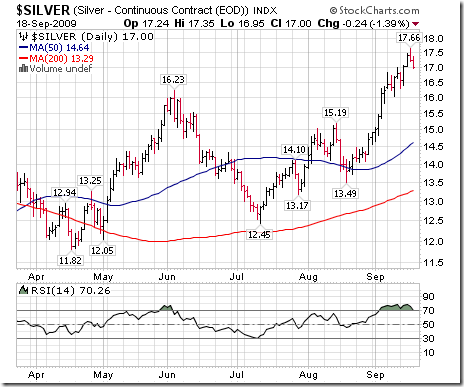
Silver gained $0.74 per ounce (1.93%) last week. It currently is testing its 50 day moving average where support is possible. Strength relative to gold was notably weaker last week. Short term momentum indicators are moving down from oversold levels. Stochastics already are oversold.

The TSX Composite Index gained 380.03 points (3.12%) last week. Intermediate trend is down. The Index remains below its 50 and 200 day moving average. Short term momentum indicators are recovering from deeply oversold levels. Strength relative to the S&P 500 Index has turned sharply positive. Upside potential is to at least its break down level at 12,763. 54.

Crude oil slipped $1.40 per barrel last week (including a $9.59 per barrel recovery from lows reached on Monday). Its 50 day moving average fell below its 200 day moving average on Friday (Death Cross?). Short term momentum indicators are recovering from deeply oversold levels. Crude easily could recover to its break down level at $89.61.

… be sure to check out the other 48 Charts including Seasonal Charts and articles Don posted this morning August 15th HERE
-
I know Mike is a very solid investor and respect his opinions very much. So if he says pay attention to this or that - I will.
~ Dale G.
-
I've started managing my own investments so view Michael's site as a one-stop shop from which to get information and perspectives.
~ Dave E.
-
Michael offers easy reading, honest, common sense information that anyone can use in a practical manner.
~ der_al.
-
A sane voice in a scrambled investment world.
~ Ed R.
Inside Edge Pro Contributors

Greg Weldon

Josef Schachter

Tyler Bollhorn

Ryan Irvine

Paul Beattie

Martin Straith

Patrick Ceresna

Mark Leibovit

James Thorne

Victor Adair