Major indexes like the S&P 500 and the Dow Industrials appear to be on autopilot — cruising along with an up-and-to-the-right pattern — thanks in large part to free money from the Federal Reserve. They are up 7.5% and 3.1%, respectively, on the year.
Meanwhile, the smaller-cap-biased Russell 2000 continues to struggle against the S&P 500, as was down -0.5% for the year at yesterday’s close.
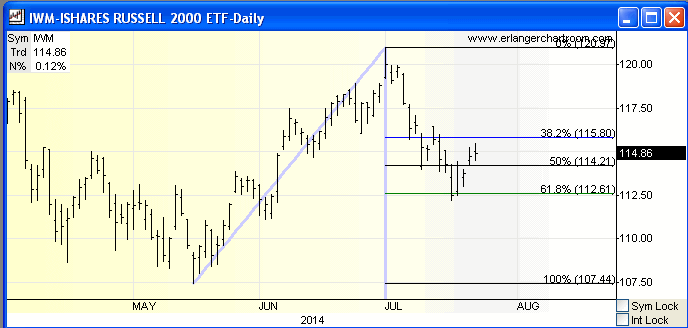
Two weeks ago, the Russell 2000, via the iShares Russell 2000 ETF (IWM), tested the 38.20% retracement ($115.80) from the May low to the July high, and last week tested the 50% retracement level ($114.21).
Until the Russell 2000 rights itself (i.e., get above the 38.20% retracement), I remain with a degree of caution for the overall stock market.
A similar pattern has emerged with several of the stocks and sectors we are watching together …

I remain with a positive outlook on Amazon (AMZN) and gold via the SPDR Gold Trust (GLD).
However, our positive view on semiconductors, via the SPDR S&P Semiconductor ETF (XSD), is complete now that there are too many mixed earnings results this July.
Witness the puke on Wednesday of Xilinx Inc. (XLNX), which gave back 10.3% on the day.

Last week, I also noted that the broadest ETF measure of the biotech stocks, the iShares Nasdaq Biotechnology ETF (IBB), was not in bubble territory. Last Thursday, it opened at $246.15 and yesterday it closed at $259.08, for a nice pop of $12.93. A positive bias remains on IBB.
Back in January, I weighed in on Byron Wein’s predictions for the year. Then in April, I reviewed my forecasts from January. Now I am grading our thinking from April.
Let me state at the outset of this update that there is a broad agreement with Wien on 70% of his ideas for 2014. However, several points were problematic, and I weighed in on how I thought they would play out.
1. The worst of the year does NOT come first due to geopolitical trouble. Wien still gets a grade of “B-” here and we get a “B-.”
January was down strong, February up strong and March down a bit on the Russell 2000. This weakness continued into mid-May. The geopolitical trouble in the Ukraine and now Israel caused volatility but not a broad sell-off.
My prediction was that the second quarter would be the challenging one for the markets, which turned out to be the case for the Russell 2000, but not the S&P 500 as noted above.
It appears this is happening particularly with the “momentum” Nasdaq names and that rocket ship known as biotech. Time will tell but so far, my timing seems to be on target.
Given that the second quarter is evolving, I give myself an “Incomplete.” The final grade will come at the end of the quarter.
2. Emerging markets will NOT prove treacherous in 2014. So far, Wien gets a grade of “C” as the iShares Emerging Markets ETF (EEM) is up for the year, and we get an “A.”
EEM was up 7.1% through Wednesday’s close. I expect EEM to continue higher IF it can get through $45 here. (It’s currently at $44.76.) Otherwise, a swoon into September could be forthcoming.
3. West Texas Intermediate crude will NOT exceed $110 unless a geopolitical crisis develops in the Middle East — which seems unlikely at this point. So far, Wien continues to get a grade of “C” as WTI crude was at $103.01 yesterday afternoon.
Here, I will give myself a “B+.” What I did not see in January was the geopolitical event driven by Russia invading Ukraine and the current trouble in Israel.
Even the Central Intelligence Agency missed that one. However, my buddy and partner James DiGeorgia nailed that one late last year.
Note, when James pontificates on geopolitical issues, pay attention. (You can catch up on his most-recent writings here.)
That being said, WTI crude had a very brief move above $110 on geopolitical tensions discussed above.
The only area where I agreed with Wien completely was that yields on the 10-year Treasury note would see 4% in 2014. So far, that has not happened and therefore we both get a grade of “C-.”
I noted in April that “There is still plenty of time for that to occur, but clearly the bond market knows something I cannot see with my data concerning the potential weakness for the U.S. economy this year.” This arrived with the Q1 GDP drop of -2.9% we saw in June.
The goal of this exercise is to continue to show you that it is important to re-evaluate your thesis on the market. As George Soros said, “Making an investment decision is like formulating a scientific hypothesis and submitting it to a practical test.”
With two quarters behind us, the practical test is well under way.
Cheers & Hit ‘Em Straight,
Geoff Garbacz
P.S. Right now, James DiGeorgia is excited about a brand-new form of energy, one that mixes sunlight and water with an idea that’s ahead of its time. The U.S. government is excited about it, too. //www.gliq.com/cgi-bin/click?weiss_uwd+GRH-0123c-video+07232014UWD1697UWD+vgbb@shaw.ca+g446+5857231“>Click here to find out why >>
P.P.S. We started looking at the SPDR S&P 500 Semiconductor ETF (XSD) earlier this summer as a potential buy idea. Eight weeks ago Thursday, it opened at $70 and is currently at $73.03, up $3.03 or 4.3%. It has moved up nicely since it was mentioned in this column. As mentioned above, we are now done with our recommendation on XSD. We hope you put some jingle in your pocket on this idea.