
Uncategorized

Economies and equity prices march steadily upward over time as growing populations and human ingenuity combine with commercial motives to increase corporate earnings. Over short periods of five years or less, there are persistent cyclical rhythms around those rising trends.
We are currently in one of those downward rhythms, but a trough is expected this summer. The second half of 2019 is likely to see a recovery in global manufacturing along with rising equity and commodity prices, and a stronger Canadian dollar. Resource stocks have been beaten down globally and expectations are low. The U.S.-China trade conflict hit many non-energy commodities and will hinder their rebounds, while energy remains unscathed. Energy stocks are likely to perform well over the second half of 2019. The expected increase in the Canadian dollar will create some currency headwinds for Canadian energy stocks, but Canadian investors will also face those headwinds directly on their U.S. holdings.
Rebound in global manufacturing ahead
We believe the best way to look at the economy’s rhythms for investment purposes is to track manufacturing activity for the global economy and key large economies (U.S., euro area, and China). While manufacturing’s share of most economies is declining, it remains the tail that wags the economic dog.
Figure 1 shows two key indicators of global manufacturing activity, Markit’s global manufacturing purchasing managers’ index (PMI) and the Organization for Economic Cooperation and Development’s (OECD) global leading indicator (GLI). The latest readings (April for the PMI and March for the GLI) reveal that the slowdown in global manufacturing that began in early 2018 continues. There are tentative glimmers of hope that the slowdown is losing momentum, helped by the U.S. Federal Reserve’s shift away from further short-term interest rate increases and several pro-growth Chinese policy initiatives. However, international trade is very weak and trade frictions between the U.S. and China, the U.S. and the European Union, and problems along the U.S.-Mexico border are a major concern.

Figure 1: Global Manufacturing Indicators
Energy Stocks and Canadian Dollar Will Follow Manufacturing Upward
Manufacturing is a leading indicator for the overall economy, just as equity and bond markets are. Turning points in global manufacturing correspond to shorter-term trend changes in equity prices, government bond yields, corporate bond spreads, commodity prices, and the Canadian dollar.
Figure 2 shows that the cycles in global manufacturing as measured by the OECD’s GLI correspond to the twelve-month change in Canadian energy stock prices. The same relationship holds for the broader equity markets, other economically-sensitive equity sectors, commodity prices, and the Canadian dollar.

Figure 2: OECD Global Leading Indicator and Canadian Energy Stocks
The continued downtrend in manufacturing activity over the first four months of 2019 has kept us cautious on the investment outlook as markets rebounded strongly from their December weakness. Equity markets look like they are heading into another intermediate correction and that the summer months could be volatile.
We expect global manufacturing to bottom this summer and recover over the second half of the year, signaling a buying opportunity in equity and commodity prices, and in the Canadian dollar. Figure 3 shows that Canadian energy stocks tend to rise strongly in the two years after a trough in global manufacturing activity. The same will be true for other economically-sensitive sectors and industries in Canada and abroad. However, energy stocks have been really beaten down and are viewed pessimistically by most investors and analysts, even though global, U.S., and Canadian energy sector earnings have held up very well in this latest global slowdown, and in Canada they are growing again. Energy is also getting by-passed in the ongoing trade skirmishes, and will be a hedge for investors against elevated Middle East tensions.
Figure 3 also shows that the Canadian dollar tends appreciate versus the U.S. as manufacturing recovers. A stronger loonie in later 2019 will create headwinds for U.S. investments.

Figure 3: Canadian Energy Stocks and Canadian Dollar After Trough in Global Manufacturing
What Could Go Wrong?
The risk to this idea is that the trade picture blows up and whacks the economy, deepening the slowdown and delaying the trough in manufacturing until late 2019 or 2020. The decline in asset prices would be more severe and the buying opportunity would be delayed, but when it does arrive, the opportunities will be greater than anticipated.
John Johnston is the Executive Vice President and Chief Strategist at Davis Rea in Toronto
Investment Outlook for the Remainder of 2019
Investors can expect short term pain during the next three months followed by long term gains to the end of the year.
North American equity markets have a history of greater volatility and lower than average returns between late May to mid-October. Current fundamental and technical trends suggest that history is about to repeat.

On the charts, broadly based equity indices including the TSX Composite Index, S&P 500 Index, NASDAQ Composite Index and Dow Jones Industrial Average moved below their 20 and 50 day moving averages in the second week in May. A period of technical repair this summer is needed before indices complete base building patterns and once again are able to move higher.
Earnings prospects support a cautious technical picture into summer. Consensus for S&P 500 earnings calls for a drop of 1.3% on a year-over-year basis in the second quarter and a gain of only 0.8% in the third quarter. Their muted trends follow no change in first quarter earnings.
Thereafter, the outlook for U.S. and Canadian equities improves. Fourth quarter earnings for S&P 500 companies are expected to increase 7.5% on a year-over-year basis. Canadian companies serving the U.S. market are expected to catch the improving economic wave in the U.S. The stage is set for a typical year end rally beginning in October in U.S. and Canadian equity markets.
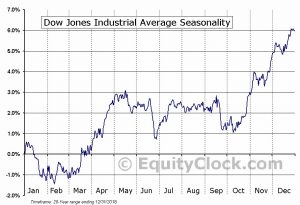
Preferred investment strategy is to hold cash equivalents, bonds and low beta equity securities between now and October with the intention of preparing to move into Exchange Traded Funds that track broadly based North American equity indices in October.
Don Vialoux is the Editor of Timing the Market

I am very pleased to be able to offer this time-sensitive compilation of exclusive analysis and insights from some of the best financial minds in the English-speaking world. It is nothing short of awesome to have this much material produced exclusively for MoneyTalks subscribers. This was achieved based on over 3 decades of relationship and friendships, and I want to thank these folks again for agreeing to participate.
Please enjoy and I hope you will encourage your friends, family and colleagues to subscribe to our free E-News Service so they can have access as well. ~ Michael Campbell
Chapter 1 – Seasonal Investing for the Rest of 2019 – Short Term Pain & Long Term Gain by Don Vialoux
Chapter 2 – Canadian Energy Stocks Waiting to Surf the Coming Global Manufacturing Wave by John Johnston, PhD
Chapter 3 – Lucky Seven Seven Major Macro – Market “Themes” for the Rest of 2019 by Greg Weldon
Chapter 4 – Why I’m Worried and What You Should Do by Lance Roberts
Chapter 5 – Gold will be a Good Hedge and Other Ideas for 2019 by Dr. Martin Murenbeeld
Chapter 6 – The Trend Letter – Our Investing Strategies for 2019 by Martin Straith
Chapter 7 – From Energy Bear to Energy Bull: Where to Invest in 2019-2020 by Joseph Schachter
Chapter 8 – Cannabis & Healthcare by Paul Beattie
Chapter 9 – Stock Picks – Taking Advantage of Low % Rates & Other Factors by Tyler Bollhorn
Chapter 10 – The Bullish Case for Big Returns in U.S. Treasury Bonds by Patrick Ceresna
Chapter 11 – Real Estate – A Case of the ‘Yeah But’s’ Again? by Ozzie Jurock
Chapter 12 – Massive Healthcare Cost Boom – Crisis & Opportunity by Ryan Irvine
Chapter 13 – Junior Resources for the Rest of 2019 by Eric Coffin
Bitcoin, which lost three-quarters of its value in 2018, has soared by 24% since Friday and more than doubled in price so far this year. At 1612 GMT it was up 0.8% at 7,874. There was no obvious reason for the sudden rise with the opacity of cryptocurrency markets rendering it virtually impossible to prove or disprove any theories. Some traders said investors moved money to bitcoin, treating it as a safe haven as traditional financial markets stumbled on fears that a worsening Sino-U.S. trade dispute could derail the global economy. But none of the four traders that Reuters spoke to could produce evidence to support that claim….CLICK for complete article
-
I know Mike is a very solid investor and respect his opinions very much. So if he says pay attention to this or that - I will.
~ Dale G.
-
I've started managing my own investments so view Michael's site as a one-stop shop from which to get information and perspectives.
~ Dave E.
-
Michael offers easy reading, honest, common sense information that anyone can use in a practical manner.
~ der_al.
-
A sane voice in a scrambled investment world.
~ Ed R.
Inside Edge Pro Contributors

Greg Weldon

Josef Schachter

Tyler Bollhorn

Ryan Irvine

Paul Beattie

Martin Straith

Patrick Ceresna

Mark Leibovit

James Thorne

Victor Adair