
Uncategorized
YOU PROBABLY don’t need me to tell you that it’s pretty risky out there, says Brad Zigler at Hard Assets Investor.
The market, I mean. Which market, you may ask? Increasingly, it doesn’t matter.
The zag of the gold market has come to look very much like the stock market’s zig. Over the past month, the correlation between the S&P 500 and gold has shot up 60 percentage points. The fact that the coefficient is now at 38% should tell you that it’s gone from a risk-neutralizing negative value to a tag-along positive.
The turnaround, too, followed a near-vertical trajectory. Not that this hasn’t happened before. Over the past two years, the correlation coefficient has dropped with equal velocity, but not risen.
“Britain under its new leadership is going the austerity route. Chancellor Osborne set plans for 81 million pounds sterling of spending cuts, all in an effort to erase Britain’s deficit by 2015. Osborne’s plan will entail the loss of 500,000 jobs in Britain’s biggest austerity push since World War II. Osborrn will require larger pension contributions, and higher retirement age, Conservatives in Parliament cheered Osborn, crying “More, more” as the word of the new austerity program emerged. There was no sense of panic on the part of the British public, perhaps because Brits remember the austerity and pain they lived through during the dark and horrific days of World War II.
Ed Miliband, leader of the British Labour Party opposition, called the austerity plan “The biggest gamble in a generation. — a gamble with people’s jobs and livelihoods. No other leading economy is trying anything like it.”
Mr. Osborne may have the nation behind him now, but in a year with unemployment climbing and living standards falling, sentiments may be a lot different. Osborne claims that the drastic cuts have removed Britain from the “danger zone” that once occupied along side of Greece and Ireland. Osborne told the MPs, “It’s a hard road, but it leads to a better future. Today’s the day when Britain steps back from the brink.”
But it’s very different in Greece and France, neither country known for their work ethic. In both countries, riots have broken out over austerity plans. When the age of retirement was increased in France from 60 to 62, literally the whole nation went on strike. The French famously don’t like to work, they love their vacations and their short work-hour weeks.
With Britain setting the tone, it won’t be too long before the austerity route hits the US. The American folks at home never suffered terribly during WW II, nor have they suffered through Korea, Vietnam, Iraq or Afghanistan. This will change drastically in the years ahead as the full force of the deficits hits Americans since the year 1939, Americans have enjoyed one long party, due to inflation, over-spending, borrowing and leveraging. In my opinion, the party’s about over. And Britain is leading the way for the English-speaking nations.”
Richard Russell Note — I think Britain’s new austerity is going to rub off on the US. This could be one of the reasons why gold is correcting. Gold may be looking ahead to the time when the US will cut out all the QE and stimulus stuff and start facing the pain of its disastrous deficits. Hard to believe that the US could actually choose austerity, but I think Britain is leading the way.
Richard Russell One of the best values anywhere in the financial world at only a $300 a year, to get his DAILY Dow Theory Letters subscription HERE
Austerity be damned, at this rate Mr. Bernanke will go down in the history books as one of the greatest money creators ever to have walked this planet!
Never mind sky-high deficits and a crushing debt overhang, at its most recent FOMC meeting, the Federal Reserve all but guaranteed another round of quantitative easing.
While the American central bank did not officially expand its quantitative easing program last month, it did reiterate its willingness to institute more aggressive monetary policy measures in order to combat the risks of deflation. Furthermore, Mr. Bernanke did officially downgrade the Federal Reserve’s outlook for inflation.
The truth is that the US is insolvent and its policymakers will stop at nothing in order to avoid sovereign default. So, it should come as no surprise that at its latest meeting, the Federal Reserve downplayed the risk of inflation, thereby setting the stage for another round of money creation.
Make no mistake; Mr. Bernanke has already created copious amounts of money. Granted, the Federal Reserve’s previous monetisation was highly secretive, but you can be sure that it did occur. Allow us to explain:
You will recall that during the depths of the financial crisis, the Federal Reserve expanded its own balance-sheet and bought all sorts of toxic assets from the financial institutions. By doing so, Mr. Bernanke created money out of thin air and bailed out the major banks.
Thus, the banks were able to dump their garbage assets on to the Federal Reserve and once they received the newly created cash in exchange for these securities, they loaned this money to the US government by purchasing US Treasuries. In summary, in the previous round of quantitative easing, the Federal Reserve created new money and instead of lending it directly to the US government, it used the banking cartel as its conduit. Back then, not only did the Federal Reserve create more than a trillion dollars, it also dropped its discount rate to almost zero; thereby allowing banks to borrow money cheaply! It should be noted that since the banks were able to obtain such inexpensive funding from the Federal Reserve, they had absolutely no qualms about re-investing this capital in US Treasuries.
At first glance, the Federal Reserve’s stealth monetisation plan seemed flawless. The banks offloaded their toxic assets on to the Federal Reserve, they made fortunes by investing in US Treasuries and the American government got access to a cheap source of funding. Magic!
Despite the fact that this financial wizardry was a lifeline for American policymakers and their banking cronies, let there be no doubt that it was an unmitigated disaster for the American public. Not only did the Federal Reserve nationalise the banks’ losses but more importantly, Mr. Bernanke’s money creation efforts have seriously undermined the viability of the US Dollar.
It is noteworthy that since bailing out the major banks and orchestrating the stealth monetisation, the Federal Reserve has been busy purchasing US Treasuries. Furthermore, it is now almost certain that in next month’s FOMC meeting, Mr. Bernanke will unleash yet another round of quantitative easing. In other words, in order to fund Mr. Obama’s out of control spending, Mr. Bernanke will create even more dollars out of thin air! Allegedly, this new round of money creation will drive interest-rates lower, thereby helping the US economic recovery. Or so the story goes.
Unfortunately, as any serious student of economic history knows, there is no such thing as a free lunch. By adding trillions of additional dollars to the monetary stock, Mr. Bernanke may succeed in bailing out his friends in high places but he is seriously jeopardising the US Dollar. In fact, bearing in mind the recent developments, it has become clear to us that the Federal Reserve wants to debase its currency. In our humble opinion, the US Dollar is a doomed currency and there is a real risk of an abrupt plunge in its value.
If our assessment turns out to be correct and Mr. Bernanke unleashes the second phase of quantitative easing, you can be sure that the US Dollar will slide against most un-manipulated currencies (which are few and far between) and hard assets. In fact, monetary inflation is the prime reason why we believe that the ongoing bull-market in stocks and commodities will continue for several more months.
Look. The US economy is swimming in debt and the total obligations (including social security, Medicare and Medicaid) now come in at around 800% of GDP! Furthermore, this year alone, Mr. Obama’s administration plans to spend another US$3.5 trillion, meanwhile the US Treasury will raise roughly US$2.2 trillion from issuing new government debt! Clearly, these numbers are unsustainable and you can bet your bottom dollar that the Federal Reserve will end up buying a large proportion of the newly issued US Treasury securities. As the American central bank funds more and more of Mr. Obama’s spending by creating new money, it will trash the value of its currency. In fact, given the growing imbalance between the government’s spending and tax receipts, very high inflation is inevitable and even hyperinflation cannot be ruled out.
For the sake of their financial well being, it is crucial that investors understand that inflation or even hyperinflation is a monetary phenomenon and a strong economy is not a pre-requisite for the debasement of a national currency. Whatever the reason, if a central bank decides to significantly increase the quantity of money in the system, that currency’s purchasing power will always diminish. This is how fiat-money regimes have operated since the beginning of time and this era is no different.
It is interesting to note that throughout recorded history, the worst excesses of inflation occurred only in the 20th century. Undoubtedly, this was a direct consequence of the adoption of fiat-money.
The following chart highlights all the hyperinflationary episodes in recorded history and as you can see, with the exception of the French Revolution (1789-1796), all of the other disasters occurred in the last century. In fact, it is an ominous sign that 29 out of the 30 recorded hyperinflations in human history occurred during the 20th century!
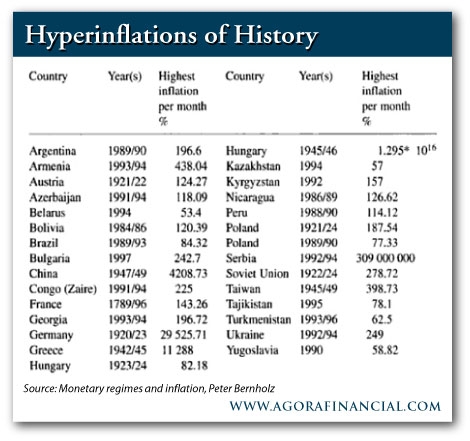
Let there be no doubt, a paper money system usually ends in the reckless destruction of money and it is no coincidence that all hyperinflations in history have occurred in the presence of discretionary paper money regimes. Furthermore, it is important to understand that a political system based on democracy is inherently inflationary and political leaders have been responsible for all major inflations in the past. Conversely, history has shown that monetary systems binding the hands of political leaders are essential for keeping inflation in check. If history is any guide, metallic monetary systems have shown the largest resistance to inflation and this is due to the fact that currencies anchored by a tangible asset cannot be inflated ad infinitum.
It is our conjecture that the current monetary system is absolutely pathetic; a system designed to enslave society. Unfortunately, the vast majority of humans do not understand the endless inflation agenda and this is why the perpetrators get away with this crime. Furthermore, let it be known that the Federal Reserve is largely responsible for the incredible inflation we have experienced over the past century.
The chart below plots the cost of living in Britain, France, Switzerland and the US. As you will note, the cost of living in these nations was relatively stable for over 160 years (1750-1913) but once the Federal Reserve came to power in 1913, everything changed. Suddenly, the cost of living exploded in these nations, so it should be clear that the Federal Reserve’s covert policy of currency inflation and debasement is solely responsible for this mind numbing inflation.
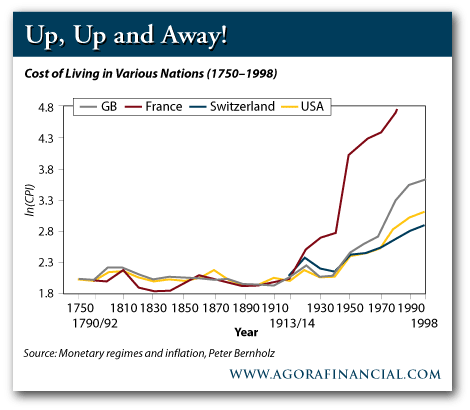
Unfortunately, the Federal Reserve and its allies have not finished inflating and over the following years, they will create even more confetti money. Under this scenario, cash will continue to lose purchasing power and the asset poor middle-class will get even more impoverished. If our assessment is correct, cash will prove to be a disastrous ‘asset’ over the next decade and once the Federal Reserve’s manipulation ends, fixed income securities will also depreciate in value.
Bearing in mind our grave concern about high inflation and the very real possibility of hyperinflation, we continue to favour hard assets such as precious metals and energy. At present, we have allocated roughly half of our clients’ capital to these sectors and it is our belief that this should be an adequate inflation hedge.
Regards,
Puru Saxena,
for The Daily Reckoning Australia
Puru Saxena publishes Money Matters, a monthly economic report, which highlights extraordinary investment opportunities in all major markets. In addition to the monthly report, subscribers also receive “Weekly Updates” covering the recent market action. Puru Saxena is the founder of Puru Saxena Limited, his Hong Kong based firm which manages investment portfolios for individuals and corporate clients. He is a highly showcased investment manager and a regular guest on CNN, BBC World, CNBC, Bloomberg, NDTV and various radio programs.
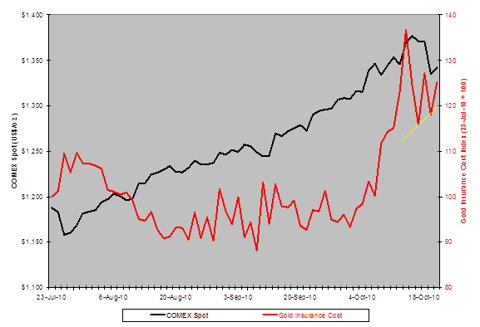
I probably don’t have to tell you that it’s pretty risky out there. The market, I mean. Which market, you may ask? Increasingly, it doesn’t matter.
The zag of the gold market has come to look very much like the stock market’s zig. Over the past month, the correlation between the S&P 500 and gold has shot up 60 percentage points. The fact that the coefficient is now at 38 percent should tell you that it’s gone from a risk-neutralizing negative value to a tag-along positive.
The turnaround, too, followed a near-vertical trajectory. Not that this hasn’t happened before. Well, in recent history; that is, over the past two years anyway. Check that. the correlation coefficient has dropped with equal velocity, but not risen.
….read more HERE
3 High Momentum Junior Gold Stocks
….read about the three HERE
3 High Momentum Gold Mining Stocks
….read about the three HERE
Buying Opportunities In Gold Market
Market fundamentals indicate a gold forecast price of $1,500 an ounce by the end of the year. Due to its recent strong rise, however, the dollar-denominated gold prices are poised to correction. This can be a golden opportunity for investors to buy or add to their favorite precious metal stocks or their physical holdings.
Much of the recent power behind rising gold prices was currency wars. Central banks all over the world are careful and cautious about a strong currency when the economies are weak. One advantage of a weak currency is that nations can inflate their debt away. They care much less about a strong currency when the economy is healthy. The US dollar has fallen sharply, as the Federal Reserve is acting fast and bold among others.
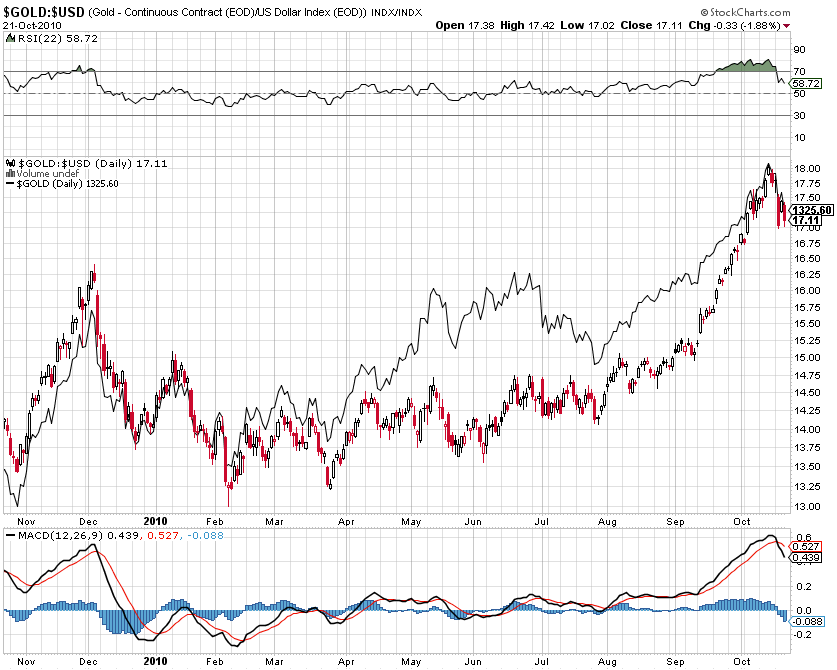
The outlook is quite bullish for gold as the fundamentals behind it remains strong. In short term, however, gold is overbought. The investment demand dwindles when prices hit new records repeatedly and much of the Fed’s bold actions on quantitative easing, aka printing money to buy bonds, may have already priced in.
When US dollar strengths against a basket of currencies gold loses as much as 3% and does not regain it when dollar falls back to its previous level. The chart below indicates the overbought situation the yellow metal is experiencing in close comparison to the underlying currency, the US dollar.
more SeekinGold HERE
-
I know Mike is a very solid investor and respect his opinions very much. So if he says pay attention to this or that - I will.
~ Dale G.
-
I've started managing my own investments so view Michael's site as a one-stop shop from which to get information and perspectives.
~ Dave E.
-
Michael offers easy reading, honest, common sense information that anyone can use in a practical manner.
~ der_al.
-
A sane voice in a scrambled investment world.
~ Ed R.
Inside Edge Pro Contributors

Greg Weldon

Josef Schachter

Tyler Bollhorn

Ryan Irvine

Paul Beattie

Martin Straith

Patrick Ceresna

Mark Leibovit

James Thorne

Victor Adair