
Uncategorized
Rep. Ron Paul, whose maverick presidential bids shook the GOP, said in the wake of this week’s elections that the country has already veered over the fiscal cliff and he sees no chance of righting ship in a country where too many people are dependent on government.
“We’re so far gone. We’re over the cliff,” the Texas Republican told Bloomberg Television’s “In the Loop” program. “We cannot get enough people in Congress in the next 5-10 years who will do wise things.” The video can be seen at http://www.bloomberg.com/video/ron-paul-on-fiscal-cliff-and-vows-to-compromise-MYkAiqYBTaiHwXZL9Tvxkw.html.
Mr. Paul, who is retiring after 12 terms in the House, said voters on Tuesday rejected Mitt Romney because he had opposed the government bailout of General Motors and Chrysler.
“The people in the Midwest voted against him: ‘Oh, we have to be taken care of!’ So that vote was sort of like what we are laughing at in Greece,” Mr. Paul said.
“People do not want anything cut,” he said. “They want all the bailouts to come. They want the Fed to keep printing the money. And they don’t believe that we’ve gone off the cliff or are close to going off the cliff. They think we can patch it over, that we can somehow come up with some magic solution. But you can’t have a budgetary solution if you don’t change what the role of government should be. As long as you think we have to police the world and run this welfare state, all we are going to argue about is who will get the loot.”
Read more: Ron Paul: Election shows U.S. ‘far gone’ – Washington Times http://www.washingtontimes.com/blog/inside-politics/2012/nov/8/ron-paul-election-shows-us-far-gone/#ixzz2Bgo7qOwU
It’s never too late to make healthy changes and change the way your body looks. If you are in your thirties, fourties, fifties, sixties… even your eighties or nineties, you can improve your life.

No one can accuse Tosca Reno of going Hollywood. Although the busy mom of five is known globally as a bestselling author, fitness model and columnist for Oxygen magazine, she remains grounded through family and by remembering her start on the pathway to success.
“My day-to-day life was a struggle,” Reno tells Lifestyler about being her heaviest weight more than 10 years ago. “I was 203 pounds and not even pregnant at the time. Even walking up the stairs was a hassle. I felt much older than my actual age.”
Clean Eating
Before adapting her more healthful lifestyle, Reno says her weight constantly fluctuated.
“I yo-yo dieted in my twenties and thirties, always losing and gaining the same weight,” says Reno. So, when she authored her first nutritional guide, in what would become the start of her Eating Clean series, she comments on how important it is to know that eating clean isn’t another fad diet.
“Eating clean has changed my life; I feel (and look) better now than when I was in my twenties,” says Reno. “I feel like I’m in control of the way I look and feel, and trust me, if I can do it, so can anyone.”
“I would tell anyone to Eat Clean for a few months and see if they notice a difference — in their energy levels, the way their skin looks, how bright their eyes are, and, of course, how loose their pants have become.”
A typical day on Reno’s eating plan, for example, might begin with a warm bowl of oatmeal, or toast and egg whites with fruit on the side; a chicken wrap and chopped vegetables for lunch; and a lean cut of steak with salad for dinner. Two snacks a day are also allowed.
Exercise and Strength Training
Many of Reno’s fans are surprised to learn the fitnessista doesn’t spend hours upon hours in a gym, she says.
“The truth is, I’m a busy woman — like many other adults out there. I have a demanding job, a husband, children, pets, an aging parent… the list goes on,” says Reno. “I make sure to make every second of my gym time count. I’m in and out in under 45 minutes so I can get on with the rest of my day.”
Her current workout schedule consists of weight-lifting three to six days a week, depending on how she chooses to split her routine. At the moment, Reno says, she’s training for a half marathon, so the need to fit in longer cardio workouts is essential.
Whenever she makes an appearance at her home gym, some of her favourite strength training moves include exercises that work the butt and thighs, like squats, lunges and cable kickbacks. “Exercises that target these large muscles are very effective for fat burning,” she says.
On days where she isn’t her best or may find it challenging to continue (just like everyone else), Reno reminds herself she’s never regretted a workout.
“There are times when I’m busy or just don’t feel like getting in the gym, but I tell myself it will be worth it when I’m finished,” says Reno. “I usually work out first thing in the morning — that way I don’t have a chance to talk myself out of anything later on in the day.”
Age and Fitness
To Reno, you are as young as you feel. Over her career, she says she’s found that most age barriers people face are psychological.
“I know now that it’s never too late to make healthy changes and change the way your body looks,” says Reno. “If you are in your thirties, fourties, fifties, sixties… even your eighties or nineties, you can improve your life.”
….read the whole article HERE – via LifeStyler Magazine
 Note from Mike: The following column written by five Nobel Prize winners in economics appeared in the Wall Street Journal. It reminds us that the US financial situation will dominate the headlines in the near future. Technical analysts like Martin Armstrong and David Bensimon see the coming problem for government finances playing a dominant role in the investment markets from 2014 through 2017.
Where are we now?
By George P. Shultz, Michael J. Boskin, John F. Cogan, Allan H. Meltzer and John B. Taylor
Sometimes a few facts tell important stories. The American economy now is full of facts that tell stories that you really don’t want, but need, to hear.
Did you know that annual spending by the federal government now exceeds the 2007 level by about $1 trillion? With a slow economy, revenues are little changed. The result is an unprecedented string of federal budget deficits, $1.4 trillion in 2009, $1.3 trillion in 2010, $1.3 trillion in 2011, and another $1.2 trillion on the way this year. The four-year increase in borrowing amounts to $55,000 per U.S. household.
The amount of debt is one thing. The burden of interest payments is another. The Treasury now has a preponderance of its debt issued in very short-term durations, to take advantage of low short-term interest rates. It must frequently refinance this debt which, when added to the current deficit, means Treasury must raise $4 trillion this year alone. So the debt burden will explode when interest rates go up.
The government has to get the money to finance its spending by taxing or borrowing. While it might be tempting to conclude that we can just tax upper-income people, did you know that the U.S. income tax system is already very progressive? The top 1% pay 37% of all income taxes and 50% pay none.
Did you know that, during the last fiscal year, around three-quarters of the deficit was financed by the Federal Reserve? Foreign governments accounted for most of the rest, as American citizens’ and institutions’ purchases and sales netted to about zero. The Fed now owns one in six dollars of the national debt, the largest percentage of GDP in history, larger than even at the end of World War II.
The Fed has effectively replaced the entire interbank money market and large segments of other markets with itself. It determines the interest rate by declaring what it will pay on reserve balances at the Fed without regard for the supply and demand of money. By replacing large decentralized markets with centralized control by a few government officials, the Fed is distorting incentives and interfering with price discovery with unintended economic consequences.
“Did you know that the Federal Reserve is now giving money to banks, effectively circumventing the appropriations process? To pay for quantitative easing – the purchase of government debt, mortgage-backed securities, etc. – the Fed credits banks with electronic deposits that are reserve balances at the Federal Reserve. These reserve balances have exploded to $1.5 trillion from $8 billion in September 2008.
The Fed now pays 0.25% interest on reserves it holds. So the Fed is paying the banks almost $4 billion a year. If interest rates rise to 2%, and the Federal Reserve raises the rate it pays on reserves correspondingly, the payment rises to $30 billion a year. Would Congress appropriate that kind of money to give – not lend – to banks?
… the Fed’s Operation Twist, buying long-term and selling short-term debt, is substituting for the Treasury’s traditional debt management.
This large expansion of reserves creates two-sided risks. If it is not unwound, the reserves could pour into the economy, causing inflation. In that event, the Fed will have effectively turned the government debt and mortgage-backed securities it purchased into money that will have an explosive impact. If reserves are unwound too quickly, banks may find it hard to adjust and pull back on loans. Unwinding would be hard to manage now, but will become ever harder the more the balance sheet rises.
“When businesses and households confront large-scale uncertainty, they tend to wait for more clarity to emerge before making major commitments to spend, invest and hire. Right now, they confront a mountain of regulatory uncertainty and a fiscal cliff that, if unattended, means a sharp increase in taxes and a sharp decline in spending bound to have adverse effect on the economy.
Are you surprised that so much cash is waiting on the sidelines?…
In short, we risk passing an economic, fiscal and financial point of no return. The problems are close to being unmanageable now. If we stay on the current path, they will wind up being completely unmanageable, culminating in an unwelcome explosion and crisis.
The fixes are blindingly obvious. Economic theory, empirical studies and historical experience teach that the solutions are the lowest possible tax rates on the broadest base, sufficient to fund the necessary functions of government on balance over the business cycle; sound monetary policy; trade liberalization; spending control and entitlement reform; and regulatory, litigation and education reform. The need is clear. Why wait for disaster? The future is now.
Click here to get weekly notice of Michael’s favourite research picks sent right to your Inbox.
As one solar company after another goes out of business, here is what investors do not know and promoters will not tell you: Solar panels do not work that well.
Sometimes not at all. But for several years, most solar systems, big and small, were so heavily subsidized, they were practically free. So lots of people did not really care.
Not enough to check the output of their systems. The few who did often had a big surprise.
That was the first shock.
The second was realizing that a large solar array was not just one system, but thousands. Each panel a mini-power plant. And the only way to figure out if the individual panels were working was to test each one.
There go your solar savings.
The gang at Google figured out that the farmer next door had plowed a field, kicking up the dirt, knocking down its power. Solar panels have to be cleaned, sometimes often.
And the place where they need the most cleaning is where solar panels work the best: The desert. But that is where water is scarce and expensive.
There go your solar savings.
Lousy panels are No. 2. Remember Solyndra? Before its well-publicized collapse, Solyndra was well known for its tube-shaped products that were supposed to collect solar power directly from above, and indirectly, reflected from below.
They found out the hard way in Livermore, Calif. There a movie theater got a lot of attention for installing a roof top solar array — first of its kind when it was installed in 2009. A year later, technicians found out the system was producing 25% less power than projected.
The movie theater had no idea. I’m not sure they ever found out.
The only laboratory that ever tested the actual performance of Solyndra products figured it out. But it was in Germany and did not receive much attention. Said one energy web site:
the report claims the Solyndra module’s shadow blocked most if not all of the sunlight before hitting the reflector foil installed below the module, allowing only a small portion of reflected sunlight to hit the backside of the module.
This is the same place where 100 reporters covered President Obama’s visit there in 2010, and not one took a moment to figure out why Solyndra’s auditors said the company was “not a going concern.”
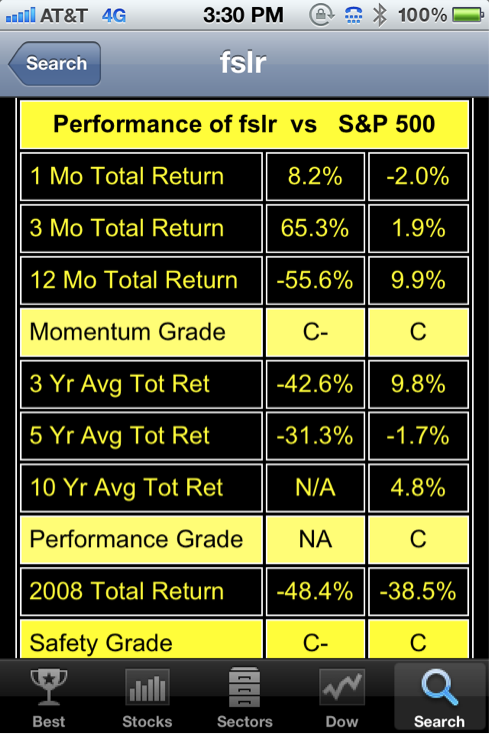
Like First Solar’s panels, how would you know? You don’t.
No. 3 is this: The darn things don’t work — at all. In San Diego, the local Space theater and museum asked some people to check its panels. As usual, they were installed with lots of fanfare.
But one year later, they were surprised that squirrels and trees had reduced their solar output to zero.
A public utility in a southern state had the same experience. A solar company wanted to field test a new energy product, and the engineers at the utility said they could test it on their system.
Soon, 10 engineers were tromping around the roof of the utility’s headquarters, looking for best place to hook up their device.
“These panels don’t work,” said one of the engineers with the new product. “There is no power coming out of these panels.”
Engineers for the utility said “Your instruments are wrong. We are sure the panels work.”
So the utility’s engineers checked with their instruments.
Sure enough: Nothing.
These stories go on and on and on. They don’t work but no one cares because most people put them up for the publicity and marketing. Not energy. The movie theater Web site brags it has: “the second largest solar power system on the roof of a movie theatre anywhere in the world!”
Solar promoters consider themselves part of a political movement to save the planet. They do not tolerate naysayers.
That is why it is still so easy to find stories that say the non-performance of solar equipment “really looks like a non-story.” That is what one analyst said after First Solar’s stock recently took a 10% hit in one day after the company revealed problems with its products.
Here’s a bonus reason No. 4: Shade. A shadow on a solar array not only knocks out power to that panel, it also shuts down a wide area of panels around it.
Listen to the National Renewable Energy Laboratories: “the reduction in power from shading half of one cell is equivalent to removing a cell active area 36 times the shadow’s actual size.”
Do your own test: Ask your neighbors if they know how shadows hurt solar panels. Most do not.
Some companies install monitors on each panel. But monitor makers find that the very existence of their product is an admission of problems in that industry. And that is the last thing the True Believers want anyone to hear about.
Especially investors.
That is why I shorted First Solar at $121 in March of 2011 — and said so on my radio show and in my newsletter.
And that is why investors should stay away from betting on their resurgence.
This article is commentary by an independent contributor, separate from TheStreet’s regular news coverage.
>To order reprints of this article, click here: Reprints
Get ready to infuse the long winter months with color, carnivals, and adventure. Chosen by our editors, this year’s best winter trips span the globe and transcend the season. Find your favorite, then share your winter trip plans with fellow travelers.

Harbin Ice Festival, China
Hibernating is not an option in the frosted reaches of northeast China, where brisk Siberian winds keep the average winter temperatures in Harbin barely above zero degrees Fahrenheit. Hardy local artisans in the Russian-influenced “Ice City” celebrate the season by sculpting ice blocks chopped from the Songhua River into colossal crystalline pyramids and palaces, whimsical dragons and fairies, and frozen slides worthy of a water park. The monthlongHarbin Ice and Snow Festival (beginning January 5), showcases the frosty craftsmanship of local carvers and international teams and includes a Snow Sculpture Expo at Sun Island recreational area and the Ice Lantern Garden Party at Zhaolin Park. Daylight activities include figure skating, ice boxing competitions, and, for the daring, a polar plunge into an ice-free section of the frigid Songhua. After dark, bundle up to see the festival’s illuminated ice displays dazzle neon bright against the night sky. Harbin is accessible via train or plane from Beijing or Shanghai.
….read more HERE
-
I know Mike is a very solid investor and respect his opinions very much. So if he says pay attention to this or that - I will.
~ Dale G.
-
I've started managing my own investments so view Michael's site as a one-stop shop from which to get information and perspectives.
~ Dave E.
-
Michael offers easy reading, honest, common sense information that anyone can use in a practical manner.
~ der_al.
-
A sane voice in a scrambled investment world.
~ Ed R.
Inside Edge Pro Contributors

Greg Weldon

Josef Schachter

Tyler Bollhorn

Ryan Irvine

Paul Beattie

Martin Straith

Patrick Ceresna

Mark Leibovit

James Thorne

Victor Adair