
Uncategorized
“We are being played; it’s time we learned the game” Drawing blood is always an option, but there’s also a “cleaner” way to control the crowds by manipulating their minds with the cattle prods of collectivist morals and a fictional narrative that supplants the reality. Let’s call it the Mind Game of Manipulative Illusions……..
……read it all HERE
How could the U.S. still not be the first destination of global capital in search of safe (although historically low) prospective returns? Well, Armageddon is not around the corner. I don’t believe in the imminent demise of the U.S. economy and its financial markets. But I’m afraid for them.
Apparently so are many others, among them the IMF (International Monetary Fund), the CBO (Congressional Budget Office) and the BIS (Bank of International Settlements). What they’re saying is that when it comes to debt and to the prospects for future debt, the U.S. is a serial offender, an addict whose habit extends beyond weed or cocaine and who frequently pleasures itself with budgetary crystal meth. Uncle Sam’s habit, say these respected agencies, will be a hard (and dangerous) one to break.
What standards or guidelines do their reports use and how best to explain them? Well, the three of them all try to compute what is called a “fiscal gap,” a deficit that must be closed either with spending cuts, tax hikes or a combination of both which keeps a country’s debt/GDP ratio under control. The fiscal gap differs from the “deficit” in that it includes future estimated entitlements such as Social Security, Medicare and Medicaid which may not show up in current expenditures.
These studies (when averaged) suggest that we need to cut spending or raise taxes by 11% of GDP and rather quickly over the next five to 10 years. An 11% “fiscal gap” in terms of today’s economy speaks to a combination of spending cuts and taxes of $1.6 trillion per year! To put that into perspective, CBO has calculated that the expiration of the Bush tax cuts and other provisions would only reduce the deficit by a little more than $200 billion. As well, the failed attempt at a budget compromise by Congress and the President – the so-called Super Committee “Grand Bargain”– was a $4 trillion battle plan over 10 years worth $400 billion a year.
These studies suggest close to four times that amount in order to douse the inferno.??Look at who’s in that ring of fire alongside the U.S. There’s Japan, Greece, the U.K., Spain and France, sort of a rogues’ gallery of debtors. Look as well at which countries have their budgets and fiscal gaps under relative control – Canada, Italy, Brazil, Mexico, China and a host of other developing as opposed to developed countries.
America’s abusive tendencies can be described in more ways than an 11% fiscal gap and a $1.6 trillion current dollar hole which needs to be filled. It’s well publicized that the U.S. has $16 trillion of outstanding debt, but its future liabilities in terms of Social Security, Medicare, and Medicaid are less tangible and therefore more difficult to comprehend. Suppose, though, that when paying payroll or income taxes for any of the above benefits, American citizens were issued a bond that they could cash in when required to pay those future bills. The bond would be worth more than the taxes paid because the benefits are increasing faster than inflation. The fact is that those bonds today would total nearly $60 trillion, a disparity that is four times our publicized number of outstanding debt. We owe, in other words, not only $16 trillion in outstanding, Treasury bonds and bills, but $60 trillion more. In my example, it just so happens that the $60 trillion comes not in the form of promises to pay bonds or bills at maturity, but the present value of future Social Security benefits, Medicaid expenses and expected costs for Medicare. Altogether, that’s a whopping total of 500% of GDP, dear reader, and I’m not making it up. Kindly consult the IMF and the CBO for verification.
Investment conclusions?
So I posed the question earlier: How can the U.S. not be considered the first destination of global capital in search of safe (although historically low) returns? Easy answer: It will not be if we continue down the current road and don’t address our “fiscal gap.” IF we continue to close our eyes to existing 8% of GDP deficits, which when including Social Security, Medicaid and Medicare liabilities compose an average estimated 11% annual “fiscal gap,” then we will begin to resemble Greece before the turn of the next decade. Unless we begin to close this gap, then the inevitable result will be that our debt/GDP ratio will continue to rise, the Fed would print money to pay for the deficiency, inflation would follow and the dollar would inevitably decline. Bonds would be burned to a crisp and stocks would certainly be singed; only gold and real assets would thrive within the “Ring of Fire.”
If that be the case, the U.S. would no longer be in the catbird’s seat of global finance and there would be damage aplenty, not just to the U.S. but to the global financial system itself, a system which for 40 years has depended on the U.S. economy as the world’s consummate consumer and the dollar as the global medium of exchange. If the fiscal gap isn’t closed even ever so gradually over the next few years, then rating services, dollar reserve holding nations and bond managers embarrassed into being reborn as vigilantes may together force a resolution that ends in tears. It would be a scenario for the storybooks, that’s for sure, but one which in this instance, investors would want to forget. The damage would likely be beyond repair.
If you want to live big, you have to pay big. Some of the greatest, largest, most exquisite homes in the world.
10. Rybolovlev Estate — $95 Million
Once owned by Donald Trump, This home has 18 bedrooms, 22 bathrooms, and last sold for $95 million from its original sale price of $125 million.
9. Silicon Valley Mansion – $100 Million
This one las went for 100 million. Only 5 bedrooms but 9 bathrooms. Has an indoor and outdoor pool.
8. Fleur De Lys – 125 Million
Currently being marketed as the world’s most expensive house, the Fleur De Lys has 41,000 square feet and 15 bedrooms.
7. The Manor – $150 Million
Aaron Spelling built and owns this. This house features 56,000 square feet, 123 rooms, a bowling alley, an ice rink and apparently an entire wing devoted to Spelling’s wife’s wardrobe.
6. The Pinnacle – $155 Million
Owned by Tim Blixseth, in Montana, this house is unique for it has a private chair lift directly from the house to a nearby ski-resort (which Blixseth owns). Best back yard because it’s a ski resort?
5. Franchuk Villa – $161 Million
This five-story, freestanding 10-bedroom Victorian Villa also features an underground indoor swimming pool, panic room, and private movie theatre.
4. The Hearst Mansion – $165 Million
This house was used in The Godfather and JFK spent his honeymoon there. Features three swimming pools, 29 bedrooms, a movie theatre and a disco.
3. Fairfield Pond – $198 Million
This 66,000 square-foot main house has a basketball court, bowling alley, and a $150,000 hot tub.
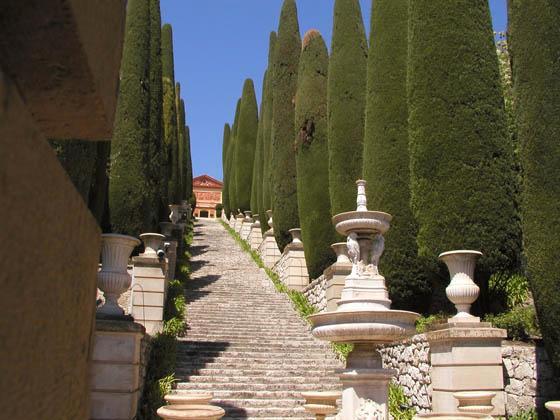
2. Villa Leopolda – $736 Million
Built by King Leopold II of Belgium in 1902 and located on the French Riviera, this home was purchased by Russian billionaire Prokhorov as a summer home. It has 27 stories, 19 bedrooms, and a rumored 50 full-time gardeners.
1. Antilla – $1,000,000,000
The one billion dollar home. Located in Mumbai, Antilla challenges pretty much everything you’d expect about “what is possible in a home” and “what is possible for architecture.” The 27-story house features six floors of parking, a health level with a jacuzzi, gym, and “ice room,” a ballroom level, several floors of bedrooms and bathrooms and even a four-story garden. The architecture is based on an Indian tradition called Vastu Shastra, which is supposed to be conducive to the movement of positive energy. In keeping with this, each floor has not only a unique design, but an entirely unique set of materials and aesthetic design – meaning each room is meant to look like it’s from a different house.
Wow, this is one powerful article. This writer exposes the fraud, corruption and lawlessness that is destroying the country. It is the largest theft of wealth from the people in world history.
The “fiscal cliff” is a myth.
Instead, what we are facing is a descent into lawlessness
In many situations, austerity programs are imposed on countries that were previously under dictatorial regimes, leading to criticism that populations are forced to repay the debts of their oppressors.
Indeed, the IMF has already performed a complete audit of the whole US financial system, something which they have only previously done to broke third world nations.
Economist Marc Faber calls the U.S. a “failed state“. Indeed, we no longer have a free market economy … we have fascism, communist style socialism, kleptocracy, oligarchyor banana republic style corruption.
Let’s look at some specific examples of our descent into lawlessness.
…..read the rest HERE
Christmas certainly has evolved, at least in this culture, from the religious and commercial intensity that were its main characteristics in my now-distant youth.
Christmas also happens to be as good a time as any to take stock of how much worse an un-Christian world would be.
To start….
……read more HERE
-
I know Mike is a very solid investor and respect his opinions very much. So if he says pay attention to this or that - I will.
~ Dale G.
-
I've started managing my own investments so view Michael's site as a one-stop shop from which to get information and perspectives.
~ Dave E.
-
Michael offers easy reading, honest, common sense information that anyone can use in a practical manner.
~ der_al.
-
A sane voice in a scrambled investment world.
~ Ed R.
Inside Edge Pro Contributors

Greg Weldon

Josef Schachter

Tyler Bollhorn

Ryan Irvine

Paul Beattie

Martin Straith

Patrick Ceresna

Mark Leibovit

James Thorne

Victor Adair