
Stocks & Equities
(1) RSI Alert: Macro Enterprises (CVE:MCR.CA) Now Oversold triggered: 07/23/2014
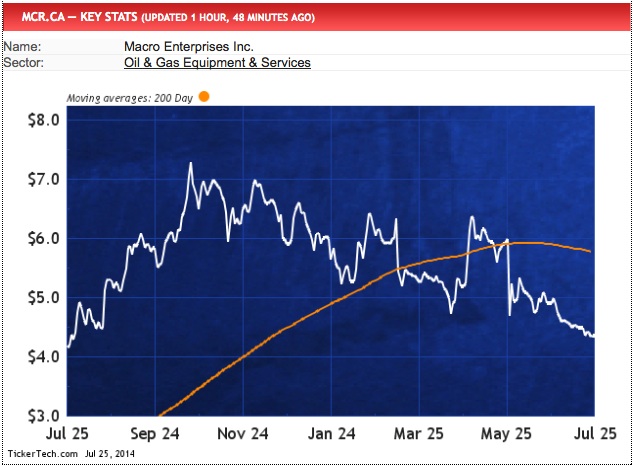
Read full article in a new window: RSI Alert: Macro Enterprises (CVE:MCR.CA) Now Oversold


Once upon a time, there were safe havens in this world, places where investors could hide when the going got rough. If you believe this fairy tale world will persist, pinch yourself. In our assessment, not only are there no safe havens left, but instability may be the new normal. Is your portfolio ready?

In a ‘typical’ crisis, if there is such a thing:
• First, the equity markets tend to have a broad sell-off as risky assets become less popular. Historically, this is where the U.S. dollar or cash in general has been king. In the Eurozone debt crisis, in this phase, the Euro was sold as a proxy for all things bad in the Eurozone.
• As a crisis evolves, markets tend to become more differentiating. When Cyprus “blew up,” Spain had a Treasury auction paying the lowest yields since the early 1990s.
• Moving on even further, the markets get used to the crisis. When a Portuguese company didn’t pay its loans on time, the markets barely blinked. Part of it was that the risk seemed manageable; but part of it was also that even though crisis management in the Eurozone continues to be far from perfect, participants kind of know the game plan to expect. With that, risk can be priced more appropriately.
Based on this pattern, pundits are quick to encourage investors not to sell and to buy the dips as the recovery is all but assured. Except, of course, if you had your money in Cyprus. The ‘buying the dip’ mentality has reached extremes; arguably, for good reason: by promising to keep rates lower for longer, the Federal Reserve and other central banks around the world have compressed risk premia. That is, the premium demanded for “risky” assets has come down. This may be most apparent in the low yields in junk bonds, an area Fed Chair Janet Yellen has called bubbly, even if her very policies are a key driver. In Europe, European Central Bank (ECB) Chief Mario Draghi has promised to do ‘whatever it takes.’ So why shouldn’t investors chase yields in the weaker Eurozone countries?
What could possibly go wrong?
Anything that looks too good to be true usually is. When risk premia is artificially depressed, it is understandable that volatility is also depressed. But if risk premia expands once again, for whatever reason, asset prices may be at risk. That’s because investors may be less inclined to buy stocks or junk bonds if it suddenly deems riskier. It can be as little as perception (“the glass is suddenly half empty”); it can be the Fed trying to engineer an ‘exit;’ or, for example, it can be geopolitical uncertainty.
There will be lots of confusing signals. For example, for a bit over a year now, the euro appeared to be the preferred “safe haven” – as investors fled emerging bond markets, it didn’t make it to the U.S. dollar, but to places such as Spanish and Portuguese bonds. Of late, though, the dollar appears to show baby steps of yet again being preferred over the euro. But don’t be fooled: the euro is weaker because of the risk that Russia might turn off the gas supply to Europe if the Ukrainian crisis were to escalate. Yet again, while the dollar has strengthened a tiny bit, the yield chasers mostly went right back into emerging markets, with some currencies there rising versus the greenback. This appears more a shuffle by high stakes yield chasers rather than a flight to safety.
While anyone may be excused for being confused by the headlines, consider the medium term outlook: pundits have suggested the Fed will only engineer an exit if the economy looks better. The corollary is that asset prices should then be able to stomach the headwinds caused by rising risk premia. Except that I have my doubts that good news in a market that’s near historic highs will compensate sufficiently for the headwinds of common sense. Let me be clearer: I’m concerned that even if, say, earnings improve, equity prices are at risk as price-to-earnings (P/E) ratios compress. Similarly, even if default rates don’t jump, bonds could fall.
And why do I say ‘headwinds of common sense’? That’s because the markets are historically a risky place to be in. It’s just of late that equity prices have risen on the backdrop of ever greater complacency (lower volatility). In such an environment, investors are chasing performance unaware of the risks they are taking on. Such investors are referred to as “weak hands” – they will be quick to jump ship when the going gets rough. And don’t think most will get out at the top, as investors have been conditioned to buy the dips. To me, it is no question that volatility – read fear – will come back. The question only is can current asset prices withstand fear?
Similarly, I hear folks arguing we shouldn’t be afraid of higher rates, as rates will only go up as the economy improves. In my assessment, Yellen has all but promised us to be late in raising rates. I can see her move nominal interest rates a little higher; but on a real basis, i.e. after inflation, I very much doubt we will see higher rates. Think about how interests are aligned when both government and consumers have too much debt? They both benefit from higher inflation, i.e. debasing the value of the debt. Who is losing out? Foreigners holding US debt may well be on the losing end of this battle. As foreigners don’t vote, their opinion may matter little.
If you are a consumer with savings rather than debt, be aware that your government’s interests are not aligned with your interests. Don’t count on the government to protect the purchasing power of your savings. Just keep in mind that during the past 100 years when government debt was generally much lower, the greenback lost over 96% of its purchasing power (as measured by the CPI). Differently said, if you are not concerned, you are not paying attention.
Instability the New Normal?
But if a crisis can be priced in, so should be a risky environment, right? It all depends on where one is coming from and where one is heading. We are coming from a highly complacent environment, but are heading towards one that may be ever less stable. I’ve already discussed rising risk premia that should be part of the normalization process. But my negative sentiment extends further.
When I raise my concerns, skeptics point out that the financial system as a whole is a lot more robust now. That’s correct in some ways, but has come at a high price: the destruction of the social fabric and political disintegration. By reflating asset prices, those holding assets disproportionally benefit, increasing the wealth gap. Indeed, I would argue policies of the Fed have a far greater impact on wealth distribution than the policies of Republicans or Democrats. Those that know how to deal with easy money, such as hedge funds, can do great in this environment; however, those that don’t know how to deal with debt easily fall through the cracks, unable to recover.
This isn’t just a U.S. problem. Citizens in large parts of the world are dissatisfied with their political leadership. The reason, in my assessment, is that they have seen their purchasing power decline. In my analysis, when citizens see their purchasing power erode over longer periods, they veer towards more populist politicians and explain:
• The rise of the Tea Party and Occupy Wall Street movements in the U.S.;
• Uprisings in the Middle East; • A populist Prime Minister in Japan; and, amongst others,
• The rise of populist parties in Europe.
Folks in the Middle East start revolutions because they can’t feed themselves anymore as food and energy prices have risen. These trends have come on the backdrop of excessive government debt. Ukraine’s problem is that they can’t balance their books; for now, they have the European Union take over from Russia subsidizing Ukraine. Politicians the world over have in common that they rarely ever blame themselves for the plight of their own people. They tend to blame the wealthy, a minority or foreigners.
To put it bluntly, there’s a reason the Great Depression ended in World War II. We don’t predict World War III is about to break out, but the aftermath of a credit bust is a fertile environment for the sort of dynamics that can lead to armed conflict. Russia has an interest in an unstable Ukraine; Japan might ramp up military spending to boost domestic growth, to name but two sources of instability. The U.S., a superpower no longer able to finance all of its commitments is not exactly a source of stability, either: the biggest threat to U.S. national security may not be China or Russia, it’s the national debt.
As the social fabric in the U.S. erodes, I believe we will elect more populist politicians, making it unlikely that we will come up with major entitlement reform to make deficits sustainable. I was dismayed by Janet Yellen’s testimony last week in which she was either evasive or ignorant about the cost of financing U.S. deficits as rates rise. If she was evasive, she missed a major opportunity to try to foster a national debate. While she provided lip service to the fact that costs will rise as rates move up, she failed to say that if we were to move back to historic rates, we could spend $1 trillion more a year a decade from now servicing the national debt (that’s based on CBO projections and historic levels of interest rates). If she is ignorant of the numbers, I’m no less concerned. Either way, though, odds are the Fed may try to keep borrowing costs low, making the discussion irrelevant. It’s in this context that I believe real interest rates will stay low for a long time, as I don’t think we can afford positive real interest rates for any extended period. This is the key reason why I like gold as an investment, as low to negative real interest rates may make the shiny metal that pays no interest (but cannot be easily ‘printed’) a formidable asset.
To summarize:
• Asset prices are at or near record levels;
• Fear appears almost absent from the markets, complacency near record levels;
• Political instability is on the rise as governments drown in debt.
The first two attributes alone should encourage investors to consider rebalancing their portfolios, taking chips off the table.
But where to hide? Historically, bonds or cash are preferred hiding places; even as bonds have performed just fine of late, I can’t help but be concerned bonds might be one of the worst investments over the next decade. I don’t advocate shorting bonds (it can be very expensive to short bonds as interest is to be paid rather than received), but rather consider shorting the dollar should real interest rates continue to be negative. Broadly speaking, buying anything with one’s dollars is akin to shorting dollars. But one can be specific by buying precious metals; one can diversify to baskets of currencies, possibly be tactical in an effort to stay a step ahead as currency wars may be raging; or one goes up the risk ladder to, say, buy equities. Indeed, equities have performed well relative to cash; but as I think I make very clear in this analysis here, I’m afraid investors buying equities now may be late to the party.
The bad news is that there’s no silver bullet, as there may be no such thing anymore as a ‘safe’ asset. The good news is that many investors could benefit from stress testing their portfolio. If you haven’t done so, make sure you sign up for this free newsletter as we explain how you can get your portfolio stress tested in an upcoming analysis. Also, for more detail on how this may play out, make sure to attend our free Webinar, today, Thursday, July 24, at 4:15pm ET. Please share this newsletter with your friends.
Axel Merk
Axel Merk is President and Chief Investment Officer, Merk Investments,
Manager of the Merk Funds.
Major indexes like the S&P 500 and the Dow Industrials appear to be on autopilot — cruising along with an up-and-to-the-right pattern — thanks in large part to free money from the Federal Reserve. They are up 7.5% and 3.1%, respectively, on the year.
Meanwhile, the smaller-cap-biased Russell 2000 continues to struggle against the S&P 500, as was down -0.5% for the year at yesterday’s close.
Two weeks ago, the Russell 2000, via the iShares Russell 2000 ETF (IWM), tested the 38.20% retracement ($115.80) from the May low to the July high, and last week tested the 50% retracement level ($114.21).
Until the Russell 2000 rights itself (i.e., get above the 38.20% retracement), I remain with a degree of caution for the overall stock market.
A similar pattern has emerged with several of the stocks and sectors we are watching together …

I remain with a positive outlook on Amazon (AMZN) and gold via the SPDR Gold Trust (GLD).
However, our positive view on semiconductors, via the SPDR S&P Semiconductor ETF (XSD), is complete now that there are too many mixed earnings results this July.
Witness the puke on Wednesday of Xilinx Inc. (XLNX), which gave back 10.3% on the day.

Last week, I also noted that the broadest ETF measure of the biotech stocks, the iShares Nasdaq Biotechnology ETF (IBB), was not in bubble territory. Last Thursday, it opened at $246.15 and yesterday it closed at $259.08, for a nice pop of $12.93. A positive bias remains on IBB.
Back in January, I weighed in on Byron Wein’s predictions for the year. Then in April, I reviewed my forecasts from January. Now I am grading our thinking from April.
Let me state at the outset of this update that there is a broad agreement with Wien on 70% of his ideas for 2014. However, several points were problematic, and I weighed in on how I thought they would play out.
1. The worst of the year does NOT come first due to geopolitical trouble. Wien still gets a grade of “B-” here and we get a “B-.”
January was down strong, February up strong and March down a bit on the Russell 2000. This weakness continued into mid-May. The geopolitical trouble in the Ukraine and now Israel caused volatility but not a broad sell-off.
My prediction was that the second quarter would be the challenging one for the markets, which turned out to be the case for the Russell 2000, but not the S&P 500 as noted above.
It appears this is happening particularly with the “momentum” Nasdaq names and that rocket ship known as biotech. Time will tell but so far, my timing seems to be on target.
Given that the second quarter is evolving, I give myself an “Incomplete.” The final grade will come at the end of the quarter.
2. Emerging markets will NOT prove treacherous in 2014. So far, Wien gets a grade of “C” as the iShares Emerging Markets ETF (EEM) is up for the year, and we get an “A.”
EEM was up 7.1% through Wednesday’s close. I expect EEM to continue higher IF it can get through $45 here. (It’s currently at $44.76.) Otherwise, a swoon into September could be forthcoming.
3. West Texas Intermediate crude will NOT exceed $110 unless a geopolitical crisis develops in the Middle East — which seems unlikely at this point. So far, Wien continues to get a grade of “C” as WTI crude was at $103.01 yesterday afternoon.
Here, I will give myself a “B+.” What I did not see in January was the geopolitical event driven by Russia invading Ukraine and the current trouble in Israel.
Even the Central Intelligence Agency missed that one. However, my buddy and partner James DiGeorgia nailed that one late last year.
Note, when James pontificates on geopolitical issues, pay attention. (You can catch up on his most-recent writings here.)
That being said, WTI crude had a very brief move above $110 on geopolitical tensions discussed above.
The only area where I agreed with Wien completely was that yields on the 10-year Treasury note would see 4% in 2014. So far, that has not happened and therefore we both get a grade of “C-.”
I noted in April that “There is still plenty of time for that to occur, but clearly the bond market knows something I cannot see with my data concerning the potential weakness for the U.S. economy this year.” This arrived with the Q1 GDP drop of -2.9% we saw in June.
The goal of this exercise is to continue to show you that it is important to re-evaluate your thesis on the market. As George Soros said, “Making an investment decision is like formulating a scientific hypothesis and submitting it to a practical test.”
With two quarters behind us, the practical test is well under way.
Cheers & Hit ‘Em Straight,
Geoff Garbacz
P.S. Right now, James DiGeorgia is excited about a brand-new form of energy, one that mixes sunlight and water with an idea that’s ahead of its time. The U.S. government is excited about it, too. //www.gliq.com/cgi-bin/click?weiss_uwd+GRH-0123c-video+07232014UWD1697UWD+vgbb@shaw.ca+g446+5857231“>Click here to find out why >>
P.P.S. We started looking at the SPDR S&P 500 Semiconductor ETF (XSD) earlier this summer as a potential buy idea. Eight weeks ago Thursday, it opened at $70 and is currently at $73.03, up $3.03 or 4.3%. It has moved up nicely since it was mentioned in this column. As mentioned above, we are now done with our recommendation on XSD. We hope you put some jingle in your pocket on this idea.
The old Dickens quote “It was the best of times, it was the worst of times” is pretty much always applicable to a world as big and complex as this one. But lately, as the disparity between financial markets (best of times) and geopolitics (worst) has grown to almost comical proportions, Dickens has been sounding even more apropos than usual. To take just a few “worst of times” examples:
- Palestinians are shooting rockets at Israel, which is responding with a full-scale invasion that will end up killing many hundreds, including an appalling number of kids.
- A coalition of Islamic radical groups called Islamic State for Iraq and Syria (ISIS) is grinding towards Iraq’s capital, home of the small city that is the US embassy. What we’ll do should it be taken is anybody’s guess, but odds are it won’t be pretty. Meanwhile, Iraq’s Christians are the largely-unnoticed victims of the fundamentalist resurgence.
- Someone using advanced anti-aircraft missiles shot down a civilian passenger jet over Ukraine, and Russia, Europe and the US are making all kinds of threats and counter-threats as they try to apportion blame. There are an awful lot of soldiers in a small space, and the press is now full of “Archduke Ferdinand moment” kinds of analysis.
Meanwhile, global growth isn’t looking so hot. See World GDP Hopes Are Collapsing, which comes with this dramatic chart:

Now, contrast this dark vision with the financial markets, where the picture has literally never been brighter. The US on Wednesday July 23: Stocks mostly higher; S&P 500 in record territory.
And that’s the tame part of the equities world. Emerging market stocks are absolutely soaring. See: EMERGING MARKETS-Indonesia, Russia gains push emerging stocks to new 17-mth high.
So what’s happening? One would think that rational investors would be cautious about buying volatile assets like stocks when there are so many geopolitical landmines just waiting to blow up — and when global growth is failing miserably to meet economist expectations. Instead they’re buying with abandon.
One possible explanation is that the world’s major economies continue to flood the financial system with credit which has to go somewhere. And with bonds yielding next to nothing, equities (and real assets like San Francisco houses and fine art) are getting the bulk of it.
China’s runaway train of an economy is exhibit number 1. See China’s debt soars to 250% of GDP:
China’s debt has soared to two and a half times its economy, Standard Chartered estimates, highlighting the difficulties Beijing faces in balancing growth with the risk of bubbles forming in its economy.
Total financial credit has surged to 251 percent of gross domestic product from 147 percent at the end of 2008, the bank said.
The article contains a must-watch interview with a guy from Motley Fool who asserts, among other things, that China can borrow as much as it wants because it owes the money to itself, and if it eventually needs to ease its debt burden it can just devalue its currency and/or mandate higher consumer spending.
This is from the “current trends will continue forever because the government will make it so” school of thought that typically marks the end of a given binge. When people can no longer rely on fundamentals to make their case, they turn to the delusion of omnipotent powers-that-be. Just go back to the dot-com and housing bubbles for tons of such assertions from now-mostly-forgotten pundits.
To repeat something that’s heard a lot these days, it’s 2007 all over again, and 2008 can’t be far off.
The alarm bells went off on Wall Street last week as Federal Reserve Chair Janet Yellen warned of a bubble in social media and biotech stocks. Indeed, in her public comments last week, Yellen stated that biotechnology valuations are “stretched, with ratios of prices to forward earnings remaining high relative to historical norms.”
Since her comments, the iShares Nasdaq Biotechnology ETF (IBB) has declined about 4 percent.
To me, Yellen’s comments were a bit behind the curve. That’s because in a Money and Markets column that was released about two weeks before Yellen’s comments, I warned everyday investors to steer clear of the biotech IPO mania.
But with the S&P 500 health sector having gained a bit over 12 percent so far this year and about 25 percent over the past year, I think it’s worth looking at some of the more established and high-quality companies in the industry for investors looking to participate in the health-care boom without taking on a lot of the risk associated with the high flyers.
 If biotech companies are too risky, what’s the everyday investor supposed to do?
In last week’s Money and Markets column, I suggested Becton Dickenson (BDX) as a high-quality core portfolio holding. Becton Dickinson is the world’s largest manufacturer and distributor of medical surgical products, such as needles and syringes. The company also manufactures a wide array of diagnostic instruments and reagents. International revenue accounts for 58 percent of the company’s business.
Another one of my favorite companies in the health-care sector is Medtronic (MDT), whose stock has gained about 16 percent over the past year. Medtronic historically has focused on designing and manufacturing devices to address cardiac care, neurological and spinal conditions, and diabetes.
Medtronic has slightly shifted its strategy to focus on partnering more closely with its hospital clients by offering greater breadth of products and services to help hospitals operate more efficiently. The recently announced $42.9 billion acquisition of Dublin-based Covidien, which pairs Medtronic’s diversified product portfolio aimed at a wide range of chronic diseases with Covidien’s breadth of products for acute care in hospitals, will position Medtronic’s as a key partner for hospitals around the world.
The addition of Covidien ramps up the competition between Medtronic and the No. 1 player in medical technology business, Johnson & Johnson (JNJ), putting Medtronic in prime position to challenge Johnson & Johnson at a time when consolidation and leverage over cost-conscious hospitals is a priority.
Medtronic’s stock has pulled back a bit because the Obama administration wants to stop corporate deals like the proposed Medtronic acquisition that could enable the company to save millions in U.S. taxes by shifting its headquarters to Ireland. But I believe the decline in Medtronic’s stock price represents a buying opportunity for price conscious investors.
As with Becton Dickenson, Medtronic’s strong cash position supports its commitment to consistent dividend growth. With a current yield of 1.84 percent and a dividend payout that’s likely to grow in the future, shareholders can expect a solid cash-on-cash return while they wait for the stock to appreciate.
In today’s risky investment environment, my aim is to focus on high quality and Medtronic and Becton Dickenson are two of the best.
Best wishes,
Bill Hall
P.S. I’ve teamed up with Dr. Weiss to bring you the expertise and guidance the wealthy take for granted, even if you have a small portfolio and can’t afford fat management fees. And I have a proprietary report in which I reveal what the super-rich do right that the average investor does wrong — or doesn’t do at all. You can get your copy, FREE, right here.

-
I know Mike is a very solid investor and respect his opinions very much. So if he says pay attention to this or that - I will.
~ Dale G.
-
I've started managing my own investments so view Michael's site as a one-stop shop from which to get information and perspectives.
~ Dave E.
-
Michael offers easy reading, honest, common sense information that anyone can use in a practical manner.
~ der_al.
-
A sane voice in a scrambled investment world.
~ Ed R.
Inside Edge Pro Contributors

Greg Weldon

Josef Schachter

Tyler Bollhorn

Ryan Irvine

Paul Beattie

Martin Straith

Patrick Ceresna

Mark Leibovit

James Thorne

Victor Adair