
Gold & Precious Metals
Up Down UP Down UP…..Then Its STAGE 4 – WHEN GOLD EXPLODES UPWARDS
STAGE 3: The price of gold is subject to increasing highs and lows and large investment funds move in and out of gold as global uncertainties wax and wane, a sign that gold is increasingly a haven in uncertain times.
pp. 151-152, Time of the Vulture: How to Survive the Crisis and Prosper in the Process, DRS, 3rd ed., 2012
In How to Survive the Crisis and Prosper in the Process (3rd ed., 2012) I describe the five stages of gold. When I began writing the book in 2006, gold was in Stage 2. In 2007, gold entered Stage 3 where speculators and investment funds become a factor to the increasingly volatile price of gold.
On October 19th, Commerzbank attributed the day’s 1.3% fall in the price of gold to speculative financial investors: “The Dollar Gold Price fell to $1732 per ounce Friday… We hold selling by speculative financial investors responsible for the price slide… In recent weeks they had strongly built up their positions and may now be seeing themselves forced to take profits given the faltering upswing.” Read here.

….read more about stage 3 then the Explosive Stage 4 HERE

The Canadian economy has shown exceptional resilience during the Great Recession and continues to charge ahead of the U.S. and other developed economies. However, due to their high exposures to volatile materials and energy sectors, the nation’s leading equity indices have underperformed their U.S. peers by a large margin. Still, investors in the pursuit of a meaningful yield can find plenty of investment opportunities in Canadian dividend stocks.
Dividend stocks have fared pretty well on both sides of the border. Despite the recent rebound in bond yields, the U.S. Treasury and Canadian government 10-year bond yields remain below 2%, which makes high-yield dividend stocks with strong fundamentals especially attractive investment vehicles for income investors.
In search of sustainable dividends at reasonably high yields, investors should focus on those companies that pay dividend yields higher than those on comparable assets and that exhibit stability and sustainability of earnings and dividend growth over time. Manageable debt levels, payout ratios below ominous rates and reasonable valuations are also important variables. Here is the top 6 of the 60 Best S&P/TSX Dividend Yielding Stocks. Go HERE or click on the image for the entire list of 60 Dividend Yields:

THESE US COMPANIES HAVE RAISED THEIR DIVIDENDS FOR 50 CONSECUTIVE YEARS
Imagine if you had bought these stocks 20 years ago.
If you had, then right now you’d be earning dividend yields of… 27%… 33%… even as high as 65%. And that’s from brand name companies like Proctor & Gamble (NYSE: PG) and Lowe’s (NYSE: LOW).
Unfortunately, most investors will never see dividend yields like these. They don’t have the patience. They want big dividend checks now, and in a classic twist of irony, they’re missing out on some of the market’s highest-yielding opportunities.
Let me explain…
When most investors think about buying an income stock, they focus solely on the stock’s current yield. They think bigger equals better, and they’re most interested in stocks that offer headline grabbing dividend yields.
Don’t get me wrong… to some extent they’re right. Clearly, a higher dividend puts more cash in your pocket.
But as I told you recently, yield isn’t the only key to a good income investment… you also need to consider a company’s dividend growth. Dividend growth can turn lower-yielding stocks into big income producers over time.
For example, right now Proctor & Gamble pays a dividend yield of 3.2%… nothing special. But in the past 20 years, the company has raised its dividend 799%. That means if you had bought the stock back in 1992, then you would be currently earning a yield on cost of 33%.
The same goes for Johnson & Johnson (NYSE: JNJ) and Coca-Cola (NYSE: KO). If you had bought shares of these companies twenty years ago, thanks to dividend increases, those shares would be paying you over 27% today.
That’s the power of dividend growth… and it’s why I think it’s one of the most important aspects of any income investment.
But that begs the question, how do you know if a company is going to increase its dividend? Dividend increases are decided by a company’s board of directors, and there’s no law that says a company must increase its payout.
That’s why I’ve found its best to look at companies that already have a strong track record of growing their dividend. If a company has a history of increasing its dividend year in and year out, then dividend increases are clearly an important part of the company’s culture. All other things being equal, if a company has increased its dividend consistently for 10, 20… even 50 years or more, then it’s going to be far more likely to keep its dividends growing in the future.
With that in mind, I recently conducted an extensive search to try and find companies that have raised their dividends for 50 years of more.

As you can see, each of these stocks has increased its dividend every year for at least half a century.
The market clearly rewards that kind of behavior. Of the 14 companies on the list, all of them have handedly outperformed the 342% return from the S&P 500 in the last 20 years.
But the real story is what those dividend increases have been able to do for income-oriented investors. Just look at the dividend yields you’d currently be earning if you had bought these stocks just 20 years ago…

As you can see, after 20 years of consecutive dividend increases, each of these stocks offers a very attractive yield on cost. The highest yielding stock on the list – Lowe’s – has a yield on cost of 65%… and that’s from a $37 billion company.
That just goes to show what dividend increases can do for your portfolio. Thanks to dividend increases, some of the market’s lowest-yielding stocks can turn into big dividend payers over time.
Of course with investing, nothing is 100% certain. Just because a stock has increased its dividend for 50 consecutive years, it doesn’t mean it’s guaranteed to increase it for another 50.
But the lesson here is simple — if you’re ignoring dividend increases, then you could be missing out on some of the market’s biggest high-yield opportunities.
[Note: If you’re interested in dividend growth, you need to learn more about my “WGB Retirement Fund.” The 12 stocks that make up this “fund” have seen dividend increases of 21% in the past year… 85% in four years… and even one that stock that’s increased payments every year for half a century. Maybe that’s why some of America’s largest pension funds own millions of dollars worth of these stocks. To learn more about these stocks — including several names and ticker symbols — follow this link.]
All the best,
Paul Tracy
StreetAuthority Co-founder, Chief Investment Strategist — Top 10 Stocks
P.S. — Don’t miss a single issue! Add our address, Research@DividendOpportunities.com, to your Address Book or Safe List. For instructions, go here.
Disclosure: Neither Paul Tracy nor StreetAuthority own shares of the securities mentioned in this article. In accordance with company policies, StreetAuthority always provides readers with at least 48 hours advance notice before buying or selling any securities in any “real money” model portfolio. Members of our staff are restricted from buying or selling any securities for two weeks after being featured in our advisories or on our website, as monitored by our compliance officer.

Earlier this year we reported on the impressive returns that were being produced from a stock screen that allows you to see which companies are attracting favorable upgrades from brokers. The Earnings Upgrade Momentum screen has continued to outperform the FTSE so far this year and one of the interesting current patterns is that half of the 10 qualifying companies are gold mining stocks. So called “earnings upgrades” – when analysts revise their expectations about a company’s performance – can be a significant indicator for individual investors. Indeed, while relying too heavily on the opinions of analysts can be a risky business, these upgrades have been shown to be a fairly influential guide to the future.
How the screen works
As a reminder, this screen works by seeking out stocks that are covered by more than three analysts. Thereafter, each company’s earnings per share estimates for the following year should have been increased by more than 5% during the previous month. In addition, there must have been at least one upgrade during the previous month, and the number of upgrades must be higher than the number of downgrades.
At the height of the financial reporting season in March this year (when the market hit a 2012 high of 5,966 points), the screen was the best performing Stockopedia strategy. Among the companies qualifying at the time were paper and packaging group Mondi (LON:MNDI) and media companyItv (LON:ITV). Both were hit by the market-wide volatility that struck in early summer but have subsequently recovered and are now trading close to their one-year highs. By contrast, Max Petroleum, a small-cap oil and gas stock on the screen back then, went on to see its price collapse under the weight of poor news from its operations in Kazakhstan. That illustrates the importance of doing further analysis and/or using diversification when screening, rather than just pickling one name blindly from a list.

In the year-to-date, the Earnings Upgrade Momentum screen has produced a return of 15.9%. The list of stocks qualifiying changes every day although we rebalance our model portfolio each quarter. Interestingly, out of the 10 now qualifying companies, six of them are mining stocks – and five of those have a strong emphasis on gold production.
Why gold now?
Between October 2008 and August 2011, the price of gold surged from around $715 per ounce to a high of $1,890. Many analysts thought the price would go on to break $2,000 but during the second half of last year gold became volatile and went on to fall to $1,550. However, since mid-August the price has been on the march again and gold currently trades at just short of $1,750. Analysts have credited much of that performance to anticipation surrounding the US Fed’s decision to launch a third round of quantitative easing. The price “pop” from the Fed’s move has been more muted than on previous QE rounds, but some institutions think the price will go on to trade much higher. BlackRock’s Evy Hambro has been reported as predicting $2,400 per ounce by next summer, while Deutsche Bank’s forecast for next year is $2,113.
…..read page 2 HERE
 Update: In the last month Tyler Bollhorn bought Dara Biosciences and sold it five days later for a 40% gain. Overall in the month of September he made money on 90% of his trades.

Commodity prices continue to look toward US event risk for direction cues as traders weigh the ability of a cautious pickup in North America to offset sluggish performance in Europe and Asia. On the economic data front, the focus is on the Richmond Fed manufacturing activity gauge. Expectations call for an improvement in October, hinting the positive cues seen in September’s releases are carrying forward. Turning to the earnings docket, cycle-sensitive names with a global footprint including United Parcel Service, E.I. du Pont de Nemours and Ryder System are in focus as markets continue to fine-tune their global growth outlook.
On balance, a risk-supportive mix of releases stands to boost gold and silver, where pricescontinue to track broad-based sentiment trends (reflected in a significant correlation with the S&P 500). Copper prices are likewise positioned to take advantage of such a scenario as correlation studies suggest the influence of risk appetite is reasserting itself. Needless to say, disappointing results on the data and/or earnings sides of the equation stand to produce the opposite results.
Crude oil continues to stand aside from the broader risk-on/risk-off dynamic guiding many benchmark assets across the financial markets. With that in mind, the weekly set of inventory figures from API may prove more significant. The monthly trend has pointed to a steady build in crude stockpiles since mid-August. A reinforcement of this dynamic may apply pressure to the WTI contract as prices approach technical support (see below) and may force a breakout. Alternatively, a meaningful drop may offer a lifeline after two days of aggressive selling.
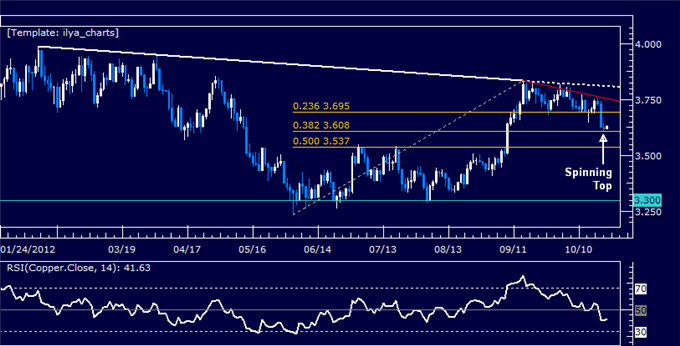
Comex E-Mini Copper (NY Close): $3.622 // -0.016 // -0.44%
Prices broke support at 3.695, the 23.6% Fibonacci retracement, exposing the 38.2% level at 3.608. A Spinning Top candle warns of indecision and hints a bounce may be ahead. The 3.695 level has been recast as resistance, with a push back above that exposing a falling trend line set from the September 14 high (now at 3.755). Alternatively, a break below support targets the 50% level at 3.537.
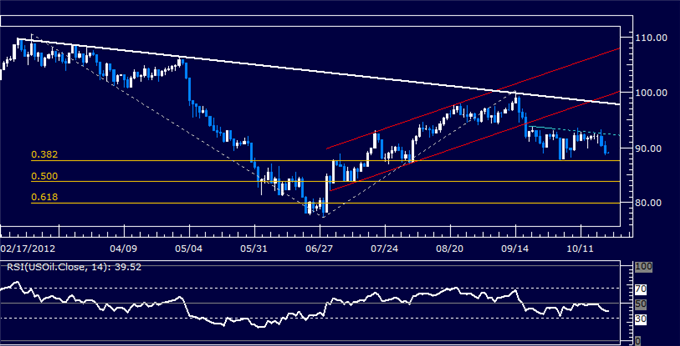
WTI Crude Oil (NY Close): $88.65 // -1.79 // -1.98%
Prices continue to consolidate above support at 87.66, the 38.2% Fibonacci expansion. Resistance is at 92.25, marked by a falling trend line established from late September, with a break above that targeting a larger downward-sloping barrier set from the February top, now at 97.90. Alternatively, a drop through support exposes the 50% level at 83.76.
…..Gold & Silver on page 2 HERE


-
I know Mike is a very solid investor and respect his opinions very much. So if he says pay attention to this or that - I will.
~ Dale G.
-
I've started managing my own investments so view Michael's site as a one-stop shop from which to get information and perspectives.
~ Dave E.
-
Michael offers easy reading, honest, common sense information that anyone can use in a practical manner.
~ der_al.
-
A sane voice in a scrambled investment world.
~ Ed R.
Inside Edge Pro Contributors

Greg Weldon

Josef Schachter

Tyler Bollhorn

Ryan Irvine

Paul Beattie

Martin Straith

Patrick Ceresna

Mark Leibovit

James Thorne

Victor Adair