Timing & trends

Flash Buy Alert

We continue to believe we may have seen a multi-year long-term bottom in the Japanese yen. The catalyst for this view is the fact Japan is now running a deficit in its trade account (see charts next two pages), compared to a consistent surplus going back to the early 1980’s. We suspect this new trade dynamic will make it increasingly difficult for Japan to fund its massive debt profile—up to 240% debt/gdp on some estimates. If so, we believe risk will finally flow into and weaken the yen. It seems to us, most of the repatriation back into Japan has already taken place, triggered by the credit crunch and Tsunami. So, on risk the yen will not receive the haven flow it has in the past.

We suggest you buy ProShares UltraShort Yen (EFT); symbol is YCS at the market. [Last Price = $43.68]

YCS has broken above its daily downtrend line going back to April 2009, and has also recently pierced the 200-day moving average on the upside. 

Screen Shot 2012-11-06 at 8.49.30 AM

Screen Shot 2012-11-06 at 8.49.54 AM

Screen Shot 2012-11-06 at 8.50.05 AM

Screen Shot 2012-11-06 at 8.50.27 AM

This chart shows the correlation between USD/JPY and the trade account. Historically, weaker trade has coincided with a weakening yen, i.e. USD/JPY moving higher. But since the credit crunch in 2007, the yen has strengthened dramatically (USD/JPY plunged) as the trade account deteriorated dramatically. We think this represented repatriation flow back to Japan. And we think this is likely done! 

Thank you.

Regards,

Jack and JR 

4 steps to picking correction-proof Real Estate

palm-beach-real-estate

For investors, withstanding the ebbs and flows of the real estate cycle is par for the course. But how do you choose a property that can do the same?

Construction consultant Marco Ganassini has been in the industry for almost 30 years, and says there are four fundamentals to consider when picking a correction-proof property that will attract tenants, mitigate risk, minimize expenditure and, most important of all, provide cash flow.

1. Avoid picking a property solely on price-point – no matter how good a deal it may seem

“The biggest mistake people make is when they chase prices is they look for property in areas where prices have been escalating, especially in the recent past, rather than looking at the fundamental value of the property,” he says. “Primarily, you should be looking for a property that, if and when a correction occurs, you won’t be forced to sell.”

According to Ganassini, there is one principle thing to consider when picking a correction-proof property.

“The whole concept surrounds mitigating risk,” he says. “You’re looking for property that has intrinsic or fundamental value, and we base that on return on investment and cash flow. You want to have some margin of safety.” He continues, “If unforeseen expenses occur, if your revenue stream gets affected, you want to make sure you have the cash flow or capital to cover it. To do that would include not over-leveraging yourself, and finding a property in already excellent condition.”

….read 2-4 HERE

The Most Important Chart in the World

With $7 trilliion in official Forex Reserves owned by emerging, non-members of the G-7 Old Boys Club of global banking elites that’s largely denominated in US$ and Euro, this chart shows the track record of the 5 major currencies reflected by the historic denominator of money…gold.

The Nobel Peace prize committee has made another remarkable choice that boggles the mind. In 2009 they gave it to Obama just for getting elected, and this year its going to the EU – for its role in “uniting the continent,” contributions “to the advancement of peace and reconciliation, democracy and human rights in Europe.” How ironic that Norway – home of the committee, was one of the few to refuse to join the EU.

The political elites of the US, UK & Europe have flooded the emerging world with their paper in exchange for goods and resources to fuel a virtual industrial revolution in one generation. Those paper holders will ultimately call the shots on the ongoing viability of that paper in due course. 

Screen Shot 2012-11-06 at 7.15.33 AM

Look at the trends above, or indeed the chart I often show in my talks that takes the same data right back to 1946. That is the track record of ‘currency management’ by the elitist “old boys club”

of the Central Bankers, IMF, BIS and World Bank. For individuals, private ownership of gold is clearly a preferred vehicle for long-term preservation of purchasing power for so long as all the paper issued by the old boys club sports negative real returns.

With a global slump underway, the merging leaders have their hands full at home, and with the US elections now and German election next Spring, they are keeping their heads down to avoid any politically motivated retaliation. But they are taking bilateral steps to settle trade in their own currencies to stem the buildup of their US$ and Euro holdings, which will have big Western consequences down the road.” 

Ian McAvity

About Ian McAvity:

“Ian McAvity…he is one of the best technical analysts around.”. I think I saw one of his marvelous, hand-drawn charts in Richard Russell’s Dow Theory Letters, and that led to my subscription to Deliberations. Ian’s timely advice helped me to profitably navigate the gold and gold stock bull market of the 1970s.

Andrew Sarlos

DELIBERATIONS on World Markets, P.O. Box 182, Adelaide St. Station, Toronto, ON M5C 2J1. 1 year, 18 issues, $225. Introductory Trial, 4 issues, $49 

3 Hot Stocks To Be Fearless With

WEEKLY COMMENTARY

This week’s Trading Lesson
Here is an excerpt from my upcoming book, The Mindless Investor, How to Make Money in the Market by Overcoming Your Common Sense. This piece is from the chapter, Be Fearless:

I think many traders have a hard time believing they can make money by buying a stock and waiting. Most of us are not taught to make our money work for us but instead that we must work for our money. Go to a job, put in the time and you get a paycheque. Work hard, and your paycheques will grow. But the thought that you can make money by putting your feet up is a difficult thing to grasp.

With that mental programming, most of us have difficulty holding on to our strong stocks and letting the profits grow. If we buy a stock at $1 and it goes up to $1.20 in a couple of days, we are likely to sell. In some ways we think of this fast return as good luck, not much different than buying a winning lottery ticket. We have a fear that someone is going to figure out that we have benefited from a mistake, and so we better get out now before we get discovered.

This thinking is strengthened when we take a trade that’s less than ideal and it goes down as quickly as it went up. If we take a marginal trade we should expect marginal results, but somehow we only remember the negative feeling of watching a paper profit turn into a loss. We tell ourselves that next time we will sell at the first sign of weakness and crystallize the gain. Avoiding pain is human nature.

Our next trade is of higher quality but we sell it on a short-term weakness and lock in a quick but relatively small profit. While lost in self-congratulations we realize that someone named Murphy is writing the laws of trading, and we watch the stock march ever higher with us eating the stock’s dust. We have jumped off a high-speed bus that is headed for Profit City.

What is behind this destructive behaviour? It’s that deep-rooted emotional response to danger that keeps us out of trouble but also makes us avoid a greater feeling of fulfilment.
Fear is what makes us sell our winners too early and hold our losers too long.
The best traders are not afraid of holding on to strong stocks, they are afraid of holding on to losing stocks. What do you do when you trade?

If you are a normal human being, you do the opposite of what the pros do. Think about the last loser that you owned. As the stock fell lower and lower, what was it that you told yourself over and over?

“It’ll bounce back eventually. I’ll just be patient.”

What your subconscious mind was really saying was, “It’s much too painful to sell this loser and see that loss of my hard-earned capital. I’ll hold on with the hope that it goes back to what I paid for it and then I’ll sell.” And of course, it continued lower because there was something wrong with the company and it deserved to go lower.
So what can we do to fight our destructive minds? How can we program ourselves to hold on to our winners and dump the losers? How can we trade without fear? Here are three of my seven criteria for fearless trading:

Only Trade Quality
Our fears are confirmed when we enter marginal trades. If you only trade the best opportunities, you will trade less but you will have greater success. This will put you on the road to fearless trading and help you simplify your trading approach. Write down your rules and do nothing unless every rule is satisfied. When you consider a stock, look for a reason to avoid the trade. If you can’t find one, then you have a trade worth taking.

Buy with Confidence
The rules that you trade with have to have a foundation of success. You have to believe in your rules or you won’t believe in holding the stock through the shakeout periods in the longer-term up trend. Analyze and test the strategy until you have proven to yourself that it works. Then trade it slowly without a lot of risk, so you can gain a greater level of confidence that it works.

Don’t Watch the Scoreboard
Sports fans don’t spend a lot of time watching the scoreboard during a game. It only matters when the game is over. In trading, the scoreboard is the profit and loss figure for your account. If you focus on the scoreboard, it is likely that you will lose sight of what’s happening in the game. As a technical trader, all that matters to me is what the chart is telling me.

STRATEGY OF THE WEEK

With the US election on Tuesday, the market has been very quiet recently with few investors willing to make a significant move ahead of the vote. Tonight, I ran a Market Scan on Stockscores with the following settings:

Sentiment Stockscore > 60
Breakout through 80 day Resistance
Volume above 20 day average
Trades > 250

Here are some of the stocks that I feel have good charts:

STOCKS THAT MEET THAT FEATURED STRATEGY

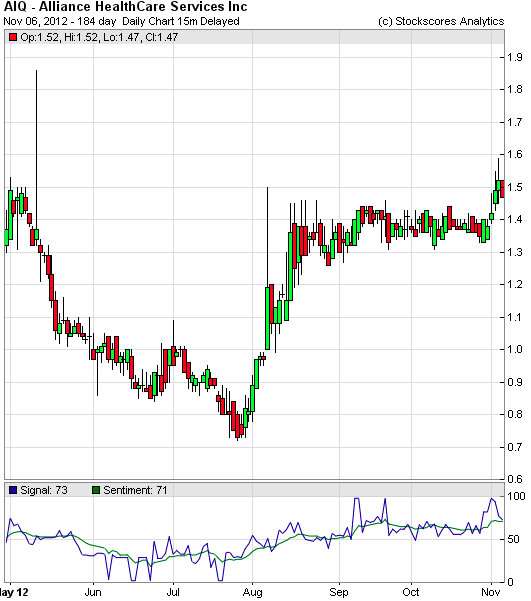
1. AIQ
AIQ is making a cup and handle pattern breakout with increasing volume over the past few days. Support at $1.33.
Screen Shot 2012-11-06 at 7.48.14 AM

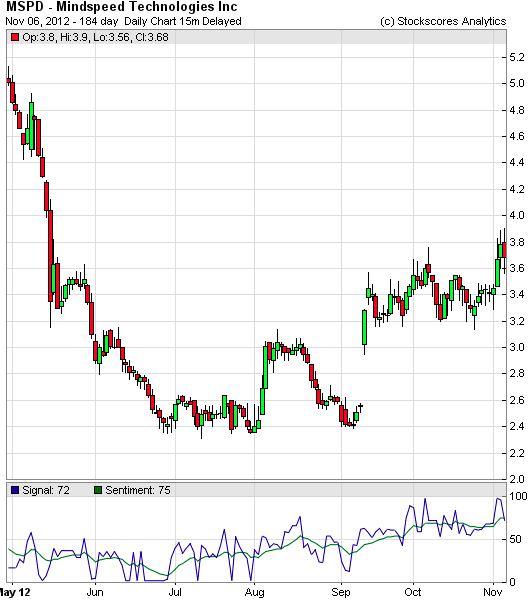
2. MSPD
I featured MSPD in the daily newsletter two days ago, it has been moving higher through resistance from an optimistic chart pattern. Support at $3.34.
Screen Shot 2012-11-06 at 7.48.31 AM

3. T.RIM
T.RIM (RIMM on Nasdaq) is shaping up as a nice long term downtrend reversal pattern. Support at $7.55.

Screen Shot 2012-11-06 at 7.48.45 AM

Stockscores Mindless Investor Book Launch Special Event
Calgary Monday Nov 12 6:30 – 8:30 pm
Vancouver Tuesday Nov 13 6:30 – 8:30 pm
Click here for information and to register for this free event

Join me as I show some of the ways I use Stockscores.com to pick and track stocks and ETFs. This is an informal evening focused on the analysis of the current market and a hunt for ways to make money from it. Free to attend and copies of my new book, The Mindless Investor, will be available for purchase for $30. Please register to attend and let us know how many copies of the book you wish to purchase in the comments section of the registration page so we can bring enough copies.

Stockscores Trader Training
The 12 week Stockscores Investor and Stockscores Active Trader training programs start with the live Foundation class on November 24th in Vancouver and November 25th in Calgary. Click here to visit the information page.

Live Trading Day
For those who have completed the StockSchool Pro, Investor or Active Trader classes in the past, I will be doing a live trading day in Calgary on Monday November 26th. Watch me trade live and learn the processes I go through to find day and swing trading strategies. Emailtylerb@stockscores.com for more information.

Stockscores Market Minutes Video
Traders are challenged with finding the right stocks at the right time. The Stockscores Market Scan tool allows you to scan the market using a wide range of filters. In this week’s Market Minutes video, I demonstrate how to use it. You can watch this week’s video on Youtube by clicking here. To receive email alerts any time I upload a new video, subscribe to the Stockscores channel atwww.youtube.com/stockscoresdotcom.

References

  • Get the Stockscore on any of over 20,000 North American stocks.
  • Background on the theories used by Stockscores.
  • Strategies that can help you find new opportunities.
  • Scan the market using extensive filter criteria.
  • Build a portfolio of stocks and view a slide show of their charts.
  • See which sectors are leading the market, and their components.

    Disclaimer
    This is not an investment advisory, and should not be used to make investment decisions. Information in Stockscores Perspectives is often opinionated and should be considered for information purposes only. No stock exchange anywhere has approved or disapproved of the information contained herein. There is no express or implied solicitation to buy or sell securities. The writers and editors of Perspectives may have positions in the stocks discussed above and may trade in the stocks mentioned. Don’t consider buying or selling any stock without conducting your own due diligence.


Peter Grandich is Cautiously Optimistic About the Juniors in 2013.

Resources Wire editor Kevin Michael Grace interviewed Peter Grandich October 24, 2012. In this second part of that interview, Grandich focuses on the prospects for junior-resource companies.

RW: The last time we spoke, you were quite gloomy about the juniors. Since then we’ve seen a rally. Are you less gloomy than you were?

PG: I don’t know if I was gloomy; it was more being realistic. We had suffered the worst bear market in quite some time in the junior resource market. There is no question that they’ve risen off the bottom, but I thought that those who were forecasting dramatic rises from that point were sadly mistaken.

Financing is still very difficult, and nothing in that area will change until at least early next year. I fully concur that the worst is behind us, but we’re not about to have nirvana any time soon. The juniors really made more of an overall sideways move. I don’t expect that the whole market to move up substantially and hold those gains until gold makes its move above $1,900.

….read more HERE

This following interview focuses on gold and the debt crisis:

Gold And The Debt Crisis

Peter Grandich Sees $2,000 Gold in 2013

RW: Let me start with market suppression. We’ve heard mainstream sources talking about the suppression of gold. And John Williams of Shadow Stats has also had some mainstream attention. Are you encouraged by this?

PG: I think the unemployment number was the biggest surprise. The talk wasn’t from the normal “conspiracy” groups but from Jack Welch, who used to run GE. While it brought attention to the possibility of manipulation, I don’t think it did anything to tone it down or stop it. Those who are doing it will continue to do so until such time as we see a smoking gun.

RW: On your blog, you called Comex “Crimenex.”

PG: Yeah, I’ve used it again, a couple of minutes ago. I’m not the first to use that terminology.

RW: Do you think gold suppression is sustainable? If so, for how long?

PG: I differ a little bit from the more day-to-day people in that I don’t believe it happens as often as they believe it does. But I don’t think there is a big difference between me and the others in that there has certainly been a reason to deter gold from rising as fast as it might have otherwise. If and when the manipulation is done, it’s obviously done in the paper market, which we know as Comex. I feel for those like GATA who say this is happening on a daily basis, as they continue to demonstrate a bigger and better circumstantial case.

Still, most of the mainstream media ignore them. I feel their frustration because when they do see something in the media about it, it’s from the parties on the opposite side who say there is no such thing, you’re stupid, a kook or tinfoil-hat person. Yet the other side has been so wrong on the price movement of gold. It always seems that those of us who have been right for the bulk of the decade are those who always have to respond to any decline in the gold price. But those who have been so wrong about the gold price never seem to have to answer for their mistakes.

RW: The people who hate gold are always talking about a bubble, and the bubble is always bursting or about to burst. Isn’t it a commonplace that in bubbles you have massive over-investment? Isn’t it true that there are still relatively few people invested in gold?

PG: Yeah. I’ve called it the biggest stealth bull market in my nearly 30 years in business. I never could have imagined it when I started working in the financial community. That something can rise in such percentage terms and not only see a lack of support but also no real participation across the board by average investors.

Bubbles are like the NASDAQ stocks in the 1990s and real estate a few years ago when the vast majority of people were in it, and their expectations were for it to only go higher. Nothing can be further from the truth in the gold market, and that’s why the bubble talk is really just BS and a façade they try to create.

The fundamental arguments they’ve made for gold to fall hundreds of dollars haven’t worked out. So they try to say that the only reason we got up here is that there are masses of people buying and hysteria accumulating. I respond that if everybody was buying it, all these people wouldn’t be profiting from their ads telling people sell their gold, send it through the mail, etc. I think that’s more the BS from what I and others have coined the Permabear camp.

….read page 2 & 3 HERE

test-php-789