
Gold & Precious Metals
Logic suggests that the gold price should be riding much higher than it is at present – what is keeping it down?’
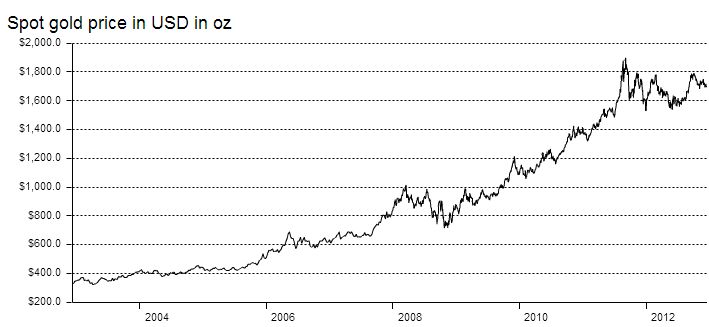
The gold market has been denying all logic. Virtually everything which is happening in the global economy suggests that the price should be rising – and probably rising fast, yet it has been unable to move out of a trading range of between around $1680 – $1750 – and every time it nears the top of this range it gets knocked back again. It certainly has made some weak holders pull out of the gold market altogether, while other half believers are beginning to find the call from gold experts that they should use the dips as buying opportunities frustrating to say the least – and they may fall out of the market too.
It’s actually interesting to look at the chart of the gold price running back ten years or so:
….read more HERE

About two weeks ago, GoldMoney sent out an apologetic email to all of its Dutch customers. The email explained how the Dutch financial regulator (AFM) considered GoldMoney to be in violation of various licensing rules and compliance requirements.
Among other things, AFM indicated that GoldMoney was selling ‘investment objects’ without a license… something that they consider a heinous breach of their silly bureaucracy.
Now, there are so many technicalities involved here– whether physical metal constitutes ‘investment objects’ anymore than a collection of 80s action figures or a cellar of fine Bordeaux. Then there’s the jurisdictional issue– GoldMoney doesn’t even operate in the Netherlands, nor does the company sell its own inventory. Etc., etc.
None of these points seem to matter; the regulators have spoken, and as a consequence, GoldMoney is now closing the accounts of every customer living in the Netherlands.
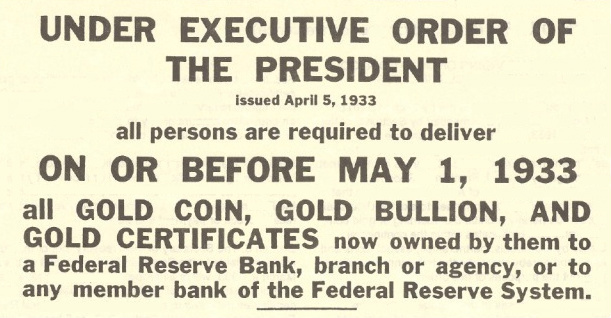 It’s always troubling when governments go after firms like GoldMoney. The more signs I see, the more I’m starting to believe that we’re heading down a path where precious metals are once again confiscated, outlawed, or at least severely restricted in many countries.
Let’s start with the why. What possible sense would it make to reduce or restrict gold ownership?
Simple. The modern financial system is a complete joke. Money is conjured from thin air, backed by false promises from bankrupt governments. Then there’s the fractional reserve swindle, centrally planned interest rates, government-produced inflation, manufactured statistics, insane credit and sovereign debt bubbles, etc.
It’s a total fraud… and like any good con, it depends on just that: confidence.
In order for a system based on -nothing- to perpetuate, it’s imperative that it commands the confidence of the people within it. And people in rich western countries have been programmed since birth to believe that the colored pieces of paper circulating around in their economies are intrinsically ‘valuable’.
It’s funny, because developing countries already know it’s a scam. They don’t trust their governments, and they don’t trust those silly pieces of paper either. Out here in Asia is a great example– most of the region is very gold-oriented. They use paper as a medium of exchange, but it’s a cultural norm to save with gold.
In fact, when I walked into an Internet cafe earlier today here in Thailand, I noticed quite a few people at the computers checking out live gold charts (from Kitco).
People in western countries are just starting to get it… and as more people peek behind the curtain to see the true crimes being committed, the system will be finished.
The gold price is a constant reminder that the fiat financial system is a con job. And the higher the gold price becomes, the more people become aware. The political establishment will do whatever it takes to maintain the status quo, and it’s possible that precious metals restrictions will become a tactic:
Step 1: Just make gold ‘harder’. To buy. To transport. To own.
Think about the changes we’ve seen over the last two years; government-regulated exchanges are continually hiking their gold margin requirements, increasing investors’ burden to buy.
On the physical side, the US government buried some insane regulations deep within last year’s healthcare bill. The new rules required a mountain of paperwork such that anyone who purchased a single ounce of gold from a coin shop would have to submit a special 1099 form to the IRS.
(The rule was later modified under intense pressure from various lobby groups, but it still gives you a good idea of what these people are thinking…)
Then there’s the new Dodd-Frank legislation that makes it nearly impossible for US citizens to trade securities and commodities from overseas accounts beyond the reach of the federal government.
Then there’s the Liberty Dollar debacle in which the US government used obscure counterfeit laws to seize millions of dollars of silver coins that were owned by the firm’s customers!
Then earlier this year, the Financial Crimes Enforcement Network (FinCEN) issued new guidance requiring that US taxpayers who hold gold in certain offshore financial accounts report such holdings on their annual FBAR. Conveniently, this ruling put up a barrier for Americans to use GoldMoney.
GoldMoney’s battle with the Dutch regulators is just another example of governments making gold ownership more cumbersome.
Step 2: Plant seeds of doubt
We’re seeing signs of this as well. “Prominent” economists have been pounding the table against precious metals with vigor, and the propaganda ministry is focusing its efforts on gold’s recent price drop to make people believe that it’s dangerous to buy.
This recent media clip in which a reporter extols the virtues of the US dollar being backed by the federal government says it all. It’s already begun, and we should expect more.
Ed Note: The Video was removed at posting time
Step 3: Tie gold to terrorism. Plant evidence.
Here are two incontrovertible facts: Westerners are petrified of Arab terrorists. The Arab world is a very gold-oriented society. It wouldn’t take much effort to link the two by suggesting (and planting evidence) that terrorists use gold to move money and finance their operations.
This will be surely be the next step… and if we start seeing this, you can bet your last ounce that restrictive controls are coming.
So what to do…?
If you live in a broke western nation, whatever you do, don’t store your gold in a bank safety deposit box. Bankers are unpaid government spies, so you might as well hang a sign up that says “please seize my assets”.
Ideally you want to move your gold out of the country. We’ve talked about anonymous boxes in Vienna’s Das Safe facility in the past, as well as Hong Kong’s The Storage. Both of these are great options to buy and store gold.
If you really want to take action, moving and storing gold overseas is a frequent topic in Sovereign Man: Confidential. If you subscribe today with a risk-free trial, you’ll get immediate access to our comprehensive ‘offshore gold’ intelligence, including unique solutions and members-only discounts with providers.

 Global markets from Mexico and Canada to Europe and Asia are beginning to take note of the U.S. fiscal cliff, the daunting array of tax hikes and spending cuts set to take effect Jan. 1 unless lawmakers find a compromise.
If there is no solution reached, the impact could be devastating to Mexico, America’s third-largest trading partner, Voice of America (VOA) News reported.
“While Mexico is doing relatively well economically, the country would take a hit if debt talks fail,” Eduardo Garcia of the Mexican financial news site Sentido Comun, told VOA.
Editor’s Note: The ‘Unthinkable’ Could Happen — Wall Street Journal. Prepare for Meltdown
The effect would be adverse because Mexico’s economy is highly integrated with the U.S. economy, Garcia said. In fact, approximately 30 percent of the Mexican economy is export-based, and the United States consumes 80 percent of those products, he said.
According to The Toronto Star, almost two-thirds of Canadians are worried that the looming U.S. fiscal cliff will harm the Canadian economy, according to a survey commissioned by Sun Life Financial.
“Canadians are right to be worried about this. If it doesn’t get resolved and the U.S. economy goes into recession, the impact would fall into Canada as well and cause difficulties here,” said Sadiq Adatia, chief investment officer at Sun Life Global Investments.
Meanwhile, the Financial Times noted that going over the fiscal cliff could impact China’s recovery
The Times said that “for all the new found optimism in the Chinese economy, it is feared that any such recovery could be derailed if the U.S. falls off the fiscal cliff. And it is this issue that is arguably still the main driver of broad market sentiment.”
Agence France-Presse, in a dispatch from Hong Kong, agreed, noting that Asian “markets are nervous that U.S. lawmakers seem to be making slow progress on an agreement.
Emerging markets in general are being affected by the talks in Washington, according to Bloomberg.
“Emerging-market equities have run up quite a bit now and investors will keenly watch the U.S. fiscal cliff negotiations and corporate performance in the upcoming earnings season for more cues,” Gopal Agrawal, chief investment officer at Mirae Asset Global Investments in Mumbai, India, told Bloomberg.
In South Africa, Independent Newspaper quoted one banker as saying currency traders there are “adopting the safety of the sidelines until there is more clarity on the fiscal cliff front.”
In the United States, however, not all consumers appeared to be worried about the fiscal cliff.
One recent college grad interviewed by CNBC at a shopping center in Los Angeles said she didn’t know enough about the fiscal cliff to have an opinion. “I’m more concerned with getting my mom the right gift.”
Editor’s Note: The ‘Unthinkable’ Could Happen — Wall Street Journal. Prepare for Meltdown

Quotable
“One of the elementary rules of foreign policy is when you are in a hole, stop digging. But judging by their recent behavior, Beijing’s foreign policy mandarins and national security establishment are clearly in violation of this rule.”- The Bullies of Beijing: China’s Image Problem, The Diplomat
Commentary & Analysis
Italian 10-yr benchmark yield at 4.56%; is the bottom in place?
European periphery country bond yields have plunged, after peaking in late November 2011. The catalyst seems two-fold: 1) the success of the European Central Bank’s (ECB) long-term refinancing operations (LTRO), which force-fed money into European banks to better match ongoing liabilities, and 2) the edict by the ECB that it would do all to save the euro and that includes “unlimited” bond buying if necessary.

Italian 10-year yields peaked at around 7.3% back in November 2011 and now sit comfortably at 4.56% today, after hitting a low of 4.4% on December 4th . December 4th was when Italy’s Economy Minister Vittorio Grilli said Italy was on track to hit its deficit targets for 2013 and 2014, Reuters reported. On Sunday, Italy’s central bank Governor, Ignazio Visco, said the country doesn’t need the ECB to handle market tensions now that market access has been restored.

In short, these are quite optimistic statements from Italy’s economics team given the Eurozone recession is still in full swing and likely deepening (S&P warned Italy’s rating could be cut if the recession continues). Plus, there is potential for a leadership crisis to rear its ugly head in Italy now that Mr. Monti has stepped down, and Mr. Berlusconi, in some form or fashion, has stepped up.
A whole lot of money has been made by those gutsy enough (and deep-pocket enough) to have bought Italian bonds early this year and held on tight for a wild ride. The question we always ask: Is everyone that wants to be in this trade already positioned or are there good reasons why it makes sense for more money to flow into Italian bonds?
Technically, there seems a little bit for both sides to support their respective fundamental view (there usually always is):
10-year Benchmark Italian Yield Daily: 1) An A-B-C correction is almost complete; or 2) a classic head and shoulders setup that suggest a test of those old lows at 3.6%?

Traders will likely be focusing on the Dec. 4th, 4.4% low. They rarely make this stuff easy so stay tuned.
Black Swan Forex Service:
We would be happy to provide samples of our forex trading service upon request. And if you have further interest, you are welcome to a free trial of the service. It is not a service for the novice, but if you are a serious trader looking for ideas, or another view to bounce against your own, I believe you will enjoy Currency Currents Professional.
Black Swan Global Macro Service:
Monthly global macro analysis and longer term trading ideas using ETFs. We are still seeking subscribers who prefer a dose of crowd skepticism delivered with their analysis. At only $99 per year this thing is a real bargain. If you would like to see a sample, please let us know.
Jack Crooks
Black Swan www.blackswantrading.com info@blackswantrading.com
Black Swan Capital’s Currency Currents is strictly an informational publication and does not provide personalized or individualized investment or trading advice. Commodity futures and forex trading involves substantial risk of loss and may not be suitable for you. The money you allocate to futures or forex trading should be money that you can afford to lose. Please carefully read Black Swan’s full disclaimer, which is available at http://www.blackswantrading.com/disclaimer

This ‘Rodney Dangerfield of Metals’ Deserves Your Respect
Gold and silver may be the metals of kings. But if you’re looking for potentially royal returns on bullion bars and coins, you may want to consider adding a “noble” (that is, durable) metal to your collection: palladium.
Investors increasingly seeking refuge in bullion as personal stores of wealth have pushed gold and silver prices ever-higher. Meanwhile, platinum is 15 times more-rare than gold, and palladium is even more rare than platinum, at 30 times rarer than the yellow metal. And yet, palladium costs less than half of gold’s current price!
I like to think of palladium as the Rodney Dangerfield of metals, because it doesn’t get the respect it deserves. This presents us with a terrific opportunity to buy while no one else is looking.
If you’re looking to add some diversity to your precious-metals portfolio, palladium looks like an investment that’s as durable as the metal itself. Here’s why …
This White Metal Is Getting Red-Hot!
Palladium demand is rising, as more of it is purchased for use in catalytic converters, its No. 1 use.
At the same time, supplies from mines in Russia and South Africa remain tight.
According to experts at Johnson Matthey, the gap between supply and demand for palladium this year is near 915,000 troy ounces, as production dropped 6 percent. That means palladium stockpiles are down … and dropping.
Next year, a growing shortfall in supply could send prices another 20 percent higher, according to analysts.
And while most of palladium demand currently comes from the auto industry, there is also plenty of demand from the investment community.
Nearly 1.9 million ounces of palladium are held by ETFs, the COMEX metals market, banks and other funds that make their holdings public.
Considering that only 6.6 million ounces of palladium are produced by mines every year, that’s quite a bit of investor interest.
Johnson Matthey expects prices to range between $550 and $750 per troy ounce in the first part of 2013. One troy ounce currently costs in the high-$600 range.
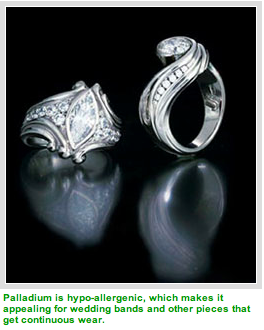 One reason for palladium’s investment appeal is steady demand among jewelry buyers, where the research group anticipates sales will be “relatively strong” at 45,000 ounces in North America, and 450,000 ounces worldwide.
Why Palladium Shines as the Metal to Buy ‘Now’
Many in the jewelry industry call palladium the “Now Metal,” as consumers are increasingly turning to it for a unique, high-quality piece of jewelry, but without the hefty price tag.
Unlike gold, palladium is naturally silver-hued without the need for alloys such as those found in white gold. And unlike silver, palladium does not tarnish or lose its shine.
The Best Way to Get Invested
How do you determine a fair price to pay for this white, and white-hot, metal? The ETFS Physical Palladium Shares Fund (PALL) is a great starting place, as it represents one-tenth of palladium’s per-ounce spot price.

Looking at a weekly chart, you can see that the physical palladium fund PALL seems poised to rise to overhead resistance. If it can push through that resistance, it could head up to a target of $92. And on the bottom of the chart, you can see that palladium has outperformed gold recently.
But with palladium itself trading at a substantial discount to gold, about $1,000 less per troy ounce, you may want to consider buying the metal outright. Here’s how …
Consider Buying Palladium Bullion in Bars, Ingots or Coins
One place to buy palladium bullion is at your local gold dealer. Just check the price of palladium at an online website like Kitco.com to make sure you aren’t being charged too high a premium.
Buying from a dealer is an extra level of security, because your dealer should check on the authenticity of the bullion before passing it along to you.
There are plenty of reputable online dealers. But one thing I DO NOT recommend you do is buy palladium or any precious metal on eBay. It’s too easy to get ripped off when the chain of custody of the metal you want to buy is in question.
I think diversification is key when investing in palladium. The metal’s future is shaping up to be a very bright one. And for those who own it in one of its many physical forms, it could serve as an attractive store of wealth for generations to come.
The ULTIMATE Bullion Portfolio for 2013
If you’d welcome a convenient, secure and discreet way to buy, store and sell your bullion coins, ingots and bars with a few clicks of your computer mouse …
If you are concerned about how runaway Fed money-printing will impact your wealth, standard of living and financial security in 2013 …
I sincerely hope that you DO NOT miss our presentation of The ULTIMATE Bullion Portfolio for 2013! The cost is zero; there are no strings attached.
If you are not already registered, simply click here to reserve your place now.
On this special conference call this coming Tuesday, December 18, at 2 P.M. Eastern (11 A.M. Pacific, 7 P.M. GMT), Weiss bullion specialist Larry Edelson will help you do four things that until now, few if any investors have ever been able to do:
• BUILD your core bullion position quickly and easily …
• DIVERSIFY your bullion portfolio using all four precious metals — gold, silver, platinum and palladium …
• BALANCE your precious metals holdings for maximum risk reduction and profit potential, and …
• TIME additional bullion investments with an eye to helping you buy lower and sell higher!
Larry will also introduce you to a revolutionary new “fail-safe” way to trade that makes investing in physical gold, silver, platinum and palladium bullion as quick, easy, convenient and painless as buying IBM or Microsoft stock:
1. It guides you to America’s most-reputable dealers — wholesalers and refiners — you can depend on for every purchase you make …
2. It ensures you can ALWAYS get extremely competitive prices on every ounce of gold, silver, platinum and palladium you buy …
3. It delivers your bullion promptly — in as little as one business day …
4. It gives you the ultimate flexibility when storing your bullion — whether in your own vault or in a highly secure facility, regularly audited by a Big Five accounting firm here in the United States …
5. It makes it easy to have your gold bullion stored at your choice of offshore vaults in Zurich, London, Melbourne and Singapore for the ultimate in privacy and security, and …
6. It ensures that you always get an extremely competitive price when you’re ready to sell your bullion …
7. All with the ultimate in convenience … all online … all with a few clicks of your mouse!
PLUS, we’ll even reveal how you can get
A ONE-OUNCE U.S. SILVER EAGLE COIN
— FREE for your core portfolio!
This is the official bullion coin of the United States of America.
It is in brilliant uncirculated condition, featuring the classic “Walking Liberty” design on the front and a design echoing the Great Seal of the United States on the reverse.
This big, heavy coin really fills the hand: It is guaranteed and certified by the United States Mint to contain one full troy ounce of 99.9% pure silver.
Right now, today, your coin is worth well over $30 — but if we’re right and silver soars to over $200 per ounce, it will be worth nearly six times today’s value.
And at the end of the presentation of The ULTIMATE Bullion Portfolio for 2013, we will invite you to claim YOUR one-ounce U.S. Silver Eagle absolutely FREE!
If you have already registered for this critical event — our final briefing in 2012 — we have reserved your place and have sent you your instructions for attending.
If not, you must do so immediately — we must have your registration TODAY — MONDAY, DECEMBER 17, 2012!
If you are serious about shielding your money and your family from the devastating consequences of run-away money printing in the year ahead, DO NOT miss this Tuesday’s all-important conference call!
All the best,
Sean
P.S. LAST DAY to register for tomorrow’s historic conference call — The ULTIMATE Bullion Portfolio for 2013! The ONLY way to gain access to this all-important call is to register NOW! Just click this link to reserve your place and to receive instructions for attending!
About Uncommon Wisdom
For more information and archived issues, visit http://www.uncommonwisdomdaily.com
Uncommon Wisdom (UWD) is a free daily investment newsletter published by Weiss Research, Inc. This publication does not provide individual, customized investment or trading advice. All information is based upon data whose accuracy is deemed reliable, but not guaranteed. Performance returns cited are derived from our best estimates, but hypothetical as we do not track actual prices of customer purchases and sales. We cannot guarantee the accuracy of third party advertisements or sponsors, and these ads do not necessarily express the viewpoints of Uncommon Wisdom or its editors. For more information, see our//www.gliq.com/cgi-bin/click?weiss_uwd+0121401-10+UWD1214+vgbb@shaw.ca+++2+4422655++“>Terms and Conditions. View our //www.gliq.com/cgi-bin/click?weiss_uwd+0121401-11+UWD1214+vgbb@shaw.ca+++2+4422655++“>Privacy Policy. Would you like to //www.gliq.com/cgi-bin/click?weiss_uwd+0121401-13+UWD1214+vgbb@shaw.ca+++2+4422655++“>unsubscribe from our mailing list? To make sure you don’t miss our urgent updates, just follow these simple steps to //www.gliq.com/cgi-bin/click?weiss_uwd+0121401-12+UWD1214+vgbb@shaw.ca+++2+4422655++“>add Weiss Research to your address book.

-
I know Mike is a very solid investor and respect his opinions very much. So if he says pay attention to this or that - I will.
~ Dale G.
-
I've started managing my own investments so view Michael's site as a one-stop shop from which to get information and perspectives.
~ Dave E.
-
Michael offers easy reading, honest, common sense information that anyone can use in a practical manner.
~ der_al.
-
A sane voice in a scrambled investment world.
~ Ed R.
Inside Edge Pro Contributors

Greg Weldon

Josef Schachter

Tyler Bollhorn

Ryan Irvine

Paul Beattie

Martin Straith

Patrick Ceresna

Mark Leibovit

James Thorne

Victor Adair