
Energy & Commodities
I’ve been showing you the benefits of 3D printing for some time now.
It’s the technology that allows you to design custom parts and products on a computer… and then simply print them out.
As Research & Development Magazine recently put it:
While traditional paper printers use a moving toner cartridge head to form lines of text, adding row upon row of toner as the paper moves through the printer, 3D printing works much the same way. Instead of toner, however, a free-moving printer head precisely deposits layer upon layer of plastic or other material to create a solid object from the bottom up.
Aircraft parts. Car parts. Appliance parts. Shoes. Even guns.
You can design all these things and then print them out with a 3D printer.
The technology has existed in its current form for about five years. And it’s taking off like wildfire.
So are the related stocks…
Here’s how the two main plays I’m watching in the space have performed over the past three months (a timespan for which the Dow is negative):

They’re up between 40%-70% in just a couple of months. But there are thousands of percent still to come.
Going Hyperbolic
Keep in mind Home Depot (NYSE: HD) has gone up 15,000% as you read that…
NASA is already using 3D printing technology to reduce space exploration costs. The U.S. military sees it as the key to future victories. Boeing (NYSE: BA) is using it to make aircraft engine and body parts. Rolls-Royce has one, too. And there are more than 30,000 people walking around right now with 3D-printed titanium replacement hips.
These industrial behemoths adopting 3D printing is what has gotten the stocks to where they are today, up as much as 270% in a year.
But it’s the next level of 3D printer buyers that will take these stocks into +1,000% territory and higher — just like Home Depot — as it becomes Harry Homeowner’s do-it-yourself mecca.
As NPR noted last week:
The first key to thinking about 3-D printers is this: Do not think printer. Think magic box that creates any object you can imagine.
In the box, razor-thin layers of powdered material (acrylic, nylon, silver, whatever) pile one on top of the other, and then, voila — you’ve got a shoe, or a cup, or a ring, or an iPhone case.
Another thing to keep in mind about 3-D printing: It democratizes who gets to be in the manufacturing business. You don’t need a giant factory and million-dollar machines. You just need $500 and a garage.
 That’s the key: $500 and a garage.
Everyone gets a level playing field to become Henry Ford.
As the price of the printers continues to fall, demand will spike sharply.
Soon, you’ll start seeing 3D printers on workbenches across America…
And that’s what will send these stocks into Home Depot territory.
Even better, biotech companies are experimenting with the technology to print out replacement human tissues and body parts, which will open up a whole new frontier of profits.
I’ve been researching one that developed a 3D bioprinter that can print human tissue for drug testing, so no animals or people are harmed.
All this will add up to a new trillion-dollar industry.
The companies operating inside it are still tiny compared to the opportunity…
You’ll want to carve out your long-term position now. This report will give you more info and show you which companies are poised for the best gains.
Call it like you see it,

Nick Hodge
 @nickchodge on Twitter
Nick is an editor of Energy & Capital and the Investment Director of the thousands-strong stock advisory, Early Advantage. Co-author of the best-selling book Investing in Renewable Energy: Making Money on Green Chip Stocks, his insights have been shared on news programs and in magazines and newspapers around the world. For more on Nick, take a look at his editor’s page.

The last four or five years have been a nightmare for many investors, especially those of us investors in the natural resource stocks. Even though gold and silver rallied to new highs in 2011 most shares did not follow and have in fact greatly lagged in performance.
Of course during this time there have been some companies that have performed well and were big winners but we know, as well as you, that on balance the natural resource sector has been a nightmare for investors of the shares of juniors and exploration companies. Frankly, that’s putting it nicely.
Throughout the darkest hours we never lost the vision of our dream. The reasons for us investing in the natural resource shares over the last few years, particularly the gold and silver shares and our position in gold and silver bullion and coins, has never changed. All of the reasons for investing in this sector are even more compelling today than ever: the massive printing of monies by the FED will, we believe, lead to incredible inflation, if not hyperinflation. Now we have Japan to open the printing presses. The entire world is awash in debt with no way out except to print, print and print. This will not end well and ultimately gold and silver will become investor’s safe haven during the coming crisis.
While it would not have been unusual to experience a pullback in the markets, virtually no one, professional or individual investor, expected what has occurred. The Dark Side of the Dream, our dream and perhaps your dream, of becoming rich in the bull market in the commodity stocks is either over or greatly delayed. So which is it?
The markets never play out the same way from one bull market to another. This interruption in the bull market in the natural resource sector will become one of the greatest head fakes of our time. A great shakeout so extreme that many investors have been so badly shaken they may never return to buy shares or long term warrants in the resource sector again. Or will they?
Emotions and investing are rarely compatible bedfellows. Strangely, investors, frequently, at the worst of times will sell out their positions because of fear, ignoring all facts, all reason, and will perhaps greatly regret their decisions. These same investors will once again enter the markets but not until they can no longer stand it as the markets are approaching their peaks. The emotions of these same investors will allow them to overstay their welcome and ride the markets down into the depths once again.
Most newsletter writers and analysts are suggesting their subscribers to be buying and buying now. However, it seems few investors are listening as they are waiting for something, but what could that be? Fact is, few investors can buy at these current outrageously low prices, they can not be a contrarian and they apparently will wait for higher prices which will be their confirmation to enter the markets. Sure, we can understand there concern but as the professionals preach, to make money, one must “buy low and sell high”. This is the time!
What are the charts telling us?


Our view is that gold is in a great long-term bull market from the chart above and is consolidating for the next up leg. Many of the junior mining companies are listed on the TSX Venture Exchange and you can see above that this has been a nightmare for those long-term investors. The last chart reflects that the Venture Exchange is now at its lowest level relative to gold since the beginning of the bull market in 2001.
Most writers of financial newsletters currently believe, as do we, that the resource shares will eventually erupt into a rip roaring bull market before the bull market in gold and silver ends years from today.
It is always a question of investor’s perception as to when, if ever, to participate in these markets.
However, we expect to fulfill the culmination of our dream within the next 3 years and we frequently recall the words of one of the legendary analyst in the resource sector of “the day when there will be no resources stocks selling for less than $5.00”. Yes, we can wait, as we have learned that patience is a required skill in the art of investing.
For the investors with their eyes still open, we suggest the accumulation of the junior mining shares while they are still available at these ridiculously low prices. It’s your money, it’s your choice.
Visit our website, www.JuniorMiningResources.com for more information and to sign up for our email list and twitter account.
January 9, 2013
Dudley Pierce Baker
Guadalajara/Ajijic, Mexico
Email: Dudley@JuniorMiningResources.com
Website: JuniorMiningResources
Junior Mining Resources was founded by Dudley Pierce Baker to bring the best junior mining opportunities to the attention of investors through his services.

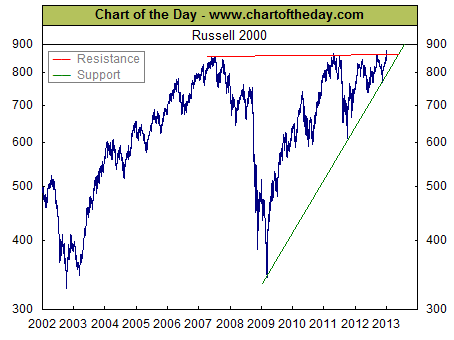
For some perspective on the current state of the stock market, today’s chart presents the long-term trend of the Russell 2000 (small-cap stocks). As the chart illustrates, the Russell 2000 rallied from late 2002 into the mid-2007 and then effectively gave all of that back during the financial crisis. The seesaw continued during the immediate aftermath of the financial crisis with the Russell 2000 recovering all losses incurred during the financial crisis in a little over two years. Since mid-2011, the Russell 2000 has traded in a rather choppy fashion which has helped define its current wedge-shaped trading range (see the red and green trendlines). More recently, the Russell 2000 has started the new year in a positive fashion by both breaking above resistance (red line) and making a new record high.
Notes:
Where’s the Dow headed? The answer may surprise you. Find out right now with the exclusive & Barron’s recommended charts of Chart of the Day Plus.
Quote of the Day
“I can’t change the direction of the wind, but I can adjust my sails to always reach my destination.” – Jimmy Dean
Events of the Day
January 13, 2013 – Golden Globe Awards
January 14, 2013 – Australian Open Tennis Tournament begins (ends Jan. 27th)
January 21, 2013 – Martin Luther King Jr. Day (observed)
Stocks of the Day
— Find out which stocks investors are focused on with the most active stocks today.
— Which stocks are making big money? Find out with the biggest stock gainers today.
— What are the largest companies? Find out with the largest companies by market cap.
— Which stocks are the biggest dividend payers? Find out with the highest dividend paying stocks.
— You can also quickly review the performance, dividend yield and market capitalization for each of the Dow Jones Industrial Average Companies as well as for each of the S&P 500 Companies.

One of the handful of people I take the time to listen to at investment conferences and whenever he speaks is Frank Holmes – Peter Grandich

During these first days of January, many adopt an “out with the old, in with the new,” approach to shed bad habits or extra pounds. Washington opted for its same ol’ strategy when averting the “fiscal cliff,” as the addictive nature of “can-kicking is a transatlantic sport,” according to The Economist. The magazine suggests that the deal made in the 11th hour is “disturbingly similar to the eurozone’s.” The short-term fix did “nothing to control the unsustainable path of ‘entitlement’ spending on pensions and health care … nothing to rationalize America’s hideously complex and distorted tax code… and virtually nothing to close America’s big structural budget deficit.”
In the end, politicians agreed to end the payroll tax cut and raise taxes on the top earners; altogether, tax increases will total $162 billion in 2013. According to a Bloomberg article, it’s the first time since 1990 a Republican leader agreed to a boost on tax rates. The legislation also represents the largest tax increase in two decades, says the Wall Street Journal.
……..read more HERE

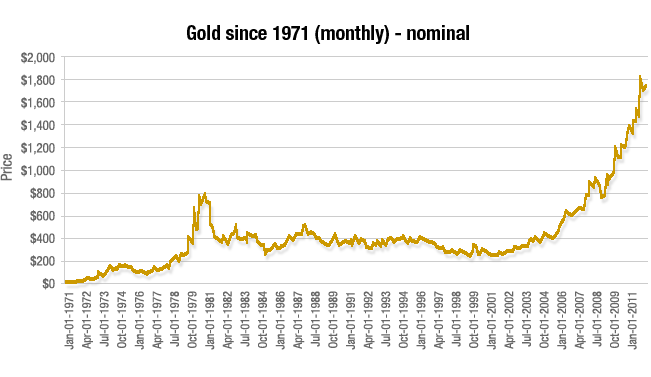
“Bull market or bear market? Below we see a listing of the year-end cost of gold denominated in Federal Reserve Notes (these notes are now commonly called “dollars”). From a market standpoint, we’re looking at one of the greatest bull markets in history. But ironically, referring to “dollars alone,” this is one of the worst bear markets I’ve ever seen.”
“Bear market? Sure, back in the year 2000, for only 273 dollars you could buy one ounce of gold. But by 2012, you needed over 1600 dollars to buy the same one ounce of gold. The eternal value of gold doesn’t change. It’s the purchasing power of the Federal reserve note that has changed.

The price of gold in terms of “dollars” has now risen thirteen years in succession. But what is even more remarkable is the fact that most Americans have totally ignored (even despised) this remarkable bull market. Let a stock rise seven or eight years in a row, and it will be the talk of Wall Street and the talk of every social gathering in the nation.
Yet this amazing bull market in gold stands alone, sneered at and almost hated. I’ve been in this business for over 60 years, and I’ve never seen anything quite like it. However, I do think I know something about human nature. What I’ve learned about human nature is that it doesn’t change. For instance, if a stock creeps up year after year, sooner or later the crowd will discover it — and then they’ll pounce on it, ultimately sending that undiscovered stock far above its reasonable price.
My belief is that somewhere ahead, the crowd will latch on to gold. Then, as disinterested in gold as they are now, the crowd will pile into gold with the same frenzy that overtook the storied “49ers” when they packed their bags, kissed their wives and kids good bye, and headed West in search of gold.
Gold is the only item that elicits both greed and fear. The greed factor is so well known that I don’t have to explain it here. But the fear factor only arises when men (and women) see the “value” of their money disappearing. Nothing concentrates the mind as dramatically as seeing the purchasing power of one’s hard-earned income and savings being ruthlessly destroyed.
As I write, Ben Bernanke’s Federal Reserve is systematically shaving off the purchasing power of the dollar in the same way that you can peel the layers off an onion. The US has been in the process of constructing the greatest credit bubble in history. The world has never seen anything like it.
This enormous bubble is now being attacked by the worldwide forces of deflation. Fed Chairman Bernanke is terrified by the mere thought of deflation. Bernanke will not stand for deflation. He has said as much. And he will attack deflation and crumbling asset prices with all the inflationary power at his command.
As the ocean of new dollars pours out of the computers of the Federal Reserve, the purchasing power of the dollar erodes. It erodes slowly at first, but as the river of dollars turn into an ocean, slowly-rising inflation segues into a monster. Finally, the crowd recognizes what is happening to their money.
The loaf of bread that cost a dollar last year suddenly costs four dollars. The cup of coffee that cost a dollar last week goes on special today for two fifty. The college tuition that cost four thousand dollars now costs sixteen thousand and there’s the extra for a dorm. You’re suddenly paralyzed. A light bulb in your head starts to glow. And just as suddenly, the mad, frantic rush for gold is on.
Old timers shake their heads knowingly and repeat the old saw, “There’s no fever like gold fever!” And the rush for the yellow metal turns into a full frenzy. Even as I write, the subtle but tell-tale signs of “gold-fever” are seen and heard. New gold funds and new gold ETFs are started.
Full-page advertisements appear in the newspapers, drawing attention to the loss of purchasing power in the dollar, and lauding the advantages of owning gold and silver. Gold vending machines appear at airports and in European and Asian department stores. Pressure is rising to force lawmakers to elect gold as legal tender.
On March 29, 2011, the state of Utah passed a law stating that gold and silver will be legal tender in the state of Utah. Imagine, just imagine — gold being treated as real money! That alone shows us how far and how completely insane the nation’s attitude towards gold and silver has become. Gold has been treated as money for 3,000 years. “As good as gold” is a well-known expression. Yet, today in the US, gold is not considered to be legal tender.
No fiat money has lasted for as long as a century. The US has had prior experience with fiat money — the Civil War Greenbacks, the “Bills of Credit” of the original American colonies, the ill-fated Continentals during the Civil War. None of these have survived, and neither will the Federal Reserve notes that we now refer to as “dollars.”
I dislike falling back on the morality argument, but consider this. I may work a lifetime for five million dollars. Yet some academic working for the Federal Reserve can press some keys on a computer and create ten billion dollars instantly without working up a sweat. Is the ten billion dollars he creates moral money? Did anyone work for the money? Did anyone take a risk for the money? Did anyone drop a bead of sweat for it? No, then I claim it is immoral and actually evil money, and as such it is doomed.
The only power evil has is the power to destroy itself. I affirm that the Federal Reserve note is doomed. When the Federal Reserve note goes down the drain, all fiat money in the world will go down with it. Today information travels around the world with the speed of NOW. People around the planet will see that fiat money is a fantasy and a counterfeit fraud foisted upon them by unconscionable and unscrupulous bankers. It is then that the crowd will turn to gold, in much the way that people turned to gold back in 1978 to 1980.
Now this may be “far out.” I’m reading a lot about silver and its huge short position. I hear that the silver shorts are bigger than the amount of physical silver that is readily available. The silver mining stocks have already surged. And I wonder if silver starts to boom, whether that action wouldn’t rub off on gold? Hmmm, it’s a thought.”
To subscribe to Richard Russell’s Dow Theory Letters CLICK HERE.
About Richard Russell
Russell began publishing Dow Theory Letters in 1958, and he has been writing the Letters ever since (never once having skipped a Letter). Dow Theory Letters is the oldest service continuously written by one person in the business.
Russell gained wide recognition via a series of over 30 Dow Theory and technical articles that he wrote for Barron’s during the late-’50s through the ’90s. Through Barron’s and via word of mouth, he gained a wide following. Russell was the first (in 1960) to recommend gold stocks. He called the top of the 1949-’66 bull market. And almost to the day he called the bottom of the great 1972-’74 bear market, and the beginning of the great bull market which started in December 1974.
The Letters, published every three weeks, cover the US stock market, foreign markets, bonds, precious metals, commodities, economics –plus Russell’s widely-followed comments and observations and stock market philosophy.


-
I know Mike is a very solid investor and respect his opinions very much. So if he says pay attention to this or that - I will.
~ Dale G.
-
I've started managing my own investments so view Michael's site as a one-stop shop from which to get information and perspectives.
~ Dave E.
-
Michael offers easy reading, honest, common sense information that anyone can use in a practical manner.
~ der_al.
-
A sane voice in a scrambled investment world.
~ Ed R.
Inside Edge Pro Contributors

Greg Weldon

Josef Schachter

Tyler Bollhorn

Ryan Irvine

Paul Beattie

Martin Straith

Patrick Ceresna

Mark Leibovit

James Thorne

Victor Adair