Personal Finance

“Not One Dime” – Obama’s Impact On You, Your Children & Markets

even-some-members-of-his-own-party-want-the-president-to-sit-this-one-outHas Our Government Become Dysfunctional?

This a.m. we comment on president Obama’s state of the union message from last evening. Perhaps the most obvious impact of the speech was the potential for further intrusion of government into our lives and the pledge that that intrusion would cost “not one dime.”

Any reasonable person will know that pledge cannot easily be fulfilled.

The top five elements of the speech according to this morning’s Wall Street Journal were:

  1. A Strong push for gun control.
  2. A call for smarter government that sets priorities.
  3. A climate change initiative he said he will do on his own if Congress doesn’t do it.
  4. A nonpartisan commission to improve the voting process.
  5. The President called on Congress to avoid to sequester said the devil is in the details and then failed to provide any (details) thus failing to advance the debate.

Completion of these five elements is highly suspect. Gun control, as proposed by Sen. Feinstein, cannot pass. Second, it is unlikely that the government bureaucracy is smarter than the individual nor can it increase its level of “intelligence” easily due to political dynamics. Third, there is significant evidence that climate change is not caused by humans and therefore cannot be changed by humans. Change to the voting process will be a strawman issue and difficult to achieve. And finally it’s beginning to appear likely that we shall have a Sequester as proposed over a year ago and extended in the recent fiscal cliff compromise.

Very clearly the president thinks he can roll the Republican House and he is indeed on a roll. To date he has had the upper hand in this regard.

Most important it is difficult to see how these top five issues can be accomplished in a “not one dime” fiscal scenario. We all know taxes must increase, but if these top five priorities are to be attained, government spending must increase. Thus far president Obama has proven very adept at assembling a power.

The assault on our lifestyle is well underway in Washington D.C. It is evident everywhere in every administration policy. It is evident to everyone. It is also evident that the Republican Party is badly split and may be unable to arrest the intrusion. While the president’s focus was on the middle class he continued to refer to “billionaires and high-powered accountants” again demonizing those in the country, many of whom have taken risks and created great wealth for hundreds of thousands of people.

This is a president that is expert in polarization of the electorate. He believes in assembling power by broadening the entitlement economy through wealth transfers. He also is convinced that government is smarter than the individual; that individual freedom must be constrained and be subservient to government fiat.

For example, last evening the president called for higher minimum wages ($9.00 an hour up from $7.25 a 24% increase) a sop to immigrants designed likely to accumulate their votes. Increased minimum wages will impact service industries and also, to a large extent, small businesses owners. So the assault is not just on ALL taxpayers. The assault is yet to be felt on business also in small business is critically important to the U.S. economy.

As we write this a.m., we admonish our readers to realize that revenues, known as taxes, must increase significantly. They must increase across the board. We do not doubt that. However taxing the rich only will not produce enough revenue to deal with the current deficit. So we shall all bear the economic problems (slower economic growth, stagnant real income, frustratingly high unemployment) arising from higher taxation. In itself this is a major issue fomenting austerity, what Bill Gross of PIMCO calls the “New Normal” American lifestyle.

The U.S. economy is driven 70% by the consumer. It has morphed into that framework over the past 60 years, since 1952. American consumerism is a well-entrenched culture that has driven growth in the U.S. and the world. China relies on the U.S. consumer. Because the country that controls the Reserve Currency may borrow at will the U.S. government has continued to borrow to sustain the American lifestyle. The U.S. has continued to run increasingly large annual deficits to the extent that now our children and grandchildren are saddled with a huge debt that likely can never be repaid.

Last evening I was interviewed by The Gold Report. One of the many questions related to the moribund natural resource market. I told the interviewer my views. I believe that we are on a downward slope in terms of our quality of lifestyle. In truth this is necessary and unavoidable. It has impacted investment dramatically.

The programs emanating from this administration, the Congress, the inability of the Republican Party to mobilize and define itself appropriately and the apparent felicity of an electorate willing to believe in every gift they are to receive from a “lame duck” President indicate that a vast wealth transfer is underway and that the endgame must be a reorganization of the economy to accommodate our grandchildren’s unsolvable debt problem.

This view may seem extreme. But you must look at the facts and decide for yourselves. No government or central bank can electronically create $85 billion a month to support paper markets. In other words, you cannot support paper debts by printing paper. Interest rates must increase at some point in the future, perhaps the near future. At that time the Federal Reserve and the Treasury will no longer be able to control interest rates at zero.

This scenario will unfold, deflation a central banker’s real fear, notwithstanding. No one yet knows the outcome. Gary Shilling believes that deflation is inevitable and must last for years as it has in Japan. Others, such as Mr. James Sinclair, believe we must see hyperinflation in our economy as soon as this year. There is no reason we cannot see both in succession. History tells us it is happened in the past. In any case the American citizen, perhaps the citizen of the world, must realize a declining lifestyle.

For example, last evening the untouchable “Third Rails” were hardly mentioned. Very clearly there are serious sustainability problems with Social Security, Medicare and Medicaid. Very clearly, mom-and-pop now to must consider postponing retirement. Obviously such considerations add to the unemployed, unemployable and under employed strata of our society. 43 million people (13%) now rely on food stamps in the United States of America and yet the Administration tells us we are not spending enough on food stamps.

In the past four years the President has pandered to the student population (the young voting population) now a $1 trillion problem of bad student loans beginning, in size, to challenge the housing problems of 2008 at 2009.

Meanwhile the emerging world is awakening from hundreds of years of poverty and economic malaise. Digital technology has served as a “Professor to the World.” The rapid distribution of cell phone technology, iPads and iPods has created an awareness of the potential increase in quality of life that is possible and highly desired. This is no longer the Third World but now the Emerging and Powerful World. It is the emerging world, largely free of the debt accumulated in the West that will, in the next two decades, lead global economic growth.

Emerging world infrastructure buildout will swamp the size of the infrastructure creation in the United States between 1950 and 2000. All sorts of commodities and hard assets will be required in quantity. Food, fertilizer, potable water, lifestyle metals such as graphite, and monetary metals will be in demand.

These have not yet been discovered.

Because they will be in short supply many will become good discovery investments. You must discuss your investment plans with your financial planner. 0% interest rates creating financial repression for your portfolio must be countered. You should consider an allocation to hard assets and in my case Discovery Investing.

Discovery investing it is risky and not for the faint of heart. However it is a socially responsible investing discipline as we have defined it using our 10 factors to analyze companies. Great discoveries create jobs and increase lifestyle through education and infrastructure for individuals.

Last evening in The Gold Report interview I reviewed a number of discovery companies mostly from Nevada a mining friendly state in a relatively mining friendly jurisdiction that I am considering at this time. They include International Enexco (see Monday’s Morning Note), Pershing Gold, Valor Gold, Almaden, Terraco Gold, NuLegacy Gold, Quaterra’s Yerington copper district, Corvus Gold, Geologix, Grande Portage is Herbert Glacier project, Quaterra’s Nieves project in Mexico and Gold Standard Ventures.

Chris and I are performing due diligence on all these names and more so these are not yet recommendations on the weekend positive Pershing Gold, Terraco Gold and Quaterra’s Yerington recently. We own shares in Pershing Quaterra, Terraco currently.

Please consider some allocation to gold and silver as we believe these prices must increase due to the current mercantilism of fiat currencies in the world. Your allocation may be to the metal itself to ETF’s or to discovery stocks. Please consider lifestyle discovery investments. The food space fertilizer space water spaces present some very attractive investment opportunities at this time.

And so we move forward with tepidity into a new economic era. It will be the era of our grandchildren and their generations. Our investment strategies today must keep pace and adjust to this rapidly changing and new economic environment.


The material herein is for informational purposes only and is not intended to and does not constitute the rendering of investment advice or the solicitation of an offer to buy securities. The foregoing discussion contains forward-looking statements within the meaning of the Private Securities Litigation Reform Act of 1995 (The Act). In particular when used in the preceding discussion the words “plan,” confident that, believe, scheduled, expect, or intend to, and similar conditional expressions are intended to identify forward-looking statements subject to the safe harbor created by the ACT. Such statements are subject to certain risks and uncertainties and actual results could differ materially from those expressed in any of the forward looking statements. Such risks and uncertainties include, but are not limited to future events and financial performance of the company which are inherently uncertain and actual events and / or results may differ materially. In addition we may review investments that are not registered in the U.S. We cannot attest to nor certify the correctness of any information in this note. We own shares in International Enexco Please consult your financial advisor and perform your own due diligence before considering any companies mentioned in this informational bulletin. We own shares International Enexco, Quaterra Resoruces and Terraco Gold


The Case for Silver Outpacing Gold

Gold and silver might move in the same direction each day. But they aren’t blood related…

A LOT OF TALK on the web right now says silver is significantly undervalued versus gold.

Many of these pundits and talking heads like to point to the historical relationship between gold and silver prices, sometimes known as the “ratio”. People even comment as to this connection as far back as thousands of years ago. Let’s take a quick look at this.

Silver, thousands of years ago, was originally thought of greater value than gold, both because it was relatively scarce in great civilizations such as the Egyptians, and because it was easier to work into useful materials. Both silver and gold have been used abundantly for ornamentation and as a thing of beauty in homes, temples and palaces. Then of course as jewelry their beauty was very much esteemed.

However, once gold was found in increasing abundance and man’s metallurgical skills improved, gold soon took over as the leader and the metal given greater value. Though silver would not lose completely that position, it would fall into the number two spot. One of the main reasons is gold’s ability to be beaten and stretched to great lengths with out and still maintain it beauty. But the most important of its properties was that it did not tarnish. In a thing of art and beauty this is an important factor and one that still to this day maintains Gold’s lead over silver for prominence in the jewelry industry.

Getting back to the ratio, as time went by silver would continue to be found in greater abundance than gold. So the differential moved to a 10 to 1 relationship in medieval Europe, and was then fixed at 15.5 in England by Isaac Newton when he was Master of the Mint in 1717. That’s almost exactly the ratio of unearthed silver to gold in the ground worldwide. As recently as the early twentieth century we had gold and silver at a 20 to 1 ratio when silver was coined as One Dollar and gold was Twenty Dollars in the USA.

1

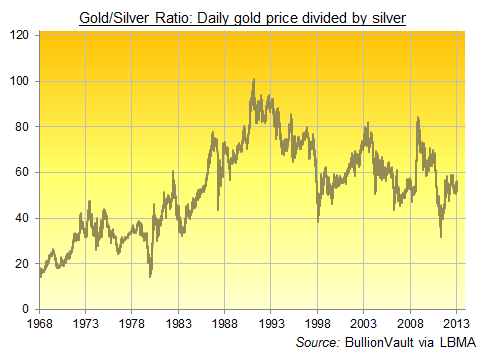
Now we are looking at the current ratio 53.15 as of this writing. It sounds high looking at historical standards. What about recent history?

Some people will point to the 1980 low of 14 to 1. But at that time the silver market was said to have been cornered by the Hunt brothers, making that level an artificial low as silver prices jumped. In 1991 we saw the high of 100 as gold hit $412 per ounce and silver remained around the $4 level. In the last ten years we have been as high as 80 and as low as 31.60.

2

So is this a good barometer to the direction of the price of silver or gold? I don’t believe so. But the ratio between gold and silver prices is an exciting spread to trade at times, even though the two metals move in the same direction almost each and every trading day.

Both metals are precious, and silver is often found with gold in the ground. Yet they are not blood related, and it’s the differences which might explain the widening or narrowing of the ration in prices.

Silver is produced in abundance as a byproduct of many other processes as well. Zinc and copper mining are among some of the principal producers. According toThomson Reuters GFMS in a report prepared for the Silver Institute, nearly two thirds of the world’s annual production of silver is as a by-product.

In the same report it is stated that in recent years silver production has increased by 25% while gold becomes ever rarer at a slower growth rate of only 6% over a ten year period. Even with the high price of gold it can’t seem to keep pace with silver. So supply and demand would have us believe that silver is increasingly more available.

Then what are these talking heads saying when they believe silver has a better opportunity for price growth than gold? Where do they come up with their belief?

Silver for sure is always in demand and though photography and x-ray film once the major consumers of the white metal are quickly disappearing new and exciting applications have come online. Photovoltaic, a major consumer, came into the fold a few years back. It continues to grow. Though, it is off significantly from its 2011 high, which still did not reach the annual consumption of silver by the photographic industry in the early part of this century.

Thomson Reuters GFMS states that world industrial demand will have dropped 8% in 2012. According to the USGS (US Geological Survey) 2011 Minerals Yearbooktotal US industrial consumption of silver was down 5% from 2010. So it is the investment market that has truly come in to fill the gap in silver.

In the same report we read that Coin & Medal demand was up 19% in 2011 over 2010 globally. The silver ETPs (exchange traded products) has grown to be holding currently around 623 million ounces which is 83% of a year’s annual production. And this January the US Mint had record sales of their silver eagle bullion coins of 7.42 million ounces as the public fears of currency devaluation weighs heavily on their minds.

Still even with this information can we be certain that silver has more upside? This is a very difficult look into the future. I believe the precious metals class will continue to perform for the foreseeable future, at least another five years while the global economy keeps languishing. The global credit problems are not over. Spain and Italy remain in crisis to mention a few and this illness will cause the doctors to keep prescribing easing, or increasing cash liquidity (printing more money).

But what of the fundamentals cost of production? The Silver Institute reports a cash cost of $7.25 per ounce for 2011. Using this as a baseline I believe most people would believe silver to be overvalued. But this number does not reflect the actual final cost to market of the metal in a form that is ready for consumption. It lacks all the detail necessary to make an informed decision. This is why it is not trading anywhere near these numbers.

In a very well thought out article, Silver Deceptions: Large Surpluses & Low Production CostSteve St. Angelo at SilverSeek argues that the actual cost of production for mining silver is much higher. Using his method of calculation, the cost of production of silver for 2011 should be $28.02 and for gold should be $1359.80. This would mean that silver at a little over a 10% premium at these market levels while gold is at over a 20% premium to today’s price.

I guess there you have it. Before considering the industrial or monetary use of silver in future, investors looking for more upside potential in silver than gold might start with that 10% differential in cost of production.

Miguel Perez-Santalla

BullionVault

Miguel Perez-Santalla is vice president of business development for BullionVault, the physical gold and silver exchange founded a decade ago and now the world’s #1 provider of physical bullion ownership online. A fierce advocate for retail investors, and a regular speaker at industry and media events, Miguel has over 30 years’ experience in the precious metals business, previously working at the United States’ top coin dealerships, as well as international refining group Heraeus.

(c) BullionVault 2013

Please Note: This article is to inform your thinking, not lead it. Only you can decide the best place for your money, and any decision you make will put your money at risk. Information or data included here may have already been overtaken by events – and must be verified elsewhere – should you choose to act on it.

Credit Supernova!

A Must, Must, Must, Read…..says Peter Grandich

IO Supernova 

This is the way the world ends…
Not with a bang but a whimper.
T.S. Eliot

They say that time is money.* What they don’t say is that money may be running out of time.
There may be a natural evolution to our fractionally reserved credit system which characterizes modern global finance. Much like the universe, which began with a big bang nearly 14 billion years ago, but is expanding so rapidly that scientists predict it will all end in a “big freeze” trillions of years from now, our current monetary system seems to require perpetual expansion to maintain its existence. And too, the advancing entropy in the physical universe may in fact portend a similar decline of “energy” and “heat” within the credit markets. If so, then the legitimate response of creditors, debtors and investors inextricably intertwined within it, should logically be to ask about the economic and investment implications of its ongoing transition.
 
But before mimicking T.S. Eliot on the way our monetary system might evolve, let me first describe the “big bang” beginning of credit markets, so that you can more closely recognize its transition. The creation of credit in our modern day fractional reserve banking system began with a deposit and the profitable expansion of that deposit via leverage. Banks and other lenders don’t always keep 100% of their deposits in the “vault” at any one time – in fact they keep very little – thus the term “fractional reserves.” That first deposit then, and the explosion outward of 10x and more of levered lending, is modern day finance’s equivalent of the big bang. When it began is actually harder to determine than the birth of the physical universe but it certainly accelerated with the invention of central banking – the U.S. in 1913 – and with it the increased confidence that these newly licensed lenders of last resort would provide support to financial and real economies. Banking and central banks were and remain essential elements of a productive global economy. 
 
But they carried within them an inherent instability that required the perpetual creation of more and more credit to stay alive. Those initial loans from that first deposit? They were made most certainly at yields close to the rate of real growth and creation of real wealth in the economy. Lenders demanded that yield because of their risk, and borrowers were speculating that the profit on their fledgling enterprises would exceed the interest expense on those loans. In many cases, they succeeded. But the economy as a whole could not logically grow faster than the real interest rates required to pay creditors, in combination with the near double-digit returns that equity holders demanded to support the initial leverage – unless – unless – it was supplied with additional credit to pay the tab. In a sense this was a “Sixteen Tons” metaphor: Another day older and deeper in debt, except few within the credit system itself understood the implications. 
 
Economist Hyman Minsky did. With credit now expanding, the sophisticated economic model provided by Minsky was working its way towards what he called Ponzi finance. First, he claimed the system would borrow in low amounts and be relatively self-sustaining – what he termed “Hedge” finance. Then the system would gain courage, lever more into a “Speculative” finance mode which required more credit to pay back previous borrowings at maturity. Finally, the end phase of “Ponzi” finance would appear when additional credit would be required just to cover increasingly burdensome interest payments, with accelerating inflation the end result.
 
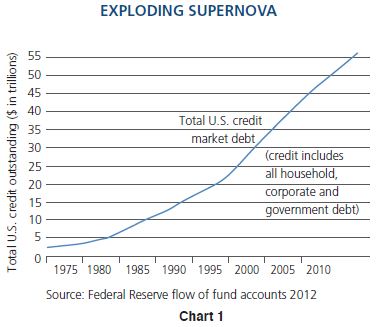
Minsky’s concept, developed nearly a half century ago shortly after the explosive decoupling of the dollar from gold in 1971, was primarily a cyclically contained model which acknowledged recession and then rejuvenation once the system’s leverage had been reduced. That was then. He perhaps could not have imagined the hyperbolic, as opposed to linear, secular rise in U.S. credit creation that has occurred since as shown in Chart 1. (Patterns for other developed economies are similar.) While there has been cyclical delevering, it has always been mild – even during the Volcker era of 1979-81. When Minsky formulated his theory in the early 70s, credit outstanding in the U.S. totaled $3 trillion.† Today, at $56 trillion and counting, it is a monster that requires perpetually increasing amounts of fuel, a supernova star that expands and expands, yet, in the process begins to consume itself. Each additional dollar of credit seems to create less and less heat. In the 1980s, it took four dollars of new credit to generate $1 of real GDP. Over the last decade, it has taken $10, and since 2006, $20 to produce the same result. Minsky’s Ponzi finance at the 2013 stage goes more and more to creditors and market speculators and less and less to the real economy. This “Credit New Normal” is entropic much like the physical universe and the “heat” or real growth that new credit now generates becomes less and less each year: 2% real growth now instead of an historical 3.5% over the past 50 years; likely even less as the future unfolds. 
IO Feb2013 Fig1
 
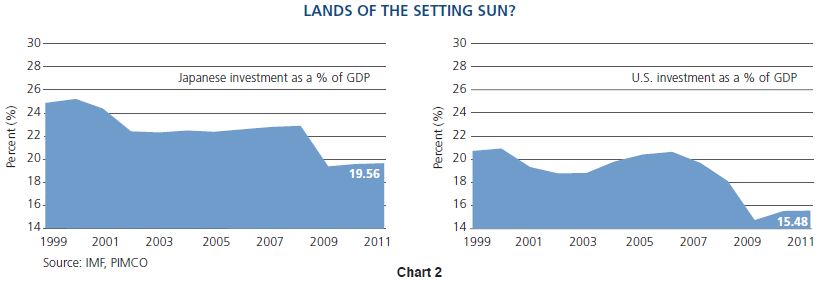
Not only is more and more anemic credit created by lenders as its “sixteen tons” becomes “thirty-two,” then “sixty-four,” but in the process, today’s near zero bound interest rates cripple savers and business models previously constructed on the basis of positive real yields and wider margins for loans. Net interest margins at banks compress; liabilities at insurance companies threaten their levered equity; and underfunded pension plans require greater contributions from their corporate funders unless regulatory agencies intervene. What has followed has been a gradual erosion of realgrowth as layoffs, bank branch closings and business consolidations create less of a need for labor and physical plant expansion. In effect, the initial magic of credit creation turns less magical, in some cases even destructive and begins to consume credit markets at the margin as well as portions of the real economy it has created. For readers demanding a more model-driven, historical example of the negative impact of zero based interest rates, they have only to witness the modern day example of Japan. With interest rates close to zero for the last decade or more, a sharply declining rate of investment in productive plants and equipment, shown in Chart 2, is the best evidence. A Japanese credit market supernova, exploding and then contracting onto itself. Money and credit may be losing heat and running out of time in other developed economies as well, including the U.S.
 
IO Feb2013 Fig2

Investment Strategy

If so then the legitimate question is: how much time does money/credit have left and what are the investment consequences between now and then? Well, first I will admit that my supernova metaphor is more instructive than literal. The end of the global monetary system is not nigh. But the entropic characterization is most illustrative. Credit is now funneled increasingly into market speculation as opposed to productive innovation. Asset price appreciation as opposed to simple yield or “carry” is now critical to maintain the system’s momentum and longevity. Investment banking, which only a decade ago promoted small business development and transition to public markets, now is dominated by leveraged speculation and the Ponzi finance Minsky once warned against. 
 
So our credit-based financial markets and the economy it supports are levered, fragile and increasingly entropic – it is running out of energy and time. When does money run out of time? The countdown begins when investable assets pose too much risk for too little return; when lenders desert credit markets for other alternatives such as cash or real assets.
 
REPEAT: THE COUNTDOWN BEGINS WHEN INVESTABLE ASSETS POSE TOO MUCH RISK FOR TOO LITTLE RETURN. 
 
Visible first signs for creditors would logically be 1) long-term bond yields too low relative to duration risk, 2) credit spreads too tight relative to default risk and 3) PE ratios too high relative to growth risks. Not immediately, but over time, credit is exchanged figuratively or sometimes literally for cash in a mattress or conversely for real assets (gold, diamonds) in a vault. It also may move to other credit markets denominated in alternative currencies. As it does, domestic systems delever as credit and its supernova heat is abandoned for alternative assets. Unless central banks and credit extending private banks can generate real or at second best, nominal growth with their trillions of dollars, euros, and yen, then the risk of credit market entropy will increase.
 
The element of time is critical because investors and speculators that support the system may not necessarily fully participate in it for perpetuity. We ask ourselves frequently at PIMCO, what else could we do, what else could we invest in to avoid the consequences of financial repression and negative real interest rates approaching minus 2%? The choices are varied: cash to help protect against an inflationary expansion or just the opposite – long Treasuries to take advantage of a deflationary bust; real assets; emerging market equities, etc. One of our Investment Committee members swears he would buy land in New Zealand and set sail. Most of us can’t do that, nor can you. The fact is that PIMCO and almost all professional investors are in many cases index constrained, and thus duration and risk constrained. We operate in a world that is primarily credit based and as credit loses energy we and our clients should acknowledge its entropy, which means accepting lower returns on bonds, stocks, real estate and derivative strategies that likely will produce less than double-digit returns.
 
Still, investors cannot simply surrender to their entropic destiny. Time may be running out, but time is still money as the original saying goes. How can you make some?
 
(1) Position for eventual inflation: the end stage of a supernova credit explosion is likely to produce more inflation than growth, and more chances of inflation as opposed to deflation. In bonds, buy inflation protection via TIPS; shorten maturities and durations; don’t fight central banks – anticipate them by buying what they buy first; look as well for offshore sovereign bonds with positive real interest rates (Mexico, Italy, Brazil, for example).
 
(2) Get used to slower real growth: QEs and zero-based interest rates have negative consequences. Move money to currencies and asset markets in countries with less debt and less hyperbolic credit systems. Australia, Brazil, Mexico and Canada are candidates. 
 
(3) Invest in global equities with stable cash flows that should provide historically lower but relatively attractive returns. 
 
(4) Transition from financial to real assets if possible at the margin: buy something you can sink your teeth into – gold, other commodities, anything that can’t be reproduced as fast as credit. Think of PIMCO in this transition. We hope to be “Your Global Investment Authority.” We have a product menu to assist.
 
(5) Be cognizant of property rights and confiscatory policies in all governments.
 
(6) Appreciate the supernova characterization of our current credit system. At some point it will transition to something else. 
 
We may be running out of time, but time will always be money.
Speed Read for Credit Supernova
1) Why is our credit market running out of heat or fuel?
a) As it expands at a rate of trillions per year, real growth in the economy has failed to respond. More credit goes to pay interest than future investment.
 
b) Zero-based interest rates, which are the result of QE and credit creation, have negative as well as positive effects. Historic business models may be negatively affected and investment spending may be dampened.
 
c)  Look to the Japanese historical example.
2) What options should an investor consider?
a) Seek inflation protection in credit market assets/ shorten durations.
 
b) Increase real assets/commodities/stable cash flow equities at the margin.
 
c) Accept lower future returns in portfolio planning.
William H. Gross
Managing Director
 
* The terms “money” and “credit” are used interchangeably in this IO.  Purists would dispute the usage and I would agree with them, arguing for the usage for simplicity’s sake and the evolving homogeneity of the two.
† Outstanding credit includes all government debt as well as corporate, household and personal debt. Does not include “shadow” debt estimated at $20-30 trillion.


Past performance is not a guarantee or a reliable indicator of future results. All investments contain risk and may lose value.  Investing in the bond market is subject to certain risks, including market, interest rate, issuer, credit and inflation risk. Equities may decline in value due to both real and perceived general market, economic and industry conditions. Investing in foreign-denominated and/or -domiciled securities may involve heightened risk due to currency fluctuations, and economic and political risks, which may be enhanced in emerging markets. Currency rates may fluctuate significantly over short periods of time and may reduce the returns of a portfolio. Sovereign securitiesare generally backed by the issuing government. Obligations of U.S. government agencies and authorities are supported by varying degrees, but are generally not backed by the full faith of the U.S. government; portfolios that invest in such securities are not guaranteed and will fluctuate in value.Inflation-linked bonds (ILBs) issued by a government are fixed income securities whose principal value is periodically adjusted according to the rate of inflation; ILBs decline in value when real interest rates rise. Treasury Inflation-Protected Securities (TIPS) are ILBs issued by the U.S. government.Commodities contain heightened risk including market, political, regulatory and natural conditions, and may not be suitable for all investors.

The views and strategies described herein are for illustrative purposes only and may not be suitable for all investors. The information is not based on any particularized financial situation, or need, and is not intended to be, and should not be construed as investment advice or a recommendation for any specific PIMCO or other strategy, product or service. Investors should consult their financial advisor prior to making an investment decision. There is no guarantee that these investment strategies will work under all market conditions and each investor should evaluate their ability to invest long-term, especially during periods of downturn in the market.
This material contains the current opinions of the author but not necessarily those of PIMCO and such opinions are subject to change without notice. This material is distributed for informational purposes only. Forecasts, estimates, and certain information contained herein are based upon proprietary research and should not be considered as investment advice or a recommendation of any particular security, strategy or investment product. Information contained herein has been obtained from sources believed to be reliable, but not guaranteed.  No part of this article may be reproduced in any form, or referred to in any other publication, without express written permission.  PIMCO and YOUR GLOBAL INVESTMENT AUTHORITY are trademarks or registered trademarks of Allianz Asset Management of America L.P. and Pacific Investment Management Company LLC, respectively, in the United States and throughout the world. ©2013, PIMCO.


Gold & Silver Stocks – Influential Markets & Looming Change

Precious metals mining stocks may not look too encouraging recently – with mostly declines in 2013 and lack of any spectacular rally. But other influential markets suggest that the situation is likely to change in the near future – the underlying metals seem poised to rally, the general stock market is rallying and the dollar is in a long-term downtrend. It is still hard to answer the title question, however, as the above factors do not give any crystal-clear signals. Let us then move on to the technical part of today’s essay to see if the charts can tell us more – we’ll begin with the analysis of the junior gold and silver stocks (charts courtesy by http://stockcharts.com.)

radomski february122013 1

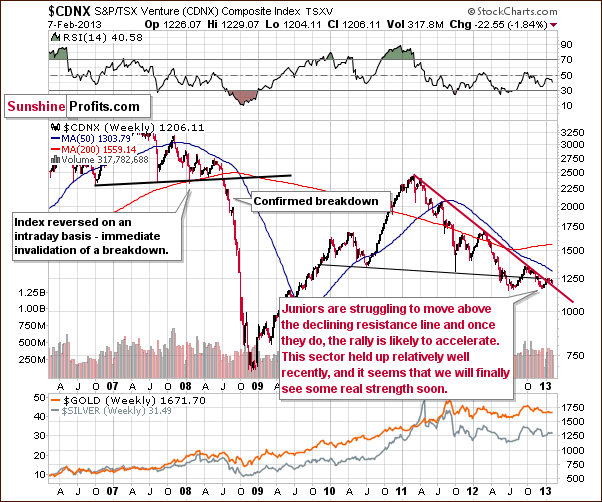
In the Toronto Stock Exchange Venture Index (which is a proxy for the junior miners as so many of them are included in it), the Junior’s sector did not do much this week as sideways trading was seen and price levels are now close to the declining resistance line. No significant breakout has been seen yet, but one is likely once additional strength is seen in the precious metals. This will probably lead to a continuation of the rally, and little else needs to be said. We expect prices to move to the upside here as well.

Let us have a look at gold senior miners now, with GDX ETF serving as a proxy.

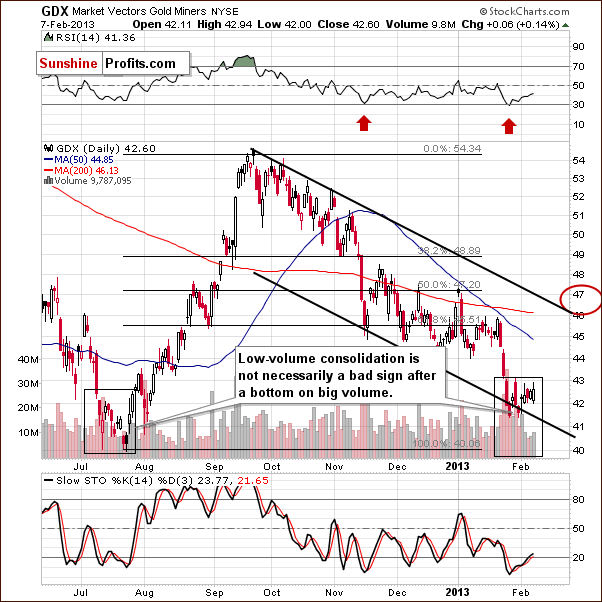
radomski february122013 2

In this week’s GDX ETF chart, not much has changed on a medium-term basis. A short-term rally was seen on Thursday but with accompanying low volume levels, it is unclear if this is a bullish sign or not. In the previous similar case when mining stocks were heavily oversold on a short-term basis after a big decline and after a bottom following a huge decline, low volume seen during the rallies which followed was not necessarily bearish. Higher prices continued and a big rally was seen to follow as well. Note that it did not happen immediately – one more move to the previous low was seen – maybe this is what we saw on Monday.

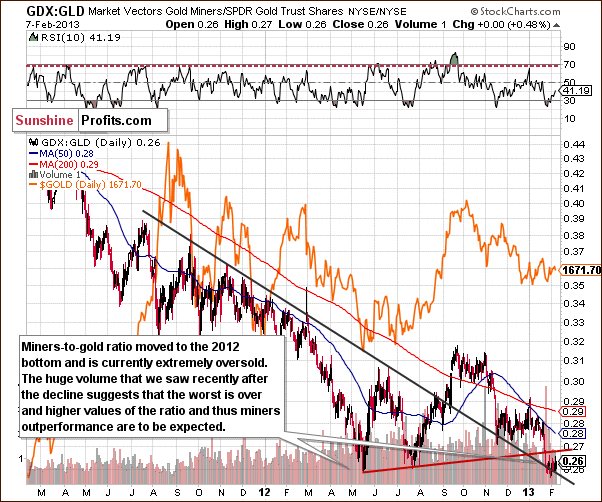
 Our final chart for today features gold miners to gold ratio.

radomski february122013 3

In today’s miners to gold ratio chart, little change was seen, and the ratio is still close to the 2012 low, which is a major support level. It will probably not move below this level as it seems the damage has already been done here, and recent high volume levels confirm it.

Since many of our readers are concerned about the state of gold and silver stocks, we would like to quote two of our subscribers’ questions regarding the precious metals market that were answered (along with many other ones in the last Premium Update). Both of them have to do with technical patterns.

Q: I have ONE major concern.  The gigantic Head and Shoulders in the HUI since 2009 with the Right Shoulder now formed and a neckline at about 375-80. If that breaks don’t we see a fast 100-150 on the HUI? Isn’t that a scary chart? I would greatly appreciate an answer on this because I am seriously considering selling a lot of my stocks in gold and silver based on that alone. The CDNX chart looks very scary also.

A: The head of this pattern would be very large compared to the shoulders, meaning that this formation is not very reliable. Also, if we use the 2012 low as the neck level (approximately), then the HUI Index is still considerably above it, so this formation is not in place, at least not yet. Therefore, it doesn’t have bearish implications. The breakdown below the 2012 low (close to the 370 level in the HUI Index) would be a very bearish technical factor, if confirmed. However, we don’t think that such a breakdown is in the cards in the coming weeks.

As far as CDNX (Toronto Stock Exchange Venture Index) is concerned, we don’t view this chart as bearish, as a small rally here will mean a major breakout that will likely result in much bigger rallies.

Let us move on to the second question.

Q: Hello P.R. Doesn’t this seem like a bearish flag: Slow grind higher in miners on low volume after big declines. What should we be looking for if this is actually the bottom?

Should the move up be bigger and on higher volume? I don’t know anything, just wondering. Every time there seems to be a break after a big decline, the decline returns with a vengeance. How is this different?

A: Generally yes, we would like to see a strong rally on strong volume to be more confident that the final bottom is behind us. The price pattern in mining stocks does look like a bearish flag pattern that would result in the continuation of the decline. However, we will not know until the miners break out either above the flag or below it. The key point here is that other markets – gold, silver, platinum – suggest higher prices in our view, and the SP Indicators suggest higher prices as well. The situation in the USD Index is also favorable. As no market moves totally on its own, we take more of them into account, and in this case the results are bullish.

Summing up, the situation in the gold and silver mining stocks is not encouraging for the short term, but taking the long-term valuation into account, as well as the other precious metals markets and related signals, expecting higher mining stocks’ prices still makes sense.

Thank you for reading. Have a great and profitable week!

Przemyslaw Radomski, CFA

Founder, Editor-in-chief

Gold Investment & Trading Website – SunshineProfits.com

* * * * *

Disclaimer

All essays, research and information found above represent analyses and opinions of Przemyslaw Radomski, CFA and Sunshine Profits’ associates only. As such, it may prove wrong and be a subject to change without notice. Opinions and analyses were based on data available to authors of respective essays at the time of writing. Although the information provided above is based on careful research and sources that are believed to be accurate, Przemyslaw Radomski, CFA and his associates do not guarantee the accuracy or thoroughness of the data or information reported. The opinions published above are neither an offer nor a recommendation to purchase or sell any securities. Mr. Radomski is not a Registered Securities Advisor. By reading Przemyslaw Radomski’s, CFA reports you fully agree that he will not be held responsible or liable for any decisions you make regarding any information provided in these reports. Investing, trading and speculation in any financial markets may involve high risk of loss. Przemyslaw Radomski, CFA, Sunshine Profits’ employees and affiliates as well as members of their families may have a short or long position in any securities, including those mentioned in any of the reports or essays, and may make additional purchases and/or sales of those securities without notice.


Update: Stocks Gold Bonds & Dollar

U.S. Stock Market – The chart in this Safehaven article and much of the analogy given fits my outlook. I’ve not worn a bear hat since MARCH 2009 and have been looking for a new, all-time high before even considering taking the hat out of storage. In a perfect world such a new high would cause a mad rush to get in and after the dust settles, the hat would likely be put to good use.

Gold – I said last week avoiding any new purchases until gold either broke above $1,700 or retested the $1,500 – $1,550 area appeared the way to approach gold until further notice. The paper market at the Crimenex continues to stifle the strengthening physical market, but in the long run, I’m betting the Putin’s of the world win out. (another recommended “Gold Thought” HERE)

U.S. Bonds – Need I say anymore? Okay if you insist.

U.S. Dollar – Continues to trade in a narrow range and this previous comment remains valid.

Mining and Exploration Stocks:

bear eats bull-lores-300x260

test-php-789