
Gold & Precious Metals
GOLD SINKS TO $1600 AS SLIDE ACCELERATES, SILVER UNDER $30, OIL & NATGAS TUMBLE
Commodities fell across the board this week, even as stock markets remained near five-year highs. Speculation about the end of the Federal Reserve’s quantitative easing programs pressured gold to the lowest level of the year, while a bearish inventory report sent natural gas skidding.
Stocks, as measured by the S&P 500, were essentially unchanged in the period. The index is up 6.5 percent year-to-date.
Macroeconomic Highlights
This week’s economic data in the U.S. were mostly positive, but disappointing news in Europe dampened sentiment. The Census Bureau reported that retail sales in the United States rose by 0.1 percent in January, as expected. Excluding autos and gas, sales rose by 0.2 percent, slightly less than the anticipated 0.4 percent.
The Department of Labor said that the number of people filing for unemployment benefits in the United States fell from 368K to 341K last week, while the Empire Manufacturing Index in the U.S. rose from -7.78 to 10.04 in February—the highest level since May 2012.
On the bearish side, gross domestic product in the eurozone shrank by 0.6 percent in the fourth quarter, more than the 0.4 percent decrease that was expected and the third-straight quarterly contraction.
Of particular note was a 0.6 percent decline in Germany’s GDP, the worst downturn in that economy since the 2009 recession.

…..read more HERE

 An over-indebted, overcapacity economy cannot generate real expansion. It can only generate speculative asset bubbles that will implode, destroying the latest round of phantom collateral.
I have endeavored to lay out the global endgame in four recent entries:
Is This the Terminal Phase of Global Capitalism 1.0? (February 8, 2013)
Note to Fed: Giving the Banks Free Money Won’t Make Us Hire More Workers (February 11, 2013)
Cheap, Abundant Credit Creates a Low-Return, Bubble-Prone World(February 12, 2013)
Europe Is Not “Fixed”: Two Charts (February 13, 2013)
For those seeking a summary, here is the global endgame in fourteen points:
1. In the initial “boost phase” of credit expansion, credit-based capital ( i.e. debt-money) pours into expanding production and increasing productivity: new production facilities are built, new machine and software tools are purchased, etc. These investments greatly boost production of goods and services and are thus initially highly profitable.
…..read 2-14 HERE
 Bullish predictions drive Wall Street’s casino
Wharton School economist Jeremy Siegel, author of two classics, “Stocks For the Long Run” and “The Future for Investors,” is one of America’s most respected financial minds. He recently told cable channel CNBC that Dow 15,000 was “definite,” with 50-50 odds of Dow 17,000 by year-end 2013.
He even doubled down in Kiplinger’s: “My Dow 17,000 projection may turn out to be too timid.” Now that’s real bull, a 20%-plus gain for 2013.
…..read more HERE

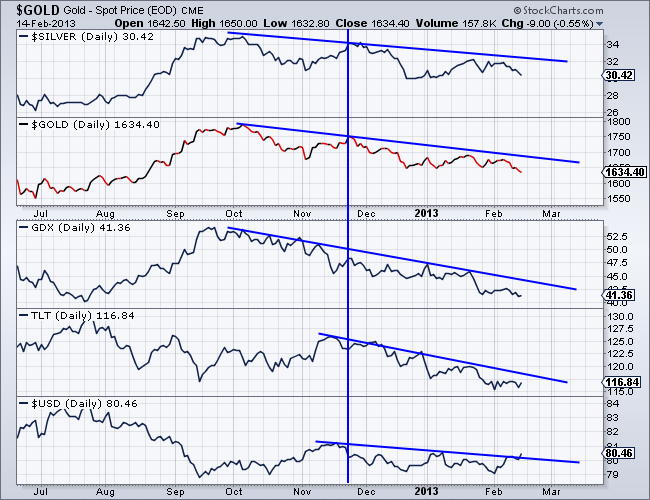
Lately we’ve been writing about the negative correlation between the equity market and the precious metals market. This phenomenon has been in place since summer 2011 and has re emerged in the past few months. Since November 23, the S&P 500 is up 8% while the gold shares are down 14%, Silver has lost 11% and Gold 7%. For those who have studied history this should not come as a total surprise. From 1972 to 1977 and November 2000 to July 2002, precious metals and the equity market trended in opposite directions. We’ve postulated that precious metals and the mining shares won’t begin a new bull phase until the cyclical bull market in US equities ends. We don’t expect that to happen immediately but there are some important signals beneath the surface (with the safe-havens) that we should direct our attention to.
First, let’s take a look at the recent activity in a number of markets. From top to bottom we plot Silver, Gold, GDX, TLT and the US Dollar. The first three markets have been in a downtrend since the end of September. Meanwhile, TLT and the buck began their downtrends in the middle of November. It appears that these markets have been tightly connected since the end of November. That is the bigger picture. The short-term term picture shows the US$ potentially breaking out and bonds not breaking to a new low.
Meanwhile, we should take note of the action in some other markets since late November. Both emerging markets (EEM) and the S&P 500 have advanced, but EEM is slowing down. Commodities failed to make a new high even as the US$ made a marginal low. As we can see, the inverse of the buck is threatening to breakdown and realign with commodities and CEF, a fund which is half Gold and half Silver. The rally since November is now seeing a negative divergence as emerging markets have not made a new high and the US Dollar could be breaking out.
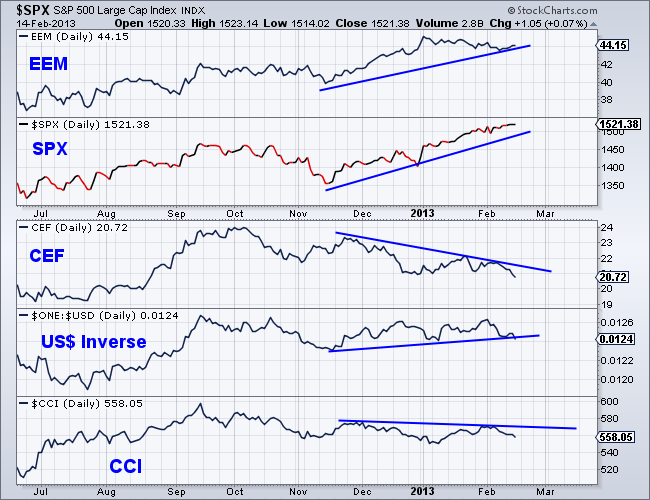
The bottom line is the action in precious metals, commodities and the US$ is signaling a warning for the equity market. The bond market needs to confirm this warning and if it does it could be the catalyst for a sell-off in equities. Keep in mind, the S&P 500 is approaching strong long-term resistance while in a state of euphoric sentiment. If you don’t believe that, check the recent sentiment surveys and ignore those who don’t provide hard data. By the way, public opinion on bonds (fromsentimentrader.com), is only 14% bulls! Sounds like we should sell bonds and buy stocks, right?
Meanwhile, the precious metals appear likely to test major support in the coming days and weeks. There will be some more pain but things are setting up perfectly for the next cyclical bull market. Gold is positioning itself contrary to risk-on assets. It has detached from the stock market and that is a good thing. There will likely be a transition period as precious metals find a bottom and the equity market reaches its peak. For now, look to buy precious metals if they reach an extreme oversold condition next week. As for the gold stocks, if you’d be interested in professional guidance in uncovering the producers and explorers poised for big gains then we invite you to learn more about our service.
Good Luck!
Jordan Roy-Byrne, CMT
Jordan@TheDailyGold.com



-
I know Mike is a very solid investor and respect his opinions very much. So if he says pay attention to this or that - I will.
~ Dale G.
-
I've started managing my own investments so view Michael's site as a one-stop shop from which to get information and perspectives.
~ Dave E.
-
Michael offers easy reading, honest, common sense information that anyone can use in a practical manner.
~ der_al.
-
A sane voice in a scrambled investment world.
~ Ed R.
Inside Edge Pro Contributors

Greg Weldon

Josef Schachter

Tyler Bollhorn

Ryan Irvine

Paul Beattie

Martin Straith

Patrick Ceresna

Mark Leibovit

James Thorne

Victor Adair