Timing & trends

The Bottom Line: Get Ready Get Set

A shallow correction between now and the end of March will provide an opportunity to accumulate sectors on weakness that have a history of outperformance into spring. Sectors include energy, retail, steel and auto & auto parts.

North American equity markets continue to track their historic trends set in a U.S. Post Presidential Election year implying a correction that started in the second week in February followed by shallow weakness until the end of March followed by resumption of an intermediate

clip image0481

clip image046 thumb2


….read more and view 44 Charts & Sector analysis HERE

Emerging nations do not view the West as partners…

IN THE LAST five years, we have seen the start of the decline of the developed world and the real impact of the economic rise of China on that world, writes Julian Phillips at GoldForecaster.

What lies ahead? James Wolfensohn, the ex-president of the World Bank, has given a short lecture in which he forecasts what the world’s cash flows would be like in 2030: 

  • For the last century and far more, 80% of the cash flow of the world flowed to what we know as the developed world where 20% of the people lived. Twenty percent of the cash flow went to the underdeveloped world where 80% of the world’s population lived.
  • By 2030 these numbers will have changed dramatically, with 35% of the cash flow of the world going to the developed world and 65% of the world’s cash flow going to the ’emerging’ world, primarily China and India.
  • In addition, he says that there will be 1 billion middle class people in China by 2050 –a figure we had previously put at 300 million. This is more than the total population of the USA and the Eurozone put together. Worldwide there will be 3 billion people in the middle classes with two thirds of them in Asia.

Think for a moment what this will mean to you individually and the world in which you live. Unless one tries to understand them, we will become a victim of the changes. The ramifications are vast; they become almost impossible to detail in advance. We can forecast principal and principle changes but will almost certainly be wrong in specific details. We then look at the changes that will affect the precious metal worlds, but even here we can only make broad sweeps.

We can be absolutely sure that man cannot weather these changes without uncertainty and instability on a scale not seen since the World Wars. This is the first ingredient that we must factor into the future and man’s way of coping. 

The fact that the prime minister of Britain has taken a huge delegation this week to India shows that the developed world is starting to try to adapt to these coming changes. Britain is even minting gold sovereigns, a coin with emotional connotations in India. 

But we do not see Asia turning to the developed world as partners in the future. The pattern to date has been to mimic the developed world’s skills, and then do it cheaper at home, exporting the products back to the people who taught them at a lower price! So the wealth and power of the developed world seeps across to the East and will continue to do so until emerging world income rises to the same level as developed world income or developed world income fall to that of the emerging world.

It’s clear that Asia is not an ally of the developed world nor are they committed to helping the developed world. The saying is true that nations have interests, not friends. This will be the case between the two sides of the world. Asia sees its first priority in lifting itself up and using developed world markets to help do that.

The developed world may see only flat growth in the medium-term, reminiscent of the postwar-era when Britain, with its outdated equipment, was quickly overtaken by Japan, where after the war everything was built new, from scratch. Both China and India are in a similar position now. As a result, manufacturing will continue to go east.

As the pressure grows on the developed world, the developed world may be pressured into protectionism to survive. The initiation of the US/European Free Trade Zone this month is the start of such survival techniques. Consequently, economic pressures will escalate into tension between East and West in global trade. The arrival of the Yuan onto the global stage will exacerbate these.

But the direct point of impact of these growing pressures will be in the monetary world. This was highlighted last week in the G-7 and G-20 meetings where quantitative easing was justified and its direct impact on the exchange rates minimized. This attitude directly undermines stability in foreign exchanges and, worse still, makes acceptable the undermining of the foreign exchange rate system itself and the need for currencies to be reliable measures of value. We have no doubt that the self-interested positions that this demonstrates will continue to grow and worsen to the detriment of the global economy. After these statements, we’re seeing sterling continue to fall. Expect to see the Yen fall to 100+ against the USD.

Since the last war the developed world has interlinked with the US in a tight knit monetary system based on the Dollar, the only currency with which to buy oil. With Asia rising and with the Yuan shortly to make its appearance on the global reserve currency table, the Dollar will lose a great deal of its control over both oil and the global monetary system. It will retain its hold over OPEC but not over Russia and if it agrees on a defined trading range between the Euro and the Dollar will ensure Europe pays for its non-European oil in Dollars still. It’s likely, however, that Russian sales of oil and gas to Europe will be made in Rubles or Euros, not Dollars. Therefore, there will be a loosening of both the US grip over oil supplies and the Dollar’s grip over the monetary world. 

We cannot see the developed world willingly cooperating with any demands made by rising Asia as this will probably be at the expense of the West’s influence and power over the monetary system. 

For instance, in order for Asia to get the voting power it would warrant in line with its rising power, it would request that it get a good chunk of the voting power. It would also request that the IMF lower the number of votes needed to pass a resolution from 85% to say, 70% with it getting a similar number of votes as the US Its alternative is to set up an equivalent body to the World Bank and the IMF –a process it has already started.

Overall expect to see the world fragment into a series of blocs with their trading partners reliant on them. This would inevitably lead to more protectionism and monetary fragmentation.

Alongside this and to reinforce the fragmentation and consolidation of self-interest in these groups, another worldwide development will begin. Both these blocs and all the nations left out in the cold will have to turn to capital and currency controls to hold on to their country’s capital. The ‘carry trade’ of borrowers in low interest currencies and lenders into high interest rate nations would be controlled to prevent the probable tsunamis of capital sloshing between the blocs.

The capital controls that are seen in Iceland at the moment are the consequences of such crises. These will become increasingly common across the world.

But the most life-changing facet of these changes for the developed monetary world will be that the damage done to the credibility of the leading currencies, the Dollar and the Euro. They will lose their current percentages of global reserves, being replaced to some extent by the Yuan and possibly other Asian currencies.

The current weakening of the Yen, Sterling and Swiss Franc are making this point right now. This process has to continue as nations, in the cause of growth, will progressively weaken their currencies and provoke retaliation from the nations who lose their advantage because of such moves. 

The process of fragmentation will create currency volatility that undermines confidence in the entire monetary system. The current discussion of a currency war will morph into a revolution against the corporation we saw in the past and see to a large extent now. We reiterate that this entire process will be exacerbated by the arrival and growth of the Yuan as an increasingly important global reserve currency.

In turn, there will be a rising need for non-national, liquid, internationally acceptable assets that would support global currencies when used internationally. We know of only one at the moment and that is gold.

Looking to buy gold at the lowest price possible? Visit BullionVault

Julian D.W. Phillips25 Feb ’13
 

JULIAN PHILLIPS – one half of the highly respected team at GoldForecaster.com – began his career in the financial markets back in 1970, when he left the British Army after serving as an Officer in the Light Infantry in Malaya, Mauritius, and Belfast.

First he worked in Timber Management and then joined the London Stock Exchange, qualifying as a member and specializing from the beginning in currencies, gold and the “Dollar Premium”. On moving to South Africa, Julian was appointed a macro-economist for the Electricity Supply Commission – guiding currency decisions on the multi-billion foreign Loan Portfolio – before joining Chase Manhattan and the UK Merchant Bank, Hill Samuel, in Johannesburg.

There he specialized in gold, before moving to Capetown, where he established the Fund Management department of the Board of Executors. Julian returned to the “Gold World” over two years ago, contributing his exceptional experience and insights toGlobal Watch: The Gold Forecaster.

Legal Notice/Disclaimer: This document is not and should not be construed as an offer to sell or the solicitation of an offer to purchase or subscribe for any investment. Gold Forecaster/Julian D.W. Phillips have based this document on information obtained from sources they believe to be reliable but which it has not independently verified; they make no guarantee, representation or warranty and accepts no responsibility or liability as to its accuracy or completeness. Expressions of opinion are those of Gold Forecaster/Julian D.W. Phillips only and are subject to change without notice. They assume no warranty, liability or guarantee for the current relevance, correctness or completeness of any information provided within this report and will not be held liable for the consequence of reliance upon any opinion or statement contained herein or any omission. Furthermore, they assume no liability for any direct or indirect loss or damage or, in particular, for lost profit, which you may incur as a result of the use and existence of the information, provided within this report.


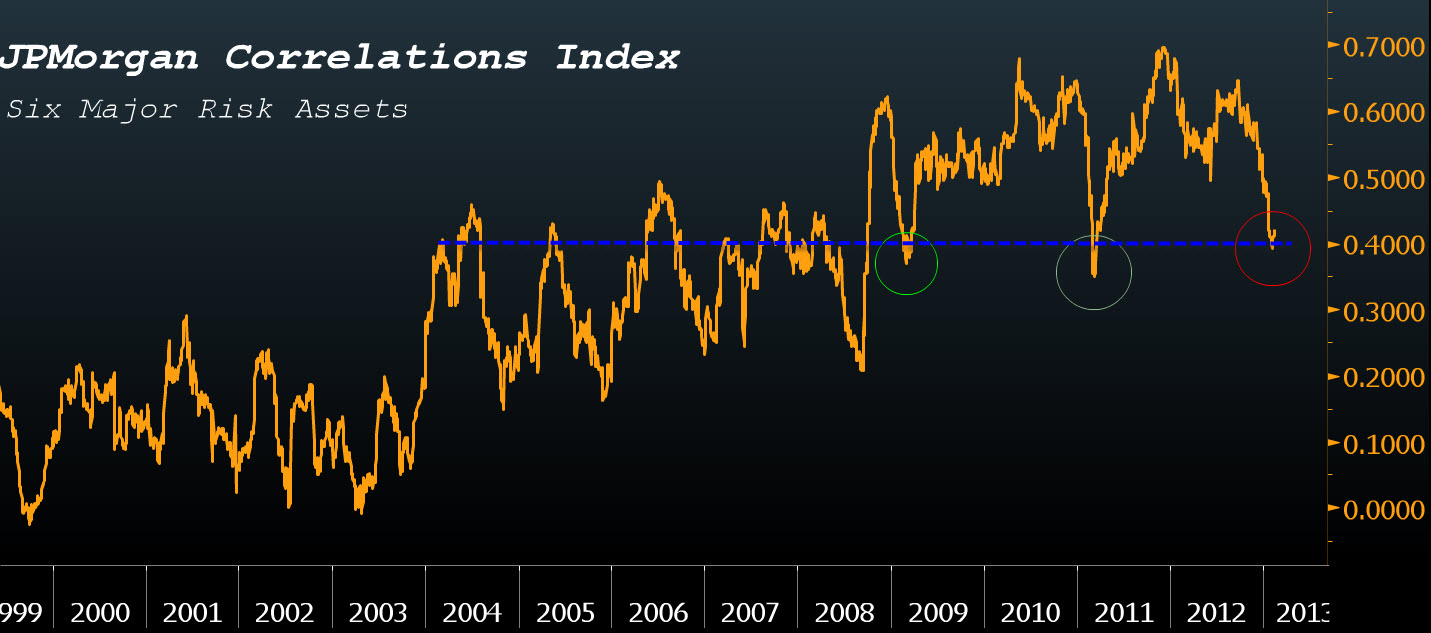
Market Believes ‘New Normal’ Is ‘Old Normal’ Once Again

20130225 corr

Simply put, this is a chart of the victory of central bank largesse over human common-sense and logic. We suspect – just as we have seen before – this cloak of invincibility will be lifted once again very soon.

…..read more HERE


Chart: Bloomberg

 

Quick RRSP/TFSA Facts – Avoid the Annual Mistake!

Financial-FreedomRegistered retirement savings plans (RRSPs) are one of the most popular investment vehicles for Canadians. Contributing to an RRSP is one way to reduce the amount you owe at tax time.

March 1, 2013, is the last day you can contribute to an RRSP for the 2012 tax year.

The amount you can contribute to your RRSPs each year without tax implications is determined by your RRSP deduction limit, or contribution room, which can be found on your 2011 notice of assessment.

The Tax-Free Savings Account (TFSA) allows Canadians, age 18 and over, to set money aside tax-free throughout their lifetime. Each calendar year, you can contribute up to the TFSA dollar limit for the year, plus any unused TFSA contribution room from the previous year, and the amount you withdrew the year before.

The annual TFSA dollar limit for 2013 is $5,500.

All income earned and withdrawals from a TFSA are generally tax-free. Plus, having a TFSA does not impact federal benefits and credits. It’s a great way to save for short and long-term goals.

Avoid the Annual Mistake!

Every year around this time, our phones begin to ring off the hook. With RRSP deadlines and new TFSA room, investors become fixated on the investment industry for a few months. This is a mistake.

Don’t get me wrong. It’s great to be in demand and busy. And for the average investor, we are pleased with the level of engagement we see at this time of year. But the mistake is trying to cram a year or more worth of investment decisions into a week or even a day around RRSP/TFSA season.

Contributions are made and securities are purchased all within a rushed day or so. Then the investor exhales and goes back to the regular routine with the occasional gander at the portfolio through the remainder of the year. Use this strategy at your peril!

By all means, make the appropriate contributions to your RRSP if its suits your investment situation. We are big supporters of TFSAs and encourage investors to pair a self-directed TFSA with our annual research service to build their own Small-Cap Portfolio. What we do not advise are contributions followed by immediate buys to create an “instant portfolio.”

Why? We advocate creating an 8-12 stock portfolio with profitable, growing, and value priced small-cap stocks for the growth area of your portfolio. In this context, there are two major problems with investors who myopically focus on RRSP season.

Number one is that creating a portfolio at one set time immediately locks you into to that point in a market cycle. If it is near a top and a meaningful correction follows, it can take years to recover. Number two is that, quite frankly, it is difficult in most markets to find 10 great stocks to buy at any given time.

It’s all about quality over quantity and often investing success is as much about the stocks you don’t buy as it is about the ones you do. We encourage Canadians to consult with their financial advisors and make the appropriate contribution decisions this month. But remember that those funds do not all have to be deployed the day, week, or month after you make those contributions.

Be patient and create the small-cap growth area of your portfolio over one to three years and review and rebalance over that time. Given the fact that at 18.86 and 17.09 times earnings respectively, the S&P/TSX Composite Index and the S&P 500 are trading above historical P/E multiples, it is likely time to leave some powder dry to employ in the event of a pullback during 2013.


KeyStone’s Latest Reports Section

2/21/2013
EXTRUSION & AUTOMOTIVE MANUFACTURER POSTS SOLID START TO 2014, DIVIDEND INCREASED 20%, REASONABLE VALUATIONS WITH A STRONG BALANCE SHEET – REITERATE BUY

1/18/2013
UNIQUE FINANCIAL SERVICES FIRM WITH STRONG CASH POSITION (58% IN CASH), SOLID EXPANSION PLANS AND ATTRACTIVE VALUATIONS

1/18/2013
ENERGY & AGRICULTURAL PRODUCT MANUFACTURER AND SERVICE MICRO-CAP STOCK WITH STRONG CASH POSITION, SOLID GROWTH, & TRUE CASH FLOW FROM RECENT ACQUISITION NOT FULLY RECOGNIZED

1/18/2013
CASH RICH TECHNOLOGY EQUIPMENT MANUFACTURER (PRIMARILY FOR O&G MARKET) WITH STRONG CASH FLOW, LOW VALUATIONS & DOMINANT CDN MARKET SHARE IN SOLID NICHE – ESTABLISH HALF POSITION

1/18/2013
CASH RICH (65% IN CASH) EXECUTIVE SEARCH FIRM WITH 6% DIVIDEND, COST CONTAINMENT PRODUCES SOLID PROFITABILITY IN TOUGH MARKET, PLAY ON POTENTIAL US JOB RECOVERY

The Forbidden History of Terrible Taxes

An interesting/funny/historical manner just how much tax you actually pay, once you factor in Direct Taxes, Indirect Taxes, excises, tarrifs, duties, business compliance costs, failed Green schemes, industry subsidies, carbon taxes, gas taxes, liquor taxes, provincial taxes, municipal taxes, property taxes, recycling taxes, CCP, Employment Insurance deductions, Government permits, fishing licenses………. and there is so much more  -Ed

sunk-under-taxes


test-php-789