
Timing & trends
Cyprus: As The Barn Door Closes
 “As it turns out, these same oligrachs may have used the one week hiatus period of total chaos in the banking system to transfer the bulk of the cash they had deposited with one of the two main Cypriot banks, in the process making the whole punitive point of collapsing the Cyprus financial system entirely moot.”
“While ordinary Cypriots queued at ATM machines to withdraw a few hundred euros as credit card transactions stopped.” Meanwhile, “The two banks at the centre of the crisis Laiki, and Bank of Cyprus – have units in London which remained open throughout the week and placed no limits on withdrawals.”
“Just brilliant.”
“In every sense of the word.”
……more on the Russian theft of their own money HERE
(Last 2 comments written by Kate the just announced WINNER of the BEST CANADIAN BLOG (scroll down at the link for Kate’s winning entry in the 13 th Annual Worldwide WEBLOG AWARDS)

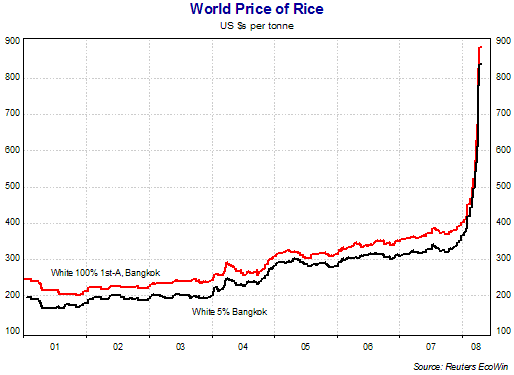
The Next Price Spike Could Be In Food
Is The Junior Potash Sector Hitting Rock Bottom?
Population growth combined with potential inflationary effects could lead to increased demand for food. Increasing populations with declining arable land per capita will force farmers to boost yield using the key ingredient potash.
Potash or potassium salts are amazing fertilizers. They make the plant stronger and improves output. Potash helps the physical condition of the crop boosting vitality. It helps a plant’s immunity to withstand drought, infection and parasites. Do not forget that potash is also used in drilling, building materials, paper, pharmaceuticals and other products.
Continuing interest especially out of Asia, India and Brazil for a secure long term supply could boost global demand to 75 million tons by 2020 and boost the need for junior potash developers. These countries have major supply demand imbalances.
The global population increases 300-400 million people every five years. Rising emerging economies require more well rounded diets consisting of higher meat based and crop intensive diets.
Arable land is declining per capiita….
(an example of a food price spike below, go to the link above to reak more)


 Most people would much rather own stocks than gold. Most of the time, they are probably right. Gold pays no dividends. Nor does it invent new things or open up new markets… or any of the other things that make stocks go up.
And now most people seem to think there is a “recovery” under way… and that the authorities have everything under control. So who needs gold?
|
How to Make 12% per Year Without Trading Stocks
Are you fed up with the stock market? Tired of taking big risks for small profits? I recently discovered a unique investment that’s gone up every year since 1950. And during the last 14 years, a number of investors have used it to earn an average of 12% every year. That’s seven times better than the S&P 500 did over the same period. Even better, this investment has nothing to do with the stock market. |
According to Kim MacQuarrie’s book The Last Days of the Incas, a sailor in the 16th century earned about 8 ounces of gold for a year’s worth of service.
How much does a merchant seaman today earn? A quick Google search reveals a wage of about $2,500 per month… or about $30,000 per year.
That seems a little low. It probably doesn’t include health insurance and so forth. And maybe it includes all of those sailors from Indonesia and the Philippines who must earn less than the typical American mariner. So let us say $40,000, which is about the average wage in the U.S.
Hmmm… Eight times $1,600 (the current gold price) does not take us far. To about only $12,800. So either MacQuarrie is wrong. Or sailors make a lot more today than they used to. Or the price of gold is far too low.
Sailors were probably not well paid in the Age of Discovery. We will guess that the average wage was probably closer to an ounce of gold per month.
That would be a wage of $1,600 monthly… still low by U.S. standards, but not by the standards of most of the world! By world standards, a sailor probably earns about as much, in gold, as he did 500 years ago.
Those are the kinds of problems and questions you run into when you’re trying to figure out whether gold is overpriced or underpriced. All we can tell is that, on the evidence of the sailors’ wages, gold is probably not far from where it ought to be.
Pizarro hit the jackpot when he conquered the Incas and stole their gold. During a four-month period, from March-July 1553, the conquistadores melted down 40,000 pounds of Incan jewelry, art, tableware and religious items. They sent one-fifth of the loot back to the king of Spain. They divided up the rest among the 168 conquistadores.
It was a bloody business (killing thousands of unarmed Incas at Cajamarca, for example). But it paid well. The horsemen in the group each got 90 pounds of 22.5 karat gold, plus 180 pounds of silver.
If they had just put the gold in a safe place, to be dug up by a distant descendant in the 21st century, the fortune would be worth about $2 million.
Getting “Cyprused”
Last week, gold got a little boost when it became apparent that (1) Europe still faces huge and disturbing financial challenges; (2) governments are ready, willing and able to steal money from bank accounts; and (3) governments are also preparing to put on capital controls to prevent you from moving your money to safety.
We maintain a small bank account in France. It is used just to make repairs and otherwise keep up our house there. The woman who handles it sent this message on Friday:
“Don’t put any more money in the account. We don’t want to get Cyprused!”
How likely is it that the French government will freeze the banking sector and skim 10% off the accounts? Not very. France is not in that kind of a cash-flow bind… yet.
But all the countries of the developed world are headed in that direction. They spend more than they receive in tax revenues. And as their debt increases, their interest payments increase too.
Of course, ultra-low interest rate policies — enabled by central bank monetizing of government debt — keeps interest payments low… for now. But low interest rates don’t stay low forever.
And as Greece, Spain, Portugal and other borrowers have already discovered, Mr. Market can be a real pain in the derriere. When he insists on higher rates of interest — fearing that he may not be repaid as promised — state budgets get shot to hell.
Then, like Cyprus, the feds get desperate for money. They will go after it wherever and however they must.
Which makes saving money dangerous, as well as unrewarding. First, the feds suppress interest rates so you get no return on your savings. Then, when they get in a jam, they “Cyprus” your savings directly.
The Cash Conundrum
We are not against holding cash. In fact, we recommend that members of our family wealth investment advisories, Bonner & Partners Family Office and Bonner & Partners Private Wealth, do exactly that.
As our old friend Rick Rule says, cash gives you the courage and the conviction to buy when everyone around you is selling. You can’t expect to snap up bargains in the market without it.
But cash also makes us nervous, thanks to central banks’ overzealous use of the printing presses. This is an important reason to keep your eye on gold (and own some too).
If the 16th-century sailor had taken his annual pay and buried it under a tree in Extremadura, it might still be there. The lucky treasure hunter would find himself as rich as the sailor who buried it five centuries ago.
The nice thing about gold is that not only does it hold its value over centuries, it is also a valuable that you can keep out of the banking system.
And like jewelry or antique autos, you can keep it at home. Bury some gold bars under your own tree. Keep them in your own safe. If the banking system freezes up or breaks down… you still have them. Pass them to your children. Give them as birthday presents. Or just lock them up and forget about them.
Gold is private money. Dollars, pounds and euros are public money.
Dollars, pounds and euros are given to us by governments and central banks. Gold is given to us by the gods.
Regards,
Bill Bonner
U.S. stocks continued mostly going up last week. But European markets fell. Gold bounced up and down… but held above $1,600.

In a previous column, I showed you how the war cycles turn violently higher this year. I also addressed the issue of war, and its implications for the markets, at the Weiss Global Wealth Summit in January.
It’s a topic that no one likes to talk about. Yet I’ve studied the history and Cycles of War in detail. And I do not like what I see happening now in the least bit.
As I’ve also previously told you, I do not expect a war between China and the United States, nor between China and Taiwan, nor Russia and the United States.
But it’s also clear to me that there are many seeds of war now being sown, in many different areas.
First, we have the rising military might of China, and its territorial expansion into the South China Sea and the Spratly Islands.
Beijing wants control over the vast oil reserves in those regions, which could turn out to be the biggest in the world. Beijing also wants to exercise control over the vast, hugely important shipping lanes in the South China Sea, another reason we should all be concerned.
And make no mistake about it. China is becoming a military giant. It now has the largest number of active-duty troops in the world, at 2.28 million.
It has 7,400 tanks. 44 attack helicopters. 71 submarines. 2004 combat-ready aircraft. And a brand-spanking new, state of the art aircraft carrier.
And Beijing is upping its military budget over 10 percent this year, increasing its military spending by $106 billion.
Second, we also have rising cyber espionage all over the world, much of it instigated by China and North Korea. The media calls it “hacking.” I call it “spying.” Either way, there’s a good chance we may one day, in the not-too-distant future, see a full-scale cyber war break out.
Third, we have Iran and Israel, the Middle East. Always a problem, my models show this year could be the year that war breaks out in the Middle East. The Arab Spring is a prelude, one that has sown the seeds of war and uprisings and rebellions all over the Middle East.
But the area that worries me the most is none other than Europe, where the demons of previous wars are still very much alive.
Europe is a cesspool of rotten politics, inept leaders,
and a monetary system that was flawed from the outset.
And worse now, is that the latest Cyprus developments are directly planting the seeds for a civil war in Europe.
Europe is going to splinter apart at the seams. I am sure of it.
The mere gall that northern European leaders have to even suggest that Cypriots’ bank accounts be raided is something no one should take lightly. It shows how desperate the situation is in Europe … and how desperate the so-called “Troika,” has become.
The European Commission (EC), the International Monetary Fund (IMF), and the European Central Bank (ECB) are all clamping down hard on weaker European peripheral countries with austerity programs and now, threats of confiscation …
When in reality, they have no one to blame but themselves for the mess that Europe is in.
Yes, countries such as Greece, Cyprus, Portugal and others were profligate. But the stronger countries of Europe — Germany especially — are equally to blame. They are the countries that practically forced the weaker European countries to adopt the euro, putting them in a position where they could not compete against the stronger economies of Germany and France …
And they are the countries that rammed loans, that are now unpayable, down the throats of those countries.
It’s gotten so bad in Europe, the rise of neo-Nazi parties is astounding.
In Greece, the neo-Nazi “Golden Dawn” party has risen in popularity from 0.3 percent of the Greek people polled in 2009 to as much as 7 percent late last year. A 23-fold increase in just three years.
 Germany’s Angela Merkel is now being portrayed in many European publications in Nazi garb.
From the north of Europe to the Mediterranean in the south, fascist and neo-Nazi parties are growing at an alarming rate, gaining over 15 percent of the vote in recent local elections in many countries.
As EU Home Affairs Commissioner Cecilia Malmström recently stated, “Not since World War II have extreme and populist forces had so much influence on the national parliaments as they have today.”
Will Europe See a Civil War?
Unless the Troika backs off the weaker, heavily-indebted countries, which is not likely, yes, I believe Europe is headed toward massive civil unrest and war.
Another aspect that worries me, is Russia. According to Moody’s ratings agency, Russians have $19 billion in Cypriot banks, nearly as much as Cyprus’ entire GDP. Russian banks have an additional $12 billion invested and have loaned another $40 billion to Cypriot companies of Russian origin.
That’s just Cyprus. While there are no clear estimates on how much Russian money, legally or illegally, is spread out over Europe, it’s safe to assume there are boatloads. In 2012 alone, an estimated $56 billion left Russia, much of it going into Europe.
Vladimir Putin is up in arms over the crisis in Cyprus. He will not stand idly by while Russian money is at risk in Europe.
Keep in mind that Russia largely controls the European energy sector. The European Union depends on Russia for more than 32 percent of its crude oil, and nearly 39 percent of its natural gas needs.
Many countries in Europe depend upon Russia for 100 percent of their energy needs.
Germany depends upon Russia for as much as 36 percent of its energy needs.
If Putin feels Russian financial losses in Europe are unjust, I don’t doubt for one minute that he would threaten to retaliate by “turning the lights out” in Europe.
Sadly, based on my work on the war cycles and what’s happening now in the next phase of the great financial crisis and Europe’s sovereign debt crisis, war and massive civil unrest in many parts of the world is a very real threat. And it’s already starting to impact the financial markets.
It’s a major geo-political reason why the dollar is now breaking out to the upside, precisely as I have been forecasting.
And, it’s a major reason behind my forecast for a much higher U.S. equity market. Frightened capital from all over the world will pour into the U.S. and emerging markets of Asia.
To play the long side of the dollar for a strong rally this year, consider investing in thePowerShares DB US Dollar Index Bullish Fund ETF (UUP).
Per my previous suggestion in my February 11 Money and Markets column to purchase a small core position in the SPDR DJ Industrial Average ETF (DIA) at $134 or better: Raise that price to buy now on a pullback to the $141 level.
If and when filled, place a stop to reduce risk at $105, on a good-till-cancelled basis.
Lastly, despite the prospects for massive civil unrest around the world and even war this year, commodities are not yet out of the woods and are instead still largely in a disinflationary trend. That includes the precious metals.
The chief reason is the stronger dollar. Plus, the austerity measures and rising taxation that’s occurring around the globe. That’s sending most money to the sidelines or into liquid equity markets.
While gold will shine again someday soon, it’s still not time to back up the truck on the precious yellow metal.
Best wishes, as always, stay tuned …
Larry


-
I know Mike is a very solid investor and respect his opinions very much. So if he says pay attention to this or that - I will.
~ Dale G.
-
I've started managing my own investments so view Michael's site as a one-stop shop from which to get information and perspectives.
~ Dave E.
-
Michael offers easy reading, honest, common sense information that anyone can use in a practical manner.
~ der_al.
-
A sane voice in a scrambled investment world.
~ Ed R.
Inside Edge Pro Contributors

Greg Weldon

Josef Schachter

Tyler Bollhorn

Ryan Irvine

Paul Beattie

Martin Straith

Patrick Ceresna

Mark Leibovit

James Thorne

Victor Adair