
Bonds & Interest Rates
What You Think Is True Might Be False and Costly!
Posted by Deviant Investor
on Wednesday, 27 March 2013 23:01
 MFGlobal – Customer assets were supposedly insured, segregated, and protected by the exchange. Apparently not! Jon Corzine “has no idea” where the assets went. Most clients had believed their accounts were safe, and they were wrong.

Faber: We are moving into a Speculative phase where….
Posted by Marc Faber & Other Authors
on Wednesday, 27 March 2013 22:05
….everything you buy today, you can buy cheaper within the next 2-3 years.
David McAlvany : We have talked about liquidity. We have talked about the implications of rising asset prices. Yet selectively, we are seeing stocks break down. You pointed out, very presciently last October, that Apple looked very much like RCA in the 1920s and could be poised for a correction. Of course, we have had the correction, close to 40%. Today, there are a growing number of stocks that are breaking down in the same manner, 30%, 50%, even 80% down in a short period, and that’s while the major indices are moving higher. What does that tell you, as someone familiar with the markets for 20, 30, 40 years now?
Marc Faber : When you have that many stocks breaking down every day, it’s not the symptom of a market that is bottoming out, it’s the symptom of a market that is already relatively high, where the bull market is already rather mature. That is what it tells me.
And by the way, I would like to add one more comment about what you said about liquidity. I’ve been in this business for a number of years, to be precise, 40 years. In the 1970s people went around the Middle East and said, “Oh, the Arabs, they have so much liquidity.” And at that time, I used to travel frequently to Kuwait, and they had a stock market, and at the peak of the Kuwaiti stock market in 1979-1980, the Kuwaiti stock market had a larger capitalization than the German stock market, and everybody always said that there was so much liquidity, it will never go down.
Fast forward: Japan in the late 1980s. Everybody told me there is so much liquidity, stocks in Japan will never go down. And then again, in the late 1990s, there is so much liquidity, NASDAQ will never go down. And for real estate the same, and so forth, and now I hear the same story. At the peak of the market, you always have lots of people who tell you how much liquidity there is around, but liquidity comes and goes, and you don’t know exactly what will happen. And I really don’t know whether the Dow Jones will peak out today, or in three months, or six months, or even a year. But we are moving into a speculative phase where my sentiment is that everything you buy today, you can buy cheaper within the next 2-3 years.
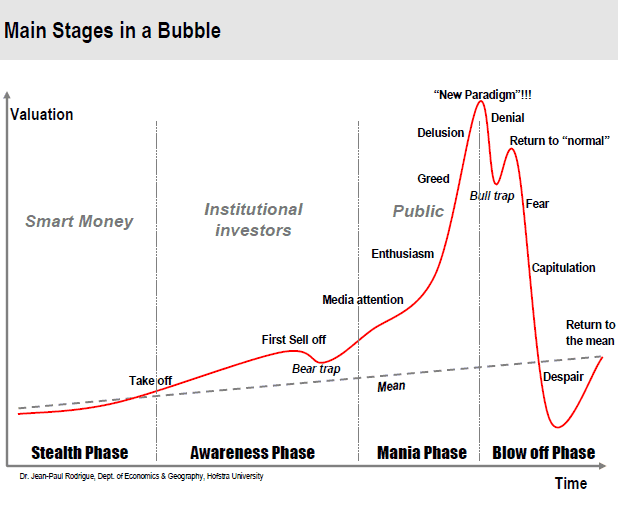
– in a recent interview with McAlvany
Click here to watch the full interview >>>>>>
5 Steps Of A Bubble
…..Ed Note: Read about bubble Characteristics, The Dutch Tulip Mania, Minsky’s Theory of Financial Instability and so much more in this article HERE

Peter Krauth, resource specialist for Money Map Press, considers the precious metals space an overarching requirement for investors. He sees value in every sector, although he admits it takes a contrarian mindset to see the opportunity among stocks that have been trending down for as long as 18 months. In this Gold Report interview, Krauth shares names from majors to mid caps to royalty companies, including those in the platinum group metals space, where supply-and-demand tensions will move the price of palladium up.
The Gold Report: Peter, playing equities is all about timing. With many resource equities trading near all-time lows, it seems like a buyer’s market. Do you agree?
Peter Krauth: Central banks have been on a fiat money printing binge since 2008. In the last 18 months, that is starting to have the desired effect. The global economy seems to be healing: Demand for goods is coming back strongly, the Dow Jones Industrial Average is setting new records. But at the same time, there will be a serious price to pay with inflation. Commodities tend to benefit from inflation. This is a very good and important space that investors need to include in their portfolios.
TGR: Does that hold true across all commodities?
PK: The entire secular commodities bull market is not completely over. It has been going for 12 years, but the average tends to be closer to 17 years. This bull market might last 20 years or even longer, if you consider development in China and India—home to nearly one-third of the world’s population—along with the rest of the developing world. These populations are improving their standards of living, growing their incomes and looking for a better lifestyle. That means someone will have to make all the stuff they will want to acquire.
However, there could be a serious low or even a setback in the form of seriously reduced economic demand or an inflationary crisis. That would quiet things for a while, but would also do a lot of cleansing. After that, we will be back on our way.
Nonetheless, investors have to be picky. Every resource has its own cycle. It takes a lot of research to decide where you should be and when.
TGR: What are you telling the readers of your newsletter about increasing their exposure to natural resources in their portfolios?
PK: Right now, I see opportunities in base metals, energy and agriculture. And of course, precious metals will remain an overarching requirement to have exposure to commodities.
The larger gold miners have become extremely cheap, with very compelling valuations. As a group, they have not been cheaper since the secular bull market started. Gold may have been in consolidation mode since it reached $1,900/ounce ($1,900/oz) in September 2011, but I believe the secular bull market is far from over, despite the possibility of some sideways or downward price action.
The Market Vectors Gold Miners (GDX), an exchange-traded fund (ETF) that many consider a proxy for the Amex Gold BUGS Index (HUI), has a price-to-earnings ratio (P/E) of 10, far better than the average blue chip stock, which is closer to 16–17 P/E.
TGR: Some say the gold price is like a ball when you drop it. The first bounce is the highest, and the bounces keep getting smaller after each drop. Does that pattern worry you?
PK: No. As the consolidation moves forward in time, the price range gets narrower and narrower. At some point, that will have to change. The price will either drop down or break out of its narrowing price range. I believe it will break out.
The gold price is unlikely to stay very stable for an extended period. There is too much political and economic instability. The run on the banks in Cyprus is an example; a lot of Southern Europe has too much unemployment and sovereign debt. Ongoing gold purchases by the central banks provide renewed support for the gold price. All of these factors, and others, will support the gold price, at least in the $1,500/oz range. It could continue sideways for some time, but the bias is very much on the upside.
TGR: What analysis do you do on small- and mid-cap resource names before adding them to your portfolio?
PK: My main filters are management, location, cash strength, ease of execution and asset quality. This analysis eliminates many potential plays, but there are more than enough attractive opportunities if you stick to those that stay within those parameters. I see no reason to take on additional risk.
TGR: Which small- and mid-cap resource names in your portfolio might you share with our readers?
PK: My favorite development-stage play is Paramount Gold and Silver Corp. (PZG:NYSE.MKT; PZG:TSX). The company recently released a preliminary economic assessment (PEA) on its San Miguel project in Mexico. The numbers look very attractive. Its initial capital requirements of $232 million ($232M) are pretty reasonable. The mine would actually produce about 57,000 oz (57 Koz) gold and more than 3 million ounces (3 Moz) silver annually for 14 years.
If you were to convert the forecast silver production to gold, it would be more than 115 Koz gold equivalent (Au eq) produced annually. With the 5% discount rate that the company used to evaluate the project, the net present value (NPV) exceeds $707M, with an internal rate of return (IRR) around 32%. This single project at a $707M NPV is more than double the company’s current market cap of $290M. On that basis alone, the stock should be twice its current $2.16/share trading price. Shares barely budged on the news of the San Miguel PEA. That is a ridiculous reaction, and a clear sign that sentiment is coloring everything gold-related.
TGR: You buy Paramount for San Miguel, and you get Sleeper, its precious metals project in Nevada, for free. Is that what you are saying?
PK: Or vice versa, or you buy Paramount for both San Miguel and Sleeper and get a lot for free.
Paramount released PEA results on Sleeper in July 2012. The startup costs would be about $340M; production would be 172 Koz gold and 263 Koz silver annually. The average operating cost was $767/oz Au eq and the IRR was about 26%, at $1,384/oz gold price. If you bumped up the gold price to $1,615/oz, the IRR shoots up to 40%. This makes Sleeper very attractive at the current gold price. Paramount prudently used lower gold and silver prices in its estimates.
TGR: Will Paramount have any trouble raising that $232M to develop San Miguel?
PK: Paramount just had some warrants exercised, so it is cashed up to $18M. That should carry it through 18 to 24 months. I believe it will keep moving both projects forward. Both are attractive and could draw the interest of a major.
TGR: Might Paramount sell one project to develop the other?
PK: I could see that as a possibility, however, given its advantageous cash balance compared to the rest of the industry, I doubt Paramount will be pushed into that situation anytime soon. It could probably even raise cash to tide it over without being overly dilutive to its shareholders.
Both projects are in great jurisdictions and have great infrastructure. With each project worth about $700M, that is close to $1.4 billion ($1.4B) in value, and the market values Paramount at less than $300M. Realistically, the shares could be 4.5 times what they are trading at now.
TGR: Please tell us about another name.
PK: We hold Timmins Gold Corp. (TMM:TSX; TGD:NYSE.MKT), a small producer whose San Francisco mine is in Mexico. The company had record gold production last year, a 27% increase year over year (YOY). It is expanding its crushing capacity, which should allow for another 25–30% growth in 2013. For a small producer, its P/E is 10.5, and its forward P/E is 7. It has a $28M cash balance and roughly $20M in debt. Timmins is very well run. It is a smaller producer with a great future.
TGR: Timmins looks to be a company that would benefit from a change in market sentiment. Do you think the market is already factoring in last week’s news that the Mexican government may raise taxation rates and royalties on mining operations?
PK: That is possible, but the Mexican government understands what it is doing. Gold production is growing fast there.
On raising taxes and royalty rates, Mexico will be the rule, not the exception. We expect to see this everywhere. Governments are hungry for income. If gold continues to rise, these companies will be increasingly profitable. This rise in taxes will have only a temporary dampening effect; it will not hurt the bull market in any way.
TGR: What will Timmins do with its cash flow?
PK: Timmins is expanding its crushing capacity, drilling off and expanding its resource. I believe that as the company was drilling off and delineating more ounces, its finding costs were $10/oz—an incredible return. Its exploration program is relatively aggressive, but the company also is confirming the gold in higher confidence categories.
TGR: Are there any other names you would like to discuss?
PK: In silver, we hold Aurcana Corporation (AUN:TSX.V; AUNFF:OTCQX), which also has been growing its production quickly. In mid-December, the company reached commercial production at its Shafter mine in Texas. It also produces in Mexico from a project called La Negra.
Shafter is a milestone that will move Aurcana to much higher production levels this year. I look forward to seeing Shafter’s contribution in the company’s Q1/13 results. Even without Shafter, Q4/12 production was up 34% YOY; overall 2012 production was up 42%.
La Negra is another exciting project. In October 2012, Aurcana announced a new resource there, which brought the silver resource from 4.9 Moz to more than 115 Moz.
Aurcana’s P/E is relatively high, at about 39. It is a smaller silver producer but it is profitable, which means a lot. Its forward P/E is estimated at 5.3, which is very low and makes it very attractive. The forward P/E reflects the higher production levels and, therefore, profitability.
TGR: Aurcana has four institutional analysts covering it. Does institutional coverage on a small company reassure you?
PK: Institutional ownership is more important. Ownership means more than just giving an opinion. Institutional investors tend to take a longer view.
TGR: Both Shafter and La Negra are past-producing assets. Aurcana has nothing in the pipeline beyond those two, although both are producing fairly strong cash flow. What does Aurcana plan to do with that cash flow?
PK: The plan is to plow it back into drilling off and expanding the resource and increasing production capacity. Aurcana wants to mill and crush more of the ore it gets out of the ground.
At La Negra, the company wants to prove up higher levels of its 115 Moz silver. Shafter is a similar story. In the first phase, production at Shafter will be around 3.8 Moz with 1,500 tons per day (1,500 tpd). The second phase will achieve 2,500 tpd. That could actually increase the Shafter production to approximately 6.3 Moz silver annually. That is close to 70–80% growth from the initial production targets. If Shafter reaches its phase 2 targets, it will be the third-largest primary silver mine in North America.
TGR: You recently wrote about the coming global shortage of palladium and the likely rise in the palladium price. Investors have heard similar refrains from experts relative to rare earth elements, lithium and even some base metals. Those commodities have witnessed only what one might call sporadic price gains. Are you “crying wolf” when it comes to palladium?
PK: The fundamentals for palladium’s supply-demand profile are very solid. On the demand side, two-thirds end up in vehicles, mostly for catalytic converters. Car sales are growing very quickly. In 2011, 77M vehicles were sold worldwide; in 2012, 81M. This year, the forecast is to reach 85M and the 2018 estimate is 104M. A lot of that growth will happen in China, which also has a serious pollution problem. China has been increasing its emission standards as its air becomes relatively unbreathable.
On the supply side, Russia accounts for 44% of palladium production; South Africa for 38%.
South Africa has serious labor disruptions. In August 2012, miners at Lonmin Plc’s (LMI:LSE) Marikana mine went on strike. Clashes between strikers and the police resulted in 46 deaths. Protests and strikes have multiplied since then. In January, Anglo American Plc (AAUK:NASDAQ) decided to close and sell off several of its platinum mines. Labor problems and production costs have just become overbearing. The mines are not profitable anymore. That does not help supply.
Ore grades from Russia have been falling quickly. Output from Norilsk, the world’s largest palladium producer, is declining. Russia also sells palladium into the physical market from Gokhran, its state repository. In 2010, as much as 1 Moz of the physical palladium—representing 15% of the global supply—came from Gokhran. In 2011, that dropped to 775 Koz and last year to 250 Koz. This year, Johnson Matthey forecast Gokhran will supply only 150 Koz. In four years, supply from Gokhran will have dropped from 15% of the global supply to only 2%. Some insiders say there will be no supply from Gokhran in 2014.
TGR: Are resource equities the best way to play palladium?
PK: They are. Palladium’s demand outlook is solid, and Russia and South Africa—source of 80% of the supply—will have a difficult time keeping up with demand. As a result, palladium prices will continue climbing. That will attract investors to things like palladium ETFs. As those ETFs use the metal as backing, it will drive up physical demand further.
The equities provide leverage to the palladium price. If companies can mine palladium at a relatively low cost, they can generate healthy profit margins. That is how investors should play this trend.
TGR: There are few platinum group metals (PGM) plays out there. Can you give us one or two names?
PK: I like Colossus Minerals Inc. (CSI:TSX; COLUF:OTCQX), a developing precious metals miner. Its flagship project, Serra Pelada in Brazil, is fully permitted and has environmental, installation and mining licenses going back to 2010. The mine is under construction, with first production planned for early H2/13. It has done all kinds of metallurgical testing and expects very good recoveries.
The company has come across some extremely high-grade intercepts for gold, platinum and palladium. Some of the high-grade intercepts have been 4,600 grams per ton (4,600 g/t) gold over admittedly short intercepts, about 2–2.5 meter (2–2.5m) sections, 1,600 g/t platinum and 1,700 g/t palladium. Its margins are likely to be extremely wide, so it should be a very profitable producer. Some of the grades at Serra Pelada are among the highest on record. The project has drilled 100,000m to date, and a lot of exploration upside remains.
TGR: For a long time, a group of workers called the Cooperativa de Mineração dos Garimpeiros de Serra Pelada (COOMIGASP) held a percentage of Serra Pelada. Does it still own a percentage?
PK: Yes, that group still owns 25% of Serra Pelada.
TGR: Is Colossus likely to try to buy them out?
PK: I think that could be part of its long-term plan.
TGR: Is Colossus on target for production in H2/13?
PK: Yes. It has a $75M contingency for construction and working capital. It sold some of its production in advance to Sandstorm Gold Ltd. (SSL:TSX.V) and Sandstorm Metals & Energy Ltd. (SND:TSX.V), but it has the right to repurchase half of those commitments.
Platinum and palladium production will be relatively important, in addition to gold. This makes it an interesting way to play the PGM space. Investors can be part of a company that is very close to production and should have attractive profit margins.
TGR: With its margins and its unusual gold-PGM project, is this a takeover target?
PK: Yes. Imminent producers inevitably become targets because they are irresistible in terms of adding to production and reserves. Colossus would be a trophy piece for a miner that wanted to own potentially large, high-grade reserves in a good, relatively safe jurisdiction.
TGR: Why have we not seen a pure PGM royalty play?
PK: The market for a pure royalty play in PGMs is probably just too small for a given royalty company to focus solely on these metals; its growth opportunities would be limited.
There are few PGM projects being developed. PGMs are found in places that are not the best or most attractive places to work. Outside of South Africa and Russia, there are relatively few viable locations, therefore, there are very few PGM projects coming onstream in the next two years.
TGR: Large-cap royalty plays in the precious metals space have had a pretty good run. Some are trading around 21 times projected 2013 cash flow. Is there still value there?
PK: I think so. Some are trading at relatively high P/Es, but there is opportunity. First, along with other precious metals equities, they have sold off to some extent. Second, and more important, they are being valued using gold prices that are probably too low.
The average analyst thinks that gold will average somewhere around $1,500/oz by 2015. They may be right, but if you look at their projections since 2007, analysts have regularly underestimated the gold price by several hundred dollars.
Inflation and money printing by central banks will not back down. Precious metals royalty companies will certainly come back quite strongly as gold continues to rise.
TGR: What are a couple of your favorites in the royalty space?
PK: Our portfolio has Royal Gold Inc. (RGLD:NASDAQ; RGL:TSX). About 68% of its revenues come from gold. Of its large inventory of assets, 39 are producing, 28 are development stage and almost 140 are exploration.
We also hold Sandstorm Gold Ltd. (SSL:TSX), a smaller royalty company with an $870M market cap. It has been aggressive, and is growing quickly. It has very savvy, experienced management, including Nolan Watson from Silver Wheaton Corp. (SLW:TSX; SLW:NYSE). Sandstorm’s recent purchase of a controlling interest in one of its competitors, Premier Royalty Inc. (NSR:TSX), grew its book quite quickly. It also closed a large deal with Entrée Gold Inc. (EGI:NYSE.A).
This is a great space. Royalty companies will continue to perform very well over the medium and long term. I definitely want to maintain exposure to precious metals royalties.
TGR: Shares of Royal Gold were trading near $100/share last fall, and now it has fallen to below $70/share. It is rare to see a royalty company fall that far so quickly. What happened?
PK: I believe delays by Barrick Gold Corp. (ABX:TSX; ABX:NYSE) on a large project that Royal Gold has a royalty in weighed on the stock.
That does not concern me. We doubled our purchase price and took profits. We continue to hold Royal Gold as a free ride. On a technical basis, Royal Gold is trading below its 200-day moving average. That 200-day average tends to be a magnet that a stock gravitates back toward and sometimes moves considerably beyond. When it does so, it can be a time to take some profits and wait for it to become more of a value once again.
TGR: Do you have some parting thoughts for us?
PK: We are in a secular resource bull market that still has lots of legs and will last several more years. The imprudent behavior of central banks printing copious amounts of fiat money just makes serious inflation more of a threat to people’s savings.
Commodities tend to be a strong beneficiary of inflation. I think everyone needs some exposure to commodities. But there is the element of cyclicality for all resources; at any given point in time, it makes sense to be in certain resources or to play them certain ways over others.
TGR: Peter, thank you for your time and your insights.
Peter Krauth is a former portfolio adviser and a 20-year veteran of the resource market, with special expertise in energy, metals, and mining stocks. Krauth is the resource specialist for Money Map Press and has contributed some of its most widely read and highly regarded investing articles to Money Morning. As editor of Real Asset Returns, he travels around the world to dig up the latest and greatest profit opportunity, whether it’s in gold, silver, oil, coal, potash, chromium, or even water. Krauth holds a Master of Business Administration degree from McGill University and is headquartered in resource-rich Canada.
DISCLOSURE:
1) Brian Sylvester conducted this interview for The Gold Report and provides services to The Gold Report as an independent contractor. He or his family own shares of the following companies mentioned in this interview: None.
2) The following companies mentioned in the interview are sponsors of The Gold Report: Paramount Gold and Silver Corp., Timmins Gold Corp. and Colossus Minerals Inc. Streetwise Reports does not accept stock in exchange for its services or as sponsorship payment.
3) Peter Krauth: I or my family own shares of the following companies mentioned in this interview: None. I personally or my family am paid by the following companies mentioned in this interview: None. My company has a financial relationship with the following companies mentioned in this interview: None. I was not paid by Streetwise Reports for participating in this interview. Comments and opinions expressed are my own comments and opinions. I had the opportunity to review the interview for accuracy as of the date of the interview and am responsible for the content of the interview.
4) Interviews are edited for clarity. Streetwise Reports does not make editorial comments or change experts’ statements without their consent.
5) The interview does not constitute investment advice. Each reader is encouraged to consult with his or her individual financial professional and any action a reader takes as a result of information presented here is his or her own responsibility. By opening this page, each reader accepts and agrees to Streetwise Reports’ terms of use and full legal disclaimer.
6) From time to time, Streetwise Reports LLC and its directors, officers, employees or members of their families, as well as persons interviewed for articles and interviews on the site, may have a long or short position in securities mentioned and may make purchases and/or sales of those securities in the open market or otherwise.

For years we have been warned by Keynesian economists to fear the so-called “liquidity trap,” an economic cul-de-sac that can suck down an economy like a tar pit swallowing a mastodon. They argue that economies grow because banks lend and consumers spend. But a “liquidity trap,” they argue, convinces consumers not to consume and businesses not to borrow. The resulting combination of slack demand and falling prices creates a pernicious cycle that cannot be overcome by the ordinary forces that create growth, like savings or investment. They say that a liquidity trap can even resist the extraordinary force of monetary stimulus by rendering cash injections into useless “string pushing.” Some of these economists suggest that its power can only be countered by a world war or other fortunately timed event that leads to otherwise politically unattainable levels of government spending.
Putting aside the dubious proposition that the human desire to strive and succeed can be permanently short-circuited by an economic contraction, and that modest expected price declines can quell our desire to consume, the Keynesians have overlooked a much more dangerous and demonstrable pitfall of their own creation: something that I call “The Stimulus Trap.” This condition occurs when an economy becomes addicted to the monetary stimulus provided by a central bank, and as a result fails to restructure itself in a manner that will allow for robust, and sustainable, growth. The trap redirects capital into non-productive sectors and starves those areas of the economy that could lead an economic rebirth. The condition is characterized by anemic growth and deteriorating underlying economic fundamentals which is often masked by inflation or asset price bubbles (I look at how stimulus has impacted the U.S. stock market in the March edition of my newsletter).
Japan has been caught in such a stimulus trap for more than a decade. Following a stock and housing market boom of unsustainable proportions in the 1980s, the Japanese economy spectacularly imploded in 1991. The crash initiated a “lost decade” of de-leveraging and contraction. But beginning in 2001, the Bank of Japan unveiled a series of unconventional policies that it describes as “quantitative easing,” which involved pushing interest rates to zero, flooding commercial banks with excess liquidity, and buying unprecedented quantities of government bonds, asset-backed securities, and corporate debt. Although Japan has been technically in recovery ever since, its performance is but a shadow of the roaring growth that typified the 40 years prior to 1991. Recently, conditions in Japan have deteriorated further and the underlying imbalances have gotten progressively worse. Yet despite this, the new government is set to double down on the failed policies of the last decade.
I believe that the United States is now following Japan into the mire. After the crash of 2008, we implemented nearly the same set of policies as did Japan in 2001. In the past two years, despite the surging stock market and apparently declining unemployment rate, the size and scope of these efforts have increased. But as is the case in Japan, we can clearly witness how the stimulus has perpetuated stagnation. (See my analysis of the new plans of the Japanese government).
In 2008, one of the country’s biggest problems was that we had over-leveraged too many non-productive sectors of the economy. For instance, we irresponsibly lent far too much money to people to buy over-priced real estate. Since then, the problem has gotten worse. Currently the process of writing, securitizing, and buying home mortgages has been essentially nationalized. Fannie Mae and Freddie Mac (which are now officially government agencies) write and package the vast majority of new home mortgages, which are then guaranteed (almost exclusively) through the Federal Housing Administration, and then sold to the Federal Reserve. According to a tally by ProPublica, these government entities bought or insured more than nine out of 10 home mortgages originated last year, a $1.3 trillion business. Compare this to 2006, when the government share was only three in 10. As a result of this, our lending is far more irresponsible than it has ever been.
In the fourth quarter of 2012, 44% of all FHA borrowers either had no credit score or a score of 679 or lower. In addition, the overwhelming majority of FHA guaranteed loans are being made at 95% or greater loan-to-value. This means down payments are an afterthought. Under the FHA’s Home Affordable Refinance Program (HARP), loans are now even extended to underwater borrowers whose mortgages may be worth far more than their homes. As a result, the FHA could be exposed to enormous losses in the event of future housing market downturns. Such an outcome would be likely if mortgage interest rates were ever to rise even modestly from their current low levels.
In fact, losses on low-quality mortgages have already left the FHA with $16 billion in losses. To close the gap, it has had to raise the insurance premiums it charges to borrowers. With those premiums expected to rise again next month, many fear that marginal borrowers could be priced out of the market. But rather than learning from its mistakes, the government just announced that Fannie Mae would pick up the slack, lowering its lending standards to match the ones that had led to losses at the FHA. In other words, we haven’t solved the problem of bad lending – we have simply made it bigger and nationalized it.
The overall financial sector is equally addicted to cheap money. Banks have seen strong earnings and rising share prices in recent years. But their businesses have largely focused on the simple process of capturing the spread between the zero percent cost of Fed capital and the 3% yield of long term Treasury debt and government insured mortgage backed securities. As a result, banks are not making productive private sector loans to businesses. Instead, the capital is being used to pump up the already bloated housing and government sectors.
Corporate profits are indeed high at the moment, but much of that success comes from the extremely low borrowing costs and extremely high leverage. Investors chasing any kind of yield they can find are pouring money into companies with dubious prospects. This January, yields on junk rated debt fell below 6% for the first time. Currently they are approaching 5.5%. Consumers are using cheap money to buy on credit. Savings rates are now hitting post-recession lows.
Lastly (but certainly not least), the Federal government is now totally dependent on the Fed’s largess. Without the Fed buying the bulk of Treasury debt, interest rates would likely rise, thereby increasing the cost of servicing the massive national debt. While Congress and the media have focused on the $85 billion in annual cuts earmarked in the “Sequester,” an increase of Treasury yields to 5% (3% higher than current levels) on the $16 trillion in outstanding government debt would translate to $480 billion per year of increased interest payments. Such an increase would force a tough choice between raising taxes, cutting domestic spending or reducing interest payments sent abroad for debt service. If foreign creditors begin to doubt that America has the resolve to make the hard choices, they may refuse to roll-over maturing obligations, forcing the government to actually repay principal. With trillions maturing each year, actual repayment is mathematically impossible.
But for now most people feel that the transition is underway to a healthy economy. The prevailing debate is when and how the Fed will let the economy fly on its own. Many of the top market analysts have great faith that Ben Bernanke can pull the monetary tablecloth off the table without disturbing the dishes. Those who hold this view fail to understand that the United States is caught in a stimulus trap from which there is no easy exit. How can the Fed wean the economy from stimulus when stimulus IS the economy? In truth, the trick Bernanke must actually perform is to pull the table out from beneath the cloth, leaving both the cloth and the dishes suspended in air. (Read how Iceland confronted its own crisis while avoiding the stimulus trap).
What would happen to the Treasury market if the Federal Reserve, by far the biggest buyer and largest holder of Treasury bonds, became a net seller? Who will be there to keep the sell off from becoming an interest rate spiking rout? It may sound absurd to those of us who remember the economy before the crash, but our new economy can’t tolerate “sky high” rates of four or five percent. What would happen to the housing market and the stock market if interest rates were to return to those traditional levels? The red ink would flow in rivers. With yields rising and asset prices falling, how long would it take before the Fed reverses course and serves up another round of stimulus? Not long at all.
That means any talk of an exit strategy is just that, talk. Not only can the Fed not exit, but it will have to delve further into the stimulus abyss. While doing so, the Fed will continuously insist that the exit lies just behind an ever moving horizon. It will repeat this mantra until a currency crisis finally forces a painful exit.
Unfortunately, the longer the Fed waits to exit, the more painful the exit will be. But trading long-term pain for short-term gain is the Fed’s specialty. In the meantime, Wall Street watches in uncomprehending stupor as the economy settles deeper and deeper into the stimulus trap.
Peter Schiff is the CEO and Chief Global Strategist of Euro Pacific Capital, best-selling author and host of syndicated Peter Schiff Show.
Subscribe to Euro Pacific’s Weekly Digest: Receive all commentaries by Peter Schiff, John Browne, and other Euro Pacific commentators delivered to your inbox every Monday!
And be sure to order a copy of Peter Schiff’s recently released NY Times Best Seller, The Real Crash: America’s Coming Bankruptcy – How to Save Yourself and Your Country.
Euro Pacific Capital, Inc.
10 Corbin Drive, Suite B
Darien, Ct. 06840
800-727-7922
www.europac.net
schiff@europac.net

Yikes: Eurogroup Head admits No Depositors Safe
Posted by Multiple Authors
on Wednesday, 27 March 2013 14:56
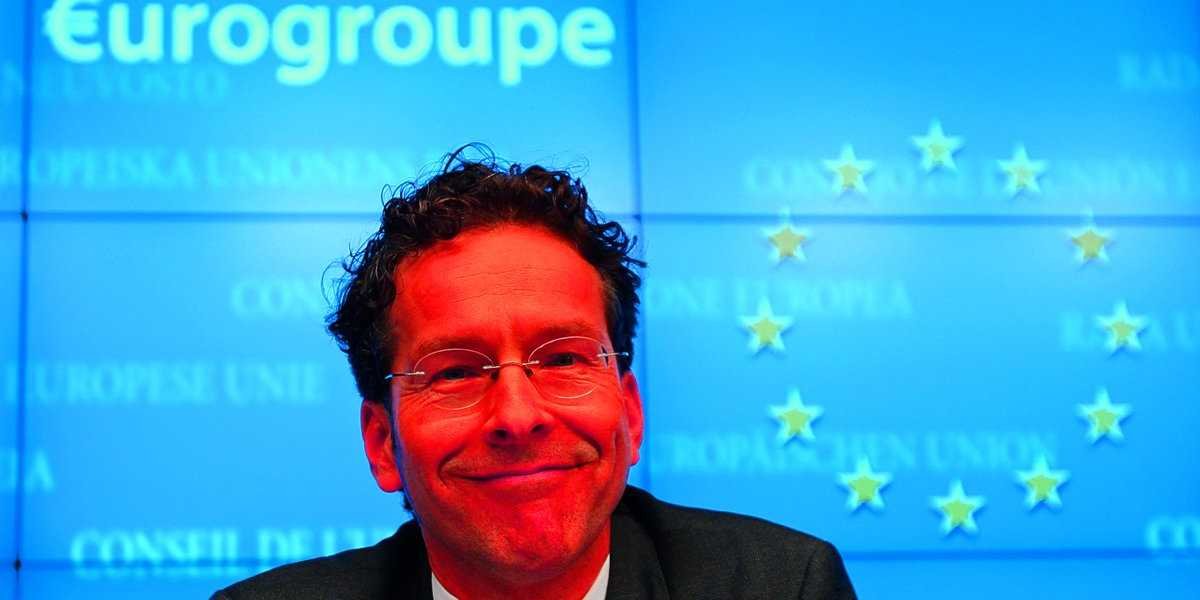 The Cyprus bailout is a template for Europe restructurings said the Eurogroup Head. The deal involved a hefty tax on depositor accounts above €100,000 ($128,000) and, more worrying for investors, an agreement to wipe out the senior bondholders of the Cypriot banks.
While that meant few losses for investors now, the big worry is what happens down the road should Italy and Spain start to stumble.
….more:
Dijsselbloem Has Given Us A Glimpse Of The Euro ‘End Game’


-
I know Mike is a very solid investor and respect his opinions very much. So if he says pay attention to this or that - I will.
~ Dale G.
-
I've started managing my own investments so view Michael's site as a one-stop shop from which to get information and perspectives.
~ Dave E.
-
Michael offers easy reading, honest, common sense information that anyone can use in a practical manner.
~ der_al.
-
A sane voice in a scrambled investment world.
~ Ed R.
Inside Edge Pro Contributors

Greg Weldon

Josef Schachter

Tyler Bollhorn

Ryan Irvine

Paul Beattie

Martin Straith

Patrick Ceresna

Mark Leibovit

James Thorne

Victor Adair