
Gold & Precious Metals
With a scary bank crisis in Cyprus driving the headlines a couple of weeks ago, gold could barely muster a rally. Notice in the chart below that the high of the move failed to clear a minor peak at 1619.70. Had it done so, we would have given bulls a fighting chance, since it would have created a bullish “impulse leg” with the potential to power quotes as much as $120 higher in just a few weeks. Instead, buyers showed themselves to be gutless, allowing the April contract to relapse down to within inches of the lower trendline. It could hold, but we doubt it.
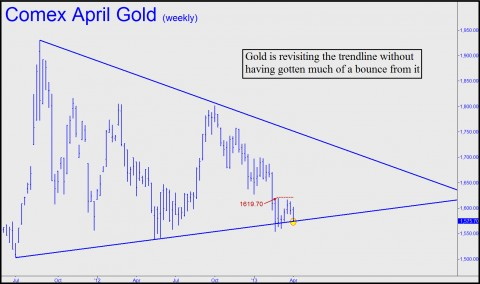
Still worse is that a breakdown is likely to send the futures down to at least 1553.50, a Hidden Pivot support identified here a couple of weeks ago when the futures were trading above 1600. If that “hidden” support should fail as well, look out below, since the next stop would be a more important one at 1487.00 that was flagged at the same time. That would represent a 5.5% fall from current levels, which would hardly be disastrous. But it would also turn a trendline that has provided support since July of 2011 into resistance, opening a path to significantly lower prices into autumn.
Three Scenarios
Because the trendline is so clear, it seems all but certain to be tested. It comes in at around 1570 this week, and you should expect it to be breached. Once that has occurred, things could play out in a few different ways. Most bullish of them would be a sharp rebound that vaults the 1619.70 peak by mid-April. That’s what we should expect to happen if the smart money is planning to shake out the weak sisters in order to run gold steeply higher without being burdened by nervous profit taking. But if gold proves unable to get serious loft within a week or two, be prepared for a downdraft to 1487.00. Another possibility is a tedious game of footsies on and around the trendline. Beware, however, if settlement occurs below the trendline for two consecutive weeks, since that would imply distribution.
Because the long-term trend in gold is bullish, we should be willing to give it the benefit of the doubt under any circumstances. Technically speaking, it would take an “impulsive” rally on the hourly chart to turn us bullish again. At present, that would imply a swift thrust hitting 1612.90 within three or four days of any fleeting dip below the trendline. We’d lay three-to-one odds against it at the moment, but stranger things have happened.

 Jim Flaherty – Canada’s Anti Robin Hood.
Everybody enjoys the story of Robin Hood, especially here in Canada; land of socialists that think like capitalists, or is it capitalists that think like socialists. What we seem to have currently is an individual in government casting himself as something of an ‘anti-Robin Hood’. Our Finance Minister, Jim Flaherty, has decided that it somehow makes sense to urge lending institutions – whose cost of funds has dropped to record lows – to charge Canadians higher rates than they might otherwise do. Rather than make their standard margin of profit, Mr. Flaherty is instead encouraging financial institutions to keep rates artificially high, and thus their profit margins also artificially high, at the expense of Joe and Mary Sixpack.
This somewhat odd tale begins in early March with the non-event of BMO announcing a ‘no-frills’ 2.99% 5 year fixed mortgage rate. I suggest this was a non-event as in the world of the mortgage broker we have had full-featured mainstream 2.99% five year fixed mortgage rates since July of 2012. Arguably we have had this rate available since November of 2011 with only a few months of exceptions here and there.
Yet somehow our Finance Minister seemed unaware of this and deemed it appropriate to apply pressure to both Bank of Montréal and subsequently Manulife Financial (they had the audacity to offer a 2.89% rate) and push their rates up with rhetoric, rather than allowing the free market to do its thing. Mr. Flaherty threw around catch phrases like ‘race to the bottom’, ‘mortgage rate wars’, and saw fit to blend into the conversation a reference to the mortgage crisis in the United States. ( For clarity on how radically different the US system was and is from the CDN system I urge you to pick up a copy of Michael Lewis’ The Big Short – comparisons between the CDN and US mortgage markets are simply not realistic or logical)
Somehow Mr Flaherty seems to be overlooking the fact that Canada has some of the most stringent mortgage qualification criteria in the world. Low interest rates are not about to trigger any sort of crisis, loose qualification guidelines and imprudent underwriting practices were the issues in the US and have arguably not been an issue within Canada ever.
This is all being done ostensibly to protect us from ourselves. In other words stealing .10% from the masses to feed the chartered banks. (This actually starts to remind me of the plot line from a great little indie film, The Office)
Let’s look at a few hard numbers. The average Canadian mortgage is $165,000 and a difference of 1/10 of a percent equals a savings of approximately $13.75 per month, not exactly life changing economics for the typical Canadian family, but hey we will keep every hard earned nickel that we can in our own pockets. Over a period of 60 months this is $825 in savings, which is not nothing.
Here in British Columbia the average mortgage is closer to $275,000 or that difference of 1/10 of a percent equals a savings of approximately $22.91 per month. ($1374.60 over a five-year period)
How do these numbers add up for the typical financial institution renewing and originating Billions of dollars worth of mortgages this month?
For each $1 billion worth of mortgage money that a financial institution charges 1/10 of a percent more than they otherwise would an additional $83,315.98 worth of interest,(translation net profit), is generated. Spread that out over a five year term and Mr. Flaherty’s comments stand to generate the Banks an additional $4,998,958.80. over five years for every $1 billion worth of mortgages that are written at the .10% artificially higher rate than they otherwise would have been were the market left alone to operate on its own terms.
Some back of the napkin math, simply because I do not have time to Google the exact figures, would indicate in excess of $10 billion worth of mortgages renewing and originating per month in the province of British Columbia alone. It is likely that 70% of these will be in the five-year fixed rate mortgages (whether this is a good thing is another story altogether) and will thus generate an additional $35 million in profit over the term for each 1/10 of one percent that lenders increase their rates by. (Potentially 70M for Manulife)
How does this even make any sense to a rational person?
It is a rare day that I find myself in agreement with the statement made by an NDP member, even at the federal level. However NDP leader Tom Mulcair hit the nail on the head when he referred to this as ‘Banana Republic Behavior’.
In any event it is my humble opinion that low interest rates are going to be with us for some time, and this is neither a bad thing for the average Canadian nor a harbinger of doom.
In closing let me lay out another set of numbers that you might find more interesting, and arguably Mr. Flaherty might want to tune into with his regulatory magic wand…assuming ‘consumer debt’ is truly his target of concern.
If there were in fact genuine concern about Canadian household debt than I daresay the focus would be on increasing regulation around consumer debt; credit cards, unsecured lines of credit, car loans, boat loans, personal loans, etc. The standards for qualification absolutely pale in comparison to those for mortgage financing.
The hard numbers; A $27,000 credit card debt at 19% yields $411.50 per month in interest for the lender. If the borrower makes only the minimum required payment the total amortization of this $27,000 loan is effectively 127 years. Yes, One Hundred & twenty seven years.
From the Banks perspective, at a paltry 2.99% they have to loan out $166,175 to generate that same yield of $411.50 per month in interest. Not quite as lucrative.
I offer the following example of how flawed things have become; The federal government dictates that I must pay off my home completely within 25 years, this is an appreciating asset in which I live of which there are several examples still standing around me which are well over 100 years old. It is also the lowest interest debt I am able to have at any point in time.
However I can head out to a discount furniture store and spend $27,000 filling my home with particleboard, pleather, and flatscreens. Items which are depreciating in nature and unlikely to have a useful life of greater than 10 years, and somehow it is okay for me to take 127 years to pay this debt off.
I am seriously concerned about the priorities of our Finance Minister. Certainly the conspiracy theorists must absolutely be having a field day with this stuff.
Dustan Woodhouse is a mortgage consultant based in British Columbia and is a regular contributor to MoneyTalks and the World Outlook Financial Conference. www.dustanwoodhouse.ca

After three weeks of waiting, the S&P 500 Index finally joined the Dow in the record books.
Last Thursday, the most widely tracked Index in the United States closed at 1,569.19 – taking out its previous all-time high of 1,565.15, which was hit on October 9, 2007.
The market hitting new records presents an opportunity for reflection. Or as Erik Davidson, Deputy Chief Investment Strategist at Wells Fargo Private Bank, says, “It is a milestone; it does cause you to stop and evaluate where you are and where you come from.”
For example, this chart certainly gives some perspective:

A Gentleman from Wall Street Daily found that chart and presented it in two articles titled:
10 Startling Statistics About the S&P’s Record High (Part 1)
and….
10 Startling Statistics About the S&P’s Record High (Part 2)
Article one begins with:
Stock Stat #1: Talk of a Tired Bull… is Total Bull
So far we’re four-plus years into a bull market. And the S&P 500 has risen more than 130%.
Even though I told you not to before, it’s only natural to assume that such a sustained and significant rally is close to the longest on record. But it’s not.
In fact, this is only the sixth longest bull market since 1929 (the year the market crashed), according to an analysis by Bank of America (BAC).
….for Statistic 2- 10 go to:
10 Startling Statistics About the S&P’s Record High (Part 1)
10 Startling Statistics About the S&P’s Record High (Part 2)

 All financial eyes should be focused on the BOJ (Bank of Japan) right now. Money managers are calling this week’s BOJ meeting, the most important one in many years.
- It’s likely to be a key factor in determining the next big move for the price of gold.
- Key market players expect Governor Kuroda to imitate Ben Bernanke’s actions, and begin buying longer maturity bonds, and more of them,with electronically printed yen.
- If Kuroda disappoints the market, the yen could rally, and the Nikkei could tumble. If the yen rallied against the dollar, gold might rally too, simply because it trades mainly in dollars.
- On the other hand, if the market believes Kuroda’s actions are a great first step in reversing Japanese deflation, gold could also rally. In the big picture, Kuroda seems to be creating a “win win” situation for gold.
- The man formerly known as “Mr. Yen”, Eisuke Sakakibara, former vice finance minister of Japan, thinks Kuroda will fail to reverse deflation.
- I don’t believe Kuroda will fail, but I believe most money managers are drastically underestimating the amount of money printing that is needed to get the job done.
- Kuroda has said he will do “whatever it takes” to get the Japanese inflation rate up to 2%. Cost push inflation (CPI) will likely be the horrific consequence of doing “whatever it takes”.
- Japan is the 3rd largest economy in the world, far larger than Germany, which is number 4. CPI could devastate Japanese savers. Worse, because Japan is such a large economy, CPI could spread around the world, and I think it will.
- The only good news about CPI is that it could push the gold price well above $2000, and push your gold stocks to new highs. Right now, I don’t think you need any more good news than that!
- Until CPI becomes a dominant theme in the eyes of professional money managers, a rising T-bond price will continue to be bullish for gold. Quantitative easing, and the resulting expansion of the Fed’s balance sheet, is the main driver of gold market liquidity flows.
- Please click here now. You are looking at the daily chart of the T-bond. The good news, for gold market investors, is that there is an upside breakout attempt in play, today. Note the key HSR (horizontal support & resistance) in the 145 area.
- Having said that, please note the position of my “stokeillator” (14,7,7 Stochastics series), at the bottom of the chart. The red lead line has risen to about 90. A crossover sell signal seems imminent, but I’m hoping that any sell-off creates the right shoulder of a bullish double-headed inverse h&s pattern.
- It’s very common, technically speaking, for the price of an asset to rise a bit above a key HSR line, before overbought oscillators “work” to pull it back down, and that may be the case here with the T-bond.
- The technical set-up of this bond chart is similar to that of gold. Pleaseclick here now. That’s the daily gold chart, and you can see that a crossover sell signal for my stokeillator is clearly in play.
- It’s difficult for gold to rally strongly, when technical oscillators are overbought and flashing sell signals. A light sell-off now, or a sideways “drift”, could be just what is needed to begin a much larger rally of $200-$300 an ounce. I think that is exactly what is in the cards now, for gold.
- Note the important HSR at about $1620. If the T-bond can surge above 145, gold should burst above $1620.
- For a closer look at the gold price, please click here now. That’s the hourly gold chart. Note the rough rectangular pattern, defined by the two black trend lines. The target is about $1575.
- Oscillators are like the tides of the ocean, or a person’s breathing pattern. Fighting the natural tendency of gold to rise and fall in a small way, as oscillators move up and down, is not a good idea.
- The situation in the Korean peninsula is potentially a big driver of higher gold prices, but that too, seems to be in sync with my stokeillator; tensions are building, but North Korea has not physically moved any significant number of troops, and that’s needed to raise the tension level. A major rise in tensions seems imminent, but it’s not quite here yet.
- Gold stocks may need a little more “rest time”, too. Please click here now. Double-click to enlarge. You are viewing the BMO Junior Golds Index ETF daily chart. Note the “waterfall” action of the technical indicators.
- That’s not a giant sell signal. It’s simply the cycle of “gold stocks life”.
- While you wait for cost push inflation to become a dominant theme in markets around the world, gold stocks will rise and fall in a small way, like the tide comes in and goes out. A tidal wave of price is coming, but investors need to wait for it, with patience. If you are bored, from waiting for “the big one”, you may want to check out my intraday gold trading service. Send me an email at stewart@gutrader.com, and I’ll send you the details. Thanks.
- GDXJ has a similar look to the BMO ETF. Please click here now . Double-click to enlarge. This is the daily chart. Volume declined during the recent rally, and now most technical indicators are rolling over, suggesting a little weakness is possible. Oscillators don’t create tidal waves, though. Fundamentals do. The fundamentals will create a tidal wave for gold, and these technical oscillators & indicators are telling you that the price of gold needs to breathe, in and out, like a person does. Let the gold price breathe naturally, and you’ll find the price action much less stressful!


Apr 2, 2013
Stewart Thomson
Graceland Updates
website: www.gracelandupdates.com
email for questions: stewart@gracelandupdates.com
email to request the free reports: freereports@gracelandupdates.com
Graceland Updates Subscription Service: Note we are privacy oriented. We accept cheques. And credit cards thru PayPal only on our website.
For your protection we don’t see your credit card information. Only PayPal does. Subscribe via major credit cards at Graceland Updates – or make checks payable to: “Stewart Thomson” Mail to: Stewart Thomson / 1276 Lakeview Drive / Oakville, Ontario L6H 2M8 / Canada
Stewart Thomson is a retired Merrill Lynch broker. Stewart writes the Graceland Updates daily between 4am-7am. They are sent out around 8am. The newsletter is attractively priced and the format is a unique numbered point form; giving clarity to each point and saving valuable reading time.
Risks, Disclaimers, Legal
Stewart Thomson is no longer an investment advisor. The information provided by Stewart and Graceland Updates is for general information purposes only. Before taking any action on any investment, it is imperative that you consult with multiple properly licensed, experienced and qualifed investment advisors and get numerous opinions before taking any action. Your minimum risk on any investment in the world is 100% loss of all your money. You may be taking or preparing to take leveraged positions in investments and not know it, exposing yourself to unlimited risks. This is highly concerning if you are an invetor in any derivatives products. There is an approx $700 trillion OTC Derivatives Iceberg with a tiny portion written off officially. The bottom line:
Are You Prepared?
 A New Era Begins
- Relativity in the Balance of Power
- The Three Pillars of the International System
- Beyond the Post-Cold War World
A New Era Begins
Eras unfold in strange ways until you suddenly realize they are over. For example, the Cold War era meandered for decades, during which U.S.-Soviet detentes or the end of the Vietnam War could have seemed to signal the end of the era itself. Now, we are at a point where the post-Cold War model no longer explains the behavior of the world. We are thus entering a new era. I don’t have a good buzzword for the phase we’re entering, since most periods are given a label in hindsight. (The interwar period, for example, got a name only after there was another war to bracket it.) But already there are several defining characteristics to this era we can identify.
First, the United States remains the world’s dominant power in all dimensions. It will act with caution, however, recognizing the crucial difference between pre-eminence and omnipotence.
Second, Europe is returning to its normal condition of multiple competing nation-states. While Germany will dream of a Europe in which it can write the budgets of lesser states, the EU nation-states will look at Cyprus and choose default before losing sovereignty.
Third, Russia is re-emerging. As the European Peninsula fragments, the Russians will do what they always do: fish in muddy waters. Russia is giving preferential terms for natural gas imports to some countries, buying metallurgical facilities in Hungary and Poland, and buying rail terminals in Slovakia. Russia has always been economically dysfunctional yet wielded outsized influence — recall the Cold War. The deals they are making, of which this is a small sample, are not in their economic interests, but they increase Moscow’s political influence substantially.
Fourth, China is becoming self-absorbed in trying to manage its new economic realities. Aligning the Communist Party with lower growth rates is not easy. The Party’s reason for being is prosperity. Without prosperity, it has little to offer beyond a much more authoritarian state.
And fifth, a host of new countries will emerge to supplement China as the world’s low-wage, high-growth epicenter. Latin America, Africa and less-developed parts of Southeast Asia are all emerging as contenders.
Relativity in the Balance of Power
There is a paradox in all of this. While the United States has committed many errors, the fragmentation of Europe and the weakening of China mean the United States emerges more powerful, since power is relative. It was said that the post-Cold War world was America’s time of dominance. I would argue that it was the preface of U.S. dominance. Its two great counterbalances are losing their ability to counter U.S. power because they mistakenly believed that real power was economic power. The United States had combined power — economic, political and military — and that allowed it to maintain its overall power when economic power faltered.
A fragmented Europe has no chance at balancing the United States. And while China is reaching for military power, it will take many years to produce the kind of power that is global, and it can do so only if its economy allows it to. The United States defeated the Soviet Union in the Cold War because of its balanced power. Europe and China defeated themselves because they placed all their chips on economics. And now we enter the new era.
The Three Pillars of the International System
In this new era, Europe is reeling economically and is divided politically. The idea of Europe codified in Maastricht no longer defines Europe. Like the Japanese economic miracle before it, the Chinese economic miracle is drawing to a close and Beijing is beginning to examine its military options. The United States is withdrawing from Afghanistan and reconsidering the relationship between global pre-eminence and global omnipotence. Nothing is as it was in 1991.
Europe primarily defined itself as an economic power, with sovereignty largely retained by its members but shaped by the rule of the European Union. Europe tried to have it all: economic integration and individual states. But now this untenable idea has reached its end and Europe is fragmenting. One region, including Germany, Austria, the Netherlands and Luxembourg, has low unemployment. The other region on the periphery has high or extraordinarily high unemployment.
Germany wants to retain the European Union to protect German trade interests and because Berlin properly fears the political consequences of a fragmented Europe. But as the creditor of last resort, Germany also wants to control the economic behavior of the EU nation-states. Berlin does not want to let off the European states by simply bailing them out. If it bails them out, it must control their budgets. But the member states do not want to cede sovereignty to a German-dominated EU apparatus in exchange for a bailout.
In the indebted peripheral region, Cyprus has been treated with particular economic savagery as part of the bailout process. Certainly, the Cypriots acted irresponsibly. But that label applies to all of the EU members, including Germany, who created an economic plant so vast that it could not begin to consume what it produces — making the country utterly dependent on the willingness of others to buy German goods. There are thus many kinds of irresponsibility. How the European Union treats irresponsibility depends upon the power of the nation in question. Cyprus, small and marginal, has been crushed while larger nations receive more favorable treatment despite their own irresponsibility.
It has been said by many Europeans that Cyprus should never have been admitted to the European Union. That might be true, but it was admitted — during the time of European hubris when it was felt that mere EU membership would redeem any nation. Now, Europe can no longer afford pride, and it is every nation for itself. Cyprus set the precedent that the weak will be crushed. It serves as a lesson to other weakening nations, a lesson that over time will transform the European idea of integration and sovereignty. The price of integration for the weak is high, and all of Europe is weak in some way.
In such an environment, sovereignty becomes sanctuary. It is interesting to watch Hungary ignore the European Union as Budapest reconstructs its political system to be more sovereign — and more authoritarian — in the wider storm raging around it. Authoritarian nationalism is an old European cure-all, one that is re-emerging, since no one wants to be the next Cyprus.
I have already said much about China, having argued for several years that China’s economy couldn’t possibly continue to expand at the same rate. Leaving aside all the specific arguments, extraordinarily rapid growth in an export-oriented economy requires economic health among its customers. It is nice to imagine expanded domestic demand, but in a country as impoverished as China, increasing demand requires revolutionizing life in the interior. China has tried this many times. It has never worked, and in any case China certainly couldn’t make it work in the time needed. Instead, Beijing is maintaining growth by slashing profit margins on exports. What growth exists is neither what it used to be nor anywhere near as profitable. That sort of growth in Japan undermined financial viability as money was lent to companies to continue exporting and employing people — money that would never be repaid.
It is interesting to recall the extravagant claims about the future of Japan in the 1980s. Awestruck by growth rates, Westerners did not see the hollowing out of the financial system as growth rates were sustained by cutting prices and profits. Japan’s miracle seemed to be eternal. It wasn’t, and neither is China’s. And China has a problem that Japan didn’t: a billion impoverished people. Japan exists, but behaves differently than it did before; the same is happening to China.
Both Europe and China thought about the world in the post-Cold War period similarly. Each believed that geopolitical questions and even questions of domestic politics could be suppressed and sometimes even ignored. They believed this because they both thought they had entered a period of permanent prosperity. 1991-2008 was in fact a period of extraordinary prosperity, one that both Europe and China simply assumed would never end and one whose prosperity would moot geopolitics and politics.
Periods of prosperity, of course, always alternate with periods of austerity, and now history has caught up with Europe and China. Europe, which had wanted union and sovereignty, is confronting the political realities of EU unwillingness to make the fundamental and difficult decisions on what union really meant. For its part, China wanted to have a free market and a communist regime in a region it would dominate economically. Its economic climax has left it with the question of whether the regime can survive in an uncontrolled economy, and what its regional power would look like if it weren’t prosperous.
And the United States has emerged from the post-Cold War period with one towering lesson: However attractive military intervention is, it always looks easier at the beginning than at the end. The greatest military power in the world has the ability to defeat armies. But it is far more difficult to reshape societies in America’s image. A Great Power manages the routine matters of the world not through military intervention, but through manipulating the balance of power. The issue is not that America is in decline. Rather, it is that even with the power the United States had in 2001, it could not impose its political will — even though it had the power to disrupt and destroy regimes — unless it was prepared to commit all of its power and treasure to transforming a country like Afghanistan. And that is a high price to pay for Afghan democracy.
The United States has emerged into the new period with what is still the largest economy in the world with the fewest economic problems of the three pillars of the post-Cold War world. It has also emerged with the greatest military power. But it has emerged far more mature and cautious than it entered the period. There are new phases in history, but not new world orders. Economies rise and fall, there are limits to the greatest military power and a Great Power needs prudence in both lending and invading.
Beyond the Post-Cold War World
An era ended when the Soviet Union collapsed on Dec. 31, 1991. The confrontation between the United States and the Soviet Union defined the Cold War period. The collapse of Europe framed that confrontation. After World War II, the Soviet and American armies occupied Europe. Both towered over the remnants of Europe’s forces. The collapse of the European imperial system, the emergence of new states and a struggle between the Soviets and Americans for domination and influence also defined the confrontation. There were, of course, many other aspects and phases of the confrontation, but in the end, the Cold War was a struggle built on Europe’s decline.
Many shifts in the international system accompanied the end of the Cold War. In fact, 1991 was an extraordinary and defining year. The Japanese economic miracle ended. China after Tiananmen Square inherited Japan’s place as a rapidly growing, export-based economy, one defined by the continued pre-eminence of the Chinese Communist Party. The Maastricht Treaty was formulated, creating the structure of the subsequent European Union. A vast coalition dominated by the United States reversed the Iraqi invasion of Kuwait.
Three things defined the post-Cold War world. The first was U.S. power. The second was the rise of China as the center of global industrial growth based on low wages. The third was the re-emergence of Europe as a massive, integrated economic power. Meanwhile, Russia, the main remnant of the Soviet Union, reeled while Japan shifted to a dramatically different economic mode.
The post-Cold War world had two phases. The first lasted from Dec. 31, 1991, until Sept. 11, 2001. The second lasted from 9/11 until now.
The initial phase of the post-Cold War world was built on two assumptions. The first assumption was that the United States was the dominant political and military power but that such power was less significant than before, since economics was the new focus. The second phase still revolved around the three Great Powers — the United States, China and Europe — but involved a major shift in the worldview of the United States, which then assumed that pre-eminence included the power to reshape the Islamic world through military action while China and Europe single-mindedly focused on economic matters.
“Beyond the Post-Cold War World is republished with permission of Stratfor.”

-
I know Mike is a very solid investor and respect his opinions very much. So if he says pay attention to this or that - I will.
~ Dale G.
-
I've started managing my own investments so view Michael's site as a one-stop shop from which to get information and perspectives.
~ Dave E.
-
Michael offers easy reading, honest, common sense information that anyone can use in a practical manner.
~ der_al.
-
A sane voice in a scrambled investment world.
~ Ed R.
Inside Edge Pro Contributors

Greg Weldon

Josef Schachter

Tyler Bollhorn

Ryan Irvine

Paul Beattie

Martin Straith

Patrick Ceresna

Mark Leibovit

James Thorne

Victor Adair