
Gold & Precious Metals
US DOLLAR LOST SOUL CHART
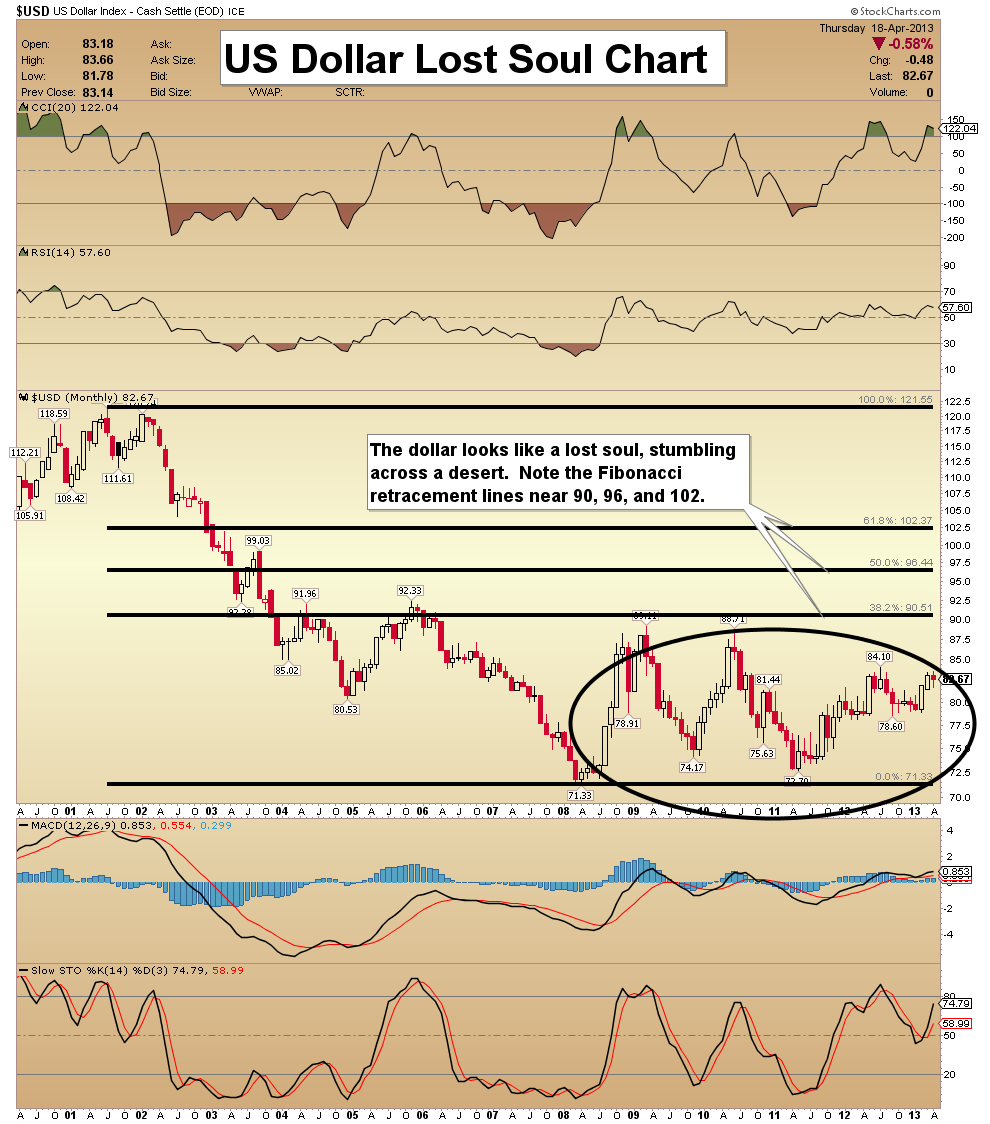
- To gain perspective on a currency, it is necessary to consider the longer term point of view. The US dollar continues to be diluted, and the US economy cannot function without large amounts of liquidity.
- The current QE program involves printing money at the astounding rate of $1 trillion dollars per year, and Fed governor Bullard said this week that he is in favor of increasing it.
- When you look back 12 years, it’s clear that the dollar is gradually being debased. Note the Fibonacci retracement numbers that I’ve highlighted on this monthly chart.
- Even if the dollar were to rally to the 100 area, it would not change the primary trend, which is down. The dollar is like a lost soul wandering across a desert. Austerity, not more QE, is the drink of water that my country’s fiat currency needs.
Gold Fibonacci Arc Chart
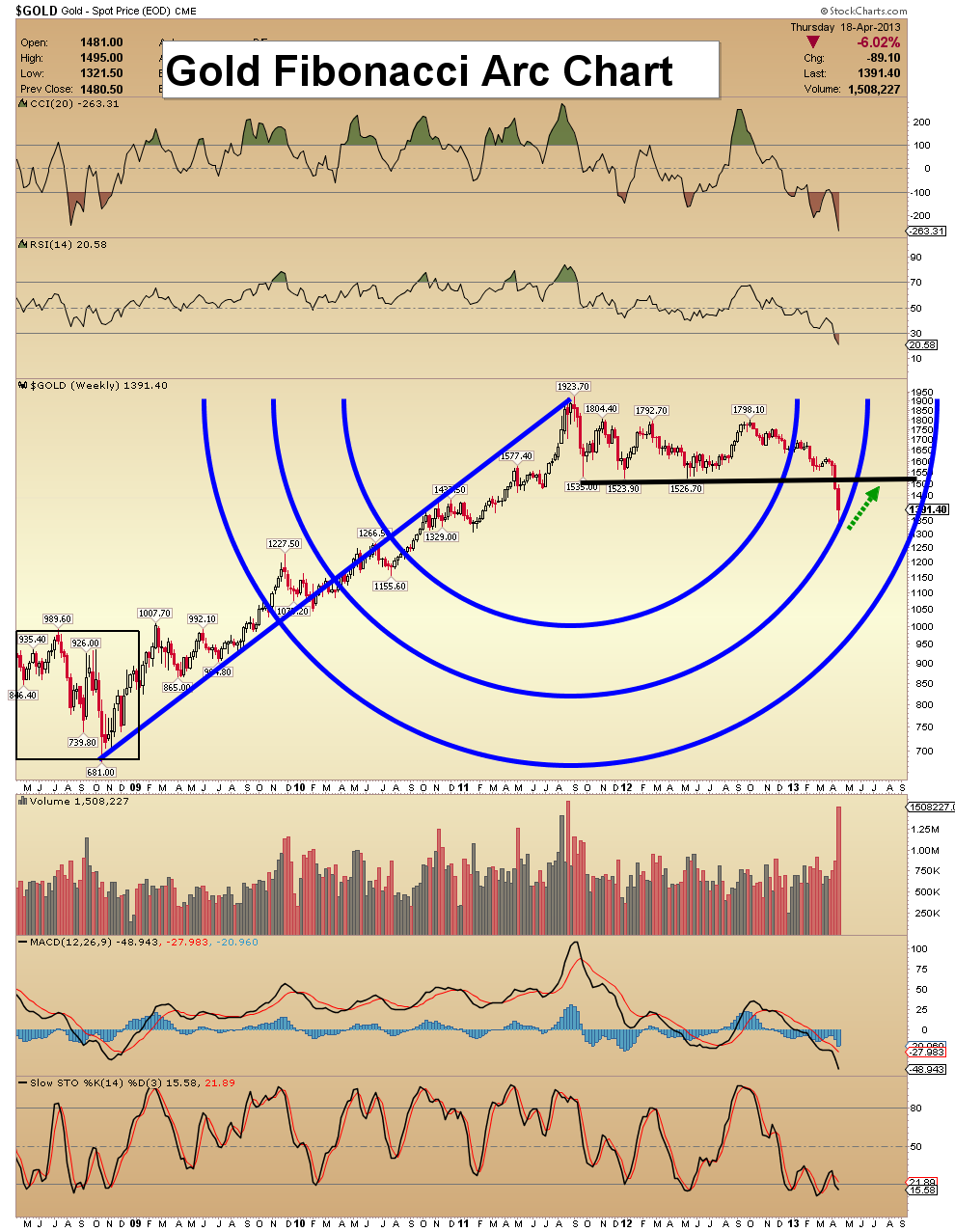
- Any correction like the one that just happened in gold, is enough to shake even the staunchest bull’s confidence. Investors must think carefully about why they own physical metals.
- There has been a party on Wall Street, driven by liquidity, not economic growth. The US economy is addicted to stimulus. More citizens are applying for government handouts. This is not how to build a strong currency. Gold ultimately moves in the opposite direction to the dollar. So, own gold. Physical gold.
- I have identified Fibonacci support areas on this gold chart. $1302 is the 50% retracement line, and gold stopped declining at about $1320.
- Also, RSI is very low. Although gold looks like it is bottoming here, I am watching the $1260 area carefully, which also offers very good support. This market seems very similar to 2008, where a V-type bottom was made, and prices quickly moved higher.
Gold Shakeout Chart
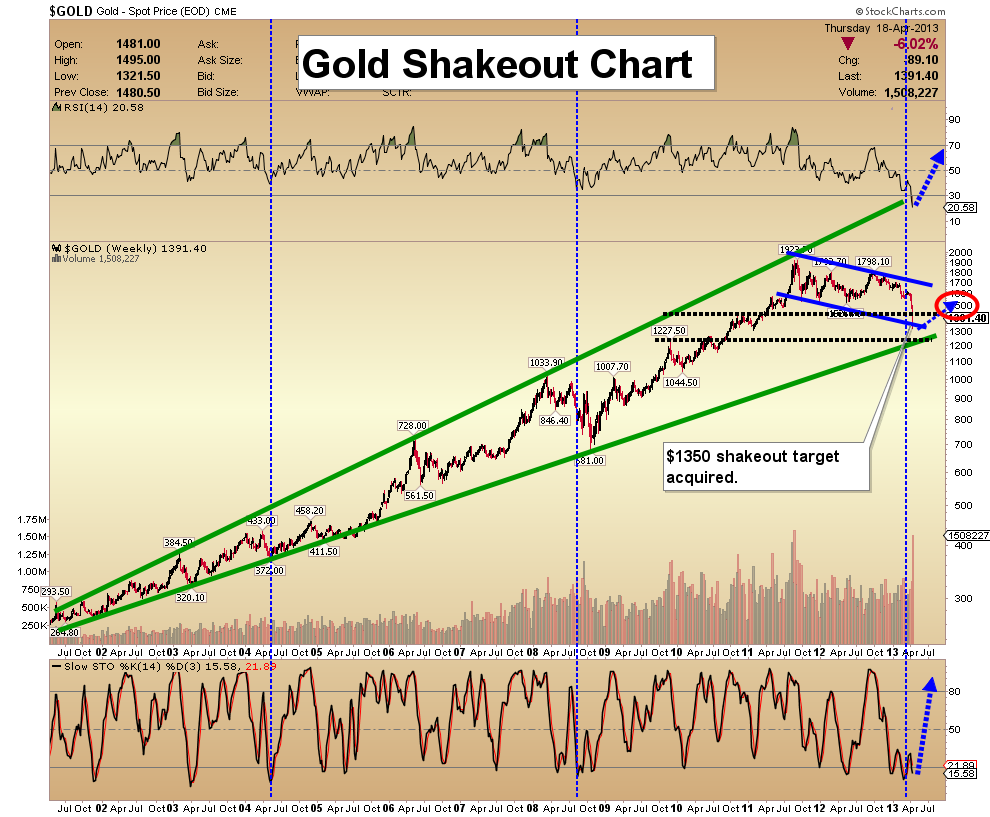
- My $1350 “shakeout” target was acquired. From either the current $1320 area lows, or from $1250, I am projecting a slow grind higher, towards the $1500 resistance area.
- Even large banks have said that this flash crash is “overdone”. The gold market is far from safe, but it does offer value.
- Tonight’s COT report is critically important. It covers all the trading that took place during the flash crash, for both gold and silver. Send me an email to trading@superforcesignals.com and I’ll send you the multi-part video analysis I will be doing tonight. I believe that tonight’s COT report is the most important one, in the history of this bull market. It could show investors whether the gold bull has simply paused, or the bear has really taken over! Thank-you.
HUI Arc Chart
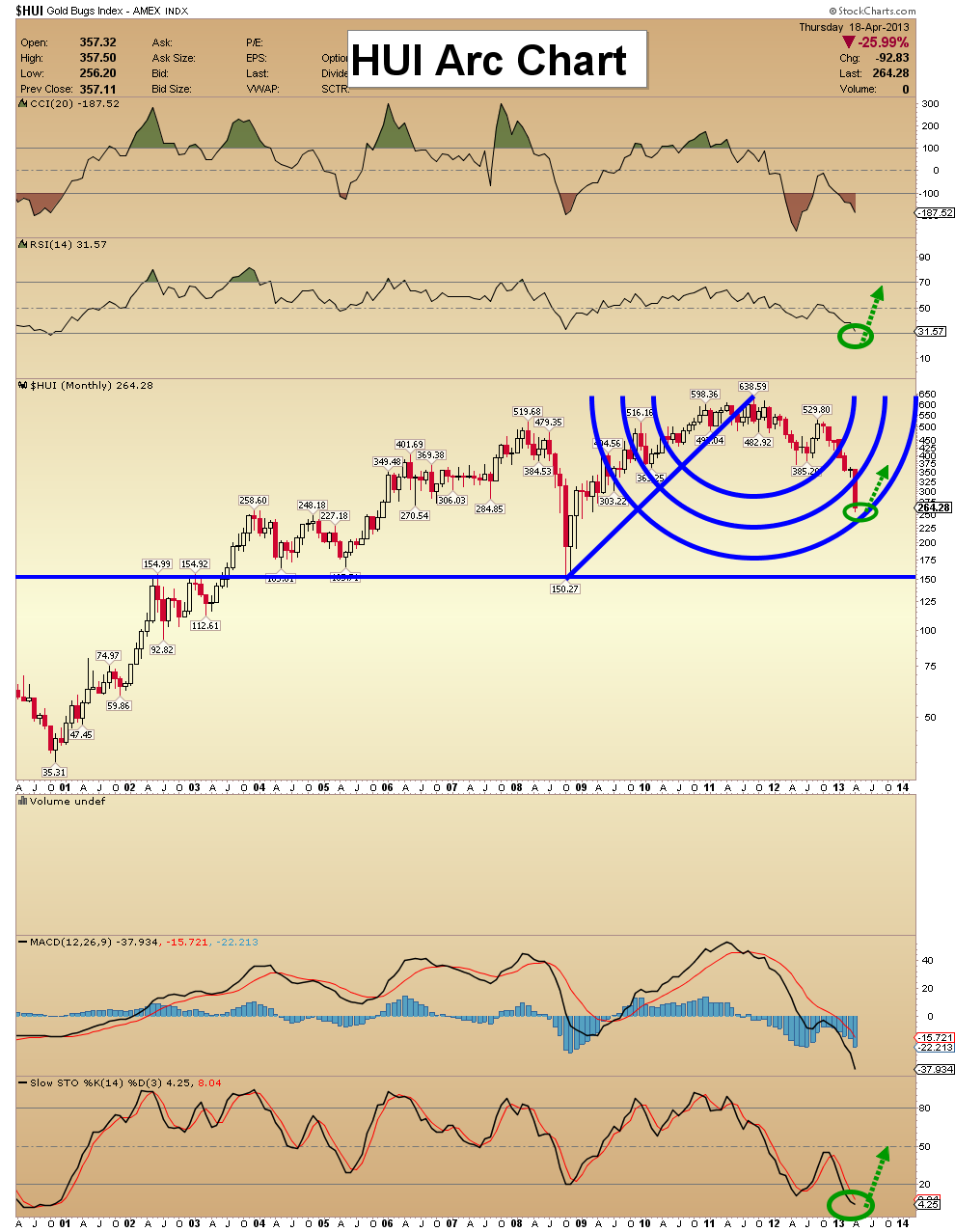
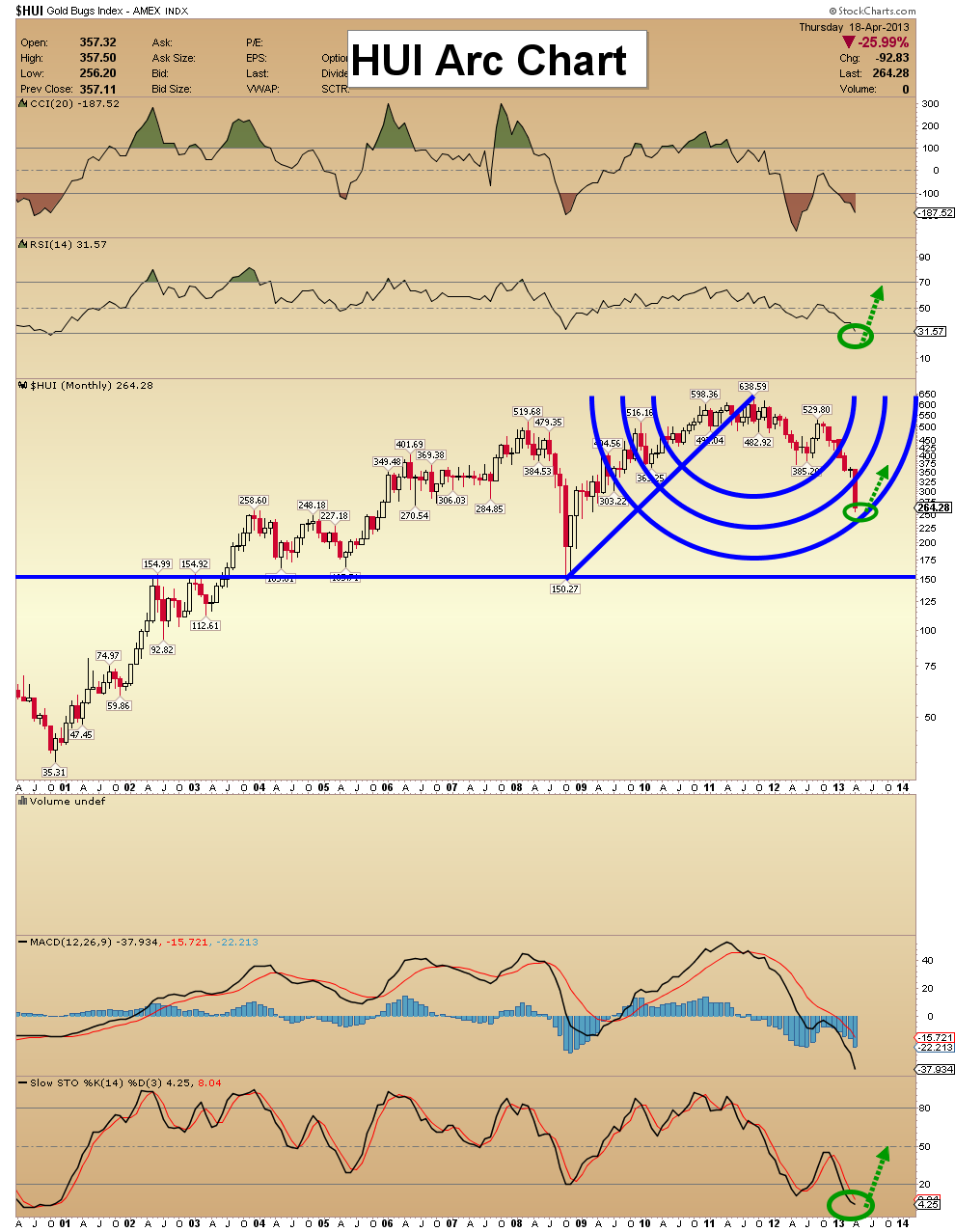
- Several weeks ago, I mentioned the 250-300 support area on the HUI chart, as a possible target price. That target was acquired.
- What I want to see now, on the upside, is a price advance on heavy volume. On the downside, the next area of support is the 175-150 area.
- Compared to gold, most gold stocks are now cheaper than they were at the low of the 2008 market bottom.
- Note how close the HUI is now, to the 3rd and largest Fibonacci arc, on this chart. Strong rallies can occur from this type of set-up.
GDX Filling The Gap Chart
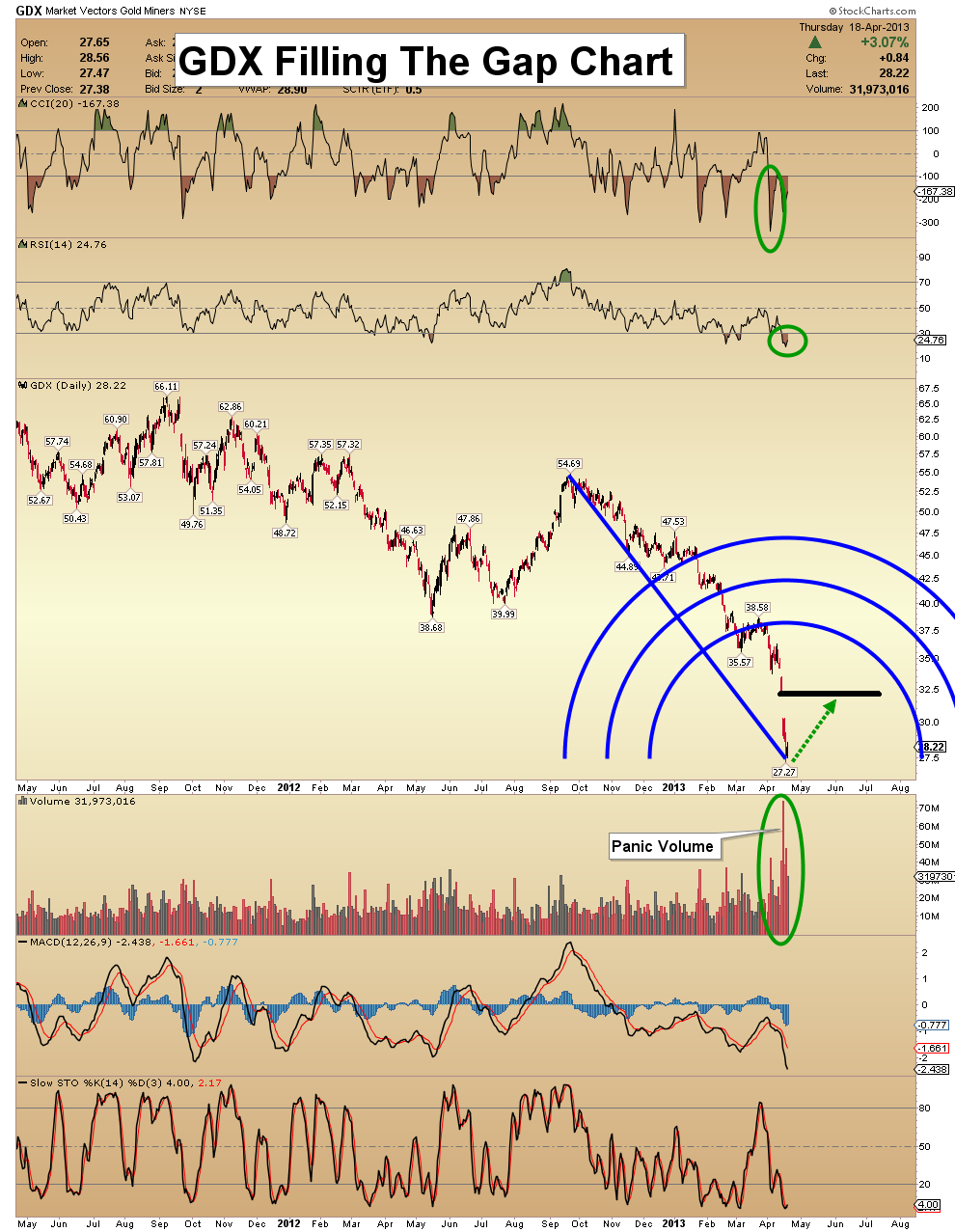
- Whether you are a bull or a bear, I think the next price objective for GDX is the top of the gap in the $32.50 area.
- Bulls should buy now, with a $32.50 target, and bears could place some light short positions around $32-$33.
- Note the massive panic volume. There’s a chance that an “ultimate low” is here, but the bottom callers (including me) have been wrong so many times, we look like a bear’s Swiss cheese sandwich.
- Regardless, the use of proper money management techniques has allowed professional gold stock accumulators to continue to buy this carnage, with a reasonable degree of comfort. Never allocate large amounts of money to any single trade.
GDXJ Channel Backtest Chart
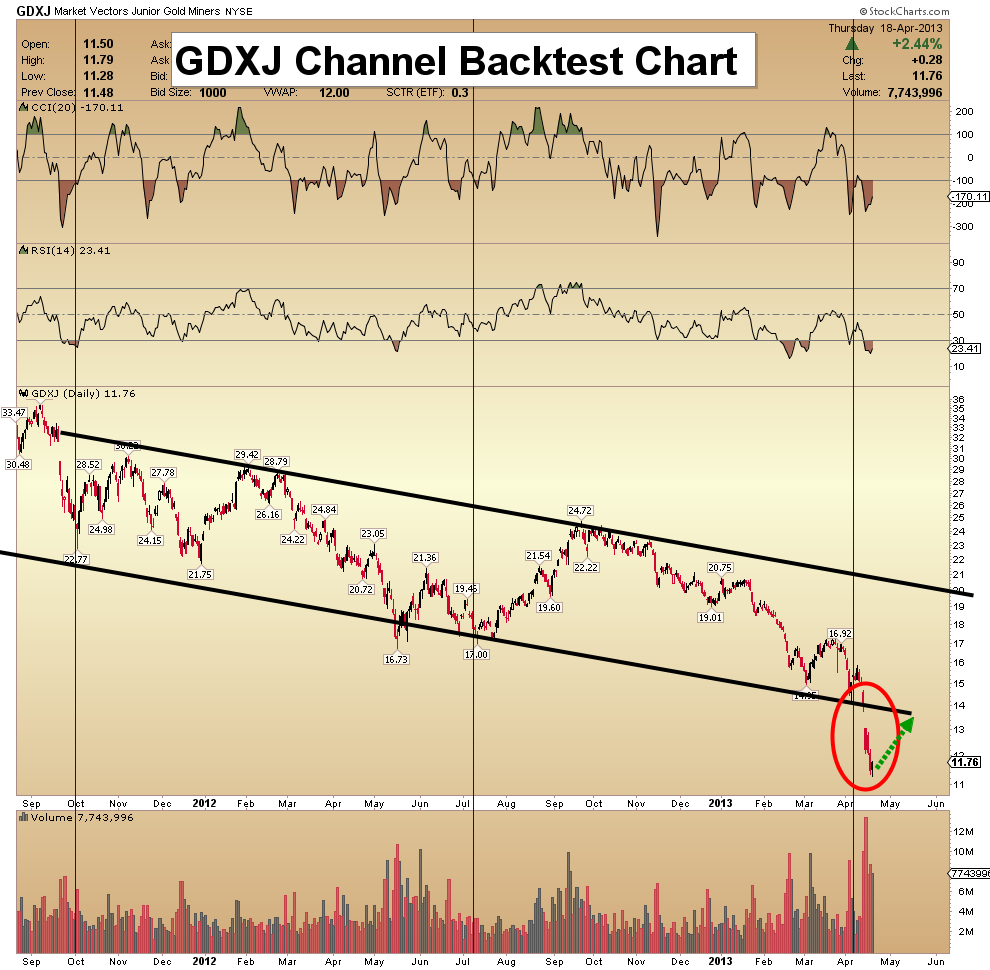
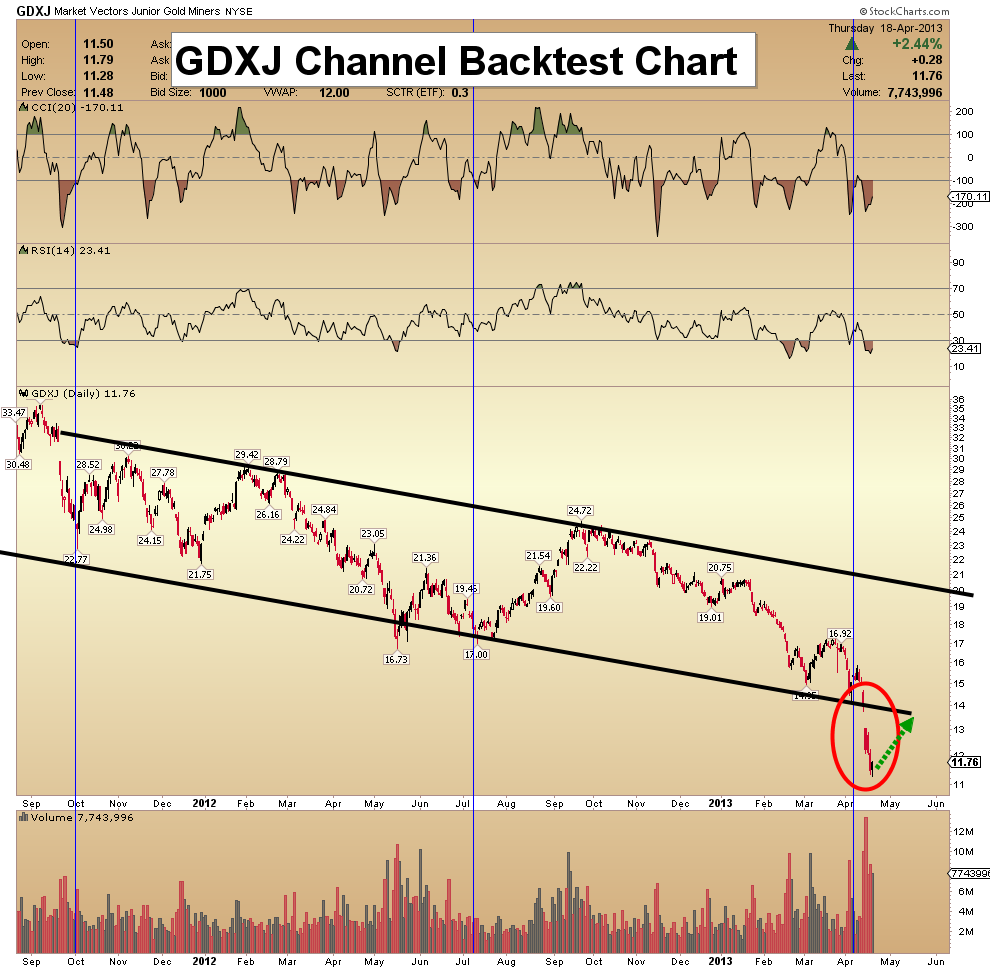
- In this sector, unless you are an aggressive trader, this is a time to stand back and let the dust settle. If you are an accumulator, this type of weakness must be bought, but preferably only “after the dust settles”.
- I’m looking for a rally back to the downtrend channel line, in the $13.50 area.
- From there, I’ll be watching the volume patterns. Volume must start increasing, if junior stocks are going to put on a substantial rally.
Silver Support Zone Chart
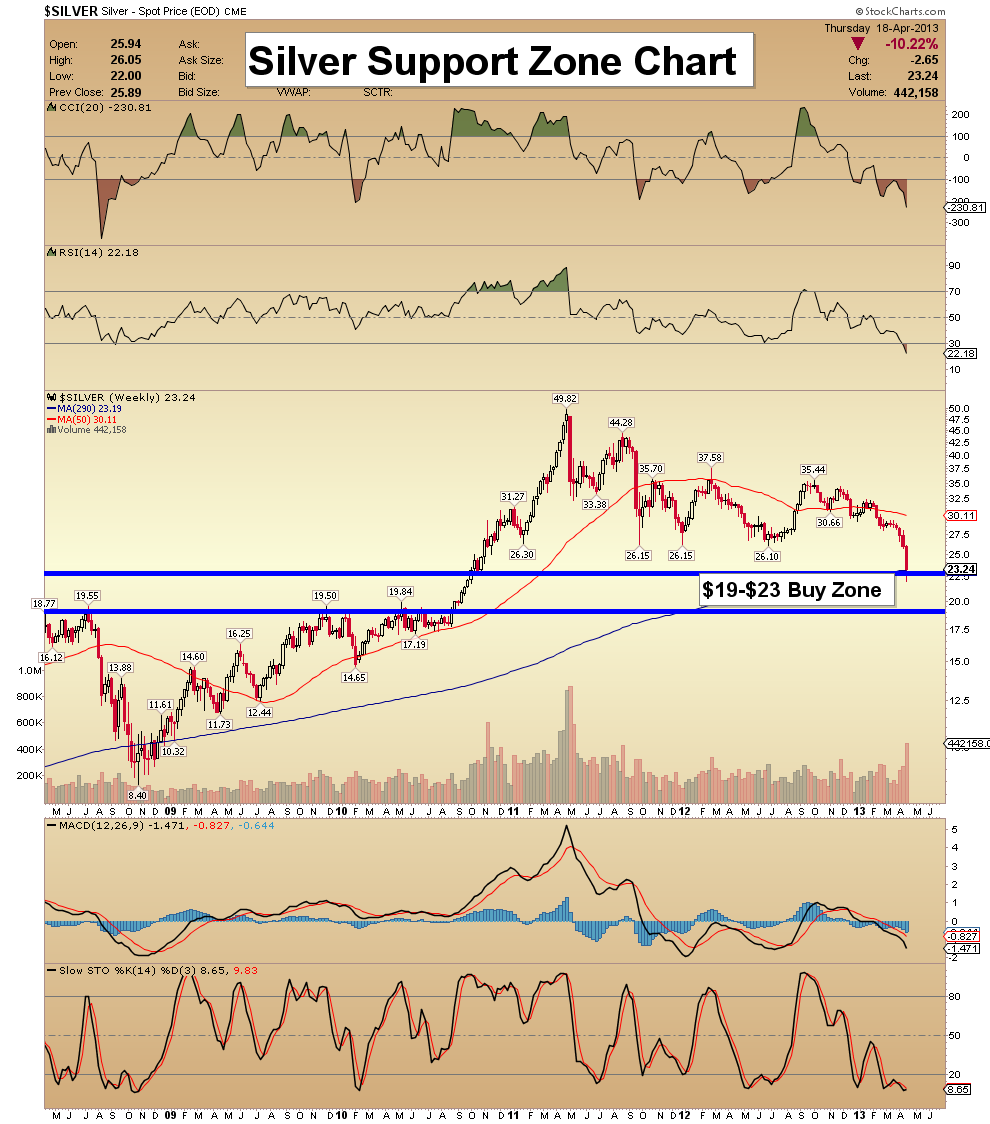
- This week, silver has come down, like many other assets. Having said that, none of the bars I own have gotten any smaller!
- Perhaps the main lesson from this huge “flash crash” is that investors need to think carefully about how much leverage to use, when purchasing silver.
- When the support at $26 failed, it was disappointing, but there is good support in the $19-$23 area.
Unique Introduction For MoneyTalks.net Readers:
Send me an email to alerts@superforcesignals.com and I’ll send you 3 of my next Super Force Surge Signals free of charge, as I send them to paid subscribers. Thank you!
The Super Force Proprietary SURGE index SIGNALS:
25 Super Force Buy or 25 Super Force Sell: Solid Power.
50 Super Force Buy or 50 Super Force Sell: Stronger Power.
75 Super Force Buy or 75 Super Force Sell: Maximum Power.
100 Super Force Buy or 100 Super Force
Sell: “Over the Top” Power.
Stay alert for our Super Force alerts, sent by email to subscribers, for both the daily charts on Super Force Signals at www.superforcesignals.com and for the 60 minute charts at www.superforce60.com
About Super Force Signals:
Our Super Force signals are created thru our proprietary blend of the highest quality technical analysis and many years of successful business building. We are two business owners with excellent synergy. We understand risk and reward. Our subscribers are generally successful business owners, people like yourself with speculative funds, looking for serious management of your risk and reward in the market.
Frank Johnson: Executive Editor, Macro Risk Manager.
Morris Hubbartt: Chief Market Analyst, Trading Risk Specialist.
website: www.superforcesignals.com
email: trading@superforcesignals.com
email: trading@superforce60.com
Super Force Signals
422 Richards Street
Vancouver, BC V6B 2Z4
Canada
Apr 19, 2013 – Morris Hubbartt

As a general rule, the most successful man in life is the man who has the best information
n July 1944, delegates from 44 nations met at Bretton Woods, New Hampshire – the United Nations Monetary and Financial Conference – and agreed to “peg” their currencies to the U.S. dollar, the only currency strong enough to meet the rising demands for international currency transactions.
Member nations were required to establish a parity of their national currencies in terms of the US dollar, the “peg”, and to maintain exchange rates within plus or minus one percent of parity, the “band.”
What made the dollar so attractive to use as an international currency was each US dollar was based on 1/35th of an ounce of gold, and the gold was to held in the US Treasury. The value of gold being fixed by law at 35 US dollars an ounce made the value of each dollar very stable.
The US dollar, at the time, was considered better then gold for many reasons:
- The strength of the U.S. economy
- The fixed relationship of the dollar to gold at $35 an ounce
- The commitment of the U.S. government to convert dollars into gold at that price
- The dollar earned interest
- The dollar was more flexible than gold
There’s a lesson not learned that reverberates throughout monetary history; when government, any government, comes under financial pressure they cannot resist printing money and debasing their currency to pay for debts.
Lets fast forward a few years…
The Vietnam War was going to cost the US $500 Billion. The stark reality was the US simply could not print enough money to cover its war costs, it’s gold reserve had only $30 billion, most of its reserve was already backing existing US dollars, and the government refused to raise taxes.
In the 1960s President Lyndon B. Johnson’s administration declared war on poverty and put in place its Great Society programs:
- Head Start
- Job Corps
- Food stamps
- Medicaid
- Funded education
- Job training
- Direct food assistance
Direct medical assistance
More than four million new recipients signed up for welfare.
During the Nixon administration welfare programs underwent major expansions. States were required to provide food stamps. Supplemental Security Income (SSI) consolidated aid for aged, blind, and disabled persons. The Earned Income Credit provided the working poor with direct cash assistance in the form of tax credits and welfare rolls kept growing
Bretton Woods collapsed in 1971 when Nixon severed (known as the Nixon Shock because the decision was made without consulting the other signatories of Bretton Woods, even his own State Department wasn’t consulted or forewarned) the link between the dollar and gold – the US dollar was now a fully floating fiat currency and the government had no problem printing more money. With gold finally demonetized the US Federal Reserve (Fed) and the world’s central banks were now free from having to defend their gold reserves and a fixed dollar price of gold.
The Fed could finally concentrate on achieving its mandate – full employment with stable prices – by employing targeted levels of inflation. The Fed’s ‘Great Experiment’ had begun – the objective being a leveling out of the business cycle by keeping the economy in a state of permanent boom – gold’s “chains of fiscal discipline” had been removed.
But there was a problem – because of the massive printing of the US dollar to cover war and welfare reform costs Nixon worried about the strength of his country’s currency – how do you keep the U.S. dollar as the world’s reserve currency, how do you keep demand strong, if one you remove gold’s backing and two print it into oblivion?
Recognizing that the US, and the rest of the world, was going to need and use more oil, a lot more oil, and that Saudi Arabia wanted to sell the world’s largest economy (by far the US) more oil, Nixon and Saudi Arabia came to an agreement in 1973 whereby Saudi oil could only be purchased in US dollars. In exchange for Saudi Arabia’s willingness to denominate their oil sales exclusively in U.S. dollars, the United States offered weapons and protection of their oil fields from neighboring nations.
Nixon also abolished the International Monetary Fund’s (IMF) international capital constraints on American domestic banks. This allowed Saudi Arabia and other Arab producers to recycle their petrodollars into New York banks.
Global oil sales in U.S. dollars caused an immediate and strong global demand for US dollars – the ‘Petrodollar’ was born.
By 1975 all OPEC members had agreed to sell their oil only in US dollars in exchange for weapons and military protection.
“In a nutshell, any country that wants to purchase oil from an oil producing country has to do so in U.S. dollars. This is a long standing agreement within all oil exporting nations, aka OPEC, the Organization of Petroleum Exporting Countries. The UK for example, cannot simply buy oil from Saudi Arabia by exchanging British pounds. Instead, the UK must exchange its pounds for U.S. dollars…
This means that every country in the world that imports oil—which is the vast majority of the world’s nations—has to have immense quantities of dollars in reserve. These dollars of course are not hidden under the proverbial national mattress. They are invested. And because they are U.S. dollars, they are invested in U.S. Treasury bills and other interest bearing securities that can be easily converted to purchase dollar-priced commodities like oil. This is what has allowed the U.S. to run up trillions of dollars of debt: the rest of the world simply buys up that debt in the form of U.S. interest bearing securities.” Christopher Doran, Iran and the Petrodollar Threat to U.S. Empire


As developed economies grew and prospered, as developing economies took center stage with their massive urbanization and infrastructure development plans their need for oil grew, and so too did the need for new U.S. dollars, as demand grew the currency strengthened. The U.S. Dollar quickly became the currency for global trades in almost every commodity and most consumer goods, it wasn’t used just for oil purchases anymore. Countries all over the world bought, had to buy, more and more dollars to have a reserve of currency with which to buy oil and ‘things.’ Countries began storing their excess US dollar capacity in US Treasury Bonds, giving the US a massive amount of credit from which they could draw.
There’s no disputing the U.S. greenback is the world’s currency – the dollar is the currency of denomination of half of all international debt securities and makes up 60 percent of countries foreign reserves.
The Petrodollar replaced the Gold Standard
Currently the only source of backing for the U.S. dollar is the fact that oil is priced in only U.S. dollars and the world must use the Petrodollar to make their nation’s oil purchases or face the weight of the U.S. military and economic sanctions. Many countries also use their Petrodollar surplus for international trade – most international trade is conducted in U.S. dollars.
It’s very obvious that the United States economy, and the global economy, are both intimately tied to the dollar’s dual role as the world’s reserve currency and as the Petrodollar.
“Trade between nations has become a cycle in which the U.S. produces dollars and the rest of the world produces things that dollars can buy; most notably oil. Nations no longer trade to capture comparative advantage but to capture needed dollar reserves in order to sustain the exchange value of their domestic currencies or to buy oil. In order to prevent speculative attacks on their currencies, those nations’ central banks must acquire and hold dollar reserves in amounts corresponding to their own currencies in circulation. This creates a built-in support for a strong dollar that in turn forces the world’s central banks to acquire and hold even more dollar reserves, making the dollar stronger still.” Harvey Gold, Iran’s Threat to the U.S. – Nuclear or the Demise of the Petrodollar?
It’s also very obvious that if global Petrodollar demand were ever to crumble the use of the U.S. dollar as the world’s reserve currency would abruptly end.
The consequences:
- Energy costs would rise substantially. American’s, because their dollar is the world’s reserve currency and they control it, have been buying oil and gasoline for a fraction of what the rest of the world pays.
- There would be substantially less demand for dollars and U.S. government debt. All nations that buy oil and hold U.S. dollars in their reserves would have to replace them with whatever currency oil is going to be priced in – the resulting sell-off would weaken the U.S. currency dramatically.
- Interest rates will rise. The Federal Reserve would have to increase interest rates to reduce the dollar supply.
- Foreign funds would literally run from U.S. stock markets and all dollar denominated assets.
- Military establishment collapses.
- There would be a 1930s like bank run.
- Dollar exchange rate falls. The current-account trade deficit would become unserviceable.
- The U.S. budget deficit would go into default. This would create a severe global depression because the U.S. would not be able to pay its debts.
Why some might think the Petro dollar is history, consider:
- Several countries have attempted to, or have already moved away from the petrodollar system – Iraq, Iran, Libya, Syria, Venezuela, and North Korea.
- Other nations are choosing to use their own currencies for inter country trade;China/Russia;China/Brazil;China/Australia;China/Japan;India/Japan;Iran/Russia; China/Chile; China/The United Arab Emirates (UAE);China/Africa Brazil/Russia/India/China/South Africa (the new BRICS are plus S.A.).
- Countries began storing their excess US dollar capacity in US Treasury Bonds, giving the US a massive amount of credit from which they could draw. But by keeping interest rates excessively low for so long a period of time, and with no relief in sight, the rate of return on U.S. interest bearing securities has been so low it’s not worth holding them to generate any kind of return for your U.S. foreign reserves, the very same reserves you want to hold to buy oil.
- The U.S. does not need its Arab Petrodollar partners as much since the invasion of Iraq with its immense oil resources (second largest in the world) and discovery of how to obtain oil from unconventional sources – shale oil, oil sands etc. Saudi Arabia and other OPEC countries in the region might be less needy for U.S. protection now that Iraq has been neutralized and Iran is in the crosshairs.
- Russia is the number one oil exporter, China is the number two consumer of oil and imports more oil from the Saudis then the U.S. does. Chinese and Russian trade is currently around US$80 billion per year. China has agreed to lend the world’s largest oil company, Russia’s Rosneft, two billion dollars to be repaid in oil.
- U.S. federal debt is close to 17 trillion dollars and is 90 percent of GDP. The deficit is a horrendous 7 percent of GDP. Political infighting and bickering has made cooperation nearly impossible and effective measures just aren’t being taken. The Federal Reserve is increasing its reserves by over a trillion dollars a year, the Fed is out of tools, its measures are not working. The ‘recovery’ is false, jobs are scarce and 6.2 million Americans have dropped out of the workforce.
Exorbitant Privilege
Valéry Giscard d’Estaing referred to the benefits the United States has due its own currency being the international reserve currency as an “exorbitant privilege.”
“Reserve currency status has two benefits. The first benefit is seigniorage revenue—the effective interest-free loan generated by issuing additional currency to nonresidents that hold US notes and coins… The second benefit is that the United States can raise capital more cheaply due to large purchases of US Treasury securities by foreign governments and government agencies…The major cost is that the dollar exchange rate is an estimated 5 to 10 percent higher than it would otherwise be because the reserve currency is a magnet to the world’s official reserves and liquid assets. This harms the competitiveness of US exporting companies and companies that compete with imports…
There is no realistic prospect of a near-term successor to the dollar. Although the euro is already a secondary reserve currency, MGI finds that the eurozone has little incentive to push for the euro to become a more prominent reserve currency over the next decade. The small benefit to the eurozone of slightly cheaper borrowing and the cost of an elevated exchange rate today broadly cancel each other. The renminbi may be a contender in the longer term—but today China’s currency is not even fully convertible.” McKinsey Global Institute,An exorbitant privilege? Implications of reserve currencies for competitiveness
The Alternatives
There has lately been a lot of talk about the demise of the Petrodollar. Fortunately, or unfortunately (depends what side of the debate your on) there exists no viable alternative to the U.S. dollar, not today, not tomorrow, not for a very long time.
The EU is a waste land, will the deeply flawed Euro even survive?
“The euro’s major weakness comes from its political base. If the entire 27-country strong European Union (EU) were backing the euro, its long-term international standing would be considerably enhanced. With only half of the E.U countries backing it, the euro zone is vulnerable in the future to a possible dissolution under the pressures of economic hardships. This is more so since the statutes of the European Central Bank are unduly rigid, not only freezing exchange rates between member states, which is OK, but also de facto freezing their fiscal policies, while the central bank itself has the goal of fighting inflation as its only objective. It seems that the objective of supporting economic growth was left out of its statutes, with the consequence that it may be unable to ride successfully future serious economic disturbances.” Prof Rodrigue Tremblay, Nothing in Sight to Replace the US Dollar as an International Reserve Currency
Well what about China you ask?
One of the preconditions of reserve currency status is relaxing capital controls so foreigners can reinvest their accumulated yuan back into a countries markets. China has strict capital controls in place. If they were to be relaxed to the level needed then market driven money flows, not China’s Communist leaders, would drive exchange and interest rates. Communist leaders would be facing the thing they fear the most – instability because they lose control over two of their main economic levers.
China has well over US$3.2 trillion in its foreign reserves. They’ve accumulated this massive amount of money over the years by maintaining the yaun’s semi fixed peg to the dollar.
Think about it; the euro-crisis makes the US dollar the preferred safe-haven, this lowers US borrowing costs. This in turn means China has to continue to lend to the US in order to hold-up the value of its current reserves, pushing down US borrowing costs.
A massive shift as many envision – China out of the U.S. dollar – would destroy the dollar and cause the instability the Communist Party fears so much. Why would China deliberately destroy its own wealth and why would Chinese communist leaders set themselves up for discord among its citizens?
“China, itself as a country, has a very limited moral international stance. It is still a totalitarian, authoritarian and repressive state regime that does not recognize basic human rights, such as freedom of expression and freedom of religion, and which crushes its linguistic and religious “minority nationalities. It is a country that imposes the death penalty, even for economic or political crimes…Only a fundamental political revolution in China could raise this country to a world political and monetary status. This is most unlikely to happen in the foreseeable future and, therefore, no Chinese currency is likely to play a central role in financing international trade and investment.” Prof Rodrigue Tremblay, Nothing in Sight to Replace the US Dollar as an International Reserve Currency
Conclusion
U.S. assets are free from default risk, free from political risk, the U.S. has never imposed capital controls and has only frozen funds once – Iran’s in 1978.
Fact; the United States of America, and only the United States of America, controls the fate of the Petrodollar. Not communist China, not Russia or Saudi Arabia or the EU.
The questionable ‘exorbitant’ privilege (the interest-free loans, U.S. Treasury purchases by foreign governments versus the loss of business competitiveness and all that entails) bestowed upon America for having the world’s reserve currency is going continue for the for-seeable future. This fact, and what it means to the U.S. and the world, should be on all our radar screens. Is it on yours?
If not, maybe it should be.
Richard (Rick) Mills
Richard is the owner of Aheadoftheherd.com and invests in the junior resource/bio-tech sectors. His articles have been published on over 400 websites, including:
WallStreetJournal, USAToday, NationalPost, Lewrockwell, MontrealGazette, VancouverSun, CBSnews, HuffingtonPost, Londonthenews, Wealthwire, CalgaryHerald, Forbes, Dallasnews, SGTreport, Vantagewire, Indiatimes, ninemsn, ibtimes, businessweek.com and the Association of Mining Analysts.
If you’re interested in learning more about the junior resource and bio-med sectors, and quality individual company’s within these sectors, please come and visit us atwww.aheadoftheherd.com
***
Legal Notice / Disclaimer
This document is not and should not be construed as an offer to sell or the solicitation of an offer to purchase or subscribe for any investment.
Richard Mills has based this document on information obtained from sources he believes to be reliable but which has not been independently verified.
Richard Mills makes no guarantee, representation or warranty and accepts no responsibility or liability as to its accuracy or completeness. Expressions of opinion are those of Richard Mills only and are subject to change without notice. Richard Mills assumes no warranty, liability or guarantee for the current relevance, correctness or completeness of any information provided within this Report and will not be held liable for the consequence of reliance upon any opinion or statement contained herein or any omission.
Furthermore, I, Richard Mills, assume no liability for any direct or indirect loss or damage or, in particular, for lost profit, which you may incur as a result of the use and existence of the information provided within this Report.


Uh-oh… We’ve got good news and bad news. But you’ll have to figure out which is which.
We also have what is probably the most important thing you will read this year…
Yesterday, the Dow fell again – 81 points. Gold went up – by almost $10 per ounce. Gold does not seem inclined to go down much more… at least, not immediately. And though some big players seem to be dumping gold – we won’t mention any names – most of the gold orders are buys, not sells.
Here’s Paul Tustain, CEO of physical gold storage business BullionVault, on gold’s recent correction:
[H]ere are some BullionVault statistics from the last few days, which I think offer a useful reminder about how markets work. Remember, first of all, that for all those people who sold in a bit of a panic, someone bought.
-
Monday and Tuesday were our strongest 48-hour period for new customers this year.
-
Since Friday, the gross value of customer bullion sales increased markedly. About 1% of gold we look after was sold back to the main market. That was characterized by a few large sellers. Holders of 99% of BullionVault inventory were not panicked.
-
Those who did sell have mostly not withdrawn their cash from the BullionVault system. To me, that suggests they may be intending to buy back into gold sooner rather than later.
-
We normally have about 230 deposits a day (300 on a Monday) and about 100 withdrawals a day (120 on a Monday). Mondays are usually higher because they include weekend activity. On Monday, we had 723 deposits versus 284 withdrawals. On Tuesday, we had 732 deposits versus 150 withdrawals.
-
Monday was a record day for business transacted, beating the previous peak of September 2011.
|
62 Years of Uninterrupted Gains? I recently discovered an incredible investment that has nothing to do with stocks, bonds, ETFs or mutual funds. Most brokers have probably never heard of it — yet, it’s gone up at least 5% every year since 1950. And since 1998, while the stock market has seen two major crashes, this investment has gone up an average of 12% per year, like clockwork. What is this unique alternative to stocks? Watch this video to find out. |
Candy for the Mind
And now… here’s why you really shouldn’t pay attention to any news. It’s “public information” – with little integrity, little quality and little usefulness.
Here’s our friend, the Swiss novelist Rolf Dobelli.
News is bad for you. It’s like sugar. It gives you a rush. It’s a distraction from your own concerns. It’s easy to digest. But this “candy for the mind” can be toxic.
In the past few decades, the fortunate among us have recognized the hazards of living with an overabundance of food (obesity, diabetes) and have started to change our diets. But most of us do not yet understand that news is to the mind what sugar is to the body.
News is easy to digest. The media feeds us small bites of trivial matter, tidbits that don’t really concern our lives and don’t require thinking. That’s why we experience almost no saturation. Unlike reading books and long magazine articles (which require thinking), we can swallow limitless quantities of news flashes, which are bright-colored candies for the mind.
Today, we have reached the same point in relation to information that we faced 20 years ago in regard to food. We are beginning to recognize how toxic news can be.
News Misleads
Take the following event (borrowed from Nassim Taleb). A car drives over a bridge, and the bridge collapses. What does the news media focus on? The car. The person in the car. Where he came from. Where he planned to go. How he experienced the crash (if he survived). But that is all irrelevant. What’s relevant? The structural stability of the bridge.
That’s the underlying risk that has been lurking and could lurk in other bridges. But the car is flashy, it’s dramatic, it’s a person (non-abstract), and it’s news that’s cheap to produce. News leads us to walk around with the completely wrong risk map in our heads. So terrorism is overrated. Chronic stress is underrated. The collapse of Lehman Brothers is overrated. Fiscal irresponsibility is underrated. Astronauts are overrated. Nurses are underrated.
We are not rational enough to be exposed to the press. Watching an airplane crash on television is going to change your attitude toward that risk, regardless of its real probability. If you think you can compensate with the strength of your own inner contemplation, you are wrong. Bankers and economists – who have powerful incentives to compensate for news-borne hazards – have shown that they cannot. The only solution: Cut yourself off from news consumption entirely.
News Is Irrelevant
Out of the approximately 10,000 news stories you have read in the last 12 months, name one that – because you consumed it – allowed you to make a better decision about a serious matter affecting your life, your career or your business. The point is: The consumption of news is irrelevant to you. But people find it very difficult to recognize what’s relevant. It’s much easier to recognize what’s new. The relevant versus the new is the fundamental battle of the current age.
Media organizations want you to believe that news offers you some sort of a competitive advantage. Many fall for that. We get anxious when we’re cut off from the flow of news. In reality, news consumption is a competitive disadvantage. The less news you consume, the bigger the advantage you have.
News Has No Explanatory Power
News items are bubbles popping on the surface of a deeper world. Will accumulating facts help you understand the world? Sadly, no. The relationship is inverted. The important stories are non-stories: slow, powerful movements that develop below journalists’ radar but have a transforming effect. The more “news factoids” you digest, the less of the big picture you will understand. If more information leads to higher economic success, we’d expect journalists to be at the top of the pyramid. That’s not the case.
News Is Toxic to the Body
It constantly triggers the limbic system. Panicky stories spur the release of cascades of glucocorticoid (cortisol). This deregulates your immune system and inhibits the release of growth hormones. In other words, your body finds itself in a state of chronic stress. High glucocorticoid levels cause impaired digestion, lack of growth (cell, hair, bone), nervousness and susceptibility to infections. The other potential side effects include fear, aggression, tunnel vision and desensitization.
News Increases Cognitive Errors
News feeds the mother of all cognitive errors: confirmation bias. In the words of Warren Buffett: “What the human being is best at doing is interpreting all new information so that their prior conclusions remain intact.” News exacerbates this flaw. We become prone to overconfidence, take stupid risks and misjudge opportunities. It also exacerbates another cognitive error: the story bias. Our brains crave stories that “make sense” – even if they don’t correspond to reality. Any journalist who writes, “The market moved because of X” or “The company went bankrupt because of Y” is an idiot. I am fed up with this cheap way of “explaining” the world.
News Inhibits Thinking
Thinking requires concentration. Concentration requires uninterrupted time. News pieces are specifically engineered to interrupt you. They are like viruses that steal attention for their own purposes. News makes us shallow thinkers.
But it’s worse than that. News severely affects memory. There are two types of memory. Long-range memory’s capacity is nearly infinite, but working memory is limited to a certain amount of slippery data. The path from short-term to long-term memory is a choke point in the brain, but anything you want to understand must pass through it. If this passageway is disrupted, nothing gets through.
Because news disrupts concentration, it weakens comprehension. Online news has an even worse impact. In a 2001 study, two scholars in Canada showed that comprehension declines as the number of hyperlinks in a document increases. Why? Because whenever a link appears, your brain has to at least make the choice not to click, which in itself is distracting. News is an intentional interruption system.
News Works Like a Drug
As stories develop, we want to know how they continue. With hundreds of arbitrary story lines in our heads, this craving is increasingly compelling and hard to ignore.
Scientists used to think that the dense connections formed among the 100 billion neurons inside our skulls were largely fixed by the time we reached adulthood. Today we know that this is not the case. Nerve cells routinely break old connections and form new ones. The more news we consume, the more we exercise the neural circuits devoted to skimming and multitasking while ignoring those used for reading deeply and thinking with profound focus.
Most news consumers – even if they used to be avid book readers – have lost the ability to absorb lengthy articles or books. After four, five pages they get tired, their concentration vanishes, they become restless. It’s not because they got older or their schedules became more onerous. It’s because the physical structure of their brains has changed.
News Wastes Time
If you read the newspaper for 15 minutes each morning, then check the news for 15 minutes during lunch and 15 minutes before you go to bed, then add five minutes here and there when you’re at work, then count distraction and refocusing time, you will lose at least half a day every week. Information is no longer a scarce commodity. But attention is. You are not that irresponsible with your money, reputation or health. Why give away your mind?
News Makes Us Passive
News stories are overwhelmingly about things you cannot influence. The daily repetition of news about things we can’t act upon makes us passive. It grinds us down until we adopt a worldview that is pessimistic, desensitized, sarcastic and fatalistic. The scientific term is “learned helplessness.” It’s a bit of a stretch, but I would not be surprised if news consumption at least partially contributes to the widespread disease of depression.
News Kills Creativity
Finally, things we already know limit our creativity. This is one reason that mathematicians, novelists, composers and entrepreneurs often produce their most creative works at a young age. Their brains enjoy a wide, uninhabited space that emboldens them to come up with and pursue novel ideas. I don’t know a single truly creative mind who is a news junkie – not a writer, not a composer, mathematician, physician, scientist, musician, designer, architect or painter.
On the other hand, I know a bunch of viciously uncreative minds who consume news like drugs. If you want to come up with old solutions, read news. If you are looking for new solutions, don’t.
Society needs journalism – but in a different way. Investigative journalism is always relevant. We need reporting that polices our institutions and uncovers truth. But important findings don’t have to arrive in the form of news. Long journal articles and in-depth books are good, too.
I have now gone without news for four years, so I can see, feel and report the effects of this freedom firsthand: less disruption, less anxiety, deeper thinking, more time, more insights. It’s not easy, but it’s worth it.
[This is an edited extract from an essay first published at dobelli.com.]
Regards,
Bill
Like Bill’s Diary?
Republish our articles on your website or blog for free. Learn How
Have a question for our editorial team?
Contact Us
Bill Bonner started Diary of a Rogue Economist to share his over 30 years of economics and market experience with as many interested readers as possible.
Diary of a Rogue Economist is always free, and it’s delivered to your email each business day.

{mp3}mtapril13ozziedilema{/mp3}
This article below came out today after Mike and Ozzie spoke above last Saturday :
Is the housing market rebound petering out? Plus: Where to find “Better Than Bonds” returns with less risk!
Last year was a good one for the housing market. Sales rebounded somewhat, the inventory of homes for sale declined, and home prices reversed course and climbed in many parts of the country.
As I’ve said before, some of that recovery was based on natural, “core” forces — with the passing of time since the implosion of the bubble, a gradual recovery in buyer confidence, and some improvement in the job market, it was only natural to see housing begin to turn.
As I’ve said before, some of that recovery was based on natural, “core” forces — with the passing of time since the implosion of the bubble, a gradual recovery in buyer confidence, and some improvement in the job market, it was only natural to see housing begin to turn.
But I also warned that the market has increasingly been turbocharged by artificial demand. That demand stems from the incredible search for yield among institutional and individual investors.
Driven to despair by the reckless policies of global central banks, which have sliced the yield on safer investments like high-quality government bonds, they’ve flooded into the housing market like marauding swarms of locusts. They’ve been snapping up houses to turn around and rent them out, often paying cash, to generate yield.
But because they’re under such tremendous pressure, they’re aggressively outbidding each other, as well as traditional buyers. They’re paying too much money for too little of a rental income stream. And I believe that has set the stage for another housing market pullback — not one as bad as we had last time around, but something of a low-grade “Echo Bust.”
It’s All about Where the Demand is Coming From
In a normal housing market, demand and pricing is driven by average buyers. Think of people just looking to put a roof over their heads, using traditional mortgages, reasonable down payments, and the like.
But much more demand these days is coming from firms like Colony Capital. Never heard of them? Well, Colony is an investment company based in Santa Monica, California. The company has raised more than $2 billion to buy scores of homes all around the country. Their portfolio totaled roughly 7,000 homes as of March, up from 5,400 at the end of last year, which itself was DOUBLE the level of a quarter earlier.
 Now 7,000 homes isn’t a lot in the grand scheme of things. But Colony is far from alone. Even bigger firms like Blackstone are active in the same business, amassing 20,000 homes at a pace of about $100 million in purchases per WEEK.
Moreover, a ton of “me too” competitors are doing the same thing. One example of the fallout: TheWall Street Journal noted in late March that more than 31 percent of the homes purchased in Southern California early this year were bought by “absentee” buyers, those who don’t actually live in the homes. That was far above the long-term average of 17 percent that prevailed between 2000 and 2010.
I don’t know about you. But my memory of the last investor-driven boom in house sales and prices is pretty fresh. From what I recall, that 2003-2005 speculative bacchanalia didn’t exactly end well. So I find it interesting that there are already a few tentative signs that the turbocharged market is losing altitude.
Just consider home builder sentiment. A key index that tracks buyer traffic, current sales, and expectations about future sales dropped to 42 in April from 44 in March. Not only did that miss expectations for a reading of 45, it was also the third monthly decline in a row. That’s not what you want to see during the heart of the spring home buying season.
Meanwhile, single-family housing starts slumped 4.8 percent between February and March. Single-family permits also slipped 0.5 percent on the month, indicating a cooling in future construction activity.
Perhaps the biggest concern of all are the dramatic, investor-driven, high single-digit and low double-digit price surges we’ve seen in speculative markets like Phoenix, Las Vegas, Miami, and so on.
Are WAGES rising that fast in those markets?
Is JOB GROWTH or economic growth accelerating that quickly in those markets?
Of course not!
The wider the gap gets between price gains caused by traditional demand drivers — and price gains fueled by artificial investor demand — the greater the risk of a nasty correction.
What to Dump if Real Estate Stalls …
Many investors and analysts on Wall Street are in love with housing stocks, mortgage stocks, and almost anything related to them. But have these people noticed that shares of leading homebuilders like D.R. Horton (DHI) and Lennar (LEN) have given up all the year’s gains? Or that they’re basically trading where they did last September?
Or how about the mortgage-levered banks like Bank of America (BAC)? If the housing and mortgage markets are so strong, then why the heck did BofA just miss first-quarter profit estimates, citing weak mortgage performance?
Its consumer real estate services loss widened to $1.31 billion from $1.14 billion a year earlier, with both mortgage servicing and mortgage production revenue falling. Mortgage banking revenue also sank 9 percent sequentially at industry behemoth Wells Fargo (WFC), while application volume fell.
My advice is that you take profits in housing-sensitive stocks if you’ve been riding them higher. If you haven’t — and are looking for someplace to target profits or hedge downside risk using short sales or put options — those may be the kinds of stocks to target.
… And Where to Put Your Money Instead!
At the same time, what can you buy instead? Especially in light of all the points I’ve been making lately: Namely, that many types of bonds are loaded down with risk … while some particular stocks look incredibly promising?
Well, I’ve spent several weeks identifying six bond-trumping investments. The result of my exhaustive research is a report I’m calling “Beating the Bond Bubble: 6 Bubble-Busting Investments for Income and Profit!” Set for release on Monday, May 6 — just over two short weeks from now — this comprehensive report is jam-packed with information, such as …
* How to build a virtually impenetrable wall of protection around your fixed income portfolio!
* Three powerful ways to profit by steering clear of the bond market implosion altogether!
* One “bond alternative” Wall Street is pushing aggressively — but that you don’t want to touch with a ten-foot pole!
* The 286 best and worst stocks to own as bonds tank — plus the one little-known corner of the bond market still worth considering!
The information in this report is incredibly timely. Many of the names it contains are already moving higher — with one just hitting a multi-YEAR high. But if I’m right, this is just the beginning of a massive new wave of gains … gains that could trounce the total return of many types of bonds!
Once this report is made public, it will sell for $149. But through a special arrangement with my publisher, you can pre-order the report now for just $99. That will ensure you can download it immediately on May 6, and put these recommendations to work for you!
Plus, this is no “one and done” report! I will follow it up with four updates — one per quarter — to keep you abreast of all the latest developments that impact your positions. That way, you’ll know when to take your profits, cut your losses, or hang on tight for more potential gains!
All you have to do to reserve your copy is click here. Or you can call my customer service team at 1-800-291-8545 . They’ll take care of you in a jiffy!
Until next time,
Mike
P.S. I think “Beating the Bond Bubble: 6 Bubble-Busting Investments for Income and Profit!” is an incredible bargain at $149. After all, you don’t just get the report and the recommendations within. You also get four quarterly updates over the span of the next year! But if you act now, you can get my hot-off-the-presses report for just $99. So please considerclicking here or calling my staff at 1-800-291-8545 right away!

….of the Bull Market in Gold and Silver?
On Friday, we witnessed a great plunge in gold (almost $80 – from $1560.30 to $1480.50) and silver (almost $1.7 – from $27.58 to $25.89) and we are seeing even lower prices this week.
It doesn’t matter if we look at gold from the USD perspective, the average non-USD perspective, or gold priced in individual non-USD currencies — we will see that the price has broken below the key support levels.
What about silver? On Friday, it moved insignificantly below some support levels (intraday 2011 and 2012 lows), and at this time, silver confirms the bearish outlook for gold. In fact, it’s only a few dollars above its 2008 high.
Does this mean that the bull market for gold and silver is gone for good?
The only answer my firm has to this question is a resounding “No.” And we say that because we realize that even the greatest of bull markets can at times decline significantly with no particular logical reason. We know that something like that happened over 30 years ago during the previous bull market when the price of gold dropped by almost half before it moved to the high, which was multiple times the previous one.
Forbes magazine ran an interesting piece a couple of weeks ago, which quoted a Time Magazine article: “To hoarders and speculators, gold lately has had about as much luster as a rusty tin can.”
The article itself is a bit rusty. The Great Gold Bust ran in August 1976 right at the bottom of a 50% retreat in the 1970s gold bull market. It had been only 19 months since gold purchases became legal for US citizens and, according to the article, “the price has fallen more than 40% from its peak of $198 an ounce. In three chaotic days of trading last week, gold fell $14 on the London market, reaching a 31-month low of $105.50 an ounce. Though the price recovered to $111 by week’s end, that is still a dismal figure for goldbugs, who not long ago were forecasting prices of $300.”
Back then, gold declined from $198 to $105.5 (over 46%) and then proceeded to gain 750% over the next three and a half years. The bull market didn’t end with the 46% decline. The current correction didn’t take gold that low, so if we take the similarity to the previous bull market into account, gold bulls shouldn’t worry about it too much as it seems it’s just a matter of time that gold will soar once again.
We are not thinking that the fundamental situation is now less favorable for precious metals than it was in the previous months. With QEs being launched almost regularly now, it doesn’t take a lot of analysis to figure out that the precious metals sector almost has to move higher eventually. The key point here is that the current decline — no matter how bad it may appear — is in all likelihood not the end of the current secular bull market in precious metals.
Is the decline already over? It’s a tough call, but there are charts that we can use to estimate it and some of them suggest so. Here’s one of them. (Charts courtesy of http://stockcharts.com.)

The Dow to gold ratio suggests that the bottom may be in already as the long-term resistance line has already been reached.
However, if we take a look at another chart – the one featuring the gold to bonds ratio — we get different signals.

The support level is relatively close, but it has not been reached so far and thus more declines may be seen shortly. The key point is that almost all charts suggest that the bottom is either in or close to being in.
Summing up, we think that the bull market in the precious metals market remains in place. Is the decline over yet? Mining stocks are still strongly underperforming metals, so the decline may not be over just yet, but it seems that it’s close to being over.
Thank you for reading. Have a great and profitable week!
For the full version of this essay and more, visit Sunshine Profits’ website.
Twitter: @SunshineProfits

-
I know Mike is a very solid investor and respect his opinions very much. So if he says pay attention to this or that - I will.
~ Dale G.
-
I've started managing my own investments so view Michael's site as a one-stop shop from which to get information and perspectives.
~ Dave E.
-
Michael offers easy reading, honest, common sense information that anyone can use in a practical manner.
~ der_al.
-
A sane voice in a scrambled investment world.
~ Ed R.
Inside Edge Pro Contributors

Greg Weldon

Josef Schachter

Tyler Bollhorn

Ryan Irvine

Paul Beattie

Martin Straith

Patrick Ceresna

Mark Leibovit

James Thorne

Victor Adair