
Stocks & Equities
The euphoria phase of the bull market that I warned about months ago is now beginning its final parabolic phase. I’m guessing we still have another month to month and a half before this runaway move finally ends. Depending on how far above the 200 day moving average it ends up stretching, I think there’s a pretty good chance we will see the entire intermediate rally wiped out in a matter of days or even hours when this house of cards finally comes tumbling down.
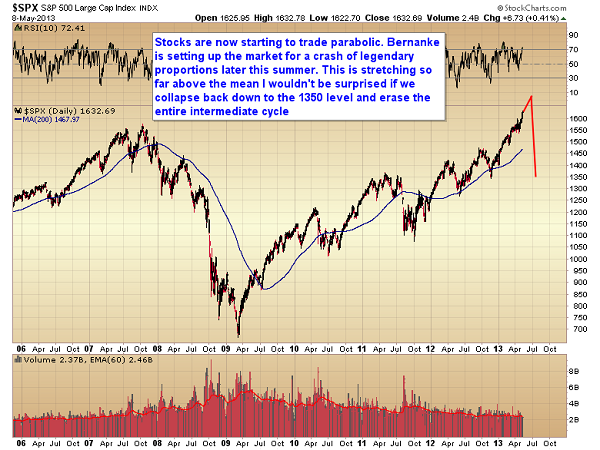

…….read more HERE


Navigating the Economic Obstacles
Unresolved challenges—sequestration in the U.S., Europe’s recession, China’s extended slowdown—could affect markets in the months ahead. — see page 3
China Property Market Executive Summary
In a world of sub-par economic growth, more lies on China’s shoulders than ever before, a key reason why China’s property market has become a flash point of investor concern. — see page 7
Commodities
Following the April slump in most commodity prices, see our latest thoughts on gold, energy, industrial metals, and agricultural commodities. — see page 24
Canada Equity Market
We are cutting our recommended rating to Neutral — see page 15
For the complete report as well as Daily and Weekly Updates CLICK HERE.


Shale oil has been North America’s great experiment, says Oil & Gas Investments Bulletin Editor Keith Schaefer. But in this interview with The Energy Report, he questions the experiment’s success and predicts steep declines ahead, with just a few formations left to supply the market. The question is what shale play will last the longest? Read on to find out how—and when—to get positioned for the end of the shale revolution.
The Energy Report: A number of experts say North American gas supply is peaking. Where do you weigh in?
Keith Schaefer: During the last three years, the mantra has been, “Drill, baby, drill,” for a number of reasons. The price of gas was never one of those reasons. Companies drilled because the technology kept improving. They drilled because they were able to get cheap foreign capital to partner in joint ventures. The market situation was not based upon economic “truth.” It was based on securing the land position and, “Economics be damned, let’s go!” But we are now returning to a real gas market based upon economic fundamentals. Where that’s going to shake out, nobody knows; the market is betting on higher prices.
The reality is, Peter, there is only one true gas formation in the U.S. that is increasing production, and that’s the Marcellus. Every other single shale gas play is now in decline. The industry is now much more disciplined in producing gas, as the rig count has gone way down. But I suggest that the price rise is a year or two away because there is so much gas drilling going on in the Marcellus and Eagle Ford. These two formations are making up the shortfall in other regions. At some point in time—nobody really knows when—the scales are going to tip: Gas production in North America will seriously decline. The gas bulls think it’s going to happen quickly, because the hydraulic fracking wells come in like gangbusters and then rapidly decline. An overall decline in supply could drive up the price.
TER: Are there undeveloped or undiscovered shale gas plays still out there?
KS: The short answer is that we do not know. Explorers are testing new areas. Just outside the Bakken, there is activity in Bowman County. There is play in the Heath Shale. It looks like the Utica will be mostly gas, not oil. But I don’t see any more Marcellus Shales out there.
TER: Is there a limit to exploration?
KS: All of the easy fruit has been picked. Remember, most of the shale plays were already well known geology, so everybody knew where the oil and gas was. We just did not have the technology to get the stuff out of the ground. As the technology has improved, bit by bit, and the politics has improved, bit by bit, the known shale plays are being developed to capacity. Is there another undiscovered giant like the Marcellus lurking somewhere? Realistically, I doubt it. The industry has very good tools for looking underground. A big monster shale play that would keep the gas glut going for another two or three years is a bit of a stretch.
TER: Will we go back to importing gas?
KS: I do not see the U.S. importing much gas for at least three years, and maybe longer, depending on existing wells’ decline rates. Right now, drillers are doing maybe four wells per square mile. With downspacing, they can get down to 8, 16 or even 32 wells per square mile. There is still a lot more domestic gas to be pumped before we need to import a lot of gas again.
TER: Let’s talk about the role of Canadian penny stocks in your portfolio. How is the shale experiment with the oil juniors going in Canada?
KS: All across North America and especially in Canada, the rush into shale oil has been a great experiment. But it really doesn’t work in a junior company. The place for juniors in an investor’s portfolio right now is getting smaller and smaller. The shale, or tight wells cost a lot of money to drill, and the juniors just do not possess the capital necessary to develop many of these plays. The wells will pay out in 12–24 months, and that is simply not fast enough for the junior companies to recycle the cash and drill another well. A junior might have a big land position, but it cannot develop it, particularly on the gas side, without continually raising equity. Many of these companies have stopped or dramatically reduced drilling. It’s a bad spiral: You drill less, you produce less and your declines are high. These smaller energy firms are in a really tough spot—for oil or gas.
TER: Is it reasonable for the management of these struggling companies to hope the price will go up and make staying the course worthwhile?
KS: Well, yes, they have no choice other than shutting down all of their production. It’s just a question of how long the wait is. I was talking with a producer the other day, and he indicated that there will be no new capital available for pure dry gas until it is hedged at $4.50/thousand cubic feet ($4.50/Mcf). Gas has to be at $5/Mcf for a couple of weeks for them to do that. So gas prices have to be $5/Mcf for the market to realistically think about putting more money into dry gas wells.
Could that happen this year? It could, but the Marcellus is still coming on strong. Next year is quite possible. The other thing is that the gas wells with lots of natural gas liquids (NGL) like condensate, propane, butane and ethane have better economics than simple dry gas wells. With NGLs, more production can come on-line at $3.50/Mcf. There is hope; prices are moving higher than most people expected at this time of year, thanks to a very cold early spring. But to say that prices will go much higher from here would be a bit of a stretch.
TER: Which junior names are doing well in Canada?
KS: In no particular order, NuVista Energy Ltd. (NVA:TSX), Advantage Oil and Gas Ltd. (AAV:NYSE; AAV:TSX) and Delphi Energy Corp. (DEE:TSX) are doing well. The market is watching these companies to see which has leverage to gas, and which can really show a huge improvement in its numbers if gas does go up. These companies are heavily gas weighted. So, if gas does turn and stay higher, they have the most torque.
TER: What about old school oil and gas production? Not everybody is fracking—how are the standard vertical wells doing?
KS: That industry has been on hold for three years while the market experimented with the shale plays. On the junior side, it’s very rare to find conventional plays. The one that I like the most on the conventional side is a company called Manitok Energy Inc. (MEI:TSX). It has done a great job of putting together a land package in the Cardium Formation in the Alberta foothills and hitting on all its wells for both gas and oil in regular conventional formations. So the old-style industry is still alive. . .a bit.
TER: Is it more efficacious to do vertical wells in the Cardium than to frack?
KS: Well, where Manitok is, yes. The old-style pools are not in shale, tight rock or tight sandstone, so you can put a regular, old-style vertical hole down. If you hit the pool, splash! That’s a great well. Manitok hit a monster well two years ago and it did 5 million cubic feet per day (5 MMcf/d) gas. Two years later, it’s still doing over 3 MMcf/d. The well has declined less than 40% in two years. A lot of producers would give their eye-teeth for a well like that. The unconventional wells typically deplete 65–85% in the first year, and another 20% during the next couple of years. When you hit a regular, old-style conventional pool with a vertical well, you can book a lot of reserves.
TER: Is the Street being realistic about the depletion rate of the unconventional wells, or do people believe the reserves will last forever?
KS: The Street is acutely aware of what the decline rates are now. At the same time, some of these plays take a long time to peak, and some of them do not. The Haynesville peaked quickly, but plays like the Barnett took more than 10 years to peak. The Marcellus is still growing, with lots of new wells coming onstream. The Street is very aware of the decline rates, and I think that’s why natural gas prices have doubled in a year despite production not going down. But I think the Street is also aware of the amount of wells that can still come on in these plays, and it is sitting back and waiting to see some kind of supply drop before bidding gas up any higher.
TER: What is the science behind the rapid depletion rate with the hydraulic fracking?
KS: Basically, with fracking, once you pump the water, steam, or sand into the formation, only the oil and gas that is sitting right inside those particular fracks surfaces. The shale formation is super oil charged, so there are still huge amounts of oil and gas left in the rock after the first go-round. One can either refrack it multiple times, or perform a water flood to liberate a little bit more oil and gas. But drillers have to be close to the fracks to get the product out. The trick is to plan the optimal size and strength of the initial frack. After the well has depleted for two to three years it might be worthwhile to refrack.
TER: Is it more expensive to frack the second time around?
KS: Remember, the well has already been drilled. If the company has drilled a $3 million (M) well, probably $1M of that is the frack. You don’t have to spend $3M again—only $1M. If the well is doing 10 barrels per day (10 bbl/d), and a refrack gets it back up to 30 bbl/d for a while, there can be substantial payback.
TER: How important is jurisdiction in assessing what companies to buy?
KS: It is very important because prior to the shale revolution, the market searched the world for new sources of oil and gas. We were getting deeper and more remote with all of our exploratory work. We had to; the thinking was that all the easy pickings in North America were long gone. Then along came the shale revolution. Everybody refocused their budgets on North America. And there have been so many discoveries in the last three or four years. Enough to keep the market excited, enough that it has not bothered going back to the international locations. The Street is saying, “Why would I take any political risks when we’re getting great discoveries with fantastic returns in the Texas, North Dakota and Alberta shale plays?”
But now investors are paying more attention to the international plays even though there are some drawbacks, such as the rise of resource nationalism. It’s becoming more difficult for free enterprise to get business done in the rest of the world. All the big discoveries are now in gas. That’s why the majors likeRoyal Dutch Shell Plc (RDS.A:NYSE; RDS.B:NYSE) andExxon Mobil Corp. (XOM:NYSE) are moving toward gas. They report in barrels of oil equivalents (boe), as opposed to barrels of oil (bbl), because to keep up their reserve base, they have to book gas reserves. Given the situation, it is very difficult for a junior to enter a new jurisdiction. Two things have to happen. A firm has to a) make sure that the geology is good; and then, b) hit a good well; and c) get the market to realize that. However, in Africa for example, a lot of juniors are having fantastic success, such as Africa Oil Corp. (AOI:TSX.V). There are a lot of ongoing junior African plays that are very high-risk, high-reward plays that can see big lifts with a discovery.
TER: Is North Africa a safe place to do business?
KS: It depends where you are in North Africa. The Street tends to wipe an entire area with one brush, and sometimes that’s justified. There are pockets in North Africa that one can operate in, though. Tunisia seems to be fairly safe for business. Obviously, Libya and Algeria are currently fraught with danger, and the Street does not want to go there. Morocco looks relatively safe. Despite the political disruptions, however, some business is done.
TER: Are there juniors in North Africa that investors should look at?
KS: The satellite juniors in the African risk play— Taipan Resources Inc. (TPN:TSX.V) and Vanoil Energy Ltd. (VEL:TSX.V) —are both funded and set to start drilling in the next six months. In Tunisia, there isAfrica Hydrocarbons Inc. (NFK:TSX.V) as well as DualEx Energy International Inc. (DXE:TSX.V), which is going to be drilling its big well within 30–60 days. In Angola, there are a couple of drill plays getting funded.
TER: Are North American investors funding African plays?
KS: Most of the money comes from London. The Europeans are much more comfortable drilling in Africa than North Americans are. North Americans are very risk averse on the international scene. They are myopic, in fact.
TER: You also follow refinery stocks. Are the risks lower there than for the producers?
KS: The refinery stocks had a great run over the last year. But in early March, they started to run into a bit of trouble. The stock charts are now consolidating. Even though the refiners are showing great earnings for the last quarter, the market looks forward. And the Street sees a very tight West Texas Intermediate (WTI)-Brent spread. So the refiner stocks are now in full retrenchment mode and not moving forward. They are consolidating the gains they’ve had over the last 9–12 months. For those stocks to move higher, we’re going to need to see the WTI-Brent spread widen again. And that could happen. As light oil production in the U.S. continues to increase, it will overwhelm the refinery complex on light oil, and we will see a drop in light oil prices here in North America.
TER: Are there any companies that you like in that space?
KS: I am watching Valero Energy Corp. (VLO:NYSE) because it has so many refineries. It has a lot of torque to any turnaround. It exports a lot of product, which is very important, and it’s the largest independent refiner.
The other refiner that I follow quite closely is called Northern Tier Energy LP (NTI:NYSE). It has been hit, like everybody else, pretty hard on the tight spreads. So I am watching it from the sidelines as the whole refinery game shakes out. But the sector certainly did give investors a great run for 9–15 months.
TER: What advice do you have for new and veteran investors in the oil and gas space?
KS: Investors need to be very patient. There are lots of good stories out there that are starting to look very cheap. But, it is not wise to run out and buy stuff just because it’s cheap, particularly in Q2/13. The second quarter is generally the weakest for the industry. As we get close to June, there’s a very good chance industry share prices will go lower. The Street wants to see if the rally in natural gas is real. If it is, and we start to see production decline, then making money in this sector should be quite easy, because there are lots of gas stocks with good teams and good assets that are trading dirt cheap. But we are at the seasonal high for gas now. So be careful. Come June and July, though, everybody wants to have their checkbooks open and take another good look at the overall scene.
TER: I appreciate your time.
KS: Thank you, Peter.

Keith Schaefer is editor and publisher of Oil & Gas Investments Bulletin, which finds, researches and profiles growing oil and gas companies that Schaefer buys himself, so subscribers know he has his own money on the line. He identifies oil and gas companies that have high or potentially high growth rates and that are covered by several research analysts. He has a degree in journalism and has worked for several Canadian dailies but has spent over 15 years assisting public resource companies in raising exploration and expansion capital. Schaefer will be speaking at the upcoming World Resource Investment Conference 2013.
Want to read more Energy Report interviews like this? Sign up for our free e-newsletter, and you’ll learn when new articles have been published. To see a list of recent interviews with industry analysts and commentators, visit our Interviews page.
DISCLOSURE:
1) Peter Byrne conducted this interview for The Energy Report and provides services to The Energy Report as an independent contractor. He or his family own shares of the following companies mentioned in this interview: None.
2) The following companies mentioned in the interview are sponsors of The Energy Report: Royal Dutch Shell Plc. Streetwise Reports does not accept stock in exchange for its services or as sponsorship payment.
3) Keith Schaeffer: I or my family own shares of the following companies mentioned in this interview: Vanoil Energy Ltd. I personally am or my family is paid by the following companies mentioned in this interview: Taipan Resources Inc. and African Hydrocarbons Inc. My company has a financial relationship with the following companies mentioned in this interview: None. I was not paid by Streetwise Reports for participating in this interview. Comments and opinions expressed are my own comments and opinions. I had the opportunity to review the interview for accuracy as of the date of the interview and am responsible for the content of the interview.
4) Interviews are edited for clarity. Streetwise Reports does not make editorial comments or

We’ve been following Audience (ADNC) for some time now as a compelling long, but yesterday’s insider buy sends such a strong signal that we felt compelled to post this now.
Yesterday, May 7th, ADNC’s CFO Kevin Palatnik bought 25,000 shares, worth $350,000. This is after a previous 50,000 share purchase on March 7th. In total, he has purchased more than $1 million worth of stock in the last two months. This is eye-opening for a CFO with a $300k salary. In all of our time following the market, we have never before seen an insider make a personal bet of this magnitude.
In light of the earnings disappointment following Mr. Palatnik’s substantial purchase in March, it is unlikely that he has been buying shares on the prospect of ADNC outperforming as a standalone entity. Instead, Mr. Palatnik most likely believes that ADNC will be acquired significantly above today’s prices.
ADNC’s circumstances alone make an acquisition likely in the long term. However, Mr. Palatnik’s continued insider purchases alter the prospect of a sale from a reasonably likely eventual outcome to highly likely in the medium term.
ADNC makes voice processors that are in several top devices, including Samsung’s (SSLNF.PK) S3 and S4 as well as Google’s (GOOG) Nexus 10. A full list of the devices that use ADNC’s technology is available here. ADNC’s voice processors improve sound quality by distinguishing between the speaker’s voice and ambient noise. As the leader in the space, ADNC is in an enviable position. The company’s technology has significantly outperformed comparables from the likes of Apple (AAPL), Qualcomm (QCOM), and others. Without ADNC, there would have been no Siri for the iPhone.
ADNC’s technology could be a compelling strategic play for potential buyers. The companies in this space compete fiercely and voice quality is becoming increasingly crucial to differentiate. Qualcomm’s Fluence product has been losing market share to Audience and the company certainly has the means to make a defensive acquisition. Other high profile potential buyers include Google and Samsung, both of whom already use ADNC’s technology in key products.
The unusually high VC ownership in ADNC is another strong indicator of a likely medium-term acquisition. A large VC ownership stake typically indicates a higher-than-normal probability for a buyout, as VCs are incentivized to cash out to return profits to their LPs. In the case of ADNC, more than 54% of the company is held by VC funds including New Enterprise Associates (21.0%), Paul Allen’s Vulcan Capital (17.6%), and Tallwood (15.7%).
ADNC has strategic importance to enormous tech companies, sizeable cash, a fast growth rate, and VC backing. These circumstances alone would make the company a highly likely buyout target on its own merit. The continued buying of ADNC’s CFO in quantities larger than his annual salary makes this a rare opportunity.
The only question remaining is what a reasonable valuation range for a buyout would be. Companies of this nature are typically bought out for a multiple of sales. Given its high growth profile and strategic importance, a buyout of ADNC would likely be in the 2x-5x sales range (Qualcomm has higher margins but much slower growth and trades around 5x sales). To us, the upper end of this range seems reasonable given Audience’s compelling IP.
What’s clear is that such a buyout would be at a substantial premium to today’s price. Using a conservative 2x sales valuation and consensus 2013 sales forecasts of $180 million, ADNC could be acquired for $360 million + $124 million of cash and marketable securities, or $20.77/share using 23.3 million fully diluted shares.
ADNC is growing quickly and we like the company’s fundamentals. However, in the interest of expediency, we have not discussed them in depth here. If you are interested in this information, feel free to reach out directly or leave a comment.

Kingsley Park Capital is a private investment fund. We employ a long/short equity strategy and are flexible, opportunistic investors. This allows us to take advantage of the best opportunities available in the market at any given time. We are most often involved in small/micro cap and special situations, including binary events. Our fund is currently closed to new investors.

-
I know Mike is a very solid investor and respect his opinions very much. So if he says pay attention to this or that - I will.
~ Dale G.
-
I've started managing my own investments so view Michael's site as a one-stop shop from which to get information and perspectives.
~ Dave E.
-
Michael offers easy reading, honest, common sense information that anyone can use in a practical manner.
~ der_al.
-
A sane voice in a scrambled investment world.
~ Ed R.
Inside Edge Pro Contributors

Greg Weldon

Josef Schachter

Tyler Bollhorn

Ryan Irvine

Paul Beattie

Martin Straith

Patrick Ceresna

Mark Leibovit

James Thorne

Victor Adair