
Gold & Precious Metals
T.S. Eliot called April “the cruelest month” in his famous poem, and without a doubt April was cruel to many gold investors. Sunshine Profits subscribers who followed our suggestions in April avoided a share of the pain. Probably no one suffered more than hedge fund manager John Paulson. He is joined by hedge fund manager David Einhorn whose Greenlight fund took a big hit on its gold miners ETF holdings. Einhorn said recently what we would consider an understatement: “We were somewhat surprised by the swift decline in the price of gold in April.” If they were following fundamental valuations and analysis only, then that’s not surprising. Paying attention to the breakdown below the key support level at that time provided a sell signal.
According to reports, Paulson’s $700 million gold fund lost 27 percent in April due to leveraged bets on gold, when the price of the metal swooned by 17 percent over a two-week stretch. What must hurt is that the majority of the money invested in the Paulson gold fund is believed to be the billionaire’s own. Regulatory filings show that at the end of last year Paulson’s firm was the largest holder of the SPDR Gold ETF, with 21.8 million shares. Paulson made his fame and fortune after he made $15 billion for his firm in 2007 by betting against subprime mortgages before the housing collapse.
Paulson started his gold purchases in early 2009, betting that gold would rise due to the government money printing machines. Paulson took a $1.3 billion stake in AngloGold Ashanti Ltd. (AU) and $2.8 billion of GLD when the metal was trading around $950 an ounce. He was the biggest holder of both at the end of last year, the most recent figures available. Even with all the negative press gold is still trading more than 50 percent higher than when Paulson started investing in the metal.
To analyze if there is more pain to come for Paulson in the coming weeks let’s take a look at one of the more interesting ratios there are on the precious market – mining stocks vs. gold and gold to silver ratio (charts courtesy by http://stockcharts.com).
Before we being, we would like to point out that we believe that the long-term picture for gold remains bullish, as the fundamentals remain in place. This, however, does not mean that gold can’t move even lower temporarily.
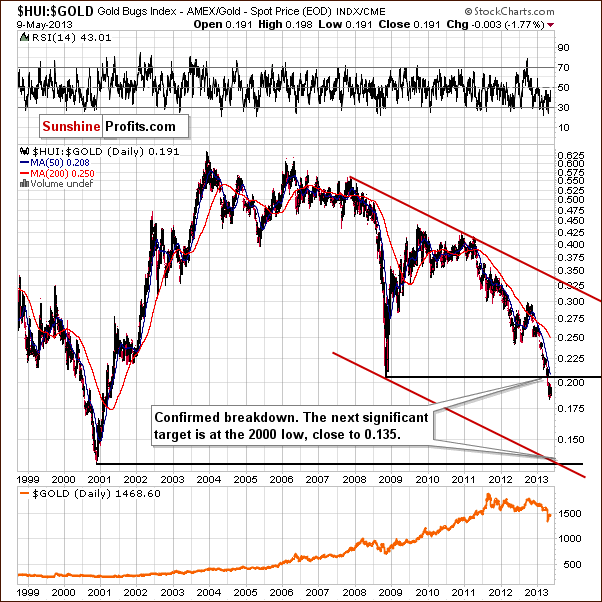
The above chart (gold stocks’ performance relative to gold) provides a very bearish picture. Please note that the trading channel and the next horizontal support intersect at a point much lower than where this ratio is today. Of course, the existence of a target level by itself is no indication that it will be reached; the trend has to be in place as well. The point here is that the ratio has already broken below the previous late 2008 major low and is now a bit more than 5% beneath it. This is a major breakdown and it was confirmed. The implication is that the trend is still down.
With the trend being down and accelerating and the recent breakdown being confirmed, there is a good possibility that the miners will decline significantly once again. This makes the previously mentioned target level a very important one. At this time it seems likely that the ratio will move to its 2000 low – close to the 0.135 level.
If gold stocks decline relative to gold as they did late in 2000, and gold declines to $1,300 or slightly higher, the target level for the HUI Index would coincide with a Fibonacci retracement level.
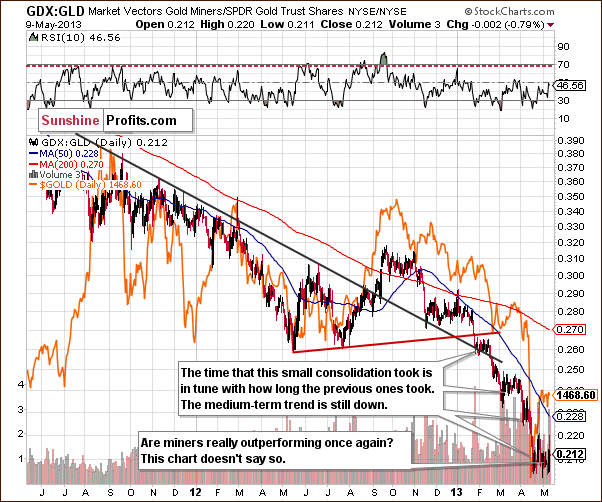
The GDX to GLD ratio chart (another way to look at the miners to gold ratio), seems to confirm that the mining stocks are clearly not leading gold higher also from the short-term point of view. Volatile back and forth daily moves have been the norm recently, and overall the situation is unchanged – still looks like a consolidation within a bigger decline and most likely is one.
Additional confirmation comes from the silver to gold chart which is an extension of our analysis from the essay on silver’s underperformance against gold.
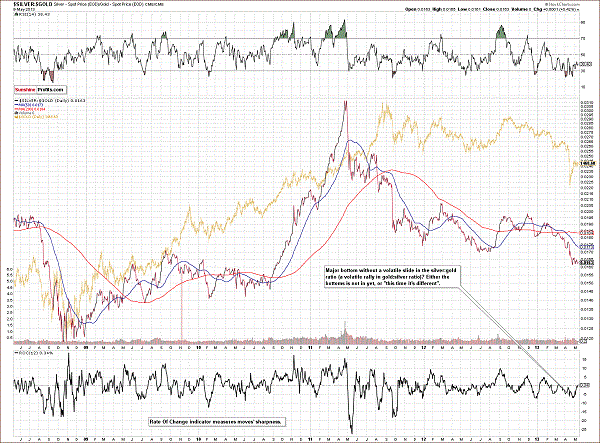
We see there has still been no sharp drop in the ratio, which indicates that the silver bulls are not giving up just yet (or that lots of short positions are not being opened just yet). This is something, which is usually seen in the final part of a major decline, so it seems that this decline has some time to go yet.
Summing up, the situation for metals and mining stocks remains bearish and the correction is likely still not over. If you’re interested in our target levels for precious metals and would like to be informed when to get back on the long side of the market, please join our subscribers.
Thank you for reading. Have a great and profitable week!
Przemyslaw Radomski, CFA
Founder, Editor-in-chief
Gold Investment & Silver Investment Website – Sunshine Profits
* * * * *
Disclaimer
All essays, research and information found above represent analyses and opinions of Przemyslaw Radomski, CFA and Sunshine Profits’ associates only. As such, it may prove wrong and be a subject to change without notice. Opinions and analyses were based on data available to authors of respective essays at the time of writing. Although the information provided above is based on careful research and sources that are believed to be accurate, Przemyslaw Radomski, CFA and his associates do not guarantee the accuracy or thoroughness of the data or information reported. The opinions published above are neither an offer nor a recommendation to purchase or sell any securities. Mr. Radomski is not a Registered Securities Advisor. By reading Przemyslaw Radomski’s, CFA reports you fully agree that he will not be held responsible or liable for any decisions you make regarding any information provided in these reports. Investing, trading and speculation in any financial markets may involve high risk of loss. Przemyslaw Radomski, CFA, Sunshine Profits’ employees and affiliates as well as members of their families may have a short or long position in any securities, including those mentioned in any of the reports or essays, and may make additional purchases and/or sales of those securities without notice.

Last month, I ran through a set of figures that cover a huge concern for retirees.
It’s vitally important information that affects nearly every dollar you have invested… yet most of what you hear about this idea is “bunk.”
I’m talking about the concern that the U.S. economy is “running off the rails”… that we are in a recession… or worse, a depression.
The figures I presented showed that our economy was growing slowly, without inviting a sharp increase in inflation. Today, nothing much has changed… No surprises, just steady progress. It’s the sort of environment that leads to gains in your stock portfolio.
But how much money should you have in stocks? And after their big rise (up 14% so far this year), are they too expensive to buy?
Below is the chart that provides our answer. It displays the historical price-to-earnings (P/E) ratio of the S&P 500. The P/E ratio is one of the time-tested ways to gauge stock market valuations. You’ll note that the S&P 500’s current P/E of around 16 is near its historical average of 16-17 times.
(Click HERE to view all 4 larger images)



The Dow rose another 48 points wednesday. Gold was up $24 per ounce wednesday,
Nothing remarkable. Nothing illuminating, either.
The newspapers and TV channels all reported the Dow 15,000 story as though it were just a stepping-stone on the way to 16,000… or 20,000… or 30,000.
Heck, the sky’s the limit!
Investors have reached a new level of bullishness. They’re borrowing again to buy stocks, confident that prices go in only one direction.
Advisors, too, seemed sure that this was not the end of a trend, but the beginning of one. Just what you’d expect at a market top.
There’s also a swift current of economic analysis telling us that the commodities boom is over… that the Fed has the situation under control… and that the bull market in gold is finished.
All of which is amazing… and often breathtaking.
Between Improbable and Impossible
Stock market investors don’t seem to know or care that the main thing propping up their investments is the same thing that will ultimately destroy them. And that the longer the situation continues the bigger the mess will be when it finally blows up.
We’re talking, of course, about Fed, Bank of England, Bank of Japan and People’s Bank of China monetary policy. It is “experimental.” It is “bold.” It is also reckless and potentially catastrophic.
Lending money at negative real interest rates creates grotesque distortions in the market.
Savers get nothing for their trouble. In fact, they lose money in real (inflation-adjusted) terms. So they shift to speculating on stocks. The stock market goes higher… but it is not a market you can trust.
It is being driven by the printing of trillions of dollars, yen, pounds and renminbi. But central bank policy hasn’t been able to budge slumping economic fundamentals. And any attempted exit by central banks in the absence of a genuine economic recovery will be, in the words of hedge fund manager Paul Singer, “somewhere on the continuum between problematic and impossible.”
It is also unnatural for a central bank to print up new money and use it, indirectly, to pay for government operations. If you could do that without penalty – that is, if you could pay for real things with fake money – you would do it all day long.
Normally, central banks don’t even try. They know the penalties make it not worth the fleeting enjoyment.
Do you see any penalties, dear reader? We don’t.
But the fact that the penalties have not yet been assessed doesn’t mean they don’t exist. And the longer we go without paying them, the greater they will eventually be.
What’s Not to Like?
At present, the feds get only rewards.
First, lower interest rates make it easier to finance federal debt.
Second, low debt interest payments reduce the outstanding debt in real (inflation-adjusted) terms.
Third, Fed Treasury bond buying indirectly funds government spending – to the tune of about $45 billion per month.
Fourth, the lack of yields in the bond market corrals investors into stocks. This pushes stock prices higher. Rich bankers and rich campaign contributors get richer.
What’s not to like?
For the moment, nothing.
But the markets won’t stay in this “sweet spot” for long. The time will come when the Fed will have to reverse its policies or face substantially higher inflation.
But how? Instead of buying bonds, the Fed will have to sell them. But to whom?
Warren Buffett has a piece of advice for Ben Bernanke: It’s easier to buy than it is to sell.
Buffett, speaking on Saturday at Berkshire Hathaway’s annual meeting in Omaha, said he is worried about what will happen when the Federal Reserve tries to wind down its recent efforts to stimulate the economy. Via a program nicknamed “QE,” short for “quantitative easing,” the Fed in recent years has bought up over $2 trillion in bonds in order to lower interest rates and promote borrowing and investment.
Some have warned that when the Fed decides to sell its trove of bonds, or even just stops adding to it, stock markets could tank. Rising interest rates could cause banks to lose billions, perhaps igniting another financial crisis. Buffett says we don’t know what will happen, but he is concerned.
“QE is like watching a good movie, because I don’t know how it will end,” says Buffett. “Anyone who owns stocks will reevaluate his hand when it happens, and that will happen very quickly”…
“People make different decisions when they can borrow for practically nothing… It’s a huge experiment.”
Charlie Munger, Buffett’s long-term chief lieutenant, who was also talking at the meeting, says he worries about more than just inflation.
“What has happened in macroeconomics has surprised pretty much everyone,” says Munger. “Given that history, economists should be more cautious when they print money in massive amounts.”
Regards,

Bill
Wall Street “Escape Plan” Saves American Retirements
Wall Street investments are dragging American investors into the poorhouse. But with this “Escape Plan,” you could start building lasting wealth today. These nine Wealth Secrets could be your ticket to financial independence. Find out how you could use these strategies to generate reliable wealth here.
Good morning. Here’s what you need to know.
- Asian markets were up in overnight trading with theNikkei surging 2.9% after the dollar crossed the key 100 yen level. Europe is rallying, and U.S. futures are modestly higher.
- The dollar crossed the crucial ¥100 level yesterday.Today the yen weakened beyond 101 a dollar. This saw the Nikkei close up nearly 3% on Friday. The Bank of Japan’s efforts to bolster its economy by weakening its currency is already reported to be working. Click here to learn about Abenomics, the Japanese experiment that is captivating the world >
- Chinese lending totaled 792.9 billion yuan in April, beating estimates for 755 billion yuan. M2, a broader measure of money supply, increased 16.1% on the year, above expectations for a 15.5% rise. The only three indicators of Chinese monetary policy that you need to watch >
- Carl Ichan and Southeastern Asset Management, two of the largest Dell shareholders, have written to the company’s board with an alternate proposal to the buyout, according to the WSJ. This is part of Ichan and Southeastern’s effort to prevent Dell founder Michael Dell, and a private equity firm, from buying out the company.
- At 9:30 a.m. ET, Federal Reserve Chairman Ben Bernanke will give the keynote address at the Chicago Fed’s banking conference.
- A woman has been rescued from the debris of the collapsed factory in Bangladesh after 17 days. 2,500 people were rescued in the immediate aftermath of the collapse and the death toll is said to have reached over 1,000. A fire broke out at another factory in Bangladesh earlier this week.
- UK Q1 construction output fell 2.4% on a quarterly basis, to the lowest level since Q4 1998.Construction accounts for 6.8% of the UK economy, and the revision is not expected to have a major impact on GDP. The biggest economic experiment of the last five years has ended in disaster >
- The Reserve Bank of Australia expects “below trend” growth of 2.5% this year. It also cut its inflation outlook to 2% in the year to December, down from 3%.
- The Treasury Budget for April is out at 2:00 P.M. ET. Consensus is for the monthly Treasury budget to post a surplus of $107.5 billion. Follow the release at Business Insider >
- Hong Kong’s economy grew 0.2% in Q1, below expectations for a 0.5% rise. This compares with a 1.4%

The 70s silver bull took place during a period from a major peak in the Dow/Gold ratio (1966) to a major bottom in Dow/Gold ratio (1980). The silver bull market started in 1971 and ended at the beginning of 1980.
The current silver bull market also started after a major peak in the Dow/Gold ratio (peak was at the end of 1999).The current silver bull market started in 2001, and it is also likely to end when the Dow/Gold ratio makes a major bottom. See the chart below, as illustration:

……view more charts & read more HERE


-
I know Mike is a very solid investor and respect his opinions very much. So if he says pay attention to this or that - I will.
~ Dale G.
-
I've started managing my own investments so view Michael's site as a one-stop shop from which to get information and perspectives.
~ Dave E.
-
Michael offers easy reading, honest, common sense information that anyone can use in a practical manner.
~ der_al.
-
A sane voice in a scrambled investment world.
~ Ed R.
Inside Edge Pro Contributors

Greg Weldon

Josef Schachter

Tyler Bollhorn

Ryan Irvine

Paul Beattie

Martin Straith

Patrick Ceresna

Mark Leibovit

James Thorne

Victor Adair