

Energy & Commodities

Is Crude Oil Ready For A Breakout & Would It Help Gold?

Jim Rogers recently said in an interview to Morningstar, that he is not disturbed by the recent tumble in gold prices.

“Gold had gone up 12 years in a row, without a down year, which is extremely unusual in any asset. Equally important, gold has only had one 30% correction in 12 years. Again, that is extremely unusual. Most things correct 30-40% every year or two. So the action in gold has been very unique and gold needed a correction. The main thing that caused it, as far as I am concerned, was that the market was ready. It needed it and it is good for gold to have a proper correction,” said Rogers. We agree. At the same time we would like to point out that this has no implications on the short term.

How does he see the future for gold?

“Certainly, over the course of ten years gold will go much, much higher because I don’t see any possibility that governments are going to stop printing money in the next decade,” he said.  “And as long as that’s going to happen then gold is certainly going to go higher and probably much higher.” We agree once again.

In a recent interview in the South China Morning Post, George Soros says, “Gold was destroyed as a safe haven, proved to be unsafe. Because of the disappointment, most people are reducing their holdings of gold.” However, he also notes that central banks are still buying gold, so he doesn’t “expect gold to go down.”

One humorous headline asked: “Who’s smartest on gold – Chinese housewives or George Soros?”

As weird as this may sound, if we’re talking about the long term, we tend to side with the Chinese housewives who have been buying physical gold in unprecedented amounts.

Hong Kong government data this week shows that imports by China from Hong Kong more than doubled to an all-time high in March. India’s purchases are set to exceed 100 metric tons for a second month in May as jewelers rush to beat central bank curbs on imports by banks.

Buyers in mainland China purchased 223.52 tons of gold in March, including scrap, compared with 97,106 kilograms in February, according to Hong Kong government data. There were also reports of similar huge surges in demand for physical gold in India, Dubai and many other countries. Just the China purchases would account for roughly 10% of the gold mined each year.

According to the China Gold Association there is a shortage of gold jewelry inventory in the country after consumers bought up supplies.

As we enter the summer, we want to know who is right, George Soros or the Chinese housewives who have been stocking up on gold. Let’s take a look at the charts to find out. In today’s essay we will focus not only on gold itself, but also on the most versatile commodity – crude oil – and how it could impact the prices of gold in the near future(charts courtesy by http://stockcharts.com.)

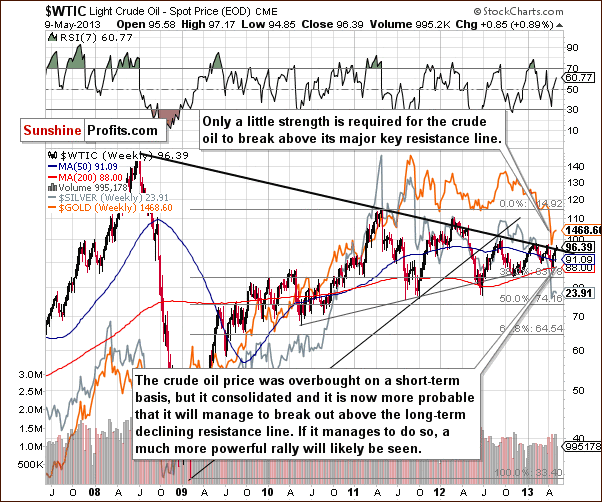
radomski may142013 1

When we examine the crude oil chart, we see that another attempt to break out above the declining resistance line based on the 2008 and 2011 tops is underway. If prices move above this resistance line, it could very well trigger a rally in other commodities and in the precious metals prices.

At this time, since the breakout has not yet been completed and verified, and since several attempts have failed in the recent past, we prefer to wait for a confirmation of this breakout before discussing the bullish implications for the precious metals in any detail.

Let us move on to the yellow metal itself and have a look its long-term chart. (Click HERE or on the Chart for larger image)

2

Here, the situation has changed very little as gold’s price pretty much moved back and forth last week. The long-term cyclical turning point is now a few weeks away and could very well coincide with the end of gold’s current decline. Whether this holds true or not, it seems likely that gold’s current decline will continue for now at least as it appears to not yet be completed.

Let’s have a look at Dow to gold ratio chart now.

radomski may142013 3

We see the ratio getting close to a key resistance level. This is due almost entirely to the Dow’s rally last week. The “problem” here is that if gold prices decline and stocks continue to rally (a real possibility), this ratio could break out above the declining resistance line and move toward 12.5, thus leading to even bigger declines in gold (below $1,200). We do not feel that such a breakout will be confirmed, however.

Summing up, a decisive breakout in crude oil could trigger a significant rally in gold. However, Since we saw several failed attempts for the crude oil in the past months, it seems best to wait for a confirmation of the breakout before discussing meaningful bullish implications for gold. For now, it still seems that the final bottom is not yet in.

Thank you for reading. Have a great and profitable week!

Przemyslaw Radomski, CFA

Founder, Editor-in-chief

Gold Investment & Silver Investment Website – SunshineProfits.com

* * * * *

Disclaimer

All essays, research and information found above represent analyses and opinions of Przemyslaw Radomski, CFA and Sunshine Profits’ associates only. As such, it may prove wrong and be a subject to change without notice. Opinions and analyses were based on data available to authors of respective essays at the time of writing. Although the information provided above is based on careful research and sources that are believed to be accurate, Przemyslaw Radomski, CFA and his associates do not guarantee the accuracy or thoroughness of the data or information reported. The opinions published above are neither an offer nor a recommendation to purchase or sell any securities. Mr. Radomski is not a Registered Securities Advisor. By reading Przemyslaw Radomski’s, CFA reports you fully agree that he will not be held responsible or liable for any decisions you make regarding any information provided in these reports. Investing, trading and speculation in any financial markets may involve high risk of loss. Przemyslaw Radomski, CFA, Sunshine Profits’ employees and affiliates as well as members of their families may have a short or long position in any securities, including those mentioned in any of the reports or essays, and may make additional purchases and/or sales of those securities without notice.


Exposing the “Great Rotation” Exaggeration in 1 Chart

Let this be yet another reminder to trust, but verify, every bit of information on Wall Street.

For months, we’ve heard that a “Great Rotation” is underway. That is, investors are dumping bonds and promptly putting the money back to work in equities. And this uptick in buying activity is precisely why the stock market keeps hitting new all-time highs.

Sounds perfectly logical. And Wall Street appears to be corroborating the theory. 

“You have this huge migration moving from grossly overweight fixed income back into equities,” says John Stoltzfus, Chief Market Strategist at Oppenheimer.

The only problem? The data tells an entirely different story. 

Here’s the proof in a single chart – and, more importantly, why Wall Street’s latest deception ironically bodes well for us…

Stocks Back En Vogue

I’ll be the first to admit that a transition is afoot. 

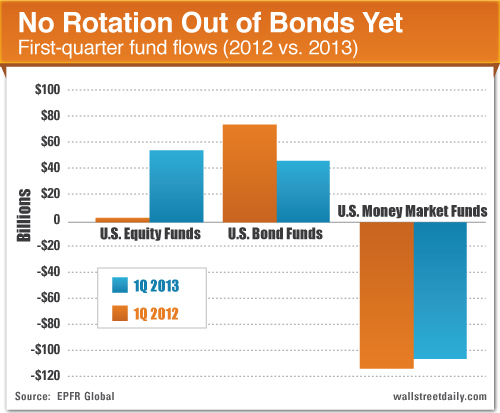
In January, investors (finally) rediscovered stocks. U.S. stock funds reversed 20 consecutive months of outflows by attracting a record $18.4 billion. 

And over the course of the first quarter, the enthusiasm for stocks intensified. According to the fund tracker, EPFR Global, investors plowed a total of $53.9 billion into stock funds in the first three months of the year. 

Yet none of these purchases were fueled by the sale of bonds.

0513-NoRotation

…….read more HERE

Morning Highlights: Start Your Engines


And now, the best of the rest …

United States


Global Macro


Finance and Markets


Asia


Why Grandich Is Saying Gold Will Hit $2,000/oz

Many junior mining investors have run off with their tails between their legs. And who can blame them when even the portfolios of market veterans like Peter Grandich, publisher and editor of The Grandich Letter, have taken a beating? But before you cash in, you might want to read why Grandich still has hope for $2,000/oz gold, and which companies he believes have the mojo to make it through this trough in this interview with The Gold Report.


The Gold ReportPeter, the last time we talked you said that the success of your marriage was resting on the performance of your junior resource equity portfolio. You are still married, so is your portfolio performing or is your wife an extremely patient woman?

Peter Grandich: Living in the doghouse isn’t that bad once you get used to it. It’s wise during this horrific bear market not to let your wife see your monthly brokerage statements.

TGR: A reader of yours apparently suggested that you should have a “kennel portfolio” for some of your dog stocks.

PG: And that was one of the kinder comments that came in recently. I would be better off running a kennel than speaking about my junior resource clients.

TGR: Tell us about what has happened and what you’re expecting for your portfolio.

PG: This has been the worst junior resource market in the 30 years that I’ve been on Wall Street. It may not be the largest percentage decline, but at least there were legitimate reasons for previous bear markets. It’s hard to justify the most recent gold takedown. Nevertheless, it happened. I just can’t seem to find any particular reasons to justify where we went.

TGR: You’re not alone. There are people who took positions in these stocks when they thought the market had bottomed and they’re still sitting with them in their portfolio. What are you doing with these stocks?

PG: These stocks have sunk way too low. Yet, I believe that this will be like the last dozen or so bear markets. There will be an inevitable bull market rally that will follow. The only justification to be a seller is that the mental stress and anguish has become so acute so that you literally can’t take another day of it. In fact, I think that’s what we’ve seen of late.

TGR: Are you still holding?

PG: I believe we’ve gone way past that level. I know inevitably a bull market will be onboard, but I don’t know if that bull market will make us whole. This was so devastating and widespread. Prices should eventually rise higher than they are now, but it will take months.

TGR: In early April, gold bears were out in force after a lengthy hibernation. Are you less bullish on gold than you were a year ago?

PG: A year ago, the technical picture suggested that the market was coming to a major change that could have been several hundred dollars up or down. My brain said it could be down, but my heart said up and I stuck with my heart.

Even after this takedown, I still don’t believe that the secular bull market that’s been ongoing for 12 years has come to an end. I still believe we’ll have a two in front of the gold price before it ends. We’re going to have to get to $2,000/ounce ($2,000/oz) before there’s any decision on my part about the end of the bull run.

TGR: What’s your message to gold bears out there?

PG: The vast majority of so-called professional advisers and the media simply hate gold. Expecting them to rally around it would be similar to going into a Ford dealer and expecting to be told, “If you really want a good car go down the block to the Chevy dealer.”

I would be worried about being a gold bear right now. You have to ask yourself what is it going to take to really crack the market? We had an onslaught of bear forecasts. We had an onslaught of selling in the paper market. Yet, as we speak, much of that decline has already been taken back. There’s going to be a reversal and these bears are going to have to run for cover.

TGR: Do you have an anecdote on physical buying that illustrates your point?

PG: In a few months’ time, I believe that we’ll learn that one of the biggest buyers was one or more central banks of significance. That’s why I believe the short sellers have a big problem going forward.

TGR: In December, you said you expected to see restructurings, rollbacks and repricing of options in early 2013. “Then we will have all the classic signs that the worst bear market in some time is behind us,” you said. We’re four months in. Are you seeing those signs?

PG: My eyesight has been impaired by the severity of the fall. Those of us still breathing in the junior market are in total shock and frozen in our tracks. It’s similar to living in New Jersey after Hurricane Sandy. We’re just starting to see the enormity of the damage now that the storm has almost passed. The takedown of the gold price a few weeks ago was the last leg of that storm. Now we should start to see the restructuring, rollbacks and repricing of stock options. We’ll all gain momentum between here and the end of the year.

TGR: What do the surviving junior companies do from here?

PG: I looked at the exhibitor list of an upcoming mining and gold show and about every company had a share price of $0.10 or less. Share prices are low and share structures are not tightly held—the inevitable has to happen if they’re going to continue. But you’re not going to see much general financing any time soon.

TGR: In a recent post on Gradich.com you talked about the coming collapse of the bond market. Tell us more about that.

PG: U.S. bonds will end up the worst investment for the next decade. The best recommendation I can make is a book that’s just been released, “The Coming Bond Market Collapse,” by Michael Pento. It clearly foreshadows what’s going to happen in the bond market.

TGR: Should the junior resource space forget about the potential for takeovers given that the majors seem to have their hands full with high capital expenditure projects and disgruntled shareholders?

PG: It’s not a question of if, but when we will see significant mergers and acquisitions (M&A). The bad news is that the prices will add very little premium. Unless the gold price rises, signaling a new leg in the market, junior market share prices won’t get much higher.

TGR: What kinds of resource companies are poised to rebound?

PG: The higher you go up the food chain the more likely you’ll see those rebounds. It’s going to be very hard for a pure exploration company that has yet to develop a project to attract significant capital any time soon.

TGR: The top of the food chain is the majors. It’s pretty difficult to find a major producer without a lot of warts. Do you still think they’re going to bounce back?

PG: In 30 years, I’ve never seen a spread in the valuations of major mining shares and metal prices as there is today. Newmont Mining Corp. (NEM:NYSE) has a 5% yield. Everything that can go wrong has already been priced into the majors at this point. The expectation is that they’re going to do the things that are necessary to get better.

However, part of that will include slowing down on some growth opportunities they thought that they had to take. There won’t be as much new gold coming into the market and that will support the gold price.

TGR: Tell us about some companies in your book and the progress they’re making, despite what’s happening in the market at large.

PG: Without a doubt, the best performer among my client companies has been Timmins Gold Corp. (TMM:TSX; TGD:NYSE.MKT). You really have to marvel at what it has achieved. Timmins began its quest to become a significant producer during the worst financial crisis in decades and is now a clear leader in the next generation of major producers.

Three other of my clients have had their shares bloodied, yet the potential for them to be significant producers has never been better in their entire corporate history. Normally these share prices are down because companies have failed at what they set out to achieve, but all three have taken great steps toward, or already achieved, their goals.

The only bad news that could come out of this is they are either taken over or merged without full price appreciation.

Those companies are Geologix Explorations Inc. (GIX:TSX; GIXEF:OTCQX)Oromin Explorations Ltd. (OLE:TSX; OLEPF:OTCBB) and Sunridge Gold Corp. (SGC:TSX.V). Those three are my largest personal holdings.

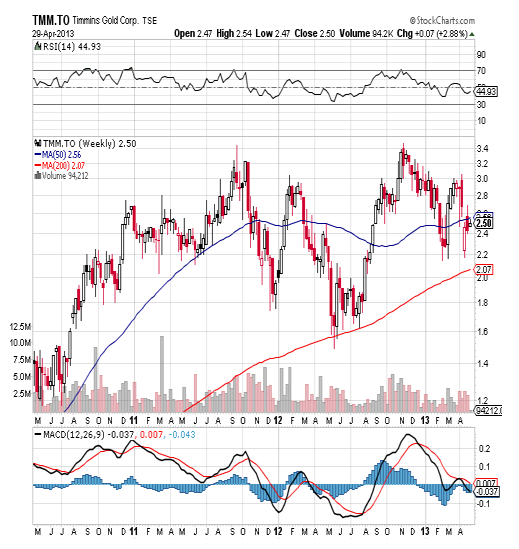
TGR: You recently posted a Timmins Gold chart on your website. What’s that chart telling you?

PG: Unlike many other gold stocks that have gotten creamed, Timmins did not decline close to them percentage-wise. It’s a sign that investors have recognized it to be an amazingly well-run company that is either going to be an acquirer or a takeover target. It’s doing too well to sit back. I would suggest that in 12 to 24 months we will learn that Timmins has gone on the acquisition trail, or was attempted to be taken over by a larger company.

TMM chart.jpg

TGR: Oromin put out a feasibility study earlier this year. What were your thoughts when you started going through that?

PG: Oromin has the single largest set of deposits in a country where gold deposits and gold mining is growing—Senegal. If it were not for this horrific bear market, the share price would be a lot higher. There are concerns of its ability to finance given what’s happened to its share price, but I suspect it could combine with its neighbor Teranga Gold Corp. (TGZ:TSX; TGZ:ASX).

Teranga would likely be the surviving company. I don’t think Oromin management wants to stay on the production side of the business.

TGR: How would investors benefit from that deal?

PG: This is one of the true rarities where combining is better for both of the companies. Each may not like what I’m about to say, but what Teranga has mostly going for it is its mill. It hasn’t been very successful on the exploration side. Oromin, on the other hand, is in partnership with one or more other parties on a series of deposits that have about 5–10 million ounces. It would be fairly expensive to build its own mill and foolish when the company next door has one and can use all the ore it can get in the coming years. The outlook for each company is vastly improved if they combine.

TGR: Is there a potential merger that would benefit Sunridge Gold?

PG: It is insanely discounted, not only because it operates in Eritrea, but also because of what happened in the junior resource market. It would have a share price probably 5–10 times higher if it were operating just about anywhere else in the world.

The bottom line is that any day Sunridge will have an updated resource study that should make it evident to everybody how ridiculously undervalued it is. It is definitely a candidate to be taken out. Unfortunately, it will not get anywhere near the price it could have gotten a year or two ago.

TGR: Sunridge put out a prefeasibility study just about a year ago. That showed a net present value (NPV) of $555 million and an internal rate of return of 27%. Do you expect the feasibility study, which is due out within the next month, to have even better numbers than that?

PG: It’s very likely. That’s why this market is so frustrating. Something has to give. You just can’t keep adding value the way Sunridge has and discount the price. If nothing else happens, a bigger company will come along that is better financed and take Sunridge out. The ore in the ground doesn’t know that it has been discounted to the level it has, and it’s still being sold around the world for a nice price.

TGR: What about the jurisdiction risk?

PG: Everybody I talk to that works there says it’s perhaps one of the best places they ever worked in all of Africa. Unfortunately, Africa creates a lot of negative buzz in the media.

TGR: Geologix is a story that’s been around for a while. It has a project in Mexico. What’s the path to making money for investors with Geologix?

PG: It’s almost to the point where it’s giving the stock away for nothing. The market cap is probably not even 10% of the NPV of the project. It’s a fairly easy deposit to develop and should not have major hiccups. It’s probably on radar of multiple companies as a possible acquisition because it’s in a good jurisdiction and has a lot going for it.

Does the fact that the market has taken this one down to a dime cause a problem for the company? Sure, but the management seems to think it has an alternative to raising capital with a general equity financing and says to stay tuned. You’ve got to give Geologix the benefit of the doubt and give it the time to see what develops.

TGR: Does Geologix have any cash-rich neighbors in Mexico?

PG: I don’t know about the cash-rich neighbors, but there are significant mines and miners operating in the general area, the type of companies that are going to be the first to notice this asset is so cheaply priced.

TGR: Do the companies we’ve discussed have enough cash to wait this market out?

PG: They have enough cash for the very short term, but all these companies are always burning matches. Until they have assets that they’re selling and can take in more money than they’re spending, they always have to raise money. That’s another reason why they’re priced where they’re at.

TGR: What should investors expect during the remainder of this year and into 2014?

PG: The U.S. stock market is nearing the end of the single largest bear market rally in history. This is what I predicted in 2009 would occur. There won’t be a collapse as soon as it does top out because quantitative easing will create a cushion. With the economy rolling over again, I don’t foresee the end of quantitative easing.

There will probably be some more shenanigans by the Federal Reserve to give another kick to the can, but the time will come when the world realizes that we cannot afford to pay back what we owe, much less the interest. That’s when the financial markets will be hit hard. That’s when there will be a collapse of the bond market and a very sharp decline for general equities.

In the meantime, we will see $2,000/oz gold. The recent gold takedown was not driven by fundamentals. It was not fun living through it, but it was actually something that is going to fortify this secular bull market that’s been underway for 12 years and is going to mark the next leg of the bull run for gold.

TGR: What’s your advice to the average retail investor in this climate?

PG: It’s just too late to sell unless you just can’t tolerate the mental anguish another day. Companies are down 90% off their highs in some cases, but some are viable. A consolidation is coming. It will have to get smaller before it gets bigger. Eventually, gold will stop making news for going down and start making news by going up sharply. That’s something I still think we have in our future. That’s why I still have hope for the junior market.

TGR: Thanks, Peter, for your insights.

Financial Adviser and Market Analyst Peter Grandich started publishing The Grandich Letter—now a blog—without a high school diploma or even a day of formal training. His ability to interpret and forecast financial happenings—which once earned him the moniker “Wall Street Whiz Kid”—has led to hundreds of media interviews. He is regarded as one of the world’s foremost market strategists.

Want to read more Gold Report interviews like this? Sign up for our free e-newsletter, and you’ll learn when new articles have been published. To see a list of recent interviews with industry analysts and commentators, visit our Streetwise Interviews page.

DISCLOSURE:
1) Brian Sylvester conducted this interview for The Gold Report and provides services to The Gold Reportas an independent contractor. He or his family own shares of the following companies mentioned in this interview: None.
2) The following companies mentioned in the interview are sponsors of The Gold Report: Timmins Gold Corp., Oromin Explorations Ltd., Sunridge Gold Corp., Geologix Explorations Inc. and Teranga Gold Corp. Streetwise Reports does not accept stock in exchange for its services or as sponsorship payment.
3) Peter Grandich: I or my family own shares of the following companies mentioned in this interview: Timmins Gold Corp., Oromin Explorations Ltd., Sunridge Gold Corp., Geologix Explorations Inc. I personally am or my family is paid by the following companies mentioned in this interview: Timmins Gold Corp., Oromin Explorations Ltd., Sunridge Gold Corp., Geologix Explorations Inc. My company has a financial relationship with the following companies mentioned in this interview: None. I was not paid by Streetwise Reports for participating in this interview. Comments and opinions expressed are my own comments and opinions. I had the opportunity to review the interview for accuracy as of the date of the interview and am responsible for the content of the interview.
4) Interviews are edited for clarity. Streetwise Reports does not make editorial comments or change experts’ statements without their consent. 
5) The interview does not constitute investment advice. Each reader is encouraged to consult with his or her individual financial professional and any action a reader takes as a result of information presented here is his or her own responsibility. By opening this page, each reader accepts and agrees to Streetwise Reports’ terms of use and full legal disclaimer. 
6) From time to time, Streetwise Reports LLC and its directors, officers, employees or members of their families, as well as persons interviewed for articles and interviews on the site, may have a long or short position in securities mentioned and may make purchases and/or sales of those securities in the open market or otherwise.


 

Bill Gates – Inventions Are The Key To Success

60 Minutes spoke with Bill Gates this weekend. Below is the interview:


Unknown

test-php-789