
Stocks & Equities
What was the trigger of the ‘87 crash when markets fell 21 per cent in one day? What was the trigger of the Nasdaq crash in 2000? What was the trigger of Japanese crash of 1989? What was trigger of 2007 crash that brought global stocks down 50 per cent?
We don’t know these things ahead of time, but something will always move markets up and something will always move them down. I would guess at the present time, given markets from the 2009 lows have in many cases increased by as much as 100 per cent, that they are no longer very cheap. …. Something could come along, geopolitically or otherwise.
I would be very careful being overweight equities. I still have 25 per cent in equities and 25 per cent in corporate bonds.
MASTER OF DOOM MARC FABER IS FEELING GLOOMY ABOUT CANADA
 Marc Faber, editor and publisher of The Gloom, Boom and Doom Report, was late to arrive to our Tuesday live discussion at Inside the Market alongside David Rosenberg. But we posed some of the questions you left for him in a later telephone conversation.
Before we did, however, we couldn’t resist asking him about his views on Canada. Not surprisingly, the famed economist known for his contrarian and often pessimistic bent didn’t exactly offer an uplifting view.
“Something will break very bad.” – in TheglobeandmailHERE
In the 40 years I’ve been working as an economist and investor, I have never seen such a disconnect between the asset market and the economic reality
THE FUNDAMENTALS FOR GOLD ARE INTACT
Marc Faber : “I love the fact that gold is breaking down because it will give a good entry point. The fundamentals for gold are intact.”

In May 2011 we presented the following chart, displaying the key support levels for silver at $34, $27 and $23; representing retracements of 38%, 55% and 65% from the 2008 low. The April 2013 low has held around the 65% retracement. Our modeling calls for an interim low in precious metals now as ‘B’ of an A-B-C rally into mid-June, possibly stretching into July.
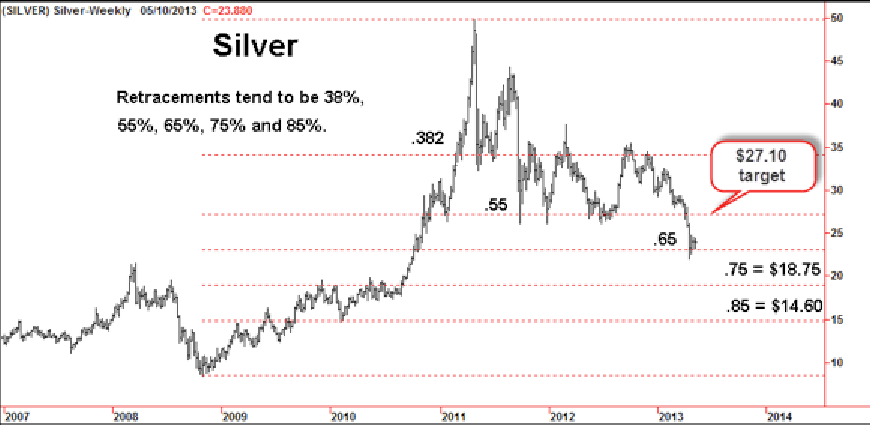
The most common reaction after giving back 65% of a major advance (i.e. $8 to $50) is a 38% retracement rally of the most recent decline. (Previous examples are 1969, 1983, 1998 and 2003.) The 38% retracement from October’s interim high of $35.44 produces a target of $27.10.
When looking for a catalyst for the potential rally one only needs to recognize that selling pressure has been unabated recently, with fifteen of the last sixteen weeks having made lower highs. This is similar to the pressure seen into the 2008 bottom and the inverse of the rallies into December 2010 and April 2011. Once the sellers have satisfied their needs there should be a reasonable vacuum permitting a breakout through $24.
A decisive weekly close exceeding $27.10 would then suggest a continuation to $35. However, a failure would suggest that the lower supports at $18.75 and $14.60 (75% and 85% from 2008) could be challenged.
CHARTWORKS – 2013/05/14
The opinions in this report are solely those of the author for the private information of clients. Although the author is a registered investment advisor at CIBC Wood Gundy, this is not an official publication of CIBC Wood Gundy and the author is not a CIBC Wood Gundy analyst. The views (including any recommendations) expressed in this report are those of the author, and are not necessarily those of CIBC Wood Gundy. The information contained in this report is drawn from sources believed to be reliable, but that accuracy and completeness of the information is not guaranteed, nor in providing it does the author or CIBC Wood Gundy assume any liability. The information given is as of the date appearing on this report and neither the author nor CIBC Wood Gundy assume any obligation to update the information or advise on further developments relating to the information provided herein. This report is intended for distribution in those jurisdictions where both the author and CIBC Wood Gundy are registered to do business in securities. Any distribution or dissemination of this report in any other jurisdiction is strictly prohibited. The author and / or CIBC Wood Gundy may have holdings in the companies discussed and may offer advice or have an investment banking relationship with the companies discussed in the report.

Why does silver move so much further, and faster, than gold…?
The SILVER MARKET often gets a bum rap. The reason is that often its gyrations are much greater than those of the gold market.
What causes this? There are theories that bankers and investment companies are conspiring to try to manipulate the market. However, buying or selling alone is not a conspiracy. It is called a speculation. Where conspiracy begins is poorly defined in law, especially where it’s one through market trading. But one factor is true: market perception can be changed by those with big wallets.
There have been times over my 30 years in the precious metals markets that I felt perception was being directed, if not manipulated, by bigger players. One ploy used in the past was to move silver stocks off of the Comex to give the appearance of a supply shortage. Such a shortage would, other things being equal, eventually drive up the price, at which time the big holders could sell into the marketplace. Anyone doing this successfully would make a hefty sum of money. They might counter by saying they still took a risk, just like any other speculator, and as such earned their reward. Because such a plan may have failed and caused them to lose money as well.
That being said, I want to go back and look at the silver market versus the gold market. You will see why we have greater volatility – meaning fluctuations – in the silver price. In the following illustration let’s take a quick snapshot of the tradable instruments in gold and silver investment.

In the illustration I took Comex open interest for both gold and silver contracts, and the holdings of the largest single gold and silver ETFs. Combining them to see their total dollar valuation, we can see that of all the dollars transparently held in these markets, gold commands 82% of the value. What this tells you is that the silver market, meaning the investment and trading side of its business, is significantly smaller than that of gold.
Why is this? The primary reason I believe is because gold is considered a currency. Whereas silver has had that position in the marketplace in the past, it does not in reality hold that weight currently. Because of this disparity, we have tremendous volatility in the silver market. In the following illustration I took the volatility index of the silver ETF and the gold VIX (volatility index) and graphed the two.

In the illustration you can see the darker line is gold and that line is significantly lower than the silver line. Silver’s volatility traded over 50% while gold only once reached 30% in this one-year chart. Though the prices often move together, and even though volatility seems to move together, it is still obvious that silver’s volatility is much greater.
I use both these illustrations to make my point. It is not because of market manipulation that silver is so difficult to trade day to day. It is simply that gold is a much larger market and more liquid. When a market has many more participants, and a greater number of committed long-term buyers, this creates greater price stability. It is the size of the market that dictates volatility.
But does this mean that silver is a bad investment? I don’t think so. Another reason that silver does not hold the same cachet as gold is because of the difficulties of handling the metal in larger quantities. Because it is less dense than gold it occupies more space, which means that storage and shipping costs are much higher. Due to these holding costs a lot of investors do not want to pay this expense.
But if demand were to grow significantly the holding costs would move lower as the turnover and volumes moved up, and that would help reduce the operating costs for active traders. One of the factors that are being looked at more and more in the silver market is its demand as a currency. Many economists (although not those that work for governments or banks) believe that we will be entering a period of significant systemic problems in the fiat currency system. Were this to come to fruition then gold supplies are not enough to support such a shift. However, silver offers an answer during these foreboding times. At that point volumes and market participants could increase to where silver volatility would not be significantly greater than its partner gold.
Miguel Perez-Santalla
Miguel Perez-Santalla is vice president of business development for BullionVault, the physical gold and silver exchange founded a decade ago and now the world’s #1 provider of physical bullion ownership online. A fierce advocate for retail investors, and a regular speaker at industry and media events, Miguel has over 30 years’ experience in the precious metals business, previously working at the United States’ top coin dealerships, as well as international refining group Heraeus.
(c) BullionVault 2013
Please Note: This article is to inform your thinking, not lead it. Only you can decide the best place for your money, and any decision you make will put your money at risk. Information or data included here may have already been overtaken by events – and must be verified elsewhere – should you choose to act on it.

Quotable
“If the great Government of the United States were a private corporation no bank would take its name on a piece of paper, because it has cynically repudiated the words engraved upon its bonds.” – Garet Garrett
IT’S OFFICIAL – CENTRAL BANKS ARE DEMIGODS
No, not because Warren “I never met a camera or young female reporter I didn’t like” Buffet says so. No, not because Nancy Pelosi or the other wealthy-class of President Obama’s supporters’ 401k plan proves the affirmative. Not even because Ben Bernanke has given Mr. Paul Krugman and Larry Summers everything they’ve hoped for, and more. But it’s because the banker for central banks—The Bank of International Settlements—has said so. [Effectively saying that CBs can create as much credit as they want; it really doesn’t matter because they will never go bankrupt—so don’t worry, they got your back.]
And we should all be very proud because “central banks gains and losses belong to society,” says the BIS. Funny though how those societal gains and losses are distributed isn’t it? Extremely steep yield curves and direct confiscation of wealth through taxation is heaped on “society” to cover the losses we guarantee. But the gains don’t seem to be distributed very evenly. I guess that is our destiny as Proles; as usual the spoils go loyal Party Members. America, ain’t it a great country!
It truly seems a tale of two economies…apologies to Mr. Dickens:

If the Central Bankers are true demigods, and doing such a “gutsy” job, as lead Party Member Warren “I never met a camera or young female reporter I didn’t like” Buffet says, why are the reserves being created not getting into the real economy where the Proles live?
• Monetary Velocity is at a new all-time low since record keeping began back in 1959 (the chart the upper right on the page above); proving Proles are worried about their future.
• Bank reserves surged again to a new record high while interests on deposits to the Proles remains in record low territory and Commercial & Industrial loans have still not surpassed where they were before the credit crunch.

The banking reserves have spiked higher yet again. If we are in the midst of a recovery, why should this be? I ran the numbers. Reserves to banks have increased over 2000% since the credit crunch. This is nothing less than stunning to me. This credit has leaked out indeed—to Party Members—who work and live in the financial economy and are compensated by increases in financial assets.
Could it just be my sour grapes for not being part of the Greenwich-cum-Street Crowd that has to make those weighty decisions each day: Should I buy a third yacht? And if so, how much longer should it be?
No matter. Be long or be wrong. There will be no pay back for this unbelievably stunning monetary dislocation and imbalance. It’s all good.
Jack Crooks Black Swan Capital
www.blackswantrading.com
info@blackswantrading.com

We live in a Financial World dominated by the collapse Europe, huge problems in the US, and the emergence of China as an ecomomic power (according to Soros, since the financial crisis started in the US in 2008, China became the motor of the global economy“).
In other words we are on the brink of colossal change.
Stir in markets at such extremes that in the case of the US Bond Market it is practically mathematically impossible for it to improve to any degree, and this may well be one of the the most important times in history to be paying close attention to really smart people like George Soros.
The Resistible Fall of Europe: An Interview with George Soros
Editor’s note: On May 12, George Soros was awarded the Tiziano Terzani Prize for his 2012 book Financial Turmoil published in Italy by Hoepli. The following interview is adapted from a press conference held in Udine, Italy, on that occasion.
SOROS: I have been very concerned about Europe. The euro is in the process of destroying the European Union. To some extent, this has already happened, in the sense that the EU was meant to be a voluntary association of equal states. The crisis has turned it into something that is radically different: a relationship between creditors and debtors. And, in a financial crisis, the creditors are in charge. It is no longer a relationship between equals. The fate of Italy, for example, is no longer determined by Italian politics – which is in a crisis of its own, I would say – but rather by the creditor/debtor relationship. That is really what dictates policies.
QUESTION: But the stock markets are apparently in good condition. Why do you think we are in a crisis? Do you think this kind of honeymoon will go on for a long time?
SOROS: The answer is no. We are in what I call a far-from-equilibrium situation. Therefore, it cannot last. But I am not in a position to predict the future.
QUESTION: The spread between German treasury bonds and Italian treasury bonds has decreased despite the current financial difficulty. Do you think this could delay the introduction of Eurobonds – which, if I am correct, you support – as a possible solution to remedy the current discrepancies among rates in Europe.
SOROS: Yes, I think it could, because this could continue, and the discrepancy in the rates would not disappear, though it would remain within a range that could be tolerated for an indefinite period. Of course, it would be a big handicap for Italy, making it m
……read more HERE
Interview with George Soros
Complete transcript of an interview with George Soros in Hong Kong on April 4, 2013.
Chinese Economy and the new Leadership
Q: What do you think of China’s economic performance in the past year?
A: Since 2008, when the financial crisis started in the US, China became the motor of the global economy. It became the driving force moving global economy forward. China’s economy is much smaller still than the US. It is smaller than the US consumer [economy]. Therefore, the growth has been slower since 2008 than it was before. So I rate China’s contribution quite high.
Q: What are the main threats to the Chinese economy?
A: They are partly external, because of the slow growth, and the inability of the global economy to continue to absorb the ever-increasing Chinese exports. And internal, because China has to change its growth model. China has to reorient itself from export and investments to domestic consumption.
It is going to be a very difficult transformation, because the household consumption is only 1/3 of the Chinese economy. Exports and investments are 2/3. The growth of 1/3 cannot make up for the slower growth in the 2/3. Therefore, the overall growth rate will have to be significantly slower than it has been up to now. That is a very important point.
I don’t have enough knowledge to have an estimate [of China’s GDP growth rate this year], but the official estimate is 7.5 per cent. The important point is that it is less than the 8 per cent which was considered sacrosanct until now. It was in fact significantly exceeded in reality. That means significantly lower growth.
Q: What will China’s economic transformation be like in a few years?
A: I think the period of rapid growth when the overall economy was growing more than 10 per cent in reality is over, and it is unlikely to recur. It is a phase of growth that occurs at the early stage of economic transformation, and it does not occur in the more mature phase that China is today entering.
Q: What do you expect from the new government after the new leadership took power?
A: I believe they are aware of the need to make this change. I should have said earlier that this change doesn’t necessarily have to occur today — the old model can last for another year or so, but it cannot last another 10 years. Therefore, the new leadership that has to think in terms of 10 years must embark on this change, especially that, in my opinion, the change was already delayed by the previous leadership which only had one or two years to go, and therefore they extended the life of the old model. That actually creates additional problems for the new leadership because with the extension, some serious imbalances have developed in the last year or so.
Shadow Banking
Q: What are the imbalances?
A: By stimulating investments, the capacity of industry increased, but the market didn’t increase enough. Therefore, the profitability of production, both of export and of investment themselves, declined. That creates financial problems — it increases the bad loans that banks have made. And also, the government has started cutting back on the availability of cheap credit. Therefore, particularly the real estate companies were forced to borrow in the quasi-bank markets. And that borrowing cost is much higher, at a time when the investments were less profitable. When it comes to repaying the loans, there may be some difficulties in collecting the money.
……read more HERE


-
I know Mike is a very solid investor and respect his opinions very much. So if he says pay attention to this or that - I will.
~ Dale G.
-
I've started managing my own investments so view Michael's site as a one-stop shop from which to get information and perspectives.
~ Dave E.
-
Michael offers easy reading, honest, common sense information that anyone can use in a practical manner.
~ der_al.
-
A sane voice in a scrambled investment world.
~ Ed R.
Inside Edge Pro Contributors

Greg Weldon

Josef Schachter

Tyler Bollhorn

Ryan Irvine

Paul Beattie

Martin Straith

Patrick Ceresna

Mark Leibovit

James Thorne

Victor Adair