
Timing & trends

Beware of Sideways Markets

Screen shot 2013-05-28 at 6.38.02 PMVitaliy Katsenelson is a modern-day American success story, the kind we need more of. He grew up in Murmansk, in the extreme northwest corner of Russia, north of the Arctic Circle and close to the Finnish border. He says he barely escaped a career in the engine rooms of Russian Navy vessels when his family wrangled a visa to emigrate to the US in 1991.


He finished high school here, knocked out a BA in finance at the University of Colorado at Denver, and followed up with an MS in finance and his CFA.  At that point, a local Denver firm, Investment Management Associates, snapped him up; and before long he was one of the two principals in the company, alongside Michael Conn.

Are We There Yet?

His first book, Active Value Investing: Making Money in Range-Bound Markets, appeared in 2007, and it proved Vitaliy had really been doing his homework: he had dug deep into the historical market data and emerged with insights that really broadened our understanding of range-bound or “sideways” markets (like the one we’ve been stuck in for more than a decade now). With the book, he also provided a very detailed strategic investment process for these very treacherous markets.

In today’s Outside the Box, Vitaliy brings those insights to bear on our present, tenuous situation, as we go on wondering what it is going to take to move the global economy off the (rapidly depreciating) dime and into a new, expansive phase. Vitaliy faces that question head-on, with a convincing combination of stock market analytics and global macro perspectives.

(This article is the core of a piece he just published in Institutional Investor. You can read the entire article HERE

Vitaliy and I corresponded on this piece for some time. I often publish something in Outside the Box I don’t agree with, as I like to listen to those who disagree with me. In this case, however, Vitaliy and I do in large part agree, although there are some minor points on which I will have to engage with him the next time we get together. We are still in the secular bear market whose imminent appearance I was writing about way back in 1999. The end of the bearish slant will come when valuations are low. That can happen with a decline in price or a sideways market for a longer period of time. It makes for a challenging equity market. But time is the healer for secular bears, and this one too shall pass. There is yet another secular bull in our future. Until then we get trading opportunities and have to look for value where we can find it.

I write from Brussels where the weather is perfect at the moment, contrary to the weather experts who told me it would be nasty. (The old joke is that God made economists so that weathermen can look smart.) There is a da Vinci exhibit around the corner that I have to find the time to see. My hosts Geert Wellens and Geert Noels (author of Econoshock) of Econopolis are keeping me busy. I have had some fascinating discussions with their clients and staff.

The 777 that American Airlines now uses to cross the pond is hereby officially declared my new favorite airplane. Besides being very comfortable, it has wi-fi on international flights and is set up to let you create your own personal work space, a new standard in flying offices. While I try and sleep when I go to Europe, I tend to stay up returning home to help with jet lag and get back to Texas time easier. That travel time just got more productive, and I can still get in my reading at my leisure.

While standing in line I noticed the lady next to me had a tag which, if you travel a lot, you recognize as a sign of a fellow true road warrior. Those designations are rare (and get some nice perks), and so I asked her to tell me what she did that had got her one of those coveted items. “Oh, I am a million miler,” She replied. My first reaction was to think “Don’t we all have a million miles?” and I assume a puzzled look danced across my face. She smiled and clarified: “I mean I fly a million miles a year.” I was truly astounded. I had heard rumors of people who did that but had never actually met anyone who did. I will have somewhat more than 100,000 miles by the end of June, and I thought I lived on airplanes. The gentleman next to us joined the conversation. He only did 400,000 a year, down slightly from past years when he was busier.

This lady had employees and projects all over the world, so when she traveled in one direction she would just keep on going around the world, which saves money, stopping where it was convenient. Three or four world tours a month and you soon get to a million miles. And she has kids and lives in west Texas. The gentleman who does 400K hops the globe fixing other people’s problems. We discussed the ins and outs of being a road warrior, and I pick up a few new tips from people who truly deserve that appellation. They both sat near me on the plane, and they soon fell asleep. I envied them, as I have trouble sleeping on planes, but I got a little more work done before landing in Brussels. It is a good thing that my “fun” is also my day job. Now, I just need to find a gym before the next meeting.

Have a great week, and take time to enjoy life, wherever you find yourself.

Your starting to learn the rhythm of the road analyst,


John Mauldin, Editor
Outside the Box
JohnMauldin@2000wave.com

How to Avoid Part-Time Retirement

Screen shot 2013-05-28 at 4.20.00 PMMany folks are afraid they simply won’t be able to retire — or stay retired — when and how they planned. We can talk about retiring later, taking a part-time job and cutting back on expenses, but those are only partial solutions. Of the seniors who are still working, very few are earning as much as they did at their peak. Their life savings still need to make up the difference.

I receive a lot of letters from very concerned baby boomers and retirees who are watching their principal erode every year, but don’t know what to do about it. Unfortunately, some have unrealistic expectations.

I received a note from a woman in her early 70s who had fired her stockbroker (for good reason) and asked if there was a basket of mutual funds she could invest in that would do the trick. I had to tell her that there simply are no “set it and forget it” solutions anymore.

When our parents retired, CDs earned enough interest to keep their portfolios afloat. As long as they had saved diligently for retirement, they could go on trips and maintain the same lifestyle without much worry.

Today, even if you have a sizeable nest egg, you still need to actively manage your portfolio. Otherwise, it will slip through your fingers.

If you are as concerned about inflation as I am, precious metals are the best place to start. Historically, they have held their value even as governments and currencies collapsed.

No, I do not suggest selling everything and buying gold and silver. There is no one investment that can do everything our portfolios need.

However, a moderate, long-term investment in precious metals will help hedge your portfolio against inflation.

What about additional income to help pay the bills?

One of the reasons the stock market is doing so well is because retirees are desperate. There is no other place left to earn a decent yield, so we have to put our money at more risk than we would like.

The lessons of 2008 are still in the back of our minds — for good reason.

But the Federal Reserve has made it clear that interest rates are going to stay low, so we have to learn to manage the risk to our portfolios as we invest in the market.

In How to Profit from Risk, I recommend allocating a small portion of our portfolio in speculative investments. Retirees have a lot to lose, so high-risk, high-reward investments should represent no more than 10% of our portfolios. And of course, never invest a penny without thoroughly researching an investment. They won’t all be winners, but when one does well, it can take a lot of pressure off the rest of your portfolio.

So if we own precious metals to hedge against inflation and a small number of speculative stocks to relieve the pressure, what should we do with the rest of our portfolio? Again, there is no one answer.

However, every investment in a retiree’s portfolio should be weighed against our Five-Point Balancing Test:


  • Is it a solid company or investment vehicle?
  • Does it provide good income?
  • Is there good opportunity for appreciation?
  • Does it protect against inflation?
  • Is it easily reversible?


If our portfolio is going to keep up with inflation and provide income to supplement our Social Security checks, a sizeable portion of it should be in reasonably safe investments that will appreciate and provide dividend yield. Putting no more than 5% of our portfolio into any one investment with a 20% trailing stop will further help limit risk. That way, if the stock tumbles, we can’t lose more than 1% of our overall portfolio.

The first cold, hard fact of retirement is that it takes a lot of money. The second is that it takes lots of work. Most of my friends who are doing well in retirement are spending a lot more time looking after their life savings and a lot less time on the golf course than they originally intended. They are, however, enjoying the peace of mind that comes with knowing they are on top of their finances.

Regards,

Dennis Miller
for The Daily Reckoning

Ed. NoteDaily Reckoning email subscribers have regular opportunities to learn specific ways to make a lot of money for their retirement funds. If you haven’t signed up yet, what are you waiting for? Click here now to start getting The Daily Reckoningdelivered directly to your email inbox, every day.

Dennis Miller is the author of Miller’s Money Forever and the free journal, Miller’s Money Weekly. Working with Casey Research analysts, Dennis advises subscribers on how to prepare a bulletproof retirement portfolio and ensure having their own money forever.

Rick Rule listed 10 key questions regarding today’s economy. They are:\

10 Questions for Precious Metals Investors

  • Is the financial crisis in the Western world over?
  • Have the G20 countries balanced their budget?
  • Did the commercial banks manage to become solvent?
  • Are (real) interest rates positive or negative?
  • Is a global competitive devaluation to increase exports still ongoing?
  • Is the European periphery still financially challenged?
  • Do the Asian countries still have a cultural affinity with precious metals?
  • Which are the US budgetary issues and solutions?
  • Are the derivatives from large banks still a problem for economies and client portfolios?
  • Can liquidity solve the issue of insolvency?

If these are the questions, then gold and silver are two good answers.

But, let’s approach these questions from a different direction.

  • Have gold or silver ever defaulted?
  • Do gold or silver have counter-party risk like EVERY paper investment?
  • On January 1, 2000 the Dow was about 11,500, gold was priced at $289, and silver was priced at $5.41. As of May 24, 2013, those numbers were: Dow: 15,303, gold $1,386, silver $22.49. Which was the best investment?
  • Gold fell (in 21 months) from over $1,900 to about $1,320. Does that mean the gold bull market is over? The Dow crashed from 14,100 (October 2007) to about 6,500 (March 2009), and then rallied back to new highs. Don’t exclude the possibility of new highs for gold and silver in the coming months.
  • Why are Chinese businesses, individuals, and their central bank buying gold as rapidly as possible? Why does the Chinese government refuse to allow any gold to be exported? Why does China (world’s largest gold producer) additionally import a massive amount of gold every year?
  • Ask the same for Russia, India, and much of Asia. What do they know about the VALUE of gold that the EU and the USA (who are selling gold) don’t understand?

Further:

  • Gold and silver have gone up and down, when priced in unbacked paper currencies. The same is true for trucks, diamonds, the Dow Index, laundry detergent, gasoline, cigarettes, and wheat. Price increases and volatility will continue.
  • Gold, silver, and the national debt have increased exponentially since Nixon severed the link between the dollar and gold in 1971. All three will continue to rise. Gold and silver will occasionally rally too far and crash, while the national debt will increase until politicians no longer enjoy spending other people’s money.
  • Goldman Sachs (and many others) have said gold is in a bubble. The same individuals and groups probably did not see the bubble in Internet stocks and housing. Do you trust them or the 3,000 years of history during which gold and silver have been real money and a store of value?
  • If JP Morgan (and others) can make huge profits using computers, complex mathematical algorithms, and High-Frequency-Trading, then they will. Often their trading temporarily drives the prices for gold and silver down. After the markets have been driven far enough down, the same trading process is used to drive the prices higher. Expect it!
  • Silver has dropped from about $49 (April 2011) to just above $20 (May 2013) – almost a 60% drop in price. Does that mean it will continue to drop more – perhaps to $10? Silver has retained its value, on average, for 3,000 years but has fallen in price for two years.On the basis of price action in those two years, most individuals (based on sentiment measures) have chosen to trust unbacked paper currencies issued by an insolvent central bank and an insolvent sovereign government instead of silver. This is typical of market bottoms, even if it is not sensible.
  • About 4.5 years ago (October 2008) silver crashed to a price bottom where “everybody felt” like it was hopeless to expect silver to rally again. About 4.5 years before that (May 2004), silver also crashed to a price bottom where “everybody felt” like it was hopeless to expect silver to rally again. But, in fact, the silver rally off the low in 2008 was over 450%, and the rally off the 2004 low was over 175%. Silver will rally again.
  • We may not trust bankers and politicians to effectively run the country, but we can trust them to “print money” and to spend in excess of their revenues. Consequently, we should trust them to drive the prices, as measured in unbacked paper currencies, for gold and silver – MUCH higher.

GE Christenson
aka Deviant Investor


Flake Graphite Prices Have Bottomed

Growth potential among end-users and underinvestment on the supply side makes graphite an obvious go-long play, according to Simon Moores, manager of Industrial Minerals Data. China’s consolidation of graphite production plays a role in that scenario. Now is the time to look for responsible junior graphite miners that base their economics on current (lower) prices, says Moores in this interview with The Metals Report.

COMPANIES MENTIONED : ENERGIZER RESOURCES INC. : FOCUS GRAPHITE INC. : IMERYS : NORTHERN GRAPHITE CORPORATION : SYRAH RESOURCES LTD. : TALGA RESOURCES LTD. : ZENYATTA VENTURES LTD.
 

The Metals Report: Simon, the Chinese government says it is no longer willing to sacrifice the environment to mine and export commodities. You recently visited several graphite mining operations in China. Is this for real or just paying lip service?

Simon Moores: When you visit these mines and see how dated and wasteful some of their mining practices are, the environmental issues are apparent. But while this stance is partially to benefit the environment, it’s also about China wanting to retain raw materials and use them to manufacture higher-value products. China does have some leading graphite producers that are now investing in not only improving their products as well as their mining practices. This is something non-Chinese companies will have to keep track of.

TMR: If China is “going green,” what are the ripple effects that graphite investors in the West will feel?

SM: China’s “going green” is twofold. Green from the mining side means becoming more efficient with graphite mining and using less hazardous materials for processing the material. This will result in less material being available for export. Buyers outside of China have no choice but to eventually find supplies elsewhere.

From the market side, going green undoubtedly means expanding the electric vehicle market. The growth for batteries, especially lithium-ion batteries, could be explosive. This could transform demand for key raw materials, especially flake graphite.

TMR: What were the biggest takeaways from your visit to China?

SM: The biggest one was China’s willingness to control the industry. Its amorphous graphite industry has been consolidated. In Hunan province, the government consolidated close to 230 small-time mines into one company that now controls 50–60% of the production in that area. Another takeaway is that flake graphite is on China’s radar. Although it was the amorphous graphite mines that were consolidated, flake graphite, which is the bigger business, was being discussed.

BlackDragonGraphiteMine

The Black Dragon graphite Mine in China. Photo credit: Laura Syrett


TMR: Some people have speculated that the consolidation strategy in flake graphite could ultimately lead China to flood the market with graphite, much like it did in the mid-’90s, forcing some graphite miners out of business. You disagree. Tell us why.

SM: Today is a completely different situation from the mid-’90s. A generation ago, China was on its way up. It was getting its primary industries underway, growing as quickly as possible, taking in as much revenue as possible. Back then, China could mine cheaply, export cheaply, undercut everybody and get quick money. There was no competition. Now, China needs to move its economy to the next level, to the value-added level. It wants to compete with South Korea, Japan, Europe and the U.S. Cheap exports are not the way to do that.

Its challenge is to appease the mining companies through things like tax breaks on higher-value products to push these companies to develop value-added products such as battery-grade graphite and even the batteries themselves. The car industry is a perfect example. Ten years ago, China didn’t have one; now I expect to see Chinese cars on European and North American roads in the next three years.

TMR: China also has a source of flake graphite in North Korea. What is going on there?

SM: China has exported flake graphite from North Korea for the last decade from a mine that once was a joint venture between North and South Korea. It exported about 1,000 tonnes in 2012. The graphite goes to China, where it is blended with other products. This is a captive source for China that has historically been used internally.

TMR: Why is this Korean source being talked about more now?

SM: I am not sure. Our research indicates that China is not getting as much flake graphite from North Korea as previously thought. The problem is that bad information gets around really quickly, especially when it is free. Everyone thought North Korea was sending 30,000 tonnes per year (tpa) of flake graphite to China. We think it was actually less than 1,000 tonnes in 2012. North Korea was considered the fourth-largest producer in the world. If the data are wrong, that could indicate there is a lot less flake graphite in the market than people realized.

The same problem exists with India. The Indian production figures that are freely available for flake graphite indicated production of 140,000 tpa when, according to our research, in the last 12 months it was actually 35,000 tpa. If that is the case, the rest of world production could be well overestimated.

TMR: The price of flake graphite has been dropping since May 2012, mostly owing to softer demand from steel refractories and lubricant markets.How is this affecting the economics of flake graphite projects?

SM: Obviously, lower prices would have a negative effect on projects whose economics were done 12–18 months ago using the very high prices we saw then. Prices have come down about 50% on average from the 2011-2012 peak. On that basis, some companies are already reevaluating.

“Graphite buyers need supply security; the price volatility of the past five years has not been good for business.”

TMR: Does that invalidate their preliminary economic assessments and other economic studies?

SM: “Invalidate” is probably too strong a word, but the more responsible graphite juniors are revaluating their economics based on lower prices. Typically, these companies use price averages for their analyses. Predicting the future price of graphite price is always guesswork. Whether they take a 12-, 18- or 24-month average, it will be an average, and there will always be problems with that.

But understandably, miners have to use a price and this is where we come in, as the only independents pricing natural graphite.

NaturalGraphitePricetrends1

TMR: What is the current price of flake graphite?

SM: Using our most commonly quoted grade, the +80 mesh, 94–97% carbon, the price is now $1,400/tonne. It has dropped about 50% since the highs of 2011 and 2012.

TMR: What price do you predict through 2015?

SM: I think the industry has seen the bottom of graphite prices and should expect a rise from here or in Q3/13. Flake graphite prices have settled higher than expected. They remain 60% higher than pre-recession levels in 2008-2009. Other commodities, especially fluorspar, have crashed and hit all-time lows. Graphite has not done that.

TMR: What is the path forward for companies developing graphite projects?

SM: It depends on the company, whether it is coming from an industry perspective or, like most of the juniors, from a stock market perspective. From an industry perspective, the hope is to move away from dependency on China. Graphite buyers need supply security; the price volatility of the past five years has not been good for business. For a company producing refractories, raw materials are by far the biggest input cost, and price volatility does not allow for long-term business planning. For long-term supply security, companies are looking away from China.

TMR: Does that make graphite a go-long play?

SM: Yes, because the fundamentals will not change any time soon.

TMR: The other great debate in this sector is whether graphene is worth talking about as part of an economic thesis.

SM: I do not think graphene will ever be a volume business for any graphite producers. The value for graphite companies going into graphene, which only a handful are doing, is the research and development (R&D) and new technology that will allow them to produce graphene from natural graphite. This technology will be a game changer for materials science, and the graphite industry will be pretty irrelevant in terms of global impact.

Some companies are experimenting with carbon sciences, merging carbon materials into their applications. Companies will never make money from selling large volumes of graphite to make graphene.

TMR: Realistically, how far away are we from producing graphene from mined graphite?

SM: A few companies are pioneering that technology. Grafoid Inc. has an R&D agreement with Focus Graphite Inc. (FMS:TSX.V) to investigate and develop a graphene-based composite for electrochemical energy storage for the automotive and/or portable electronics sectors. They have just launched the world’s first trademarked graphene product—MesoGraf. But this material is still in the R&D phase.

The value of these companies is their research into the best methods to produce graphene and finding applications for it. No one really knows how to use it—the graphene pioneers have to build an industry and convince people to use it. Everyone now knows the theory, but the reality—the real world application—is something that will take time.

“There have not been any new mines opened in a generation. When you have this kind of growth potential, matched with underinvestment on the supply side, it doesn’t take a genius to work out that something has to change.”

I went to a graphene event last month, and it struck me that people are not worried about how to produce it, they are more focused on developing the market, on getting end-users to try to make products that include graphene.

TMR: What will be the next graphite project to reach production?

SM: If the press releases are anything to go by, I would say Ontario Graphite Ltd. (private). But it is hard for us to analyze because it is a private company that does not put out much information. We look less at the tonnages in the ground and more at the flake distribution of the deposit. Ultimately, these companies will need to sell material. Flake fines, or smaller-flake graphite, is the hardest to sell, while large flake the easiest.

TMR: Suppose, just for the sake of argument, that Ontario Graphite did add the 20,000 tonnes it says it will to the market. With TIMCAL (a member of Imerys [NK:PA]) already operating at a roughly similar production rate, could both operations continue at a profit?

SM: No, I do not think those two mines could both operate at that rate for very long—not in today’s market conditions. The good news is that the production rate at TIMCAL’s Lac des Iles mine has always been falling, while costs have been rising for a while now. TIMCAL has been looking at other options and other mines, at other graphite juniors. You can pretty much assume that Lac des Iles is on its last legs, which is good news for graphite juniors.

TMR: What does that news from TIMCAL mean for a company like Northern Graphite Corporation (NGC:TSX.V; NGPHF:OTCQX), which also has an advanced-stage graphite project in Ontario?

SM: It is great news for companies like Northern Graphite. The TIMCAL mine is a generation old. Northern Graphite has been around for ages under a different name prior, but I think that will pay off because of the amount of information the company has on that deposit. I think everything it’s been working toward will pay off.

TMR: As a graphite deposit, what does Bissett Creek have going for it?

SM: The large flake size is the key attraction. The grade is very low, but that’s not much of a problem with graphite mining if you can economically extract it. Northern Graphite has a much higher distribution of large-flake material, which is what the industry wants.

TMR: What are the next steps for Northern Graphite?

SM: The next step is to redo the economics. The company released more drill information and increased its confirmed resource data. From there, it is a matter of riding out the storm until the market cycle comes around again. When that happens, it will be one of the strongest junior graphite companies.

TMR: In our last interview you talked about Energizer Resources Inc. (EGZ:TSX.V; ENZR:OTCBB) and its Green Giant project in Madagascar. Can you give us an update?

SM: Energizer Resources is doing something very similar to Northern Graphite. It has its asset, its project and a lot of information gathered already. Energizer has to get the word out and go to the market to get funding. I think management is focusing on that, because there is only so much drilling and reporting public companies can do. In other news, Energizer is planning on making an agreement with the nearby Sakoa Coal Field project that would allow Energizer to purchase “over-the-fence” power and share infrastructure, reducing its operating costs.

Logistics is a major factor, particularly in somewhere like Madagascar. If the company can team up with a much larger operation, then it will be a compelling project.

TMR: Can you share a couple of other graphite stories that have compelling narratives?

SM: Talga Resources Ltd. (ASX: TLG) has been working on a JORC-confirmed (Joint Ore Resources Committee) graphite resource in Sweden. In terms of volume, it is smaller than deposits in Canada or Africa, but in terms of quality it is up there. I would look out for it.

Syrah Resources Ltd. (ASX: SYR) is the leading graphite junior in Australia. It also is developing the Balama graphite project in Mozambique. Syrah had a great 12 months when everybody else struggled.

Zenyatta Ventures Ltd. (ZEN: TSX.V) has made a lot of headlines in recent months and enjoyed a high share price when everyone else has suffered. The company has a unique project with very high carbon purities. Zenyatta has been coy about allowing others to test this so far. The data it has released is very impressive on the carbon purities front, but because it’s so unique, the question is whether or not it can be used in the same markets as flake or synthetic graphite. Only time will tell.

TMR: What thoughts would you leave investors with for the rest of 2013?

SM: Look at the long-term basics in the graphite industry. Look at where graphite is used. Traditional volume markets include refractories, which is the steel industry. High-tech uses include electric vehicle batteries and portable electronics. Very few raw materials have this balance.

Look at the supply situation. China continues to dominate, and there have not been any new mines opened in a generation. When you have this kind of growth potential, matched with underinvestment on the supply side, it should not take a genius to work out that something has to change.

TMR: Simon, thank you for your time and your insights

Simon Moores is manager of Industrial Minerals Data, a business that sets prices for natural graphite and fluorspar industries from offices in London and Shanghai. He has been reporting on, researching and analyzing the non-metallic minerals sector since 2006, when he joined London-based publishing and research house Industrial Minerals. He has specialist knowledge in critical and strategic minerals including graphite, lithium, rare earths and titanium. He led the research and publication of the market study, “The Natural Graphite Report 2012: data, analysis and forecast for the next five years.” He has chaired conferences and given keynote presentations around the world. He has also been interviewed by international press including London’s Times regarding Chinese control on world graphite production, and The New York Times with regard to rare earths after breaking the story that China blocked exports to Japan in 2009.

Want to read more Metals Report interviews like this? Sign up for our free e-newsletter, and you’ll learn when new articles have been published. To see a list of recent interviews with industry analysts and commentators, visit our Streetwise Interviews page. 


DISCLOSURE: 
1) Brian Sylvester conducted this interview for The Metals Report and provides services to The Metals Report as an independent contractor. He or his family own shares of the following companies mentioned in this interview: None.
2) The following companies mentioned in the interview are sponsors of The Metals Report: Energizer Resources Inc. and Northern Graphite Corporation. Streetwise Reports does not accept stock in exchange for its services or as sponsorship payment.
3) Simon Moores: I or my family own shares of the following companies mentioned in this interview: None. I personally or my family am paid by the following companies mentioned in this interview: None. My company has a financial relationship with the following companies mentioned in this interview: None. I was not paid by Streetwise Reports for participating in this interview. Comments and opinions expressed are my own comments and opinions. I had the opportunity to review the interview for accuracy as of the date of the interview and am responsible for the content of the interview. 
4) Interviews are edited for clarity. Streetwise Reports does not make editorial comments or change experts’ statements without their consent. 
5) The interview does not constitute investment advice. Each reader is encouraged to consult with his or her individual financial professional and any action a reader takes as a result of information presented here is his or her own responsibility. By opening this page, each reader accepts and agrees to Streetwise Reports’ terms of use and full legal disclaimer. 
6) From time to time, Streetwise Reports LLC and its directors, officers, employees or members of their families, as well as persons interviewed for articles and interviews on the site, may have a long or short position in securities mentioned and may make purchases and/or sales of those securities in the open market or otherwise.


The Building of the Biotech Revolution

Revolutions have a funny way of starting in a small and amorphous way…

They begin with a cornerstone that shapes everything to come. It is the reference for all of the other stones that form the foundation.

Before you know it, the ground floor is in place.

Progress is limited, though — and a keystone needs to fall into place to push on.

Once it does, everything is in place to build a towering monument that soars to dizzying heights.

The cornerstone of the biotechnology revolution was placed in 1980. But what you might not know is that it nearly didn’t happen…

A patent examiner rejected General Electric’s application for a patent on a bacteria developed by Ananda Mohan Chakrabarty that was capable of breaking down crude oil.

The Cornerstone

The first appeal was lost by GE, but the second was won.

The case ended up on the Supreme Court docket where justices ultimately ruled 5 to 4 that that a living, human-made micro-organism is patentable subject matter. The precedent became the point of reference for years to come.

Suddenly, the race was on to patent new genetic modifications to existing organisms and to isolate and modify variations of human DNA and proteins…

Over the last three decades, we’ve seen an explosion of patents on modified and engineered bacteria, viruses, isolated and manipulated human cells, plants, and even entire animals. It has created countless opportunities and redefined entire companies.

I’m sure most of our readers have heard about Monsanto, but how many of you are aware this company has been around since 1901? By the 1940s, Monsanto was a leading plastics and chemical producer… It wasn’t until 1983 that it entered the biotech sector and patented modifications to plant cells. The implications of this early move have come to define the entire corporation, for better or worse.

Later applications started to define the precedent for allowing human-based genetic patents.

In 1998 the U.S. patent office allowed a broad patent on primate stem cells. In 2001 a second patent exclusively focused on human stem cells.

There are now over 3,000 to 5,000 U.S. patents on human genes — and 47,000 on inventions involving genetic material.

Isolation of genes led to synthetic compounds like Lipitor and Plavix… By the late 1990s, direct study of genetic coding isolated more complex conditions such as cancer and autoimmune disorders… A decade later, investors are starting to see how a full-blown revolution in biotech will grow from here.

How does all of this translate in the market?

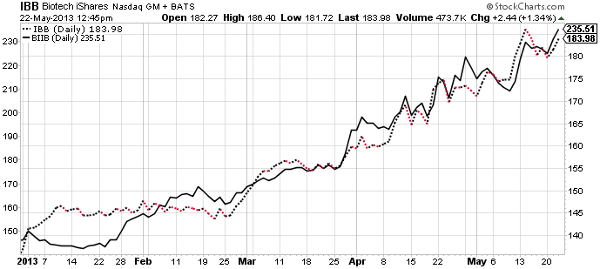
The iShares NASDAQ Biotechnology ETF (NASDAQ: IBB) is up about 35% for the year.

Biogen Idec (NASDAQ: BIIB) has a treatment for spinal muscular atrophy and multiple sclerosis in early trials. Its shares are up about 45% for the year.

ibb-biib-chart

The only problem is that shares are already trading at high values relative to current financial figures. Biogen Idec, for example, is trading around 25x profits.

There’s a better way to get in early on an explosive biotech play.

The Keystone

Drug trials are extremely expensive and lengthy. The average length of time for a trial program is eight years — practically an eternity to see if a speculative investment will truly pay off. And average trial costs to get a drug from the lab and into the market have risen over 60% to nearly $500-$800 million.

Why take a position in a company that has to spend that much over nearly a decade after a patent is approved?

Why not capitalize on the biotech revolution by investing in companies that sell the specialized chemicals that are critically essential to the trial process?

This brings us to the keystone: All the early research and patents are in place, but to push to greater heights, the perfect stone needs to be used to support continued upward growth.

Today I want to share with you one such keystone…

It’s called the keyhole limpet — a sea snail that lives in the shallow waters of the Eastern Pacific.

Medical companies around the globe heavily rely on a compound known as Keyhole Limpet Hemocyanin (KLH), a substance that naturally induces an immune response.

KLH is also an ideal carrier molecule for vaccine antigens (substances that promote the generation of immune responses) against cancers and infectious agents.

Hundreds of drugs rely on KLH in the trial process to get into the market.

But there are only 100,000 of these snails left in the wild. Once the KLH has been extracted from them, they die.

The scarcity and importance of KLH has driven the cost per gram to between $35,000 and $900,000 per gram, depending on the quality. The average drug needs 115 grams in total.

The protein is absurdly massive and is impossible to synthesize, even with the most advanced technology available.

That leaves one company with a distinct advantage: It has learned how to grow the limpets on land and extract the protein without killing them…  

And it has patented the process.

The company just positioned itself as the keystone to the future of the useful application of biotechnology. The KLH it produces will foster a medical revolution that cures several types of cancer, autoimmune disorders, congenital defects, and more.

Outsider Club‘s Nick Hodge recently returned from a visit to the California laboratory where this company has perfected this process… and next week, he will be releasing the video footage of his meeting with the company’s CEO and his tour of the facility.

You don’t want to miss this. Stay tuned.

Take Care,

adam english signature

Adam English for Outsider Club
Follow Adam on Twitter @AdamEnglishOC


test-php-789