
Bonds & Interest Rates
Japanese markets suffered an elevator shaft-like failure late last week, dropping 7.32% in the single largest decline since the horrific March 2011 earthquake and tsunami. Global markets followed suit but recovered.
This is the third-largest economy on the planet in the fastest-growing region in the world.
Ostensibly, a drop in Chinese PMI that fueled global slowdown fears was what the talking heads agreed was the reason.
They were wrong.
In reality, there were three other real factors.
And every investor needs to know what actually happened:
1) Benchmark 10-Year Japanese Government Bonds topped 1% for the first time in a year
As was the case with gold a few weeks back, this bond event pushed “value at risk” metrics or VaR beyond normal limits.
Typically Japanese traders could have simply purchased offsetting hedges like options or other derivatives, but their greed glands have been in consumption mode for so long that there was no additional cash to do so. They were, for lack of a better term, fully invested and fully margined.
Remember a while back when I told you that traders would sell equities if they had to bring VaR models in line? This is exactly what happened.
Having already sold substantial portions of their gold a little over a month ago, Japanese traders began selling equities as hard and fast as they could to compensate for six sigma volatility in Japanese government bonds. Again.
And, for the second time in weeks, traders effectively walked away from the bid — nobody wanted to buy. So prices that had begun to slide accelerated to end the day down a staggering 1,143.28 points, or 7.32%, as America slept.
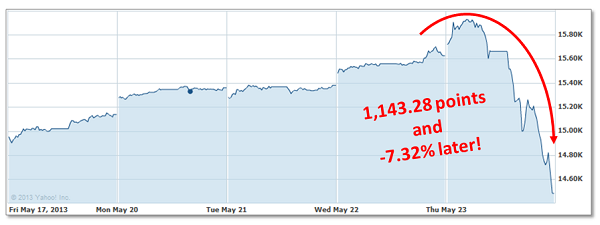
2) Japanese traders are the first to put together the implications of Bernanke’s comments
Bernanke made comments via written testimony to Congress May 22 from the Fed’s April 30 – May 1 meeting suggesting that the end of stimulus may not be far away.
What’s interesting to me about this is that very few people here in the United States lasered in on the meat of his recent observations – namely that when the Bank of Japan is finished with its stimulus, the BOJ’s balance sheet will be three times larger than the Fed’s balance sheet compared to GDP.
But Japanese traders sure did. I know, because I received several calls from panicked Japanese bond trading colleagues in the middle of the night wanting to know if they had interpreted Bernanke’s comments correctly from English to Japanese.
In practical terms, what the Bank of Japan is planning to do is like expanding the Fed’s ledgers to $12 trillion – expensive, fraught with risk and almost completely un-repayable except by default.
So they began taking profits in addition to burning off the risk premium needed to bring VaR in line. That all but guaranteed that momentum was firmly to the downside all day in Tokyo.
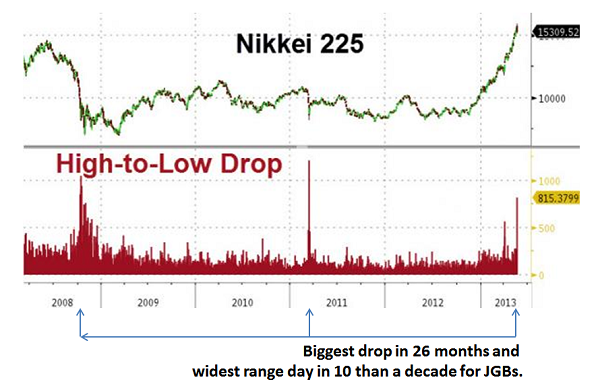
Figure : Zero Hedge/ Bloomberg / Annotations Fitz-Gerald Research
3) The Bank of Japan lost control over normally placid Japanese markets for the day.
The way I see it, this drop was Japan’s “Lehman Brothers” moment.
It’s the first time traders have really felt panic in a while and a sign that all is not well in any central bank-manipulated market, but especially in the big three markets of the United States, the EU, and Japan.
All it will take to induce a watershed moment is traders taking matters into their own hands. Absent additional liquidity, whatever central bank they target will lose control and the markets will adjust on their own, as completely as they need to.
What that actually looks like and when that happens, we don’t know. Nobody does. But the bet is this is more of a “when” question than an “if” question. The same derivatives traders that locked the PIIGS (Portugal,
Italy, Ireland, Greece and Spain) out of the barnyard in Europe have now set their sights on Japan. And Prime Minister Abe’s unlimited stimulus is simply more slop in the trough as far they’re concerned.
Japanese financial companies at the center of this tempest fell off the proverbial cliff. Consumer lenders were particularly hard hit as were major industrials. Shinsei Bank (8303), Mitsubishi Motor Corp (7211) and Tokyu Land Corp (8815) were among the biggest losers.
While they are still tallying the wreckage as I write this, some sources are suggesting that last Thursday’s fire sale may have just buzz cut 1.5%-2% of Tier 1 capital from the Japanese banking system. That’s bad.
Tier 1 capital, in case you are not familiar with the term, is what the bankers call “core equity capital,” meaning it’s the money that a bank has on hand to support all the risks it takes, including lending and trading.
The point: The banks Japan needs for its recovery just got weaker.
Now for the trillion-Yen question…what does this mean for your money?
- As long as traders perceive central bankers have room to maneuver and are willing to use the printing presses, the markets will have an upward bias. Don’t fight the Fed is now don’t fight the Feds – plural.
- Selling because others have panicked is never good. Sell because the underlying premise upon which you own a stock has changed or you’ve hit your trailing stop (which you hopefully have in place ahead of time as we continually encourage you to do)
- Stay in the game…just make sure it’s the right game. If you’re nimble you can probably trade Japan’s equity markets. But the far better alternative is to bet against the Yen using either currency or an ETF alternative like the ProShares UltraShort Yen Fund (NYSE: YCS). If there’s one thing that’s going to torpedo Japan eventually, it’s higher rates ahead and the currency will reflect that when it happens, regardless of why it happens.
At the end of the day, somebody is going to make a bundle on the volatility ahead…it might as well be you.
Related Articles and News:
- Money Morning:
Three “Abenomics-Proof” Investments - Money Morning:
Is Japan About to Fire the First Shots in a 1930s Style Currency War? - Money Morning:
Can Kuroda’s New Round of “Easy Money” Finally Revive Japan? - Money Morning:
Why Gold Really Crashed and What You Can Do About It


Saut: “We are currently involved in the longest buying stampede chronicled in my notes, and my notes run a little over 50 years. I first discovered ‘buying stampedes’ and coined that phrase back in the 1970s. They typically run 17 to 25 sessions, with only 1 to 3 session pauses or pullbacks before they keep going.
This one has lasted 102 sessions as of today….
…..read the other surprises Eric King extracts from Jefferey Saut HERE

 Must-Reads for Thursday, May 30
1. Wall Street Breakfast: Must-Know News by Wall Street Breakfast
2. U.S. Dollar Breakout: Gold To $1,250, Silver To $19 By Year End by Mike Williams
3. We’re Just At The Tip Of The Iceberg, Triple Net REITs Will Soon Be A Glacier Sector by Brad Thomas
4. Silver Wheaton: A Buy Even With Lower Realized Prices And A Billion Dollar Debt by Jeff Williams
5. How Much Is This Giant Tech Stock Really Worth? by Gillian Mauyen
6. Electric Utility Investors Should Worry More About Pricing Than Comparable Yields by Jon Parepoynt
7. 2 Potentially Explosive Small Cap Stocks For 2013 by Kelly Berman
8. The Frannie Gamble by Felix Salmon
9. Taiwan Semiconductor Tries To Pull A FinFAST One by Ashraf Eassa
10. Avanir Pharmaceuticals’ CEO Presents at 38th Annual dbAccess Health Care Conference (Transcript)
Most Popular
Fannie Mae And Freddie Mac: All Speculation, Little Value by Dividend Monkey
One Word Separates Apple From $500 by Dana Blankenhorn
BlackBerry Q10 Outsells iPhone 5 And Galaxy S4 In France by Jean-Christophe Larsimont
Real-time Market Update

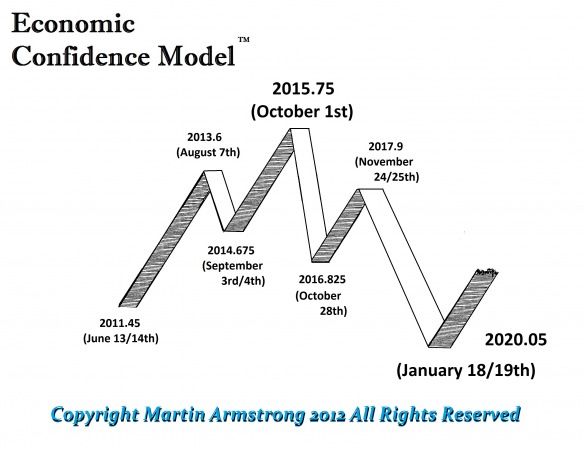
September is the German Elections. However, the first week of August is the turning point on the Economic Confidence Model that the computer is starting to pick up in many markets. Look for those that make lows at that time will rally generally thereafter. The market marking high at the time in August, may then turn down into October.
One Reader Writes: Yes Europe in their summer, for those that actually work(ed) in European institutions, the upper management — (parasites – say it the way it is), will take ALL of August off as vacation time (can you imagine 4 weeks!!!!!!!!!!!!!!…I mean WHO in the US gets the luxury of 4 weeks vacation???). AND as the saying goes “when the cats out the rats/mice play” So September might be too late MA.. August could be the fireworks month…
The Warns of Collapse are Coming from Inside Government Now
Posted on by Armstrong Economics
EU Energy Commissioner Günther Oettinger is part of a growing undertone within the European government that is finally getting real. He has warned that Europe is a one giant case destined for restructuring and that some countries in Europe have simply become ungovernable anymore. He has warned that Brussels does not have a clue what’s going on and still behaves as there is no crisis. They are living in a state of denial and the longer this continues the worse it will get. France is not prepared for what is coming and is way too far down the Marxist path with public spending ratio of 57% of GDP. The amount of government workers in France are double that of the EU average. There is just no hope as politicians stand in the way of saving Western Civilization.
Günther Oettinger’s recent remarks have been reported in the German newspaper:
http://www.welt.de/politik/ausland/article116606006/Oettinger-bezeichnet-die-EU-als-Sanierungsfall.html
Inside sources have been telling us that the bad-mouthing of especially myself is coming from both bureaucrats and bankers who realize that our proposal to stop borrowing and eliminate taxation to revive the economy and restore our liberty is against their self-interests. They are getting desperate to try to prevent anyone from looking at reform that goes against their self-interests. They would rather destroy society and try to be the richest men in the middle of a wasteland employed by a government that hunts down its citizens to feed the undeserved pensions of bureaucrats than consider what is best for everyone. The hatred hurled our way is amazing and it illustrates one thing – we hit the sweet-spot.
see: Cyprus Proposal
The Untouchables & Politics Come 2016
“I hope I am smart enough to buy more if Gold (& Silver) goes down low enough.”
interviewed on May 29th by the Economic Times arm of the Times of India, Rogers started out the interview by saying he thought the Gold price correction likely to continue, and that it may touch a new bottom.
“A correction in precious metals was long overdue, Gold was up 12 years in a row, which is extremely unusual for any asset. I don’t know about any asset in history which was moving up for 12 years without a declining year. So gold was overdue for a correction. Normally things correct 30-40% every year or two. So, the anomaly in gold was the price action for 12 years.
Now hopefully we are having a long overdue and necessary correction. It may take a bit longer for gold to make a new bottom or sound bottom, and then the bull market will continue.”
Rogers also comments on his positions in Oil, Natural Gas and World Wide Stock Markets in this interview which you can read in it’s entirety HERE


-
I know Mike is a very solid investor and respect his opinions very much. So if he says pay attention to this or that - I will.
~ Dale G.
-
I've started managing my own investments so view Michael's site as a one-stop shop from which to get information and perspectives.
~ Dave E.
-
Michael offers easy reading, honest, common sense information that anyone can use in a practical manner.
~ der_al.
-
A sane voice in a scrambled investment world.
~ Ed R.
Inside Edge Pro Contributors

Greg Weldon

Josef Schachter

Tyler Bollhorn

Ryan Irvine

Paul Beattie

Martin Straith

Patrick Ceresna

Mark Leibovit

James Thorne

Victor Adair