
Timing & trends
 The following is GoldMoney contributing author Felix Moreno’s interview with famed investor Jim Rogers. We hope you enjoy it.
Félix Moreno: Please tell us about your new book, Street Smarts. What was your motivation for writing it?
Jim Rogers: To my surprise people tell me it’s my best book. I never would have expected this reaction. I’ve written a few books about specific things, but my publisher said, “look, you’ve never sort of pulled it together: how did you get from the backwoods of Alabama to Singapore” – among a few things. I had a few setbacks along the way, and a couple of successes. So I sat down to put it all together in the book, how it all worked and everything seemed to be worth it. Some people seem to enjoy it, to my delight.
FM: I enjoyed it – I especially liked the story about your start at the Quantum Fund and your trading days, before retiring at 37. I also enjoyed your book Hot Commodities, in which you talk a lot about the current bull market in commodities. You set up your commodity index fund in 1999?
JR: It started on August 1 1998. The first bull year was 1999.
FM: You always say in your interviews that you are not a very good market timer, but I beg to differ. I’d like to turn to gold: you are one of the few gold bulls who had actually been calling for a correction in the past few months, or at least saying that we were in a correction and that, even though you were very optimistic in the long term, we should expect lower prices now. You must feel vindicated now.
JR: Every once in a while I get it right. Even I get it right sometimes. Vindicated? I don’t take any great pleasure in it. I just talk about the way the world works. It’s reality. Unfortunately some people don’t like to see how the world works, but yes, I did happen to get it right this time.
FM: So what is your opinion on the current state of the gold bull market. You’ve said repeatedly that you expect it to go much higher this decade. How do you see it right now?
JR: Unfortunately from my point of view, and I own gold and haven’t sold any, we are in a long overdue and much needed correction. The anomaly was that gold had been up 12 years in a row. That’s not normal, typical action. It’s abnormal, which worries me and should worry all the gold bulls. It has now corrected for some 18 to 20 months now. I find that encouraging. I mean, I don’t know, because I’m not a very good market timer, but I do know that most corrections go on long enough to scare a lot of people and scare them out of their positions, and that’s what I would expect to happen.
I’ve had people write to me and say: “gold cannot go down 30%”, and I say: “turn on your computer. It’s there.” There are a lot of mystics that are still true believers. Until it scares a lot of people the correction is not over. I would certainly like the correction to be over this afternoon and see gold go to $2,000 or to $3,000, but that’s not reality.
FM: You are one of the few well-known investors who actually says when he is buying or selling something. Most are scared of giving away their secret formula. What percentage of your portfolio is in precious metals?
JR: First of all I won’t say, but second of all I don’t know. I don’t have a committee that I have to answer to, so I don’t have a clue. I do know that I own a fair amount of precious metals, I’ve been buying them for years and I never sold them.
FM: Are you more invested in gold or in silver?
JR: Value wise more in gold, because gold sells for many multiples of the price of silver. But maybe I own more ounces of silver. But so what? Gold is so much more valuable.
FM: You write that you concentrate very much on fundamentals. However you lump gold in with other commodities in several of your books. Do you analyse gold as a commodity or do you look at it as money?
JR: Everybody has their own view. Mine is that gold is not money until you can go into a shop and get someone to accept it as money. Gold, certainly in recent decades, is nothing more than a commodity. Yes at times it has been money in the past, but so has silver, so have seashells, so have cattle. A lot of things have been used as money. Silver has been money more than gold historically, and throughout the world there is a lot more silver around.
FM: But you have to admit that gold isn’t easily valued as other commodities are. After all inventories of gold and the stock-flow ratio are very different from soybeans, rice or oil. The amount of gold that is mined or produced or recycled each year is very small compared to the stock of gold sitting in bank vaults and central bank vaults. So it’s hard to value gold using supply and demand, or at least annual supply and demand like with other commodities.
JR: If you mean annual supply and demand by the amount mined and the amount consumed, yes. The amount mined and consumed is very low compared to the overall inventory of gold. All the gold ever mined is still somewhere and that is going to continue for the foreseeable future. From that point of view I guess it is harder to value – to figure out the price of gold – rather than wheat for instance.
FM: I have to ask: have you heard of Bitcoin? Do you own any?
JR: I’ve heard of Bitcoin, I’ve never taken the time to figure out how it works and what it is. I know it’s there.
FM: You talk a lot about the future of China. You mention that China is the only one of the BRICs that you see having a very bright future. In fact you say that the acronym is off by only three letters. But why China? What makes it better than, say India?
JR: Have you ever been to India? If you can only visit one country you should go there. It is the most exceptional country in the world from a tourist point of view. But from the point of view of doing business, it’s the worst bureaucracy in the world, and the infrastructure’s a nightmare. It’s a very extraordinary place to visit – the languages; the man-made and natural marvels; the food; the religions; the languages. It’s extraordinary, but not as a place to do business unless you are in with the right people. If you are in with the government – the right part of the government – yeah, you’ll make a lot of money. But otherwise be very careful.
FM: Would you like to comment on property rights in Singapore? As you might know GoldMoney has recently opened a vault there, because it’s one of the countries that respects property rights and gold will be safer from confiscation and high taxes there.
JR: Well, I live in Singapore. Singapore does respect property rights and it’s an efficient and, from my point of view, terrific place to live. Who knows what’s going to happen over the next 50 years, but at the moment it is one of the sounder places to have assets. Whether the new gold vault here will work, I don’t know. But I do know that Singapore is a sound place to have assets.
FM: You don’t expect some populist politician suddenly sticking a huge tax on it?
JR: I would not expect that to happen on Singapore. I would expect it to happen in other places, maybe in the US.
FM: In your book you call the US “The largest debtor in the history of the world”.
JR: That’s not an indictment, that’s a fact. If you consider it a negative fact, it’s an indictment. It happens to be a fact that it is the largest debtor nation in the history of the world. The debt is going through the roof, you know with all the shady rates. I do criticise it. I don’t like it. I’m an American citizen. I’m an American taxpayer, so I hate what’s happening with the debt situation in America. No nation in history has gotten itself into this situation and got out without a crisis. So I guess it is an indictment.
FM: I Do you expect the US politicians to do something about the debt? To balance the budget any time soon?
JR: No, not at all. Not either the present politicians or future politicians. The situation is so dire that it would be almost impossible to balance the budget and pay down the debt without an enormous amount of pain. Now suppose that somebody could win an election on that platform – well within six months or a year or two, he would either be assassinated or give up because the people would say “wait a minute, we didn’t know it was this much pain. This is not what we had in mind” and he would be thrown out and his policies reversed. No it’s not going to happen until there’s a crisis or a semi crisis. That’s the lesson of history. Nobody gets out of this situation until there’s a crisis.
FM: What would you say to those that see the current situation as perfectly sustainable, especially in reference to the money printing, quantitative easing, etc.
JR: I would suggest that they get out a couple of simple history books and see if there has even been a way out. For what it’s worth, there has not been and there won’t be. I suggest that they look it up. They don’t have to listen to people like me, look it up.
FM: Do you think that Bernanke and the Fed have an exit plan from QE and zero-rates?
JR: Mr Bernanke’s exit plan apparently is that he is going to leave his job. He doesn’t want to stick around for the hangover. He doesn’t want to be around for the consequences of what he’s doing. I don’t know if there’s an exit plan. If and when they stop it’s going to cause lots of ramifications in the market and lots of, perhaps even chaos, but certainly turmoil and upset. The only exit plan that he’s talked about is to let it all mature. That sounds wonderful, but it’s not very practical.
FM: It seems that the whole “let’s get out before it crashes” worked well for Alan Greenspan.
JR: Well, Alan Greenspan did get out before it collapsed, more or less, but if nothing else, history has figured out that he is a charlatan who didn’t know what he was doing in the first place.
FM: So you don’t think that they have an exit plan. Does that mean that you are in the inflation camp? Do you think that the crisis is going to come from high inflation like in the ‘70s and ‘80s, or are you in the deflation camp? That it will come through bankruptcies, banking collapses and debt defaults?
JR: Throughout history when you print staggering amounts of money, it has always led to inflation. Now, you can have an inflationary boom, an inflationary feel-good period, but usually the politicians just keep printing. No politician is going to run on a platform, or could get elected on a platform of “we are going to have pain”, so they are going to continue to print money. You know as Mr Bernanke is doing, the BoJ, the Bank of England, the ECB. They all say the same thing. They are all doing the same thing. So they are going to continue to print money. Eventually of course what always happens is that inflation gets higher and higher and then the bubble pops and you have deflation and harder times. But between here and there is a long way, because they are not going to stop printing money. That’s all they know how to do. It’s the wrong thing, but it’s all they know to do.
FM: Capitalism without bankruptcy is like Christianity without hell and you give examples of banking crises where there were no bailouts. What is your opinion on the bailouts?
JR: It’s not supposed to work that way. You are not supposed to take money away from the competent people and give it to the incompetent so that the incompetent can compete with the competent people with their own money. That’s not the way capitalism is supposed to work. That’s not the way morality is supposed to work. I know politicians don’t care about morality. It’s not going to work. You see what happened in Japan. Japan has had two lost decades. Their stock market is down by 70-75% from where it was 23 years ago. This system has never worked.
In the 1920s America had this problem and America balanced the budget and raised interest rates. I repeat: balanced the budget and raised interest rates. They had a terrible 18 months, but then they had the most exciting economic decade in American history. Scandinavia did the same thing in the early ‘90s. When the Japanese were refusing to let people fail, the Scandinavians let people fail. They had a terrible two or three years, but since then Scandinavia has been an extremely strong and exciting part of the world.
This way (the bailout way) doesn’t work, and there are no examples of something like this having ever worked. It’s not going to work this time either.
FM: Some argue that a current example are the eastern European countries: Estonia, Lithuania, etc, who made big cuts within one year of the crisis and are now growing faster than the rest of Europe.
JR: There’s no question. You can look at other places: Iceland, Ireland – you know, the places that did take some pain have certainly done better than the places that denied reality.
FM: From the Spanish perspective, it’s certainly not better to have a lost decade or two by trying to postpone all the big budget-balancing hard work.
JR: You can postpone it all you want, but the problems just mount. There is no country in Europe that’s going to have lower debt this year than last year, or lower debt the next year than this year. Every one of them will run up the debt, instead of decreasing the debt.
FM: Do you expect the Euro to lose the currency wars? Which will fall down the cliff first? The yen, the euro or the dollar?
JR: It depends on what standard of measure you are talking about. The Japanese claim that they are going to print “unlimited” amounts of money. That’s their word, not mine. Unlimited amounts of money. I would expect the yen to go the furthest the fastest. But America has also said “wait guys, we’ll print a lot of money too” – though they didn’t say “unlimited”. And the British said “we should do it”.
So I don’t really know. It’s a very good question, which one to own. I don’t own the yen, because “unlimited” is a pretty hefty amount of money. I grapple with this every day, which currencies to own. Believe it or not I was even contemplating putting money into the ruble – only because it seemed less flawed at the moment than these others.
FM: You seem to have had a change of heart recently regarding Russia.
JR: In recent months I have seen that Mr Putin and people in the Kremlin have changed their attitude. It will take a while for all this to sink in. They said for many years that they welcomed foreigners and capital, but they were lying. They shot you, they put you in jail, and they confiscated your wealth. But now Mr Putin seems to understand that he has to play by international rules, he cannot go on putting people in jail and taking their money. If he wants to play on the world stage he has to treat international capital, and domestic capital, in a proper way. You can ask me in 10 years if I got it right or not.
FM: The Russians are more friendly to depositors than the Cypriots – and perhaps many other jurisdictions as well.
JR: Well, what happened in Cyprus as you know is that most of the big depositors were foreigners. It’s always easy to take advantage of the foreigners. 125 years ago America threw the foreigners right, left and centre. Nearly all developing countries find a way to take advantage of foreigners. It’s not a particularly good comment on world society. Cyprus voters did lose money, but nothing like to the extent of the foreign folk.
FM: On the other hand there are a few countries that do welcome foreign money like Singapore or Hong Kong.
JR: It might just be an anomaly of history. We can look back in eight years and see if Singapore and Hong Kong are still welcoming. I suspect they might do, but unfortunately throughout history there have been countries that welcome money, but then they get fat and lazy and they become anti-foreigner and confiscate their money. I don’t think you can find any country in history that has consistently welcomed foreigner’s money for centuries. Yes, for a century or two or even three maybe. But nobody has a history of always welcoming foreign money.
FM: But it gives hope to see that Hong Kong and Singapore changed China. Perhaps another “lighthouse city”, another good example could change Europe, Latin America…
JR: As long as my lifetime and my kid’s lifetime – I guess that would be more than most people can expect.
FM: You have become very favourable towards competing currencies as a solution to the crisis of fiat money.
JR: That’s the only solution that has ever worked long term. Nothing has worked a long time – including gold, silver, seashells, cattle. Nothing has worked long term except that you choose your money.
FM: You write about how you opened a Swiss bank account in the ‘70s. Could you do so today?
JR: It’s getting more and more difficult for foreigners – for Americans I should say – to open bank accounts anywhere in the world, because of the problems with the US government. I’ve had places where I’ve had accounts for years who have called me to say “look we love you, but we have to get rid of all American accounts”. It probably is possible to open a Swiss bank account, but I don’t know, I haven’t had to do it in a long time. I still have my Swiss bank accounts, which are all reported by the way, but it is becoming a problem for Americans.
FM: FATCA and the growing amount of regulation is one reason why so many are looking to Bitcoin and cryptocurrencies in general.
JR: Yes, it’s becoming a huge problem for Americans, honest Americans at least.
FM: What would you tell American leaders and politicians?
JR: Resign.
FM: The same thing to Ben Bernanke?
JR: No, Bernanke I would tell him to close the Federal Reserve and then resign.
FM: So you wouldn’t want, for example, Jim Grant as Fed chairman?
JR: I know Jim and I like him, but he has some ideas I don’t think would work. He’s a wonderful goldbug and has been for many years and is convinced that the gold standard would solve America’s problems. You know, the gold standard didn’t work either in the long term. They found ways to get around it. Or they just abolished it. The gold standard has its own problems too. The only way to survive is to let people decide for themselves what they want to use as money. Someone can use gold, or we find enough people who want to use seashells, or whatever.
FM: So competing currencies and may the best money win?
JR: It’s the only solution that has worked throughout history. Every government imposed, every dictated from of money has always failed. Including the gold standard.
FM: Yes, although the gold standard does have a record of lasting hundreds of years on several occasions. But I agree, nothing lasts forever and it’s better to have something that can evolve, not imposed from the top down.
JR: I’m not sure I know a case where the gold standard has lasted hundreds of years, but if you say so, yes. Gold has certainly had recurring uses. Not necessarily the gold standard, but gold itself has had recurring uses many times in history. But as I said before, silver has been used more historically than gold around the world, and so have other things.
FM: In fact China has used silver for a very long time. A lot of Spanish silver dollars ended up in China when they were kicked out of the US.
JR: Yes the Chinese have a longer history of silver than they do of gold, but again, many places do. Jesus was sold for 30 pieces of silver, not 30 pieces of gold. Silver was the predominant currency back in those days, in that part of the world.
FM: China has also had a long history with paper money. If there’s one constant in the history of money it’s that paper money never seems to last more than 40 or 50 years before blowing up.
JR: Paper money doesn’t have a very glorious history, but again, nothing imposed by the government has a very long and glorious history.
FM: On that positive note, and hoping for many good things to come in this new century, I’d like to thank you for talking to GoldMoney, and hope that you will be back soon.
JR: I’m delighted. Thank you very much. Let’s do it again.
GoldMoney – The best way to buy gold online.

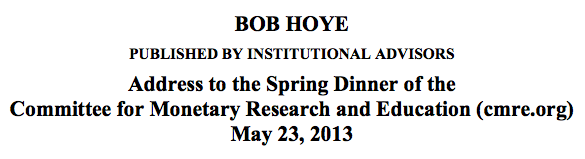 There are any number of names that can be used to describe the Administration’s policies. However, in this polite assembly it is best to stay with what is printable and ask the question about which description fits best?
It is hard to avoid terms that have become derogatory epithets. Liberal is one, progressive-Democrat is another. And then there is communist, socialist, fascist and corporatist to list only a few. But all describe current U.S. policy.
Academics intensely debate the differences between Lenin and Trotsky. But it is more practical to review the similarities. Actually coercive political movements and their promotional labels are all the same in the quest for power. What’s more, the quest repeats in an all-too-real nightmare of Groundhog Day. Although burdened with nonsense about Obama ending the rise of oceans, in the West we remain thankful that the old and recurring political experiment in big government has avoided state murder.
So far it has just been the assassination of constitutional norms. And with remarkable irony, those that protest the assault and defend the traditions of freedom are called Nazis. This shows more passion than commonsense and suggests that all of the experiments of bullying political movements need a universal description.
The General Theory of Authoritarianism elegantly defines the experiment as “That which is not compulsory, is prohibited.” Of course, the corollary is “That which is not prohibited is compulsory.”
This can be applied to Marx, Lenin, Mao and Keynes. The latter’s The General Theory of Employment has assisted all manner of authoritarians in the West to finance the greatest experiment in intrusive government since the 1600s. Keynes’ own preface to the 1936 German version of his theories boasted that his recipes would work best in “conditions of the totalitarian state.” They have assisted such ambition.
Sadly, Keynes’ notion that an economy can be managed to avoid the nasty times that attend the business cycle was just a personal revelation, and not new. Keynes was lucid until the 1929 crash when he took a hit and discovered the liquidity preference. Edward Misselden had a similar revelation during the Crash of 1618. The revelation was also personally discovered by John Law in the turbulent early 1700s and by Walter Bagehot just at the start of the Great Depression that followed the 1873 Bubble. The essential recipe has been that throwing credit at credit contraction will make it go away.
The purpose of this address is to review the laws of the General Theory of Authoritarianism as derived from two previous examples. The distinction is that what follows is based upon how financial history actually works, rather than upon how it “ought” to work. The two previous examples of the senior economy going authoritarian brewed up in the Third Century and in the Sixteenth Century.
But, before expanding this, there are a couple of instructive ironies.
In the early 1600s the civic administration in Malines in Belgium made the cultivation and consumption of potatoes illegal.
Why? Because potatoes caused leprosy. Was this an example of Post-Medieval superstition or just plain stupidity?
There was more to it than either. It was bureaucratic absurdity as a great experiment in big government went out of control. Potatoes were new and it has always been easier for control freaks to deny the new than to change long-standing traditions.
On the last serious famine in Africa, America was quick to provide basic foods. Almost immediately, political activists protested such aid, as it could include grains genetically modified by evil corporations.
Why? Because genetically modified foods would impair the health of the starving. Is this an example of Post-Modern superstition or just plain stupidity?
Actually, it is all of the above and then some. Bureaucratic intrusion has always used superstition and slogans. As Rome was corrupted from a republic to a brutal police state ambitious leaders celebrated the “Genius of the Emperor”. On our experiment in big government, the politically ambitious have promoted the “Genius of the Federal Reserve”.
Mao used his Little Red Book to inspire the “Great Leap Forward”.
Today’s authoritarians have been equivalently ambitious in crafting a Big Red Book of “political correctness” which provides an endless list of issues on the way to perfect a progressive society.
Will they continue to dominate?
Not likely, as today’s frenetic policymaking is another example of ending action. The establishment claims the Republicans are finished, but a veteran trader would say that they have become very oversold as the Democrats have been the focus of a buying mania.
Some of the Main Stream Media are recovering their ability to criticize. Besides that, cheerleading a losing team is so yesterday.
Last week, even the Washington Post wrote that Obama is failing in his attempt to prove that “activist government could also be smart government”.
How important is this?
Beyond losing some of its support from ardent Main Stream Media, something much bigger has been going on. Essentially, the last Great Reformation was propelled by a printing industry that was independent of the authoritarians. This time around, the internet, talk radio and talk TV are definitely independent of the control freaks. Government institutions will be reformed.
The motivation for bureaucratic greed has been great wealth and prosperity. Other people’s.
Rome had accumulated enormous wealth through conquest and tribute. Even enhanced by massive depreciation, the ability to fund unlimited government eventually became impossible. Plagued by decades of predation, what was left of the productive sector departed to Northern Italy. Seeking sustenance, the bureaucracy moved to Istanbul which is still an important commercial center. Rome was not located at a natural trading point and from a population of some 1 million it collapsed in a few hundred years to only 80,000. Trying to support some 400,000 on welfare in a city of one million was uneconomic.
The next accumulation of enough wealth to provoke another such experiment started in the early 1500s. It was inspired by the unprecedented windfall of gold and silver from the New World. Spain was the dominant power and its administration went out of control. The massive flow of real money was not enough to satisfy the demands of unlimited government, which borrowed endless amounts and “printed” endless amounts of money. Spain defaulted at least three times on its way to becoming a lesser power.
Ambitious bureaucracy needed even a bigger organization than those of one or two countries and eventually corrupted the Catholic Church. The Protestant Reformation involved religion but the main theme was productive individuals and families reforming in-your-face government. Political power devolved from central authority to regions as well as to the individual.
The next accumulation of wealth was not based upon conquest or windfall treasure, but upon productive work in an essentially free-market economy. Despite the testimony of millions of economic text books, the enormous rise in prosperity had nothing to do with the “Genius of the Federal Reserve”. It had everything to do with private initiative introducing science and technology to producers and consumers.
Sadly, unprecedented increases in the overall standard of living have earned the hostility of authoritarians. Envy and greed have again driven confiscatory taxation and as that has always been inadequate to the demands of unlimited government. Naturally, to satisfy its ambition the state turns to currency depreciation.
The inquiring mind may wonder how long demented central bankers can go before they turn towards responsibility?
Yes we can all wonder, but it won’t be voluntary. Political and market changes will force all agencies of big government into accountability. Chagrin can provide forceful instruction and this is getting close.
Culmination of the two earlier examples of inflation and bullying politics could provide the “ending action” model. After a hundred and fifty years of relatively stable prices to 1500, purchasing power eroded from 682 to 100 in the early 1600s. Prices went up by a factor of seven.
Since the Fed opened its doors in January 1914, purchasing power has plunged from 100 to 4.3. Prices have soared by a factor of twenty plus and, yet on May 2nd, Paul Krugman, the socialist running-dog, said that there is “Not enough inflation”.
Some may be thinking that we are in a political trap as described by Orwell or Rand. This suggests it will not end.
Tocqueville had a good handle on today’s governing classes and their supporters distressing the producing classes.
“Society was cut in two: those who had nothing united in envy; those who had anything united in common terror.”
This also suggests bullying without end.
This would have been the grave concerns of the productive classes on two previous examples, but after a hundred years of barely enduring the financial assault the public suddenly became more critical. Then government did something incredibly and acutely stupid.
Diocletian was a well-organized dictator and was reckless with his depreciation and became very concerned about rampant price inflation. He did not have economists to lay the blame on the public with “inflation expectations”. Stupid Policy # 1 was severe depreciation. Stupid # 2 was price and wage controls imposed in 301 AD. Stupid # 3 was backing up price and wage controls with the sword.
There were numbers of approved religions and cults. They did not criticize big government. Only one was indifferent and it was banned and persecuted.
The Edict on Prices was effective in rapidly collapsing the economy so as a diversion it was followed by the Edict against Christians, otherwise known as the “Great Persecution”.
Perhaps concerned about the injustice and sensing the collapse of bureaucratic edicts, Constantine moved in 306 to legalize Christianity and to return confiscated property.
The frenzy of radical policymaking came to a shuddering halt.
For much of this time the term barbarian meant stranger or Christian and mainly meant class distinction. Somewhat similar to the way that today’s establishment looks down on non-liberals. Many ordinary Romans began to admire those from the Northern Provinces as “innovative” and thrifty. Also admired were Northern fashions of long trousers and blonde hair. These were upsetting to the establishment and were banned. The dictates of fashion prevailed.
The contrasts then would be similar to the governing classes in Washington DC and to those of the typical Texan today. If you can appreciate this you can understand the collapse of the Roman bureaucracy.
The next great experiment in authoritarian political correctness began its end in the early 1600s and evolved more clearly in England than in Europe.
A distinctly grand, but stupid policy erupted in England in the early 1600s. A decade of boom times, rising prices and prosperity was followed by a recession and rising unemployment. The folly includes three key players: King James, Alderman Cockayne and the Archbishop, who recorded the meetings.
The perceived problem and opportunity was that British exports of cloth were finished in the Netherlands, which was the commercial centre. The alderman persuaded the king that England deserved the “value-added” and persuaded him to duplicate facilities already existing in Europe.
Unfortunately the weak economy and unemployment continued and in 1618 the king became concerned. Particularly as successful merchants were calling the scheme as “a Sepulcher – attractive without, Dead bones within”.
Then in November of that fateful year, which was seasonally appropriate for financial calamity, credit markets crashed. The archbishop recorded that the king told the alderman “in could bloude before ye Council Table that if he had abused him by wrong information his 4 quarters would pay for it.” As this meant “hanged, drawn and quartered”, the archbishop continued with “Ye poore Alderman stood infinitely amazed”.
A pamphleteer by the name of Chamberlain observed that it was strange that the “wisdom of the state could be induced [to rely upon] the vaine promises of ydle braines”.
Well, be that as it may, but outside of this assembly there are too many idle brains employed by today’s exceptionally intrusive government. Saul Alynsky, wherever he is, will be looking up and nodding his approval.
Now there is a saying from the old and dreadful Vancouver Stock Exchange that applies to today’s weird world.
“So long as the stock is going up, the public will believe the most preposterous of stories.”
And then when it goes down belief vaporizes and is replaced by chagrin and eventually condemnation of the promoters.
The next credit crisis will demonstrate that all of the “stimulus” was a futile waste of taxpayer money. Let’s call it Stupid Policy # 1, and it will be recognized as such.
How much has financial history been changed by the massive “stimulation”?
The discovery of problems at Bear Stearns in June 2007 stimulated, well, a massive stimulation that did not prevent the worst financial disaster since 1929. The Crash was a classic and the consequent severe recession and weak business recovery are characteristic of a lengthy post-bubble contraction.
Remember that in 2007 the establishment boasted that “nothing could go wrong”. The Fed had the dream team of economists but the establishment did not anticipate the worst Crash since 1929.
At four years this recovery is showing signs of maturity and as it rolls over, the public will realize that interventionist remedies have not worked.
The recognition of Stupid # 2 involves the promotion of man-caused global warming. This has been underway for some 15 years as the amount of atmospheric CO2 continues to increase but global temperatures have not. The supreme blunder has been that the promoters have argued that global warming has been due to only one influence and nothing else.
Ironically, the “nothing else” is what really drives climate that has been the sun. Since the mid-1990s some solar physicists have been calling for diminishing output from the sun. The recent solar minimum has been the deepest since 1913 and the current up cycle has been the weakest in over a hundred years. North America has clocked the second coolest spring on data back to the late 1800s. Northern Europe and England recorded the coolest winter and spring in decades.
The establishment did not anticipate the turn to a quieter sun.
However, some government agencies have been forced to admit that warming isn’t what it was hyped to be.
By way of summary, the worst of times for the individual have been the best of times for statists. But I’m very optimistic that this sordid social contract is about to fall apart.
In the Western World, independent opinion has been ridiculed to the greatest degree since the early 1600s. Regrettably, nineteenth-century liberalism has become a state religion and once again bureaucrats have become dedicated to “That which is not compulsory is prohibited”.
In the Western World, for the first time since the early 1600s independent scientific inquiry has been condemned by the arbitrary dictates of a state religion. Man-caused global warming is the modern equivalent of the Vatican insisting that the solar system rotates around the Earth. While glaringly erroneous in real time, the ambition was to control thought not the climate. The Church’s interest in the economy made no attempts to control it. But was mainly focused upon “fairness”, “usury” and venally finding ways to confiscate private savings.
Today’s ambition by control freaks shows audacity away beyond precedent. Communists limited themselves to merely making the perfect man. Now political leaders demand not just a managed economy but also a managed climate.
Mother Nature has been doing something else about the climate and the trading floor cynic observes that politics and financial markets have both been corrupted. Mister Margin knows that brokerage accounts are leveraged at levels not seen since 2007 and that the bubble in lower-grade bonds is unprecedented.
At the climax of any speculative fury, the power shifts from the Fed to the margin clerks – every time. Each has a vastly different job description. The Fed’s task has been to get the accounts leveraged. Mister Margin’s job is to get the accounts in line.
On the political side, America has an outstanding record of self-governance and is not ungovernable, now. It is the frenetic Administration that has become ungovernable.
I trust that everyone in this assembly is prepared to enjoy a fabulous change in politics and in the markets. In so many words, the veteran trader is calling for a lengthy bear market for authoritarian ritual, and a new bull market for commonsense.
Evidence is piling up, and it points to big changes in markets around the globe. I suggest you read this very carefully. You need to know about the latest developments.
Three weeks ago I told you about the May 10 Tweet from legendary bond trader Bill Gross. He said “the secular 30-yr bull market in bonds likely ended 4/29/13.” Our team here at Weiss Research made the same prediction months earlier, but it was still significant that Gross said this publicly. His huge PIMCO funds are a major player in Treasury, corporate and other bond markets, so people pay attention whenever Gross speaks.
On Wednesday of this week, Gross spoke again. In a CNBC interview — with no need to stay within Twitter’s 140-character limit — Gross went further. He predicts a new relationship between stocks and bonds.
Let’s stop here for a second. Stockbrokers and investment advisers typically recommend a “balanced” strategy. Keep part of your money in stocks and the rest in bonds. Over time the stocks should outperform, but you still need bonds. Why? Bonds tend to do well when stocks are in a bear market. They’re useful as a cushion, reducing your overall portfolio volatility.
Think of it this way: Stocks and bonds are a playground see-saw. When one side goes down, the other goes up. Stocks and bonds have a similar pattern. (In investment lingo it’s called “negative correlation.”) When your stocks are doing well, the bonds probably don’t look very exciting. But when the stock market crashes, the bonds are likely to outperform. So the experts recommend holding both, and reducing the stock allocation as you enter your retirement years.
Historically, this approach worked well for many years. Everyone from trillion-dollar pension funds to middle-class IRA holders depend on it. If this is your plan, I’m not suggesting you abandon it, and I don’t think Bill Gross would, either.
But yesterday he hinted the “balance” is changing.
***
Gross now thinks the correlation between stocks and bonds is changing from negative to positive. In other words, they will be much more likely to move up and down together. Here is how he described it to CNBC viewers:
“If bond prices go down, stock prices should go down as well. That’s simply because the global levered trade is dependent upon a stable Japanese yen and a stable (Japanese government bond) yield and a stable Treasury yield.
“Once you produce instability, then that leverage starts to unwind, the housing market gets affected, and stocks come down.”
Whew! This quote has a lot to unpack, but zero in on the second sentence. He says global trade depends on three factors:
- Stable Japanese yen
- Stable JGB yield
- Stable (U.S.) Treasury yield
Now look at the markets the last few weeks. The yen is anything but stable. JGBs are under serious pressure, with much-higher yields looking very likely. And now U.S. Treasury yields are breaking out to levels we haven’t seen in over a year.
Add those three together, and according to Gross we should expect instability, de-leveraging and problems in both housing and stocks. Wow!
“But wait,” you may say. “Ben Bernanke and the Fed have their hands on the wheel. They’ll keep us on track, won’t they?”
No, they won’t. Gross says Bernanke can’t control the economy and never has. Here is another quote.
“I think Bernanke has a lost a little control in terms of the real economy. As a matter of a fact he never had it. And to the extent that low interest rates reduce savings and therefore reduce consumption, to the extent that they reduce the return on investment for corporations, to the extent that they destroy business models and then technically jam up the repo market, you’ve sort of lost control of economic growth going forward.”
Cutting through the jargon, Gross says Bernanke didn’t have much control in the first place, and is losing whatever influence he may have had on the economy.
Once a central bank cuts interest rates to zero, it has no more bullets. The Bank of Japan found out the hard way when 20+ years of forced liquidity resulted in almost zero growth.
What does this mean for investors like you and me? Two conclusions:
First, if your investment strategy depends on bonds remaining stable as the stock market falls, you may want to consider alternatives.
Second, we have to watch the markets closer than ever. The global changes Gross talks about may unfold slowly for months, or the world could change in a matter of weeks.
I know this is a lot to think about, but it’s very important. Here are some other stories the Uncommon Wisdomteam is following.
***fffffffffffffffffffffffffffffffffffffffffffffffffffffffffffffffffffffffffffffffffffffffffffffffffffffffffffffffffffffffffffffffffffffffffffffffffffffffffffffffffffffffffffffffffffffffffffffffffffffffffffffffffffffffffffffffffffffffffffffffffffffffffffffffffffffffffffffffffffffffffffffffffffffffffffffffffffffffffffffffffffffffffffffffffffffffffffffffffffffffffffffffffffffffffffffffffffffffffffffffffffffffffffffffffffffffffffffffffffffffffffffffffffffffff
In Other Market News:
- U.S. stocks rallied today on some good economic news. A revised estimate for U.S. economic growth in the first quarter came in at 2.4%, a bit weaker than expected. Traders think this may influence the Fed to keep the faucet open.
- The Securities and Exchange Commission hit the Nasdaq stock market with a $10 million fine for last year’s botched Facebook (FB) public offering. The exchange’s systems failed when the highly-anticipated FB shares hit the market. (Speaking of Facebook, have you liked our Uncommon Wisdom fan page yet?)
- Agribusiness giant Monsanto (MON) has egg on its face after a wheat species that was genetically modified to resist normal pesticides was found on an Oregon farm. The seeds were never supposed to leave the lab. Now the entire U.S. wheat harvest is under suspicion.
- Many of our main export customers won’t buy genetically modified crops. Already the European Union said it would test wheat imports from the U.S. and Japan canceled a tender offer for white wheat. Monsanto shares finished the day slightly lower on the news.
I’m watching all these stories closely — and keeping watch for any more Bill Gross comments. Look for more news and analysis for you tomorrow.
Have a great evening!
Good Luck and Happy Investing.
Brad Hoppman
Publisher
Uncommon Wisdom Daily
 It’s been said in investing, you can “insist on being RIGHT, or you can focus on making money.” It’s “gut-check time” yet again in the Precious Metals markets. And yes, I mean that quite literally.
Here’s the current context: Silver appears to be on the rise again after very recently testing its mid-April fall to $22ish (ignoring its mini-flash crash last week). Gold appears to be bouncing off a slightly higher low last week versus its mid-April low of $1325.
The big question on many people’s minds is how high can the PM’s run in the face of their own chart patterns, and perhaps more importantly the context of other risk-asset markets?
Following all the research and analysis I’ve down over the past few weeks, my personal opinion is that there is a little more upside in each of the PM’s over the next five to eight trading days, but that we are definitely NOT out of the woods yet. Two of my most reliable sources (Martin Armstrong and Charles Nenner) are being very clear that much more downside risk should show itself in the next two weeks or so.
That being the case, our recently purchased and SMALL PM-related positions have either been harvested, or have very tight stops under them. That’s just the nature of our investment style.
Of course, only time will tell if we have already made a meaningful bottom to rise from, or if there is still more downside left. Will they (and by extension will “I”) be right, or will we move higher from last week’s lows?
While most people are focused on the question noted above, this is a really great opportunity to re-assess your own appetite for risk and any biases that may be clouding your judgement. And the “elephant in the room” question is “Is your own ego getting in the way?”
Here are some questions for you to ponder:
- Is it more painful for you to a) admit you were wrong by selling at a loss, or b) for you to continue to lose money because you refuse to admit you were wrong?
- In the face of hard evidence (i.e. “Price”) that directly contradicts an investment thesis that you’ve fully committed to (by buying and then holding), do you tend to make excuses (e.g. “it’s manipulation!”) and/or change your intended time horizon for that particular position in order to avoid having to admit that your thesis is incorrect?
- Do you find yourself doing even more research to find additional sources that agree with your position so that your intellect (read: ego) gets soothed, thereby further entrenching your resolve to hold your current position?
- When you are faced with these types of financially and emotionally painful situations, do you do what most people do – go back into your head and try to re-gain perceived control over the situation via additional analysis?
The headline to this article makes reference to “gut-check time” specifically because we humans are so incredibly adept at being able to fool ourselves into believing the stories that constantly run through our heads. Unfortunately, developing complex intellectual narratives to explain – to ourselves and others – how and why we are “right” does NOT change the objective reality of PRICE patterns. This kind of stubbornness is yet another manifestation of the unhealthy parts of our personality, i.e. our ego.
So why do I refer literally to a “gut-check?” Our brains can fool us, but our bodies cannot lie. Here’s an extreme example: if you’ve ever had a near-death experience (e.g. in high-speed traffic), you can probably remember the physical sensations generated by your body in response to your fear. This is the electro-chemical reactions generated by your own hormones, in response to external sensory awareness (e.g. you saw a large oncoming truck veering into your lane). It’s an extreme example, but one which demonstrates beyond question how genuinely tuned-in our own body is with reality.
The risk of embarrassment from being wrong and/or experiencing financial loss generates similar – albeit less extreme – sensations, and these often manifest themselves – from just below the rib-cage in our solar-plexus and down as low as our naval…quite literally in our gut area. That knot in your gut is RARELY wrong.
Learning to pay attention to and actually trusting our own physical response to investment decision-making situations – and not relying solely on our “brain power” – is an important part of increasing self-awareness. It’s really learning to value and trust your own intuition, and that’s a pre-requisite to making more frequent profitable investment decisions.
This is all part of being much more mindful in everything we do…not just in investing.
Patience and Discipline are accretive to your wealth, health and happiness.
Cheers,
Andrew H. Ruhland, CFP, CIM
President, Integrated Wealth Management in Calgary and Portfolio Strategist with ETF Capital Management



-
I know Mike is a very solid investor and respect his opinions very much. So if he says pay attention to this or that - I will.
~ Dale G.
-
I've started managing my own investments so view Michael's site as a one-stop shop from which to get information and perspectives.
~ Dave E.
-
Michael offers easy reading, honest, common sense information that anyone can use in a practical manner.
~ der_al.
-
A sane voice in a scrambled investment world.
~ Ed R.
Inside Edge Pro Contributors

Greg Weldon

Josef Schachter

Tyler Bollhorn

Ryan Irvine

Paul Beattie

Martin Straith

Patrick Ceresna

Mark Leibovit

James Thorne

Victor Adair