
Gold & Precious Metals
I hope you saw this week’s amazing interview on gold that Larry gave to former British MP John Browne.
But if you didn’t — or you’d like to review the highlights — here’s an abridged transcript …
GOLD: Four Secret Signals
How to Know When It’s Time to Buy or Sell
John Browne: Hello and welcome to Money and Markets TV! My name is John Browne, former member of British Parliament and its Treasury Select Committee.
In this video, we’re going to take a close look at how a top analyst identifies the major tops and bottoms in the gold market, and my guest today is the ONE man I can honestly say has absolutely nailed just about every major turn in the gold market over the past 12 years.
His name is Larry Edelson, and when it comes to gold and commodity investments, he has the kind of credentials that other analysts can only dream about. In the mid-1980s, he was one of the world’s largest gold traders, handling an average of more than $1.9 billion worth of gold in today’s money, every single day. As a result, Forbes, Bloomberg, CBS Marketwatch, CNBC and many other major financial programs and publications often turn to him for his analysis of the gold markets.
In his 35 years in finance, Larry has managed several investment funds and founded his own brokerage and money management firm with offices in New York, Hamburg, Dusseldorf, Vienna, and Osaka, Japan.
Our mission today is to show viewers how they can identify major tops and bottoms in gold, by showing them how you have done it since 2000. In 2000, with gold at $260 per ounce, you became one of the first analysts in the world — perhaps even THE first — to urge investors to buy gold. Larry, what did you see that nobody else did?
 Larry Edelson: Gold had fallen for 20 years. Its decline was so persistent that most analysts were expecting gold to fall to below $100 an ounce. So the negativity was huge.
John: So your first clue was that gold was an obvious contrarian play at the time.
Larry: Exactly. Plus, at the same time, the bullishness in the stock market back then was also off the charts.
John: Are these kinds of extremes in investor sentiment easy to spot?
Larry: If you can keep an open mind, yes. But most people tend to get caught up in the emotions of the times, and that can cloud their vision.
So I’ve developed a proprietary system that helps me identify and quantify extremes in sentiment, and to do so on a daily trading basis, a monthly basis, a quarterly basis, and even an annual basis. That way, there’s no guessing involved.
So these were my first signals — extreme pessimism in gold and extreme optimism in stocks. When you get those kinds of extremes, it almost always signals an imminent turn.
Second, my study on gold’s long-term trading cycles told me a bottom was due.
Third, back in 2000, volume was drying up near the $260 level in gold, which told me the turn was here.
Fourth, it was also clear that the U.S. dollar had entered a long-term bear market. So that made buying and holding gold all that much easier.
John: In hindsight, it’s clear that you were right about the dollar. In fact, over the following 11-years, the dollar lost 43 percent of its purchasing power.
Larry: Yes, and the final confirmation of a bottom came when gold failed to fall below its critical support levels for the entire year of 2000. That’s when I concluded we were within inches of the bottom.
John: That was the bottom. Now let’s fast forward to September 2011. That was a time when nearly everybody else was saying gold was headed to thousands of dollars an ounce, but you warned that a major correction was just ahead.
In fact, in a widely published bulletin dated September 18 — just 12 days after gold’s record high at $1,920 — you announced that you had turned bearish and urged your readers to HEDGE their gold positions. Once again, you saw something that others didn’t. What was it?
Larry: I saw the exact opposite of the signals that had told me gold was set to soar in 2000.
First, it was a contrarian play. Nearly everybody else was bullish on gold at the time — extreme optimism on gold. That told me that there was a good chance that everyone who was going to buy was already in the market. My computer confirmed it. A big correction was likely.
Second, my study of cycles told me that after 11 years of rising gold prices, a decline was inevitable, and that it would likely last two years.
Third, at the $1,920 high in September 2011, volume and open interest in the futures markets were contracting, the exact opposite of what was happening at the bottom back in 2000, also indicating the top was at hand.
And finally, it was clear that troubles in the euro zone were creating a strong new source of demand for U.S. dollars, likely to drive the value of the dollar higher against the euro, a major negative for gold at that time.
So in my September 2011 issue of the Real Wealth Report, I told my subscribers to hedge up with inverse ETFs.
John: Again the major indicators that warned you of the correction were (1) sentiment, (2) cycles, (3) trading volume, and (4) the U.S. dollar. And sure enough, gold subsequently plunged a couple of hundred dollars.
Larry: Yes. But gold’s decline was just getting started. So I instructed my readers to add MORE hedges in October and December 2011. Plus, in December — immediately after the mining sector peaked — I recommended that my readers sell ALL of their mining shares.
John: Since you issued your now-famous warning on gold, the yellow metal has fallen as low as $1,310 — a 31.7 percent decline.
Larry: And the average mining share has fallen even farther, declining a whopping 61 percent.
John: So relying primarily on these same four major indicators, you have remained bearish on gold since its record high, repeatedly warning your readers that it still had farther to fall.
Larry: Yes, I have.
John: In recent months, though, most other analysts have been saying that the trillions of dollars being printed by the Fed — PLUS massive money-printing by the Bank of Japan and the European Central Bank — would instantaneously push gold prices through the roof. Yet, you’ve continued to tell your readers that the correction would not end anytime soon.
Larry: Right. And believe me, lots of people really hated me for that forecast. Many gold bulls were out to have my head. Others said I must have lost my mind.
John: So how and why did you stay bearish?
Larry: Simply because I didn’t see any major reversals in the four major signals that caused me to forecast a correction in the first place. I’m not always right — but the markets are. They are never wrong. When they don’t respond to what should be extremely bullish developments or forces, it’s clear that the character of the market has changed.
John: So let me ask you the question that I get asked most often today: When is Larry Edelson going to turn bullish on gold again? When are you going to issue your long-awaited “BUY” signal?
Larry: I can’t tell you until the market tells me. I can tell you, however, that we’re getting very close. As I said before, gold’s two-year correction ends this year.
John: That leaves two remaining questions: When during this year will gold bottom? And second, atwhat price level?
Larry: For the answers to these questions, I don’t guess. I don’t have opinions. But I do have my cycles and trading models. So when they tell me to start buying, you can bet that I’ll be buying with both hands and that I’ll start backing up the truck. Personally, I am super excited about it for three reasons:
It will be the most important buy signal in gold since my buy signal way back in 2000, 13 years ago.
It will represent the beginning of gold’s next major leg higher, which will take it to over $5,000 an ounce in the next three years.
And, I personally plan on making more money in gold over the next three years than I did over the last 13. So it’s going to be hugely rewarding and a lot of fun.
John: Thank you, Larry. We’ll see you then.

As a general rule, the most successful man in life is the man who has the best information
Concerns about climate change, carbon footprints, energy security and the rising cost of fossil fuels spurred a revival of interest in nuclear power generation. In early 2010 we saw the start of a of a global nuclear renaissance. It was derailed by Fukushima-Daiichi.
The nuclear renaissance, and a bull market you should be aware of, has been restarted.
State of nuclear power in the USA
 The USA has 104 nuclear power reactors in 31 states. Since 2001 these plants have achieved an average capacity factor of over 90 percent, generating up to 807 billion kWh per year and account for 20 percent of total electricity generated.
In 2012, U.S. suppliers and civilian owner/operators (COO) purchased 56 million pounds U3O8e.
U.S. uranium suppliers:
- Australia/Canada – 35 percent
- Kazakhstan, Russia and Uzbekistan – 29 percent
- Brazil, China, Malawi, Namibia, Niger, South Africa, and Ukraine – 19 percent
Seventeen percent of the U3O8e delivered in 2012 was U.S. uranium, 83 percent was foreign supplied uranium at a weighted-average price of $54.07 per pound – $2.4 billion sent out of the country to foreigners instead of creating new high quality mining, processing and transportation jobs in the U.S.
Ten percent, or just 4.9 million pounds, of the 49 million pounds U3O8e uranium loaded into U.S. civilian nuclear power reactors during 2012 was from U.S. mined uranium, 90 percent was foreign supplied uranium.
According to the World Nuclear Association (WNA) there are plans for 13 new reactors in the U.S., three reactor units are under construction, and as many as six may come online in the next decade for a total of 10,860 MWe.
The U.S. Department of Energy projects that U.S. electricity demand will rise 24 percent by 2035. Maintaining nuclear energy’s current 20 percent share of generation would require building about one reactor per year starting in 2016, or 20 to 25 new units by 2035.
Each GWe (1 megawatt = 0.001 gigawatts) of increased capacity (enough electricity to power one million homes) will require about 200 tU/yr of extra mine production and each reactor about 400-600 tU for the first fuel load.
Under the terms of the 1993 government-to-government nuclear non-proliferation agreement (Megatons to Megawatts program), the United States and Russia agreed to commercially implement a 20 year program to convert 500 metric tons of HEU (uranium 235 enriched to 90 percent) taken from Soviet era warheads, into LEU, low enriched uranium (less than 5 percent uranium 235). The HEU agreement ends late in 2013 and removes 24 million pounds of uranium supply from the U.S. market.
In 2012, the United States mined just 4.1 million pounds of uranium.
Global Demand
Current annual global uranium consumption is 190 million pounds, annual global mine production is 140 million pounds, inventory draw downs, the down-blending of weapons-grade material and the enrichment of tails material are a large portion of supply and currently make up the difference. However with inventories dwindling and the HEU agreement ending, the drying up of most non-mining uranium supply sources seems certain.
NuCap Ltd., a London-based industry consultancy, says the annual consumption of uranium will increase to 265 million pounds by 2020. According to The Australian newspaper global demand for uranium fuel is going to increase to 280 million pounds U308 by 2030.
According to the World Nuclear Association:
- There are 439 operating nuclear power plants in the world
- 62 new plants are currently under construction
- 139 new plants are in the planning stage
- 326 new plants are in the proposal stage
- China will build 50 new reactors by 2030 – a 500 percent increase over current reactor numbers – and by 2020 be consuming one third of globally mined uranium. The country currently has 26 reactors under construction and plans to increase installed capacity to between 70 and 80 GWe by 2020 and extend its nuclear capacity to 200 GWe by 2030
- India is planning to build 35 new reactors, a 150 percent increase
Japan restarted two of its offline reactors in 2012 and is expected to restart another half dozen before the end of 2013.
Security of Supply
“Under the megatons-to-megawatts agreement, the U.S.’s uranium purchases from Russia have consisted entirely of uranium recycled from decommissioned Soviet warheads. This agreement did serve U.S. national security interests for nuclear non-proliferation. However, that agreement expires in 2013, at which time U.S. utilities will purchase Russian uranium from the country’s state-run nuclear company, Rosatom, and its affiliates. This uranium will be sourced from mines, not decommissioned warheads, and will therefore cease to serve any national security interest.
Reliance on the Russian state-run nuclear company for U.S. nuclear fuel supply poses serious challenges in terms of U.S. energy security. For instance, in the winter of 2008-09, the Russian state-run natural gas company, Gazprom, suddenly cut off all natural gas exports to Eastern Europe for more than a month, leaving millions of homes without heat or electricity in the middle of one of the harshest winters in recent history…
Given the growing demand for electricity and the number of new reactor builds planned, it is likely that the markets for uranium will only grow fiercer, placing the U.S. in a precarious position indeed if it does not develop domestic uranium deposits.” Virginia Uranium Inc.
Consider…
The Somair uranium mine in Niger, owned and operated by France’s Paris based Areva (a uranium miner and nuclear reactor builder), was very recently the site of a terrorist attack. Areva, the world’s leading nuclear company has been working in Niger for more than 40 years and obtains more than 30 percent of its uranium from the country. Areva produced more than 4,500 tonnes of U3O8 from the country in 2012 – 3,000 tonnes coming from Somair. According to the World Nuclear Association Niger ranks fourth in the world for uranium production and accounts for 10 percent of world supply.
Cameco (TSE: CCO), is the world’s largest uranium producer and is planning to increase its U.S. production in the Powder River Basin, Wyoming. Cameco president and CEO Tim Gitzel told an audience at the company’s 2013 annual general meeting that utilities will need to return to the market soon to full-fill their requirements beyond 2016, this resupply happening just as the Russian Highly Enriched Uranium (HEU) agreement ends late 2013. Gitzel also said Cameco, and many other companies, have put their greenfield projects on hold and with little new supply coming on stream the future remains strong for the uranium industry.
Uranium One (TSE: UUU), is one of the world’s largest publicly traded uranium producers with a primary listing on the Toronto Stock Exchange and a secondary listing on the Johannesburg Stock Exchange. Commercial in-situ recovery (ISR) mining has been ongoing in the Powder River Basin since 1987, with production coming from Cameco Resources Inc.’s currently operating Smith Ranch-Highland mine in the southern Powder River Basin and from Uranium One’s Willow Creek ISR mine also in the Powder River Basin. Uranium One’s major shareholder (50 percent) is JSC Atomredmetzoloto (ARMZ) which is a wholly owned subsidiary of Rosatom, the Russian State Corporation for Nuclear Energy.
Uranerz Energy Corp. (NYSE: MKT, TSX: URZ) is a U.S. mining company operating in Wyoming’s Powder River Basin where it controls a large strategic land position. URZ is expected to be in production (initial annual recovery targeted for 600,000 to 800,000 pounds after ramp-up) in 2013. Uranerz has a processing deal with Cameco and long term sales contracts for a portion of their production with Exelon (operator of the largest nuclear fleet in the U.S.) and an undisclosed U.S. utility. The Company’s Nichols Ranch ISR uranium project is licensed for a capacity of two million pounds per year of uranium yellowcake.
Conclusion
There is no shortage of uranium in the ground – there is enough to meet expected demand for the foreseeable future. Unfortunately, a lot of it is just not economic to dig up at current prices. Exploration for new deposits seems to be falling drastically and with lead times approaching a decade or more, the mining industry looks like it is not going to have enough supply to meet the increased demand.
Many analysts expect demand to start exceeding supply in early 2014, if so we should soon see spot prices start moving up towards the current long term contract price of roughly $60/lb. Most uranium, 80 to 85 percent, is sold directly under long-term supply contracts between buyers and sellers, just 15-20 percent of uranium is sold at the quoted spot price.
Supply price shocks and market disruptions could happen if there are problems (terrorist attack, NGO interference, natural disaster) with any of the major supply sources. A source of U.S. market vulnerability is the relatively low level of inventories held by buyers and sellers.
In 2012, U.S. suppliers and civilian owner/operators (COO) purchased 56 million pounds U3O8e – the United States mined just 4.1 million pounds of uranium. Current annual global uranium consumption is 190 million pounds, annual global mine production is 140 million pounds, stockpiles are dwindling and the HEU agreement with Russia ends this year.
The inevitable, the unpreventable U.S. and global mined uranium shortage should be on all our radar screens. Is it on yours?
If not, it should be.
Richard (Rick) Mills
Richard is the owner of Aheadoftheherd.com and invests in the junior resource/bio-tech sectors. His articles have been published on over 400 websites, including:
WallStreetJournal, USAToday, NationalPost, Lewrockwell, MontrealGazette, VancouverSun, CBSnews, HuffingtonPost, Londonthenews, Wealthwire, CalgaryHerald, Forbes, Dallasnews, SGTreport, Vantagewire, Indiatimes, ninemsn, ibtimes, businessweek.com and the Association of Mining Analysts.
If you’re interested in learning more about the junior resource and bio-med sectors, and quality individual company’s within these sectors, please come and visit us atwww.aheadoftheherd.com
***
Legal Notice / Disclaimer
This document is not and should not be construed as an offer to sell or the solicitation of an offer to purchase or subscribe for any investment.
Richard Mills has based this document on information obtained from sources he believes to be reliable but which has not been independently verified.
Richard Mills makes no guarantee, representation or warranty and accepts no responsibility or liability as to its accuracy or completeness. Expressions of opinion are those of Richard Mills only and are subject to change without notice. Richard Mills assumes no warranty, liability or guarantee for the current relevance, correctness or completeness of any information provided within this Report and will not be held liable for the consequence of reliance upon any opinion or statement contained herein or any omission.
Furthermore, I, Richard Mills, assume no liability for any direct or indirect loss or damage or, in particular, for lost profit, which you may incur as a result of the use and existence of the information provided within this Report.
Richard Mills does not own shares in any company mentioned in this report.
Uranerz Energy Corp. TSX: URZ is an advertiser on Richard’s site, aheadoftheherd.com

What’s 400 miles long and worth nearly $50 billion to about half a million Texans?
I’d like to give you three guesses, but I have a feeling you might only need one, maybe two — both of which got kick-started about five years ago…
If you think about it, October 2008 wasn’t the best time to have an oil and gas boom. After all, it took until October 7, 2008, for the Treasury Secretary to acknowledge that the housing bubble burst. By then, crude oil prices had begun their precipitous drop as demand plunged nearly 10% between July and October.
Yet, the implosion of crude prices served only to mask two major events for the Texas oil and gas industry that year: the resurgence of activity in the Permian Basinand the birth of the Eagle Ford Shale.
The latter took place on a single drilling pad in La Salle County.
Specifically, it was a small, relatively unknown company called Petrohawk Energy and their rig crew who drilled the STS-241-1H well in the South Texas…
Over 14,000 feet and two million pounds of proppant later, the well was placed on production at a rate of 9.1 million cubic feet of natural gas equivalent per day. Soon after, a second well affirmed what we suspected: that Petrohawk had discovered a new shale gas field.
The discovery sparked a massive drilling rush that effectively mapped out the Eagle Ford’s southern gas and northern oil windows:

Up, Up, and Away
…..read more HERE
 Junior’s are on “a gigantic sale on assets I want to own” – Rick Rule
Jeff Clark: First, Rick, what’s your basic explanation as to why gold crashed a few weeks ago?
Rick Rule: I think there are two parts to the answer, maybe three. First, the gold market was technically weak. The second thing is that there were a lot of institutional players long gold on leverage, using capital that was borrowed rather than their own, so when the price crashed they had to unwind very rapidly.
The fact that there was a very large futures player who attempted to come out of the market all at once during a period in time when the market was extremely illiquid is, of course, also very suspect. I know that most Internet articles are focused on the one large 400-tonne sale at a very odd point in time, and I would certainly agree with the suspicion that if I were a holder of that size and I was looking to sell or had to sell, I probably wouldn’t have chosen to do it all at once or in a very illiquid time in the market.
I think that one of the things you have to look at in the gold market is that we are changing the nature of ownership, from institutional momentum holders who are leveraged, which is a long way of saying “weak hands,” to physical individual buyers on a global basis, which is a different way of saying “strong hands.” So one of the things that happened in the gold smackdown is that gold did what many things do in bear markets: it went from weak hands to strong hands.
Jeff: I saw a BNN video where you said the capitulation process isn’t over. What makes you say that?
Rick: I don’t know if I have an opinion regarding the capitulation process in gold and silver, but I certainly think that the lows are yet to come for the junior mining equities. My experience in 35 years in junior equity markets is that bull markets end in an upside blowout, and bear markets end in a downside puke. I think we were partway through that a couple weeks ago, but I think it got interrupted. I haven’t seen the sort of cataclysmic capitulation selling that usually marks a bear market bottom. It doesn’t mean that just because it has always happened that way that it will happen this way again, but I haven’t seen the capitulation selling. What I have seen, for example, is mutual funds being forced to sell to meet redemptions – but I haven’t seen the no-bid market that usually marks the cataclysmic bear market bottom.
Jeff: And the point is that you expect that.
Rick: I do.
Jeff: That was a record selloff a few weeks back.
Rick: It didn’t have the duration that one would have expected. These things are usually two or three week long sell-fests. I forget what month it was in the year 2000, but there was an absolutely comical selloff. People who were on margin didn’t find it funny at all, but because I was cashed up and I was extremely experienced, it was just an absurd theater that I took advantage of. There were a bunch of people who didn’t know much about these stocks that bought them in 1996, and that same group of morons that knew nothing about what they owned or why they owned them and so puked them out in 2000. Your job as a speculator is to be on the other side of both of those trades.
Jeff: This implies that gold returning to the $1,900 level and going higher could be a couple of years away.
Rick: I have no opinion on that. It’s important to note that most of the juniors are nonviable at any gold price. When people ask me what would happen to the price of Amalgamated Moose Pasture if gold went to $2,000, I’m forced to say to them, “Well, it really shouldn’t matter. Amalgamated Moose Pasture doesn’t have any gold. They are looking for gold, and if the price of something that you don’t have any of goes up, it shouldn’t make any intrinsic difference.”
The truth is, we need to unwind the excesses of the last decade in the junior market. We’ve done a pretty good job of that, but we need to finish it.
Don’t get me wrong, I’m a gold bug. But if you think gold is going higher, buy gold. If you are going to buy gold stocks, buy them because there is some internal reason to own that company and why it is becoming more valuable. Never confuse the two.
Jeff: Good point. What do you make of the record insider buying in the junior market?
Rick: I think there are two things to consider there. The first is that the high-quality gold juniors are very cheap. We believe, statistically, that the high-quality gold juniors are the cheapest they’ve ever been since 1992. So you are seeing very sophisticated buying of the gold juniors to match the selling from other places.
The other thing you’re seeing with insider buying are financings where they issue God knows how many millions of shares at a nickel to raise $300-400K, which are basically going to pay insiders’ salaries. These people are basically putting the money from one pocket into another pocket, and issuing themselves 10 or 11 million shares in the process. There are hopefully 500 or 600 companies headed to extinction.
Both of those things are happening. One of them is bullish, and the other is just the way these junior markets work.
Jeff: A lot of analysts, especially the CNBC types, claim the gold bull market is over, that we’ve entered a bear market and it’s time to get out.
Rick: I disagree with that on many levels. The narrative associated with gold and the narrative associated with the resource story hasn’t changed. How many of your readers – in fact, how many listeners to CNBC or CNN – believe that the Western world’s financial crisis is over? How many believe that any of the G20 nations can balance their budget? How many believe that central bank liquidity is a substitute for solvency, owing more than you can pay back? How many people would deny that physical gold demand has been strong?
The point is that the narrative that drove the gold market in 2006 and 2010 is very much intact. Nothing, in fact, has changed. The only thing that has changed is the perception and the price, both of which are lower, which is better. So yes, I am absolutely a gold bug, particularly when you compare it with the alternative, the US 10- or 30-year Treasury, which Jim Grant famously describes as “return-free risk.” Does return-free risk sound attractive to you? It doesn’t to me.
Jeff: Right.
Rick: I also need to say that my 30-year track record and Eric Sprott’s 30-year track record are a function of being extremely aggressive buyers in very bad markets. The $10 billion business that is now Sprott, Inc., is really a consequence of aggressive investing during bear markets. In periods like the 1990 bear market and the year 2000 bear market, it is precisely markets like these, when we have taken pain but have also taken aggressive action. And the rebound coming back out of markets like these can be very violent. You don’t have the ability to reap the rewards of those upturns if you are not an aggressive investor in downturns like these.
Jeff: I’ve heard you say that you’ve made the biggest part of your wealth during big selloffs. This has been one for the record books, so are you viewing this as being another one of those opportunities?
Rick: Absolutely, Jeff. Let’s face it, I’m 60 years old. This is probably my last major market cycle. I’m going to make the most of it. I can tell you that I’m having the most fun I’ve had in my career for 13 years. I have spent all my life honing my skills, building up the capital, building up the client base – this is tailor-made for me. I realize this period is unpleasant for some people, but the market doesn’t care if it’s unpleasant. The market doesn’t care if it’s inconvenient. You take what the market gives you – and this market is giving me a gigantic sale on assets I want to own.
Jeff: It’s very exciting from that perspective. It begs the question, though: how do investors know when to reenter the market? How do we know when to buy?
Rick: You know, Jeff, I’m always early. Your friend Doug Casey will tell you that about me. I have a very logical mind. I believe if A is true, B is true, and C is true, then X will be the result. And when I reach that conclusion, I often confuse imminent with inevitable. So I don’t know the answer to that.
What I do know is that my own net worth seems to go up fivefold coming out of a bear market and going into a bull market. Suppose it took 18 months longer than I had hoped; does that really matter, given the magnitude of the outcome? When there is a sale at a store for goods that you want, do you really worry too much about the fact that there might be another sale two weeks from now? I don’t think you do. When goods that you want to own are attractively priced, you buy them.
Jeff: What about the investor who has already built a full position in a high-quality company; how does someone take advantage of what you’re essentially calling a lifetime buying opportunity?
Rick: I think a key part of the answer has to do with “high-quality company.” Most investors, particularly in the junior sector, are very bad at stock selection, and they don’t have a good sense of what constitutes a high-quality company. If, in fact, I am to answer the question precisely as you asked it – what does a person do if they already have a full position in a high-quality company – then the answer is easy: relax. But if the question goes to somebody who has a laundry list of 20 companies and doesn’t really remember why he or she bought the companies and is not aware of the fundamentals of the company and hasn’t bothered to benchmark those companies against other companies that exhibit similar characteristics, that’s a very different question.
In bull markets and in bear markets, one must continue to high-grade one’s portfolio. One must make oneself at least once a year sell at least 20% of the portfolio. If you have 20 names in the portfolio, you have to make yourself sell four or five of them, and increase your positions in your best names. And you don’t just do that in bull markets, you do it in bear markets, too.
Jeff: It’s critical to be selective with stock picking.
Rick: It is absolutely critical. You’ve heard me say this before: if you merged every junior exploration company in the world into one company, that company would lose somewhere between $2 billion and $5 billion a year. So how do you price the industry… do you price it at five times losses? Ten times losses? The question, of course, is apocryphal.
What you need to remember is that all of the performance that gives the sector its occasional luster is concentrated in the top 10% of companies. People who are going to participate in the sector need to either spend the time or spend the money to have their portfolio selectively high-graded on a consistent basis. It’s all about stock selection. If you want the extra leverage inherent in equities, do securities analysis and pay attention to those equities.
Jeff: Someone wrote to me recently saying, “I thought I was going to get rich in gold stocks, and here they are plummeting.” What is your response to the investor who makes that kind of comment?
Rick: That’s easy. Natural resource businesses and precious metals businesses are capital intensive and extraordinarily cyclical. Somebody in the sector must always remember, you are either a contrarian or you will be a victim. It’s funny; people only want to be contrarians when it’s popular. The fact that the narrative hasn’t changed, the fact that the facts haven’t changed, the fact that nothing has changed except the TSX.V being off by 60%, means that the same goods that appeared attractive to people at twice current prices must be more attractive now.
The gentleman or the lady who wrote to you is probably somebody who only believed in the narrative when it was being reinforced by the market. That’s not being a contrarian, that’s being a victim. If you came into a market when it was popular in 2010 and then you exit the market when it’s unpopular in 2013, that’s a classic example of buying high and selling low, a silly thing to do.
Remember the take-home phrase: you are either a contrarian or you are a victim. To buy low, you have to buy in markets that don’t have competition. To sell high, you have to be a seller in markets where other people are greedy. It’s that simple.
Jeff: Are there any specific catalysts you’re looking for to turn the gold market around, as well as gold stocks?
Rick: There are three catalysts in every market. First, markets work, and the cure for low prices is simple: low prices. Bear market pricing causes bull market pricing. And the overvaluations of bull markets cause bear markets.
With regard to gold itself, I think the real catalyst will be the fact that on a global basis, people are mistaking liquidity – counterfeiting, if you will – with solvency. The truth is that the Western world has lived beyond its means for some substantial period of time, and they are attempting to engineer a default by depreciating the purchasing power of the denominator – the currency – so I think that’s the ultimate catalyst for gold.
With regard to the stocks, which are a very different set of circumstances, I would suggest that one catalyst may be an increase in the gold price, but a much more important catalyst is the fact that high-quality gold companies, in our opinion, are selling at the best price they have sold at for 20 years. They are simply too cheap. It won’t be immediate, but it will cause some of the higher-quality names to be taken over, because it’s cheaper to buy gold than it is to go find gold.
And the third thing that’s really going to surprise people in the juniors is that we are slowly coming into a discovery cycle. There is nothing that adds hope and liquidity like a discovery. People talk about what a pathetic market we had last year, but if you happened to own Reservoir Minerals before its discovery, the stock went from $0.26 to $3.50. Africa Oil went from $0.80 to $10. This is a market that will reward performance, but it’s a market that has been starved for performance, too.
Jeff: Okay, last question. I’m a planner, so I want to write down in my calendar what year I’m going to be sitting on a beach sipping a mai tai with you after we’ve sold our junior stocks for 10 or maybe even 100 times our original investment. What year should I write in my calendar?
Rick: I suspect it will be in the epicenter of a bull market five years from now. It might be sooner, frankly, but I’ve found that these cycles take four or five years, and we’re sort of two and half years into the cycle.
First, though, we need a cataclysmic selloff to mark the bottom. Then we’ll go sideways for a while. I certainly think that people who are involved in the gold stocks that don’t have a two- or three-year time horizon are delusional.
Jeff: Okay, it’s in my calendar. Thanks for the insights, Rick.
Rick: It’s an enormous pleasure for us, Jeff. We have done this for 30 years in the Sprott organization, and this is our third big decline. And as I said, the fact that we manage $10 billion is due to bear markets, and your speculative readers need to remember that.
Jeff: Good point. Where can readers go if they want to learn more about Sprott?
Rick: We would love for people to come visit us at Sprott Global. We encourage them to sign up for our daily Sprott commentary by hitting the subscribe button at Sprott’s Thoughts on the website.
Jeff: Very good. Thanks again, Rick.
Rick: Always a pleasure, Jeff.
As Rick pointed out, knowing the timing of a cycle is only one part of profiting: a successful investor also needs to differentiate winning companies from failures. He, Doug Casey, John Mauldin, and others discussed these issues and much more in the recent Downtown Millionaireswebinar. If you want to be positioned for maximum profits in the junior metals sector, you need to see this video today.

Michael Lombardi: Is it just me, or have investors completely abandoned the concept of risk and reward?
The reality of the situation is that the key stock indices are treading in shark-infested waters and the risks are piling up daily. I see bearish signals all over, but the theme among investors, even conservative investors, continues to be “keep buying.”
Margin debt—that’s the amount of money borrowed to purchase stocks—on the New York StockExchange (NYSE) reached its all-time high in April. Margin debt on the NYSE registered at $384.3 billion as the key stock indices hit new record-highs. (Source: New York Stock Exchange web site, last accessed May 29, 2013.) The highest margin debt ever reached prior to this was in July of 2007, when it stood just above $381.0 billion. At that time, just like today, the key stock indices were near their peaks and “buy now before it’s too late” was the prominent theme of the day
Looking ahead, corporate earnings, which ultimately drive the direction of the key stock indices, don’t look so good. So far, 106 companies in key stock indices like the S&P 500 have provided their corporate earnings outlooks for the second quarter, and more than 80% of them have issued earnings outlooks that are negative! Corporate earnings growth for the second quarter is now projected to be only 1.4%—and the estimate keeps going down! (Source: FactSet, May 28, 2013.)
And this chart doesn’t look good either:
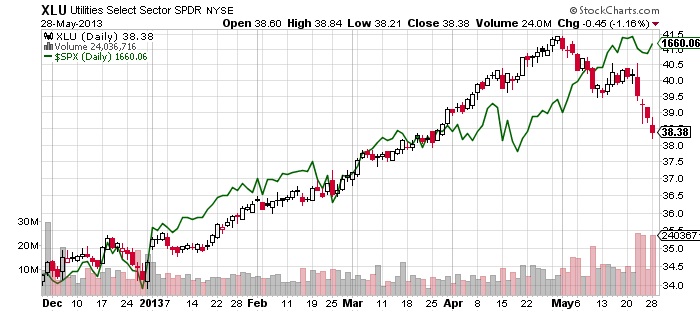
The above chart shows the performance of the S&P 500 utilities stocks through an exchange-traded fund (ETF) called the Utilities Select Sector SPDR (NYSEARCA:XLU). Why is this chart important?
….read more HERE


-
I know Mike is a very solid investor and respect his opinions very much. So if he says pay attention to this or that - I will.
~ Dale G.
-
I've started managing my own investments so view Michael's site as a one-stop shop from which to get information and perspectives.
~ Dave E.
-
Michael offers easy reading, honest, common sense information that anyone can use in a practical manner.
~ der_al.
-
A sane voice in a scrambled investment world.
~ Ed R.
Inside Edge Pro Contributors

Greg Weldon

Josef Schachter

Tyler Bollhorn

Ryan Irvine

Paul Beattie

Martin Straith

Patrick Ceresna

Mark Leibovit

James Thorne

Victor Adair