


…practically no matter what Bernanke and his minions do to further screw up the markets.
Check out these 5 factors from Keith that lead to investing success.

 Zurich is a delightful city. So much history! So much beauty! So much money!
You can barely throw a Kruggerand in any direction without hitting a rich banker or his model wife.
They stroll along the Limmatquai. They dine at the Kronenhalle. They shop on Bahnhofstrasse.
And what do they think of today’s markets?
“It’s crazy what is happening,” said our friend. “But crazy things happen. You just have to make sure you’re not doing something crazy too.”
What crazy thing happened yesterday? The Financial Times says stocks rose when investors got good news from the manufacturing sector.
Maybe.
We noticed a big bounce in gold. The metal was up $32 an ounce. And beaten-down gold miners showed even more gains.
Whassup? End of the correction in the gold market?
Only a fool would pretend to know where gold will come to a bottom. I guessed $1,100 yesterday. Colleague Chris Hunter (who will be providing us with our new Market Insightnotes every Monday, Wednesday and Friday) thinks it could be lower.
Nobody knows. But a lot of people think they know. And when people think they know something that they can’t really know, it is an opportunity for those who don’t know and who know they don’t know. Is that clear?
Our old friend Mark Hulbert at The Hulbert Financial Digest reports that independent financial advisors have never been more bearish on gold than they are today. Other indicators tell us that the public and the professionals are overwhelmingly against the yellow metal…
Even at the “top” – when gold was near $1,900 an ounce – few investors owned gold. It was considered kooky. Bizarre. Vaguely seditious.
Since so few people owned it, few were unhappy to see it go down. And when it did begin to correct, all those investors who had jumped into the gold market at the last minute, because they didn’t want to be left behind, thought they should get out immediately. Their rush for the open door is what brought about the sharp sell-off.
Meanwhile, serious investors are not speculating on the next move of the gold price. They’re accumulating gold… and measuring their wealth in it.
We’ve heard investment professionals recently tell us that gold is no longer necessary. It’s just a hedge against central banks going wild, they say. And, now that the Fed has demonstrated its willingness to “taper” its bond buying, there is no need for gold, especially when official consumer prices are rising at an annual rate of just 1.4%.
But consumer prices aren’t the only kind of inflation…
Nor are they the first kind…
The first kind of inflation is the kind that raises values for the lucky 1%. People who own financial assets – stocks, mainly – see their wealth increase as a result of central bank manipulation.
That’s the kind of inflation that most people like. Even if they aren’t part of the 1%… and they don’t own stock… they are happy to see a bull market on Wall Street. They imagine – like Ben Bernanke – that somehow this ‘wealth’ will trickle down to the working stiffs.
They’re right. It does seep into the consumer economy, eventually. But not as wealth. As anti-wealth. Prices for toilet paper, parking spaces and cookies increase. The working stiffs end up with lower real purchasing power.
We’re not there yet. Consumer price inflation is still – apparently – very low. In fact, we are in what looks more like a period of disinflation than an inflationary cycle.
In fact, we’re so far away from consumer price inflation that investors can’t see it coming. They think the feds have everything under control. They think the economy is fundamentally sound… and that monetary policies are fundamentally sensible!
They’re betting that Mr. Bernanke can work things out with Mr. Market…
We don’t approve of speculation – not in gold and not in anything else. Most people – including us – don’t have the stomach for it.
Instead, put your money to work the way serious people do. The way the Swiss do. If you haven’t done so already, begin a lifetime program of gold accumulation, not gold speculation.
Set aside some amount. Buy gold every month. And hope the price goes down so you get more for your money.
Regards,
Bill
Bill Bonner founded Agora Inc. in 1978. It has grown into one of the largest independent newsletter publishing companies in the world. In 1999, along with Addison Wiggin, Bill founded The Daily Reckoning. Today, this daily e-letter reaches over 500,000 readers around the globe.
Bill has also co-written two New York Times bestselling books, Financial Reckoning Day and Empire of Debt. He has written or co-written other widely read books as well, and has penned a daily column at The Daily Reckoning for over 12 years. Recently, Bill decided to “retire” from his role at The Daily Reckoning and begin writing his Diary of a Rogue Economist.
Bill Bonner’s Diary of a Rogue Economist is your gateway to Bill’s decades of accrued knowledge about history, politics, society, finance and economics. Sometimes funny, sometimes frightening – but always entertaining and packed with useful insight, Diary of a Rogue Economist can help you make sense of the complex world we live in today.


Many investors are understandably nervous when it comes to what the markets will do this week. Some are downright agitated.
My take? Keep calm.
The markets are doing what they need to be doing right now. The big swings we’re experiencing lately are not a sign that the markets are broken. Far from it.
On the heels of a 137.43% run off March 2009 lows, the pullback we experienced last week was absolutely normal. Long overdue, in fact.
I’m actually glad to see the volatility because it means the markets are working normally. A little give and take is absolutely essential when it comes to bigger gains and better returns.
Hard to stomach with everything that’s going on? Yup…which is why It’s worth noting that the markets have posted positive second half gains 26 of 26 times since WWII when the S&P 500 has turned in positive January and February returns. Those aren’t bad odds.
So now on with the show…what is the biggest mistake you can make right now?
Let me put it this way – it’s something locked in our brains. And it loses investors more money than every other investment “problem” combined. Let me show you something:
The probability of correctly timing the stock market just 50% of the time is a mere:
0.000000000000000000000000000000000000000000000000
000000000000000000000000000000000000000000000000
000000000000000000000000000000000000000000000000
000000000000000000000000000000000000000000000000
000000000000000000000000000000000000000000000000
000000000000000000000000000000000000000000000000
00000022883557%.
Jamie Dimon has higher odds of being the next Fed Chairman.
Why are we so incredibly bad at something that seems so basic? Like I said, it’s a “brain thing.” Let me explain…
You hear a lot about the term volatility when the markets jump like this. But most people don’t really understand what it means. Volatility is simply a measure of the variation in price of any financial instrument over time. Unfortunately, the news has preconditioned investors to understand it as a negative influence because volatility rises when the markets drop.
In fact, quite the opposite is true. Volatility is really an expression of both up and down market movement. The key is in learning how to manage it so that your portfolio is not disproportionately impacted by either big down days or lost opportunity that comes from massive upswings.
Take the DOW, for instance. Over the past 110 years we’ve experienced two World Wars, multiple currency defaults, the Korean Conflict, Vietnam, the Gulf Wars, terrorism, presidential assassination, inflation, deflation, the Financial Crisis…and the index still rose 35,174%.
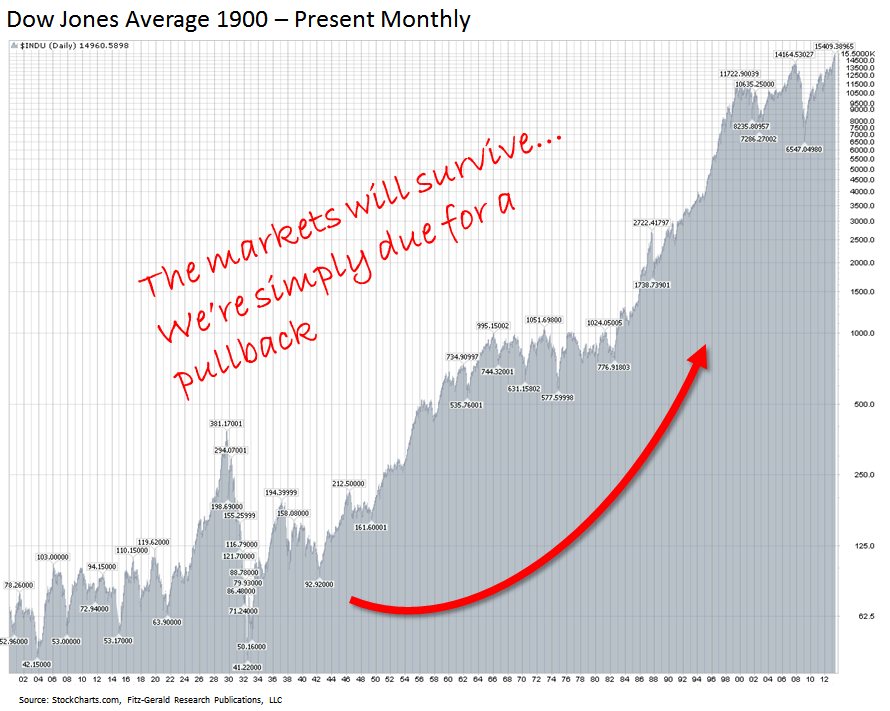
The markets have endured plenty of “volatility” over the years. In fact, if you look far enough back, you find that the markets actually do a pretty good job under conditions that should have killed them.
What makes short-term volatility so dangerous is the impact it has on your mind and specifically on yourdecision making.
I’ve written about this before but it bears repeating:Investors systematically deviate from otherwise rational decision making when the markets drop.
Scientists think this is because of decisions that get made under duress when the primary concern is losing money are made using reactionary segments of the brain rather than those that are anticipatory.
Whether Bernanke cuts QE has nothing to do with it. He and his central banking buddies are sideshow inputs at best. So is the notion of a Chinese credit crunch, a European meltdown or any of half a dozen other things investors are worried about at the moment.
That’s both good news and bad news.
Bad news first…there’s nothing you can do about this. Our brains are hardwired to do different thinking when forced to decide between decisions that result in a “gain or loss” and “relative value.”
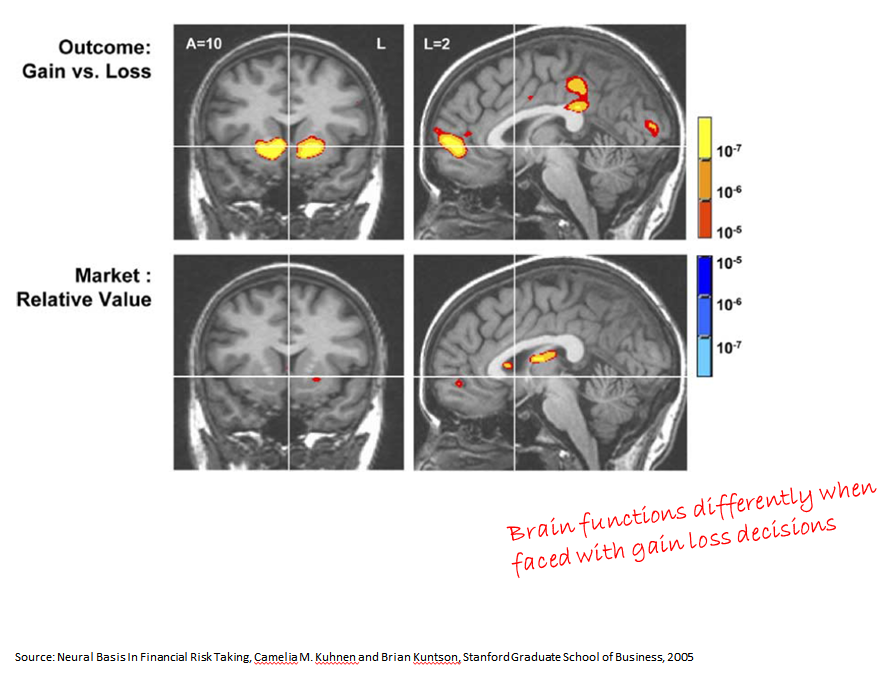
Not only that, but we literally use different sections of our brain – the NAcc and the Anterior Insula – to process what’s happening in the markets depending on whether they are rising or falling and how they relate to the two decisions I’ve just mentioned.
You can see this quite clearly in MRI imagery.
In this shot for example, you can see that the top two images show marked activity in the Nucleus Accumbens or NAcc under conditions focused on the anticipation of gains.
The bottom two images reflect a brain that is anticipating more subjective incentives correlated to risk aversion and feelings.
As you can see, the difference is quite pronounced which is why the two Stanford scientists who conducted this study, Camelia M. Kuhnen and Brian Knutson, believe that activation of one of these two regions can actually lead to a shift in risk preferences.
Having spent 33 years in the markets, I agree. I’ve seen more than my share of people “wig out” when conditions get choppy. You probably have too and now you understand quite literally why.
This is why casinos concentrate the visitor experience around “perks” and creature comforts like free drinks, jackpots, great food and fun – because they know that doing so is more likely to activate the reward seeking anticipatory NAcc portion of the brain.
Wall Street operates in much the same way but with a subtle refinement. Their advertising is geared towards total wealth management, confidence and control. They know that big down days engage the anterior insula, so it’s in their interest to communicate with potential clients after experiencing the fear of loss or, in some cases, actual losses. If you’ve ever heard Wall Street insiders talking about “feeding the greed gland,” this is what they’re talking about.
Traders take this a step further. There is no subtlety about it. The more panic and fear you feel and the more irrational your decision making becomes, the more likely you are to play into their neural network which is, not by accident, completely wired toward profits.
That’s why it’s not uncommon for the big trading firms to engage in serious psychological testing to determine exactly which people they want on the trading desks. And let me tell you that it’s NOT people who react to fear; it’s those who remain focused with laser-like intensity on profits and potential and who are able to control the NAcc portion of their brain.
It’s not that they don’t feel the fear that paralyzes many investors; they’ve just learned to override it. This, in turn, keeps them in the right neural circuits when they are needed most.
Speaking of which, under normal circumstances investors “get it right” about between 50%-70% on average when they’re focused on opportunity. That’s according to Boston-based DALBAR which tracks investor behavior over time using something called the “Guess Right Ratio.”
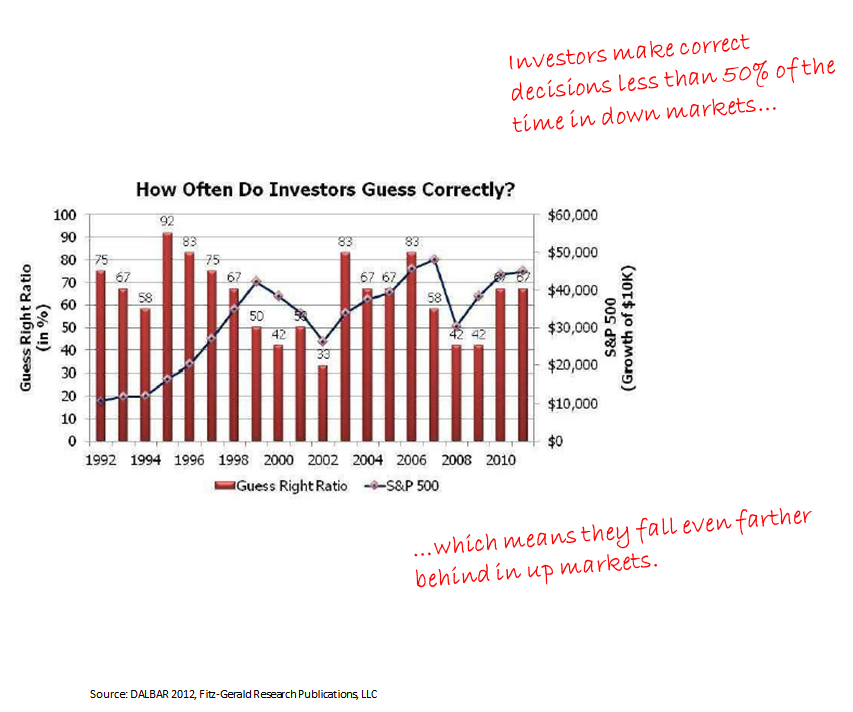
You can see very clearly that the higher percentage scores are during periods when the markets are trending like they were in the late 1990s, off the post 2002 bottom and off the March 2009 lows.
But when the markets really let loose or are reaching major inflation points like they appear to be now, that figure drops to less than 50% as fear of loss becomes the primary driver. Sometimes far less.
That’s why at those points in time, investors have a less than random probability of making a sound investment choice when the markets drop.
Now for the good news.
You can absolutely overcome the negative impact of bad decision making using a few simple tricks to override the very dangerous neural programming we are born with.
First, keep history in mind. The markets have a defined upward bias. Therefore, investing profitability is more a function of identifying periods when the markets favor upward movement and buying in. I know that sounds like timing but it isn’t; it’s more like identifying probable behavior. Generally speaking, big down days are best because of the principle of mean reversion (which is a subject that I’ll be writing about in an upcoming “Marketology” column).
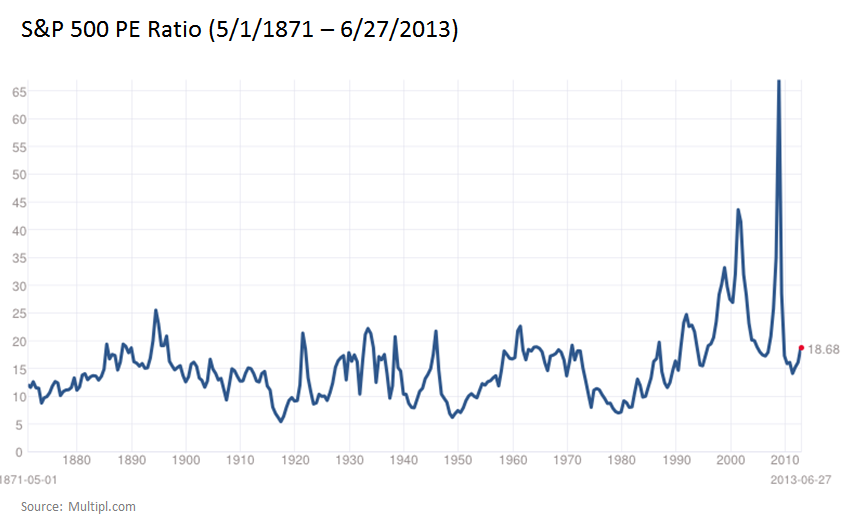
My favorite means of doing this is simple valuation. During the dot.bomb era, we saw valuations run so high that the PE ratios as measured by the S&P 500 shot over 60 times earnings. History shows that serious rallies begin when PEs are in the single digits.
Right now, the average PE for the S&P 500 is 18.68 according to Multpl.com, which is a little higher than I’d like to see but not so high as to defy putting new money to work, particularly if Team Bernanke remains accommodative.
Second, always use trailing stops to protect your capital and harvest gains. If you’re a more sophisticated investor, consider put options or even specialized inverse funds to do the same thing.
Trailing stops allow you to firmly engage the opportunity circuit of the NAcc and, in doing so, substantially diminish Wall Street’s ability to play you for a pasty by forcing you to make fear based decisions.
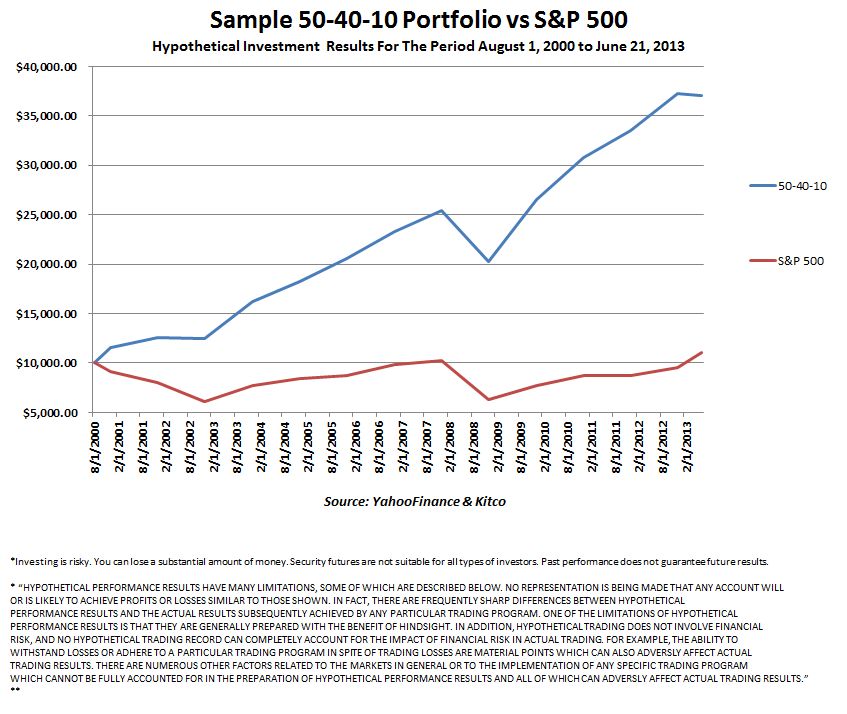
Third, develop and stick to a carefully structured, risk averse portfolio like the 50-40-10 I advocate in the Money Map Report. With its emphasis on risk averse choices, high income and rebalancing, it’s a simple very powerful tool that keeps you in the hunt for upside. This is especially true during down markets because it keeps you from disproportionately weighing the possibility of losses over gains of the same size, which is what most people do and make costly decisions.
Over time, this can really “add up” by helping you tap into profit oriented neural circuits you need to be successful…
About the Author
Keith Fitz-Gerald has been the Chief Investment Strategist for the Money Morning team since 2008. He’s a seasoned market analyst with decades of experience, and a highly accurate track record. Keith regularly travels the world in search of investment opportunities others don’t yet see or understand. In addition to heading The Money Map Report, Keith runs The Geiger Index, a reliable, emotion-free guide to making big money and avoiding losses, and Strike Force, which aims to get in, target gains, and get out clean.

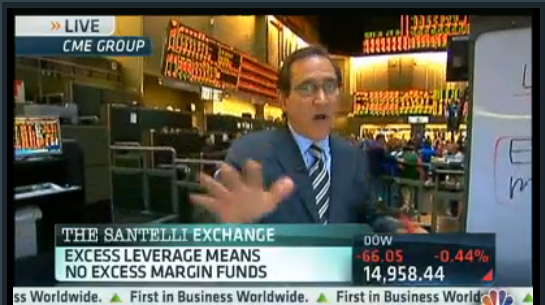 click on image or HERE to listen to Santellii’s comments on leverages and outflows.
Transcript: (Ed Note the 3 min video is superior to the transcript)
Courtney, thanks. Let’s go from the New York Stock exchange to the Santelli Exchange. over to you, Rick.
Listen, i have to continue to talk about the deleveraging because it is the topic du jour. even with the big Blackhawk celebration, a lot of the talk continues to be exactly what happened, why did it happen, when it happened, how important was that?
In order to try to pick or help you viewers or listeners get an idea where interest rates may go, where equities may go, where leverage may go or not go ever again, we have to understand what happened. and let’s start in a very simple place, leverage. i’ll tell you why this is so fascinating a conversation i had with a couple of my sources yesterday. That in the world of hyperleverage, there isn’t going to be any money left for excess margin. In other words, it’s counterintuitive that the trading community, investors, funds, have a certain amount of leverage on and it’s not the same everywhere but it’s still rather large. What is excess margin?Excess margin means you have some money laying around,whether it’s your Gold position, Bond position, S&P, or ETF, whatever it is, that when the position starts to work against you and you need to pony up more money, where does that money come from?
That is at the epicenter, in a simple way, of what may have been the catalyst for much of what we’ve seen.
Now, i know you always hear me talking about the Fed, the FOMC, Ben Bernanke and that the markets still have their moments of power, but i do have to say the other big conversation the last 24 hours is no matter what you think about all of those topics, that Ben just happened to be the guy that we all identified, everybody seems to identify with being the culprit. Somehow as to the catalyst. I’m not so sure that’s true. i think in leverage, no excess funds, things have a way to work in reverse in an aggressive fashion but it’s even more interesting.everybody wants to talk about the great rotation. Now, you could go to CNBC, they will have a boat load of stories about the exact numbers. i’m going to round out. There’s been basically record outflows for the last month or so in the bond world, just the last week it’s been rather large. You could break it down into taxable, non-taxable, municipals, whatever. But here is the key, equities and equity etfs are also seeing outflows. This really needs to be thought through. as much as everybody wants that to be true, it doesn’t seem to be true, and this has to figure in because you could be the biggest bond guy in the world and you can see all the flows, but in the end the real key is the inflows and that’s what we’re not seeing there. Back to you.
Well put, rick. Very well put on a week where we’re watching flows carefully, thanks a lot.

 “Technically, commodities look horrible…precious metals look bad. But tech factors would suggest we’re approaching at least an intermediate low. The commercials, which are essentially hedgers, people who produce gold and so continuously hedge, at the present time they have an extremely low short exposure, basically they’re accumulating gold.
“Whereas gold is close to $1,300 compared to say $700 in 2008, conditions in the mining industry are horrible. The exploration companies are running out of money and industry conditions are worse than they were in 2008. So I think that a lot of supply that potentially comes to the market through new exploration will simply not be there. In emerging economies sovereign funds, central banks and individuals will continue to accumulate physical gold.” – in marketwatch
“…not because of Fed’s statements because, like always, they hedged their bets in the sense that this tapering off would not necessarily stop. Mr Bernanke said if the economy does not improve along the lines that we expect we will provide additional support. I think the markets are worried about something else,” – in marketwatch
“The Chinese economy is much weaker than the official statistics suggest. At the present time, the Chinese economy is, at the very best, growing at 4% per annum. Without huge credit expansion there would be no growth at all.” – in marketwatch
……..more posts HERE

I know Mike is a very solid investor and respect his opinions very much. So if he says pay attention to this or that - I will.
~ Dale G.
I've started managing my own investments so view Michael's site as a one-stop shop from which to get information and perspectives.
~ Dave E.
Michael offers easy reading, honest, common sense information that anyone can use in a practical manner.
~ der_al.
A sane voice in a scrambled investment world.
~ Ed R.

Greg Weldon

Josef Schachter

Tyler Bollhorn

Ryan Irvine

Paul Beattie

Martin Straith

Patrick Ceresna

Mark Leibovit

James Thorne

Victor Adair