Gold & Precious Metals

Precious Metals Enter “Summer Lull”, Will Miss “Commodity Supercycle” Says SocGen


The GOLD PRICE ticked higher in London trade Monday morning, rising from its lowest weekly close in three years as Asian stock markets fell but Eurozone shares jumped over 2% higher.

Major government bonds ticked higher, easing interest rates down, while the US Dollar held steady after last week’s strong gains on the currency market.

A Wall Street Journal survey says the majority of economists think that Friday’s jobs data mean the US Federal Reserve will start reducing its quantitative easing program as early as September.

Silver bullion today ticked back above $19.22 per ounce, regaining half of last week’s 3.6% drop.

“Unlike the April rout [in gold prices],” says the latest monthly report from brokers INTL FCStone, “which drew out a slew of buyers, we are not seeing the same type of reaction this time around.

“[This suggests] the complex remains vulnerable from the physical side as well.”

The gold price is now “near the lows of the year,” says David Govett at fellow brokers Marex Spectron, but “For the moment at least, I do think we have done enough.

“I now think we are moving into the good old summer lull. Overall direction will be sideways.”

New curbs on gold bullion imports to India – where the Hindu calendar’s Chaturmas will now keep gold demand low until September – cut legal inflows by 81% in June from May’s record high of 162 tonnes, a government official told journalists today.

Sales are however “expected to go up again” because of the gold price, the official added.

“India’s gold imports will be somewhat the same or slightly more for July,” agrees Commtrendz Research’s Gnanasekar Thiagarajan, quoted by Reuters, “as some bargain hunting interest was seen.”

The Indian Rupee fell Monday to fresh all-time lows against the Dollar, reducing the gold price discount for buyers in the world’s No.1 consumer market.

“The [Reserve Bank of India] is definitely concerned about Rupee weakness,” says Nick Verdi at Barclays in Singapore.

Rather than intervening to support the Rupee with cash trades, however, “It will look to combat this mostly through verbal intervention,” he reckons.

Meantime in Egypt, the 12th largest private gold consumer in 2012, the main stock market sank almost 3% as fighting continued after more than 40 supporters of ousted president Morsi were killed at the weekend.

“Tensions in Egypt put pressure on local [gold] demand,” says German refining group Umicore in a quarterly trading update, “as some retailers started to think of closing their shops for fears of looting.”

With the gold price now 36% below its Dollar record of September 2011, Russia’s state treasury Gokhran – the official trader of gems and precious metals – is preparing to buy gold on the domestic market after a two-year gap, Reuters reports.

Invited to sell gold onto the open market when prices neared their 2011 peak, “We were forbidden to buy gold directly [from Russian miners],” a source tells the newswire. 

“If we receive permission, we will be happy to start buying gold again,” the source added.

Russia’s central has continued to acquire gold bullion for its own reserves, adding more than 78 tonnes in the last 12 months and rising to 7th place amongst the largest nation-state holders.

Western Europe’s central banks, in contrast, have so far sold only 4.3 tonnes of the 400-tonne limit set by their Central Bank Gold Agreement this year.

Running from September, the agreement was first signed in 1999 to cap erratic sales by European governments as the gold price sank to three decade lows. 

“Gold prices are going to generally drop down throughout the year,” reckons Société Générale’s head of commodities research, Michael Haigh, speaking today at a media briefing in Singapore.

Pointing to possible “price hedging” by gold-mining producers, “They’ll start selling into the market,” Haigh warned, “which puts more downward pressure on gold prices.”

SocGen’s outlook for gold is in stark contrast to its broader view of the commodities “super cycle”, which Haigh believes will continue for another 15-20 years thanks to “population and urbanization” in emerging Asian economies.

“But it’s not going to be an upward price for all.”

Forecast by many analysts to overtake India as the world’s No.1 gold consumer in 2013, China imported its second greatest monthly volume of gold bullion through Hong Kong in May, data showed last week.

Through the first 6 months of the year, separate data showed Friday, gold bullion deliveries made to traders using the Shanghai Gold Exchange totalled 1058 tonnes.

That was precisely 50% of the 2012 full-year total.

The plunging gold price however saw shares in Zijin Mining – the largest gold miner in world No.1 mining nation China – today drop 11% after it forecast “very poor results, below expectations.”

“The fact that the gold price has fallen is actually going to be very healthy,” said gold-mining fund manager Evy Hambro of Blackrock to Bloomberg last week.

“We need to see costs taken out of the industry; we need to see the companies stop producing the ounces that don’t make money and focusing on the ones that do.”


Adrian Ash

BullionVault


Gold price chart, no delay | Buy gold online


Adrian Ash is head of research at BullionVault, the secure, low-cost gold and silver market for private investors online, where you can buy gold and silver in Zurich, Switzerland for just 0.5% commission.


(c) BullionVault 2013


Please Note: This article is to inform your thinking, not lead it. Only you can decide the best place for your money, and any decision you make will put your money at risk. Information or data included here may have already been overtaken by events – and must be verified elsewhere – should you choose to act on it.

The Bottom Line: Potential Sectors Gold, Energy & Biotech

The U.S. employment report on Friday helped to give a boost to world equity markets and most sectors. However, the employment report also brought concerns including higher interest rates, higher energy prices (crude oil, heating oil, gasoline) and a higher U.S. Dollar. Short term strength is not sustainable, particularly in front of mixed second quarter earnings reports and mixed third quarter guidance. Preferred strategy is to take advantage of short term strength in equity markets to take trading profits.

Selected sectors with favourable seasonality in the summer time need to be watched for entry points if they show signs of base building. Potential sectors include gold, energy and biotech. All already are showing positive strength relative to the S&P 500 Index.


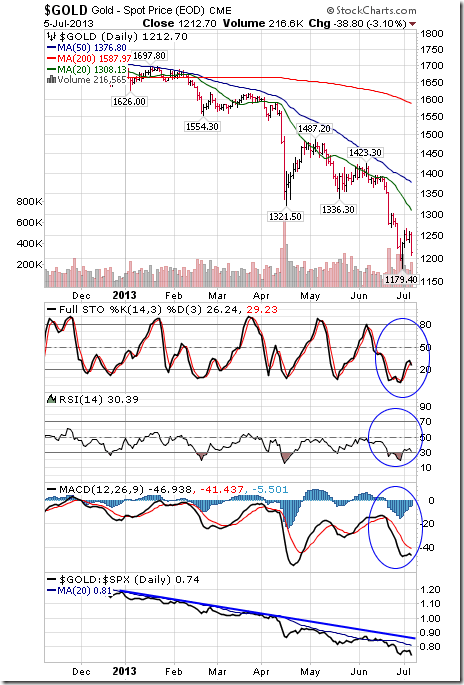
Gold fell $19.40 per ounce (1.23%) last week. Trend remains down. Gold remains below its 20, 50 and 200 day moving averages. Strength relative to the S&P 500 Index remained at 0.0 out of 3.0. Short term momentum indicators are trying to recover from oversold levels.

clip image032 thumb

100 oz. Gold Futures Continuous Contract Seasonality

Analysis has revealed that with a buy date of September 13 and a sell date of May 23, investors have benefited from a total return of 128.74% over the last 4 years. This scenario has shown positive results in 4 of those periods.

The buy and hold return for the past 4 years was 87.94%.

image thumb-1


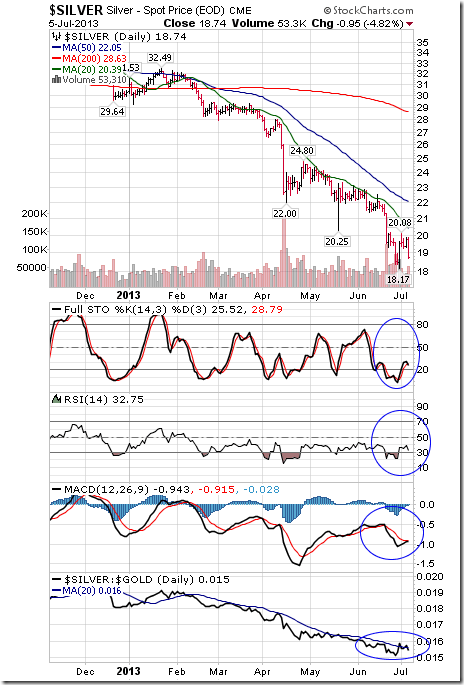
Silver lost another $0.82 (4.19%) last week. Trend remains up. Silver remains below its 20, 50 and 200 day moving averages. Strength relative to the S&P 500 Index and Gold remains negative. Technical score remains at 0.0 out of 3.0. Short term momentum indicators are trying to recover from oversold levels.

clip image034 thumb

Silver Futures Continuous Contract Seasonality

Analysis has revealed that with a buy date of September 16 and a sell date of May 11, investors have benefited from a total return of 251.41% over the last 4 years. This scenario has shown positive results in 4 of those periods.

The buy and hold return for the past 4 years was 79.27%.

image thumb

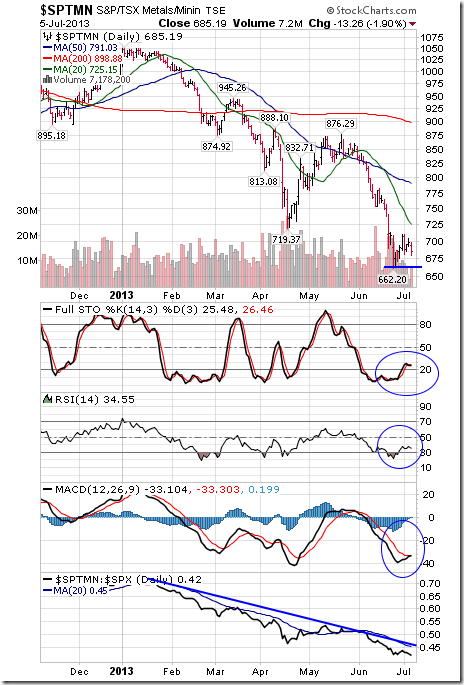
The TSX Metals & Mining Index fell another 20.37 points (2.89%) last week. Trend remains down. The Index remains below its 20, 50 and 200 day moving averages. Strength relative to the S&P 500 Index remains negative. Technical score remains at 0.0 out of 3.0. Short term momentum indicators are trying to recover from oversold levels.

clip image038 thumb


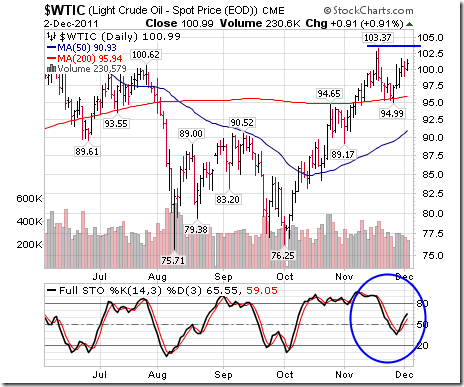
Crude Oil gained $6.63 per barrel (6.86%) last week despite strength in the U.S. Dollar. Intermediate uptrend was confirmed on a move above $100.42 to reach a 15 month high. Crude remains above its 20, 50 and 200 day moving averages. Strength relative to the S&P 500 Index remains positive. Technical score remains at 3.0 out of 3.0. Short term momentum indicators are overbought, but have yet to show signs of peaking.

clip image028 thumb

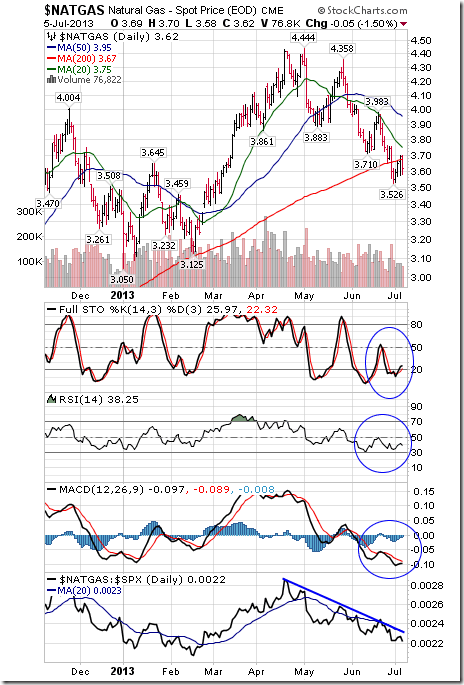
Natural Gas added $0.04 (1.12%) last week. Trend remains down. Gas remains below its 20, 50 and 200 day moving averages. Strength relative to the S&P 500 Index remains negative. Technical score remains at 0.0 out of 3.0. Short term momentum indicators are oversold.

clip image029 thumb

…….so many more charts and commentary at Don Vialoux’s Timing the Market HERE

……seasonality at EquityClock including the Stock Market Outlook for July 8th HERE


All Eyes on Europe This Summer

Almost everyone I talk to thinks the European sovereign debt crisis has passed. All is on the mend in Europe, they say.

But as far as I’m concerned, nothing could be further from the truth.

First, severe austerity measures continue to this day, and they are hollowing out Europe’s economic growth.

The proof is in the numbers. Before the Greek crisis flared up, debt-to-GDP in Greece stood at 113 percent. Today, even after all the write-offs, Greece’s debt-to-GDP is a whopping 157 percent.

In Spain, pre-crisis debt stood at 40 percent of GDP. Today it’s 84 percent.

In Italy, it was 106 percent. Now it’s 127 percent.

In France, it was 68 percent. Now it’s 90 percent.

Even Germany’s debt-to-GDP is worsening, leaping from almost 67 percent in 2008 to 82 percent today.

Debt-to-GDP is as much as 44 percent higher than it was at the beginning of the crisis, and the austerity measures are causing the entire European continent to implode, creating some of the worst social chaos we have seen in modern times.
Screen shot 2013-07-08 at 6.52.32 AMSecond, Italy, Portugal, Spain, and Greece remain hotbeds for massive social unrest.

Each and every one of these countries is in way over its head. And each and every one of them is in the depths of a nightmare caused by austerity measures. Just last week, two Portuguese cabinet ministers resigned over the harsh austerity measures the country has had to endure.

Spain’s unemployment just hit 26.9 percent. Portugal’s, 17 percent. Italy’s, 12.2 percent.

Unemployment among youth is off the charts. Spain’s under-25-year-old unemployment rate is 56.5 percent. In Greece, it’s even worse at 59.2 percent.

Corporate and personal bankruptcies are surging. Social discontent is on the rise again. And tensions between countries within Europe are higher than ever.

Third, European banks are a disaster in the making. According to Weiss Ratings, 202 financial institutions in Europe with capital of more than $16.1 trillion are rated D+ or lower.

I repeat, that’s $16.1 trillion of capital — equal to our country’s GDP — at risk of going up in smoke.

It’s the ugliest economic picture for Europe since the 1930s, when 17 countries went belly up, sending hundreds of billions of dollars worth of francs, marks, lira, and more flooding into the U.S.

That, in turn, sent the U.S. stock markets exploding higher. It sent the dollar and gold simultaneously into a moon shot as well. And it’s all about to happen again.

Why? Because …

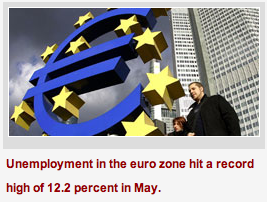
Fourth, Europe’s economy as a whole is sinking fast. Eurostat, the European Union’s statistics office, said unemployment in the euro zone hit a record high of 12.2 percent in May. A total of 19.34 million people are unemployed.

Figures due out next month are expected to show that the euro zone continued to shrink in the second quarter, the seventh quarter in a row.

With growth sharply slowing, plus uncertainty over which dominoes will be the next to fall, there’s a very real chance of a massive bear-market collapse in Europe this year, one that could take down the entire European Union.

Fifth, deflation is high. With austerity measures squashing growth all over Europe, deflation is starting to run rampant.

According to the latest data, prices that euro-zone producers charged for their goods fell for the third straight month in May, while producer prices in the 17 countries that use the euro declined 0.3 percent. That may not sound like a lot, but annualized, it’s a 3.6 percent deflation rate.

On top of that, Europe is facing more hits to economic growth, more debt going bad, more unemployment and more social discontent in the months ahead.

In short, nothing, and I mean nothing, has been solved in Europe. The crisis will soon escalate with a vengeance.

So what does all of this mean for you and your investments? A heck of a lot!

When, not if, Europe’s economy roils again, likely later this summer:

First, you’re going to see trillions of euros stampede for the exits. That’s going to send several large European financial institutions down the tubes.

Second, that will likely send global interest rates rocketing higher. The U.S. will not escape rising interest rates. In fact, our rates are already heading higher.

Third, it’s going to send the U.S. dollar into rally mode, right along with gold. Just like it did in the early 1930s when Europe last went bankrupt.

Fourth, it’s also going to send our stock markets roaring higher. Just like it did between 1932 and 1937, when the Dow Jones Industrials soared 387 percent as Europe went under.

Fifth, it’s going to give you many profit opportunities to potentially make more money that you ever dreamed of. In stocks. In commodities. In the dollar. And in gold and silver.

My suggestions right now are …

  1. Keep your eyes on Europe. And keep most of your liquid funds in cash, ready to be deployed on a moment’s notice, but as safe as can be right now.

The best way, in my opinion: A short-term Treasury-only fund in the U.S., or the equivalent.

  1. Earmark a portion of your cash for speculation. Not too much, and not too little. I recommend 25 percent of your total investable funds. Funds that you do not need for anything else.

Finally, pay particular attention to gold and silver. They now offer more profit potential than they have in at least the past two years.

Best wishes,

Larry


Variable Rate World, Part 1: Staring Into the Abyss

509

Interest rates soared again last week. This weekend a lot of people are running a lot of numbers and getting some terrifying results.

It seems that the past few years of falling interest rates have lulled a big part of the global economy into financing with variable-rate debt. So when interest rates go up, there’s a world-wide reset in interest costs that, best case, amounts to a tax increase on individuals and businesses and, worst-case, threatens to blow up the whole system.

The most familiar but least worrisome part of this story is the adjustable rate mortgage, or ARM, which is basically a teaser-rate home loan that rises over time towards the prevailing 30-year fixed rate. This rate jumped from 3.5% to 4.5% in just the past month, which means ARM resets are now aiming at a higher target.

…..read more HERE

Grandich: Things

THINGS

I interviewed Nick Barisheff, who is calling for $10,000 gold. Normally, I shy away from these “sky-high” predictions but after seeing him interviewed more than once, I felt he presented a realistic and legitimate case.

Nick Barisheff is President and CEO of Bullion Management Group Inc., a bullion investment company that provides investors with a secure, cost-effective and transparent way to purchase and store individual Good Delivery gold, silver and platinum bullion bars. Recognized worldwide as a bullion expert, Barisheff is the author of $10,000 Gold: Why Gold’s Inevitable Rise is the Investor’s Safe Haven. He is a speaker and financial commentator on bullion and current market trends.

.….for the entire interview go HERE

test-php-789