
Personal Finance
 I own equities, and I should thank Mr. Bernanke. The Fed has been flooding the system with money. The problem is the money doesn’t flow into the system evenly. It doesn’t increase economic activity and asset prices in concert. Instead, it creates dangerous excesses in countries and asset classes. Money-printing fueled the colossal stock-market bubble of 1999-2000, when the Nasdaq more than doubled, becoming disconnected from economic reality. It fueled the housing bubble, which burst in 2008, and the commodities bubble. Now money is flowing into the high-end asset market—things like stocks, bonds, art, wine, jewelry, and luxury real estate. The art-auction houses are seeing record sales. Property prices in the Hamptons rose 35% last year. Sandy Weill [the former head of Citigroup] bought a Manhattan condominium in 2007 for $43.7 million. He sold it last year for $88 million.
Money-printing boosts the economy of the people closest to the money flow. But it doesn’t help the worker in Detroit, or the vast majority of the middle class. It leads to a widening wealth gap. The majority loses, and the minority wins. Although I have been a beneficiary of this policy, I can’t approve as an economist and social observer. – in Barron’s
Marc Faber – Sprott Money News Interview – Jul 22, 2013
Nathan McDonald of Sprott Money News interviews Marc Faber in the video report above. He begins asking Mark his view of the speech from Ben Bernanke and the Fed’s FOMC meeting minutes for June which have just been released,
Faber: in China without Huge Credit Expansion there would probably be no Growth at all
“The Chinese economy is growing at something like 4 per cent per annum, and without huge credit expansion there would probably be no growth at all.” – in South China Morning Post
You might also like:
Faber : The FED is Causing the Crisis with its very Expansionary Monetary Policy
Have the quantitative easing measures / stimulus by various central banks done an irreversible damage to the long-term prospects of global economy, markets (equity and commodity)? Why / why not?
Faber : There are people believe that Ben Bernanke and other central bankers have saved the world’s financial system. I am not saying that they are wrong but I am suggesting that the crisis occurred in the first place because of the expansionary monetary policy – principally by the US Federal Reserve since the 1990’s.
In other words, each time there was a crisis – be it S&L (savings and loans) crisis, LTCM Hedge Fund crisis, Mexican peso crisis which is also known as the Tequila crisis – ahead of Y2K, monetary policies were eased and liquidity injection occurred. And then we had the Nasdaq collapse in the year 2000.
The US Federal Reserve then again embarked on extremely expansionary monetary policy, which created a gigantic credit bubble and home prices surged.
When this came to an end, that’s when the crisis actually happened. Had the US Fed not pursued very expansionary monetary policies and paid attention to excessive credit growth, there would have been no crisis.
The Policy Decisions in Japan are quite Dangerous
In the case of Japan, we have had essentially very little growth and some deflationary pressures until last October after which the Bank of Japan (BoJ) embarked on monetary easing policies. Since then the Yen has weakened considerably and the stock market has risen sharply.
I think that the policy decisions in Japan are quite dangerous because it essentially gives a green signal to other countries regarding monetary easing. If there is have low economic growth and if the share market is not performing well, then most likely the currency will go down. This will help economy temporarily and lift asset prices.
FABER : The Euro-zone is not going to Grow
…..read more HERE
Marc Faber is an international investor known for his uncanny predictions of the stock market and futures markets around the world.

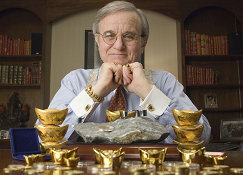 World famous gold guru Jim Sinclair is telling his followers that the gold price will soon move in ‘hundreds of dollars a day’ when the Comex changes its settlement rules as it must because the exchange is running out of physical gold.
‘The cause of today’s spectacular rise in the gold price is the reality that with Friday continue large drop in Comex warehouse gold inventory,’ he writes. ‘No cogent argument can be formed against the reality that because of the continue fall in gold inventory that within in 90 days or sooner the Comex must change its delivery mechanism.
Cash settlement
‘The highest probability is that Comex will have to move to cash settlement rather than gold. Part of that settlement could be lots of 100,000 GLD (gold exchange traded fund) that represents the ability to exchange for gold.
‘Their problem is that if GLD is part of the settlement mechanism for the spot Comex contract that GLD will be destroyed by the convertibility. It is a truism in gold that which is convertible into gold will in fact be converted over time.
‘Gold rose today because those knowledgeable know the inevitability of the changing of the Comex contract, as it is today which calls for settlement in gold between contracting parties. There is no question this is the emancipation of physical gold from the fraud of no gold, paper gold.
‘The emancipation will cause physical gold exchanges to take birth and to be the discovery mechanism for the price of gold. This is the end of the ability to use paper gold future contracts as a mechanism to make the gold price sing and dance at the will of the manipulators.
True value
‘With manipulation coming to an end the true value of gold will be discovered by the cash exchanges that are now taking birth. The advent of the cash spot exchanges around the world is the natural demise of the Comex set up as convertible and now being converted.
‘As long as one can buy spot, pay insurance, transportation and re-casted by Rand Refinery to Asian products sold profitably, the demands for real gold are ending the hay days or even existence of the futures exchanges.
‘Gold is headed back to be traded as it was before 1973. Gold will trade well above $3,500 and those who have lived in the gold market like me for now 53 years know it. A price of $50,000 for gold is not out of the question as a result of its emancipation from fraudulent paper, no gold, paper gold.’
Gold running out
He continues: ‘The warehouse inventory of every futures gold exchanger is screaming this. The fact that there is no meaningful above ground supply of gold is screaming this. The fact that most of the central banks supply of gold is leased is screaming this.
‘There is no reason why gold cannot move up hundreds of dollars a day when the Comex changes their spot contract settlement, as they must, as they will, very soon.’
The next edition of the popular ArabianMoney investment newsletter has an exclusive interview with Jim Sinclair and edited highlights of his four-hour presentation in Vancouver on July 10th. Sign up to see this private circulation publication (click here).
 The Fed wants to keep long-term yields depressed, but its policies are riddling the market with risk.
FORTUNE — Last Wednesday, at a conference in Cambridge, Mass., Ben Bernanke sought to clarify the statements that shocked the markets just three weeks earlier. This time, the Federal Reserve Chairman reassured his vast, anxious audience that his pledge to start shrinking the Fed’s $85 billion in monthly purchases of long-term bonds, the latest version of “quantitative easing,” or QE3, didn’t mean that the Fed was abandoning the easy money policies that have cheered the markets for four years. The Fed would support the economy with “highly accommodative monetary policy,” intoned the Chairman, “for the foreseeable future.”
…..read more HERE

 Greetings!
Now actually take a moment to think about it, which Reuters obviously didn’t do (or if they did they didn’t care that their conclusion doesn’t make a whole lot of sense.) But I suppose what matters is what traders and investors think about the news.
Here’s what I think:
China is facing a very real credit market dilemma. And they openly recognize the growing risks of perpetuating their investment-led growth model of recent years. Yet they come out now and claim investment can further prop up economic growth and help China avoid a hard-landing.
Maybe in the short-term. Maybe if they create artificial demand for certain commodities and materials by promising railroad projects. Maybe if prices of these commodities and materials don’t fall further, maybe China can convey a sense of economic recovery.
It’s the same modus operandi. And maybe that way of operating still has some life left.
I tend to think it doesn’t.
Read on …

 I’ve spun a few yarns in recent years about my days as a naval officer; not, thank goodness, tales told by dead men, but certainly echoes from the depths of Davy Jones’ Locker. A few years ago I wrote about the time that our ship (on my watch) was almost cut in half by an auto-piloted tanker at midnight, but never have I divulged the day that the USS Diachenko came within one degree of heeling over during a typhoon in the South China Sea. “Engage emergency ballast,” the Captain roared at yours truly – the one and only chief engineer. Little did he know that Ensign Gross had slept through his classes at Philadelphia’s damage control school and had no idea what he was talking about. I could hardly find the oil dipstick on my car back in San Diego, let alone conceive of emergency ballast procedures in 50 foot seas. And so…the ship rolled to starboard, the ship rolled to port, the ship heeled at the extreme to 36 degrees (within 1 degree, as I later read in the ship’s manual, of the ultimate tipping point). One hundred sailors at risk, because of one twenty-three-year-old mechanically challenged officer, and a Captain who should have known better than to trust him.
We survived, and a year later I exited – the Diachenko and the Navy for good – theirs and mine. I think I heard a sigh of relief as I saluted the Captain for the last time, but in memory of those nearly tragic moments, let me reprint an article posted on wikiHow, outlining exactly how to go about abandoning ship should you ever venture into the South China Sea or anywhere close to Davy’s infamous locker. The article is a bona fide and serious attempt to instruct would be passengers in a Titanic-like disaster. I found it, however, as comical as yours truly pretending to be a chief engineer in 1969. Judge for yourself…
…….read more HERE


-
I know Mike is a very solid investor and respect his opinions very much. So if he says pay attention to this or that - I will.
~ Dale G.
-
I've started managing my own investments so view Michael's site as a one-stop shop from which to get information and perspectives.
~ Dave E.
-
Michael offers easy reading, honest, common sense information that anyone can use in a practical manner.
~ der_al.
-
A sane voice in a scrambled investment world.
~ Ed R.
Inside Edge Pro Contributors

Greg Weldon

Josef Schachter

Tyler Bollhorn

Ryan Irvine

Paul Beattie

Martin Straith

Patrick Ceresna

Mark Leibovit

James Thorne

Victor Adair