

 As competition from the developing world pushes up the price of energy, metals, minerals and other raw materials, finding new sources of supply is at a premium.
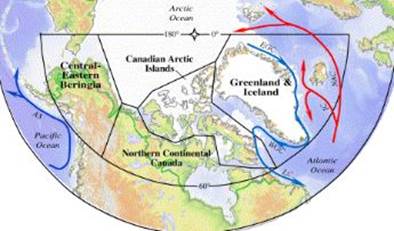 The southwest region of Greenland, where
  Travel from Sisimiut to sites further north doesn’t start till May, at the earliest, because of ice, although climate change is playing a role here with sea ice disappearing at an advanced rate.
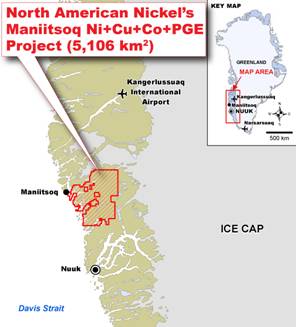 Last year North American Nickel attracted worldwide attention when it was announced by the Geological Survey of Denmark and Greenland (GEUS) that the Maniitsoq structure represents the remains of the oldest-known meteorite impact site in the world. The meteorite impact is said to be three billion years old and may have consequences for nickel exploration.
 In the spring of 2011, NAN evaluated the historical data from the GNB and came to the conclusion that modern helicopter time domain electromagnetic (TEM) technology could potentially detect and follow the nickel sulphide mineralization in the subsurface. NAN applied for and was granted a large, exclusive mineral exploration licence covering much of the GNB and conducted a test helicopter TEM survey. The survey detected numerous anomalies some of which corresponded to known mineralization which had not responded to previous types of airborne geophysics used at the site.



 Iron miners don’t make cars, so why should rare earth miners make magnets? According to longtime rare earth expert/consultant Jack Lifton, “mine to magnet” vertical integration strategies are little more than pie in the sky schemes. But Lifton just might have the perfect solution for the world’s rare earth element supply problems. In this interview with
The Metals Report: Recently, you have written about the strategies junior rare earth element (REE) miners need to follow to survive this tough market. What are the critical attributes of a surviving junior REE miner?
Jack Lifton: Junior REE miners need a well formulated business model. That is critical and often missing. My experience indicates that in the REE industry, many junior miners have not given any thought to their business beyond producing concentrated ores. In this business though, downstream processing is a critical part of the added value. A miner needs to produce something that customers want to buy. This revelation surprised many of the enormous number of juniors that popped up over the last five or six years. Companies that understood the supply chain had a greater chance of surviving. In REEs, profits are not derived directly from mining ore, because the concentrates are heavily discounted by the market due to the current shortage of accessible separation capacity outside of mainland China.
TMR: So greater vertical integration is the key to profitability? Is completely vertically integrated the best?
JL: You can’t be totally vertically integrated. The end-use products that contain REEs are complex. For example, an iron miner with the strategy to make cars would be laughed at. Yet, when a REE miner advocates making REE permanent magnets, everybody applauds. Simplistically, it sounds like a great way to make money. But it is an example of the foolish overreach by almost all of the REE juniors a few years back. And nobody has accomplished it. Interestingly, that type of “mine to magnet” vertical integration does not exist in the Chinese industry for the simple reason that it doesn’t make economic sense.
TMR: Does that mean the differentiator between the survivors and the non-survivors is technology—either proprietary technology or operational use of technology?
JL: I’m calling it “technology awareness.” In other words, company survival is dependent on recognizing limits. Patented processing technology is not necessarily important. But most companies that make REE permanent magnets have quite a bit of proprietary knowledge they don’t disclose. No outside company is going to get that process knowledge for free. When I heard about companies talking about their “mine to magnet” strategy, I realized they really didn’t understand what REE permanent magnets were all about. To me it was Bay Street hype or Wall Street hype. It was obvious promotion. However, I noticed that small investors and even institutional investors, who should know better, were falling for this story.
I have been saying from day one—total vertical integration is not possible. Now that doesn’t mean that there weren’t companies like Great Western Minerals Group Ltd. (GWG:TSX.V; GWMGF:OTCQX) or evenMolycorp Inc. (MCP:NYSE), that weren’t attempting to do this by mergers and acquisitions. Great Western, for example, acquired what was an existing high-technology company, Less Common Metals Ltd. of Great Britain, which was already in the rare earth magnet alloy market making a profit. What Great Western did with Less Common Metals was an example of sensible vertical integration. However, when companies started trying to get into these technology-enabled end products on their own, this was just silly.
Companies should have been looking at each step of the process required to produce a sellable product. They needed to understand a multi-step value chain. For example, if they are able to concentrate the REE ores, what do they do with the ore concentrate? How will the company get from the ore concentrate to some kind of chemical solution or solid form that it can then further process? With the REEs, the first step to create a bulk concentrate is not much of an accomplishment. The real problem in REE processing is separation—and that is the issue that most REE juniors have not solved in a cost effective way.
TMR: Are there technologies that differentiate some juniors in separation?
JL: No. At this point, everyone is planning to separate and purify REEs using the same basic technology, called solvent extraction. The differentiator is the ability to cost effectively separate the most valuable heavy rare earths (HREEs). The richest REE mineral concentrate contains little of the desirable HREEs. Most REE ore is 75% to 80% light rare earths (LREEs)—mostly lanthanum, cerium, neodymium and praseodymium. Of the LREEs, the only one that is really critical is neodymium, which is the basis of most of the REE permanent magnets. All of the other critical REEs, the ones that we really need in our modern technology are the HREE category. Altogether, these would not exceed more than 15–20% of the total mass of the best ore. When processing and separating REEs, almost 80% of the material will be lanthanum and cerium with a smaller amount of neodymium,the revenue from which has to pay for the separation of all of the first three elements. After that, the operator needs to calculate if it makes sense to keep running to produce another 5–6% of the HREEs that are valuable. While the richest deposit is up to 20% HREEs, an average deposit is more likely between 1–5% HREEs. As ore is processed to separate the less common HREEs, the cost gets progressively higher. Solvent extraction is a very expensive process such that operational costs of the technology becomes a differentiator. When it comes to survivors, we can discuss a company like Orbite Aluminae Inc. (ORT:TSX; EORBF:OTXQX). Orbite’s success isn’t all about a new technology, it’s about a streamlined technology.
TMR: What is Orbite doing differently than others?
JL: Orbite is starting small. The juniors that I believe will survive have a willingness to cut back on their projections of future production volume. I’m only going to talk about those who are not yet producing. In the United States, for example, there is Ucore Rare Metals Inc. (UCU:TSX.V; UURAF:OTCQX) and Rare Element Resources Ltd. (RES:TSX; REE:NYSE.MKT). In Europe we’re talking about Tasman Metals Ltd. (TSM:TSX.V; TAS:NYSE.MKT; TASXF:OTCPK; T61:FSE). These companies have all developed the same business model independently. The idea is to size mining and refining correctly. The total output of Ucore will be 2,200 tons per year (2,200 tpa) total rare earth oxide (TREO). Rare Element Resources and Tasman are on the order of 5,000 tpa each of TREO, which are skewed in total value toward the HREEs.
A good example of right sizing is Rare Element Resources recent business model showing the majority of its income will come from everything but lanthanum and cerium. Lanthanum and cerium in that plan are around 15% of the total value. To me, this is excellent. Those elements are nearly 80% of the produced volume, but represent only 15% of the revenue. The majority of the revenue comes from neodymium and heavier elements. The plans for Ucore and Tasman are similar. They have refocused their business models to produce less volume and more of the “good stuff.” To do that they had to reconsider their plans for building solvent extraction plants. The new plans are not like Lynas Corp. (LYC:ASX) or Molycorp. The Lynas plant will process 122,000 tpa of ore, to produce 22,000 tpa of concentrate mostly in lanthanum, cerium, neodymium and praseodymium. Approximately 5% of the total is the midrange and HREEs. That is only 1,000 tpa of the best material. But the company has had to construct one of the largest solvent extraction plants in the world to be able to get at that 1,000 tpa.
The current production rate at Molycorp is approximately 19,800 tpa. It is almost entirely LREEs, because the deposits in California do not have significant midrange or HREEs. Unless they bring in new ore sources, they will be producing exclusively LREEs. The publically available numbers indicate the Molycorp plant cost over $1 billion ($1B) and Lynas approximately $800 million ($800M). Those are huge capex numbers for an industry that is under price pressure.
The business models of Rare Element Resource, Ucore and Tasman call for separation plants of 2,200–5,000 tpa. Frontier Rare Earths Ltd. (FRO:TSX) in Africa is approximately the same size. Assuming that costs scale, to estimate the capex of a 5,000 tpa plant, I can divide Lynas’ approximate costs by four. That is about $200M for a plant to produce 5,000 tpa. Ucore’s projected costs are lower according to its plan. These capex figures are numbers that are reasonable if you’re producing HREEs.
Let’s discuss Orbite again, where the situation is a little different. The company’s plan is to establish a 1,200 tpa solvent extraction REE separation plant. It is designed to process the entire spectrum of REEs. Orbite’s REE capex plans amount to $32M based on using byproduct feedstock from a large aluminum oxide plant to be brought into operation on the Gaspé Peninsula of Québec. A 1,200 tpa, total-spectrum REE plant for $32M is much cheaper per-unit capex than either Lynas or Molycorp, both of which have plants that are limited LREE separation. If the Orbite facility can be built according to plan, it will be a benchmark for low-cost REE separation. Keep in mind that Orbite is not a REE company. Orbite is a high-purity alumina oxide company that plans on producing REEs as a byproduct.
I’m very impressed by what I know of Alkane Resources Ltd.’s (ANLKY:OTCQX; ALK:ASX) business model. Alkane is a polymetallic producer and its mix of metals, which includes zirconium, niobium, yttrium, REEs and gold, has allowed it to minimize the risk of depending entirely on REE production. Alkane is making a series of individual off-take agreements with separate vertically integrated refiners who themselves are also downstream end users and marketing experts in the products for which Alkane will provide the feedstock. This is an outstanding 21st-century business model that has allowed Alkane to create a synergistic revenue stream. In a sense, Alkane has become a mini-Glencore International Plc (GLEN:LSE), a vertically integrated trading company. This is a business model that I urge juniors with polymetallic deposits to emulate.
These producers are all pushing the industry toward centralized HREE separation. It would make a lot of sense if individual producers focused on LREE separation and left the heavy concentrates to be toll processed centrally by one company. HREE separation is a capability today of the Rhodia division ofSolvay Group (SOLB:NYX), which has a full-scale separation plant of 9,000 tpa in France that processes the total spectrum of REEs. That plant has been in operation for 45-years and is dedicated to making specialty chemicals for the Solvay Corporation, the current owner of Rhodia. The Rhodia feedstock is mostly sourced from China and production is geared toward internal company needs—at this time it is not a toll separation plant.
TMR: Is there room in the industry for an international toll separation plant to be built?
JL: Yes. Even if Rhodia were to run its current plant only as a toll separation, it wouldn’t produce enough volume both for Rhodia’s internal needs and for the international, non-Chinese consumers.
TMR: In August, you are presenting your case for a new international REE toll refinery to the Chinese Society of Rare Earths. What reaction are you expecting?
JL: My thinking about this has evolved. I think that the Chinese want this to happen. The Chinese are now restructuring their REE production industry and downsizing it to match their internal demand. They will grow the industry in the future, but only to meet their domestic demand. I do not believe that the Chinese are interested in the REE export business. In the last year the Chinese have cut legal, reported production by more than 30%. Originally, Chinese domestic users consumed 60% of their own production. It’s up to more than 80% today. When I proposed an international toll refinery, I was surprised at the positive reaction I got from this in China. I was told by a high-ranking Chinese official in the REE industry that this is an excellent topic. The Chinese really do want to hear outsider views on this. It appears that the Chinese would like the rest of the world to develop enough REE production and refining so that the domestic Chinese REE industry can be left alone. That’s my analysis at this point in time.
TMR: How would new international toll refining change REE pricing? Would there still be a Chinese domestic price and a different international price?
JL: Yes. At the moment the export prices are set by tax. Domestically, Chinese REEs are much cheaper than internationally posted prices because of the large export tax. There’s a cap on volume as well as a large tax. The prices we see for cerium or lanthanum in North America, for example, are Chinese domestic prices plus export duties and transport.
The problem for a new REE producer is—which price is it that you’re going after? For example, say I can buy lanthanum in Chicago for the Chinese export price of $20/kg. Suppose I can produce lanthanum in New Jersey for $10/kg. That looks like a solid profit. The problem is “where is your market?” Yes, $10/kg is great if you’re going to sell this into a North American market and the Chinese maintain their export duties. That is fine, except that there’s no real market for these materials in North America. There’s no total supply chain outside of China. China is the main place where the raw materials get turned into finished product. China is the only location of an existing “mine to magnet” total supply chain. Better than even, “mine to magnet,” China has “mine to vacuum cleaner,” “mine to car,” and “mine to washing machine.” They’ve got everything. As a North American producer of lanthanum, I’m going to have to sell into China at the domestic price, and pay the import duty and cover transport costs. These are all issues that junior miners do not think about. But these issues matter if you are trying to finance a $1B refinery. Is there a market at the price you’re going to produce? It’s not just about your costs per kilogram. When there is an accidental or intentional monopoly player like China, there are substantial additional factors to consider. And we haven’t even mentioned the possibility of import quotas. And then there is the uncertainty. . .everything could change tomorrow.
The Chinese REE market is evolving rapidly. They have dramatic overcapacity in everything: mining, refining, fabrication, you name it. There is a desire to cut back to profitable unit production. As they move in that direction, prices will rise in China. The Chinese goal is to have prices that can sustain the industry. External competition in the commodity markets is not their concern. The model of Rhodia as a toll refinery does not concern China. Solvay is not in the mining business. They don’t make metals. They don’t make magnets. They are a solvent exchange separation and high-purity refining company. Their output goes directly to the chemical, automotive and high-tech industries. Rhodia has a large competitive advantage because of its extant investment and China is not trying to take it away.
However, REE permanent magnets are a different business because the refined elements from a company like Rhodia have to go to metal maker, an alloy maker and then a magnet maker. While they have these industries in Europe, there is not enough capacity to satisfy all European industrial demand. The Chinese dominate the HREEs because there are no sources outside China. There are still no mines outside of China that are producing significant quantities of HREEs. The Chinese still supply 100% of the world production.
The locations of the REE survivors will determine where the toll refining business opportunities will happen. Ucore is in Alaska, Rare Element Resources in Wyoming. The American political climate is such that exporting natural resources to China, especially ones that have been as hyped as REEs, is not very likely to get the support of the government. Therefore, I think there is a strong possibility of a REE toll refinery being built in North America.
Tasman is located in Sweden and does not have to deal with the U.S. political climate. In this case, there is a strong possibility that HREE concentrates will be sold to China, for processing inside China. Other than Rhodia and perhaps two other small facilities in Japan, there’s no HREE processing capability outside of China. While Tasman could ship ore or concentrates to China for the dysprosium content, the company wouldn’t make any money doing it. Tasman is under review by several European companies as a source for potential feedstock into their vertical supply chain. That would be one path to the creation of a central European REE toll separation and refining plant.
The entire HREE industry of the world, which today is 100% in China, produces total of 15,000 tpa of HREEs. Of that, 60% is the element yttrium. Two new toll refining plants outside of China could double the world’s production of the HREEs. In order to do that, we’d have to obtain HREEs ores from outside of China. The surviving juniors will be the companies that supply the midrange and HREEs to these types of refineries.
TMR: Could the Molycorp plant be modified slightly become a toll refinery?
JL: It would be more than a slight modification. It would be very expensive. I wrote earlier this year that if I were Molycorp, I would change the company direction. I would deemphasize mining and expand the Phoenix project to be the Western world’s toll refiner. To me, that would be an ideal solution.
TMR: Does Molycorp agree with you?
JL: Well, I have to admit that statement of mine met with some ridicule from the company, but now I’ve noticed that they’ve gotten very quiet. The company is in the process of restructuring. Theoretically, as a toll refinery, Molycorp would be well positioned. Executing that strategy would be another matter. Financially, it would be tough. However, although the California plant only separates LREEs, Molycorp is in that business of total-spectrum rare earth separation because of its ownership of Neo Materials, which has two small plants in China. Those are relatively small plants, but they are capable of processing and purifying HREEs. Putting that technology into operation in California would be expensive. However, I think that’s a good idea. Because Molycorp has no HREE feedstock, it would become a toll refinery.
TMR: Is there anything you want to summarize before we sign off?
JL: The “good stuff” the industry needs is the HREEs. I still hear to this day, “Rare earths are like gold.” No they’re not. Not all of them. The juniors that have worked out solid business models to produce HREEs will be the survivors. One or two international toll refineries would further enable the development of any and all of these deposits. If there was a toll refinery that could process midrange and HREEs concentrates, this would make ventures in Australia, like Hastings Rare Metals Ltd. (HAS:ASX) andNorthern Minerals Ltd. (NTU:ASX), extremely interesting while simplifying the business models for the junior miners we discussed. Otherwise, we’re going to wind up with a monopolized Chinese REE industry and the rest of us will be looking at it from the sidelines.
TMR: It has been great to talk to you again.
JL: Glad to speak with you.
Jack Lifton is an independent consultant and commentator, focusing on market fundamentals and future end-use trends of the rare metals. He specializes in sourcing nonferrous strategic metals and due diligence studies of businesses in that space. He has more than 50 years of experience in the global OEM automotive, heavy equipment, electrical and electronic, mining, smelting and refining industries.
Want to read more exclusive Metals Report articles like this? premail=djkwnuweh@gmail.com” target=”_”blank””>Sign up for our free e-newsletter, and you’ll learn when new articles have been published. To see a list of recent interviews with industry analysts and commentators and learn more about metals companies, visit our homepage.
DISCLOSURE:
1) J. Alec Gimurtu conducted this interview for The Metals Report and provides services to The Metals Report as an independent contractor. He or his family own shares of the following companies mentioned in this interview: None.
2) The following companies mentioned in the interview are sponsors of The Metals Report: Great Western Minerals Group Ltd., Orbite Aluminae Inc. and Tasman Metals Ltd. Streetwise Reports does not accept stock in exchange for its services or as sponsorship payment.
3) Jack Lifton: I or my family own shares of the following companies mentioned in this interview: None I personally, as an operations consultant, am paid by the following companies mentioned in this interview: Ucore Rare Metals Inc., Rare Element Resources Ltd. and Tasman Metals Ltd. My company has a financial relationship with the following companies mentioned in this interview: None. I was not paid by Streetwise Reports for participating in this interview. Comments and opinions expressed are my own comments and opinions. I had the opportunity to review the interview for accuracy as of the date of the interview and am responsible for the content of the interview.
4) Interviews are edited for clarity. Streetwise Reports does not make editorial comments or change experts’ statements without their consent.
5) The interview does not constitute investment advice. Each reader is encouraged to consult with his or her individual financial professional and any action a reader takes as a result of information presented here is his or her own responsibility. By opening this page, each reader accepts and agrees to Streetwise Reports’ terms of use and full legal disclaimer.
6) From time to time, Streetwise Reports LLC and its directors, officers, employees or members of their families, as well as persons interviewed for articles and interviews on the site, may have a long or short position in securities mentioned and may make purchases and/or sales of those securities in the open market or otherwise.