
Energy & Commodities
 Micheal comments on 2 new studies that chronicle the impact that 2 new drilling techniques, especially Fracking, has had on consumers in general and the poor in particular.
{mp3}mccommnet091113{/mp3}

One of the most significant financial events is taking place before our very eyes, and yet not many are paying attention to it, says Louis Gave, CEO of the well-respected GaveKal Research.
 After the Lehman collapse in 2008, firms around the world suddenly canceled orders to China, causing Chinese exports to collapse by 30%. With the US dollar acting as the world’s reserve currency, greasing the gears of international trade, suddenly those dollars became scarce as the US banking system paralyzed credit around the globe. This led China to ask, “Why should badly managed banks in the US affect our trade with other countries?”
Not wanting to suffer the same consequences again, China has since responded by conducting trade agreements with its partners to trade not in the world’s reserve currency, the US dollar, but with its own currency: the renminbi. As a result, “In the past five years, China has moved from 0% renminbi and 100% US dollars to, now, 18% denominated in renminbi. That’s a massive, massive change,” says Gave.
“The internationalization of the renminbi, the creation of the RMB bond market, is one of the most important financial developments of the past decade,” he says.
…..read more HERE

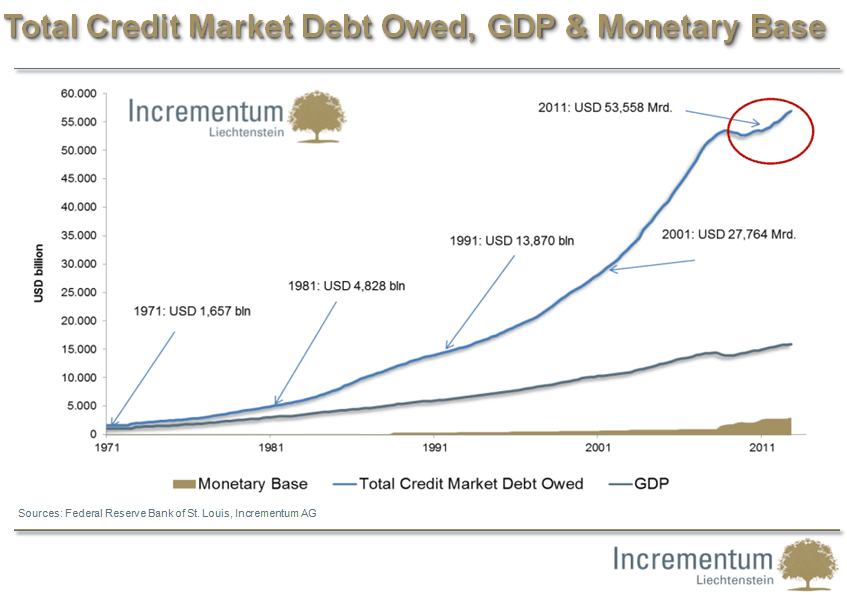
In an excellent collection of 50 charts, Ronald Stoeferle presents all fundamental data related to gold’s bull market and the too-big-to-fail debt bubble. Stoeferle is Managing Director at Incrementum Liechtenstein and writer of the famous In Gold We Trust reports.
The charts cover three major themes: gold, debt and economy, currency debasement. In this article, we highlight the ten most powerful charts. They tell the complete fundamental story and lay out the most likely scenario going forward. The full presentation is mandatory study material.
The debt bubble keeps on growing. The nominal amounts are beyond imagination. The key take-away here is the diminishing rate of return of a marginal unit of debt. In other words, central planners need to create increasingly more debt for less economic growth. That is worrisome, to say the least. By the way, did you know how much debt has been created per citizen (on average)? Please don’t try to imagine this figure also applies to yourself. It is no information for the faint-hearted.


 In the mid-1970s, an investor with tremendous business experience, Warren Buffett, became the business “coach” and confidant of the Washington Post‘s Katharine Graham. Graham became chairman and CEO of the newspaper company unexpectedly when her husband committed suicide. She leaned heavily on Buffett’s business judgment – especially when it came to the question of how to manage the business fund. Buffett addressed that critical question in a private letter to Graham.

-
I know Mike is a very solid investor and respect his opinions very much. So if he says pay attention to this or that - I will.
~ Dale G.
-
I've started managing my own investments so view Michael's site as a one-stop shop from which to get information and perspectives.
~ Dave E.
-
Michael offers easy reading, honest, common sense information that anyone can use in a practical manner.
~ der_al.
-
A sane voice in a scrambled investment world.
~ Ed R.
Inside Edge Pro Contributors

Greg Weldon

Josef Schachter

Tyler Bollhorn

Ryan Irvine

Paul Beattie

Martin Straith

Patrick Ceresna

Mark Leibovit

James Thorne

Victor Adair