
Gold & Precious Metals
-
 The price action of gold has been relatively “tame” recently, despite all the drama and emotional excitement created by the US government shutdown.
 -
In the big physical markets of Asia, China’s imports have surged, but India’s have been crushed by government regulation.
-
With imports down by as much as 90% in India, gold refineries are losing a lot of money. In the big picture, refinery closures are bullish for gold, but investors need a lot of patience.
-
If Indian smuggling is accounted for, it could be argued that overall Asian gold demand is roughly the same now as it was at this time last year. That’s price-neutral news for gold.
-
If the Indian government restrictions didn’t exist, gold prices would probably be much higher than they are now. Unfortunately, the restrictions do exist, and most bank analysts believe that US central bank tapering of the QE program will cause more investor selling.
-
Essentially, the super-crisis of the West is in a “lull”, and Asian demand is “mixed”. Value-oriented investors and institutions are gold buyers, but the overall gold market can probably be summarized as “soft”.
-
The market has a floor of physical demand under it, but that floor is more like a sponge than a layer of bedrock.
-
Since gold rose to sell-side HSR (horizontal support and resistance) in the $1410 – $1430 area, I’ve suggested that gold market investors should buy nothing, unless the price declined to $1266.
-
Please click here now. That’s the daily gold chart. Gold did touch the $1266 area last week, and it’s trading there again today.
-
Unfortunately, the $1266 – $1275 area is arguably the neckline of an ugly head and shoulders top pattern. I’ve highlighted that HSR line in black.
-
The technical target of this top pattern is about $1120. Gold traded between $1523 and $1923 for quite a long time, and it could be argued that the technical target of that range breakdown is also about $1120.
-
The green bullish wedge pattern is still intact, but its demand line is being severely tested. Note the position of my stokeillator (14, 7, 7 Stochastics) at the bottom of the chart. It’s a bit of a mess, and there’s a crossover sell signal in play.
-
Please click here now. That’s a 30 minute bars chart for gold. It’s also very bearish, at least in the short term.
-
For many years, some analysts in the gold community have argued that the comex gold market is “manipulated by the banksters”. I don’t know if the market is manipulated or not, but I do know that a number of mainstream analysts have begun to express serious concerns about some sizable gold trades that were recently executed on the comex.
-
Art Cashin is the director of NYSE floor operations for UBS bank. He’s recently been quoted by some mainstream media, as well as by the gold community, questioning why thousands of comex gold contracts have been sold at once, “at the market”. Worse, it’s apparently happened on several occasions.
-
Professional fund managers normally sell their positions at a rate that the market can handle, without creating wild price movements. If gold sales are being made unprofessionally, it’s understandable why powerful analysts like Art Cashin would be concerned about the motives of the sellers.
-
Regardless, in the big picture, my firm view is that global cost push inflation will be created by the “excessive” use of quantitative easing by the Japanese central bank. I expect that Japan’s biggest export will become cost push inflation.
-
The financial condition of the government of Japan is much worse than most other governments. That means that money printing, in the form of QE, can get out of control much more easily than in other nations.
-
If the current volume of Japanese QE continues for another year or two, or even accelerates, I expect serious inflation to occur.
-
On that note, I’ve suggested that the price of sugar is perhaps a better lead indicator of a surge in the global inflation rate than gold or silver.
-
When sugar makes a big move, up or down, gold and silver often tend to follow. Please click here now. That’s a weekly chart for sugar. I’ve highlighted a number of huge bullish wedge patterns on the chart, and this is the biggest of them all.
-
Note the enormous volume that occurred soon after the breakout from that wedge formation. I’ll remind all gold and silver investors that sugar’s last big peak was in early 2011. That was several months before gold and silver peaked, proving sugar’s ability to be a key indicator of gold and silver price action.
-
The current move in sugar needs to be watched. A short term correction is overdue, but sugar could be indicating that the actions of the Japanese government and central bank are much more of a “game changer” than most investors realize.
-
After the oil price shock of 1973, it was sugar, not gold and silver, that suggested that stagflation could occur, and it did.The current price action of sugar is suggesting that the gold bears have a short term edge, but have they failed to do their cost push inflation homework?


Special Offer For Website Readers: Please send an Email to freereports4@gracelandupdates.com and I’ll send you my free “Get Jacked With JNUG & JDST” report! JNUG-NYSE and JDST-NYSE are the new triple leverage junior gold stock ETFs. There’s one for the bulls, and one for the bears. I’ll show you the charts I’m using now, to minimize risk and maximize potential reward!
Thanks!
Cheers
Stewart
Written between 4am-7am. 5-6 issues per week. Emailed at aprox 9am daily.
Email: stewart@gracelandupdates.com
Mail to:
Stewart Thomson / 1276 Lakeview Drive / Oakville, Ontario L6H 2M8 Canada
Risks, Disclaimers, Legal
Stewart Thomson is no longer an investment advisor. The information provided by Stewart and Graceland Updates is for general information purposes only. Before taking any action on any investment, it is imperative that you consult with multiple properly licensed, experienced and qualifed investment advisors and get numerous opinions before taking any action. Your minimum risk on any investment in the world is: 100% loss of all your money. You may be taking or preparing to take leveraged positions in investments and not know it, exposing yourself to unlimited risks. This is highly concerning if you are an investor in any derivatives products. There is an approx $700 trillion OTC Derivatives Iceberg with a tiny portion written off officially. The bottom line:
Are You Prepared?

Another of history’s many lessons is that governments under pressure become thieves. And today’s governments are under a lot of pressure.
Before we look at the coming wave of asset confiscations, let’s stroll through some notable episodes of the past, just to make the point that government theft of private wealth is actually pretty common.
• Ancient Rome had a rule called “proscription” that allowed the government to execute and then confiscate the assets of anyone found guilty of “crimes against the state.” After the death of Julius Caesar in 44 BC, three men, Mark Anthony, Lepidus, and Caesar’s adopted son Octavian, formed a group they called the Second Triumvirate and divided the Empire between them. But two rivals, Brutus and Cassius, formed an army with which they planned to take the Empire for themselves. The Triumvirate needed money to fund an army of its own, and decided the best way to raise it was by kicking the proscription process into overdrive. They drew up a list of several hundred wealthy Romans, accused them of crimes, executed them and took their property.
• In the mid-1530s, English king Henry VIII was short of funds, so he seized the country’s monasteries and claimed their property and income for the Crown. As historian G. J. Meyer tells it in The Tudors: The Complete Story of England’s Most Notorious Dynasty:
“By April fat trunks were being hauled into London filled with gold and silver plate, jewelry, and other treasures accumulated by the monasteries over the centuries. With them came money from the sale of church bells, lead stripped from the roofs of monastic buildings, and livestock, furnishings, and equipment. Some of the confiscated land was sold – enough to bring in £30,000 – and what was not sold generated tens of thousands of pounds in annual rents. The longer the confiscations continued, the smaller the possibility of their ever being reversed or even stopped from going further. The money was spent almost as quickly as it flooded in – so quickly that any attempt to restore the monasteries to what they had been before the suppression would have meant financial ruin for the Crown. Nor would those involved in the work of the suppression … ever be willing to part with what they were skimming off for themselves.”
• Soon after the French Revolution in 1789, the new government confiscated lands and other property of the Catholic Church and used the proceeds to back a new form of paper currency called assignats. The resulting money printing binge quickly spun out of control, resulting in hyperinflation and the rise of Napoleon.
• During the US Civil War, Congress passed laws confiscating property used for “insurrectionary purposes” and of citizens generally engaged in rebellion.
• In 1933, in the depths of the Great Depression, president Franklin Roosevelt banned the private ownership of gold and ordered US citizens to turn in their gold. Those who did were paid in paper dollars at the then current rate of $20.67 per ounce. Once the confiscation was complete, the dollar was devalued to $35 per ounce of gold, effectively stealing 70 percent of the wealth of those who surrendered their gold.
• In 1942, after entering World War II, the US moved all Japanese citizens within its borders to concentration camps and sold off their property. The detainees were released in 1945, given $25 and a train ticket home – without being reimbursed for their losses.
Since the 2008 financial crisis, various kinds of capital controls and asset confiscations have become common. A few examples:
• Iceland required that firms seeking to invest abroad get permission from the central bank and that individual Icelanders get government authorization to buy foreign currency or travel overseas.
• Greece pulled funds directly from bank and brokerage accounts of suspected tax evaders, without prior notice or judicial due process.
• Argentina banned the purchase of U.S. dollars for personal savings and required banks to make loans in pesos at rates considerably below the true inflation rate.
• The US Fed proposed that money market funds be allowed to limit withdrawals of customer cash in times of market stress.
• Cyprus, a eurozone country, responded to a series of bank failures by confiscating 47.5% of domestic bank accounts over €100,000.
• Poland in September responded to a budgetary shortfall by confiscating the assets of the country’s private pension funds without offering any compensation.
• Spain was recently revealed to have looted its largest public pension fund, the Social Security Reserve Fund, by ordering it to use its cash to buy Spanish government bonds. Currently 90% of the €65 billion fund had been invested in Spanish sovereign paper, leaving the fund’s beneficiaries dependent on future governments’ ability to manage their finances.
Now for the big one, reported by Automatic Earth on Saturday October 12:
The IMF Proposes A 10% Supertax On All Eurozone Household Savings
This is a story that should raise an eyebrow or two on every single face in Europe, and beyond. I saw the first bits of it on a Belgian site named Express.be, whose writers in turn had stumbled upon an article in French newspaper Le Figaro, whose writer Jean-Pierre Robin had leafed through a brand new IMF report (yes, there are certain linguistic advantages in being Dutch, Canadian AND Québecois). In the report, the IMF talks about a proposal to tax everybody’s savings, in the Eurozone. Looks like they just need to figure out by how much.The IMF, I’m following Mr. Robin here, addresses the issue of the sustainability of the debt levels of developed nations, Europe, US, Japan, which today are on average 110% of GDP, or 35% more than in 2007. Such debt levels are unprecedented, other than right after the world wars. So, the Fund reasons, it’s time for radical solutions.
The IMF refers to a few studies, like one from 1990 by Barry Eichengreen on historical precedents, one from April 2013 by Saxo Bank chief economist Steen Jakobsen, who saw a 10% general asset tax as needed to repair government debt levels, and one by German economist Stefan Bach, who concluded that if all Germans owning more than €250,000, representing €2.95 trillion in wealth, were “supertaxed” on their assets at a 3.4% rate, the government could collect €100 billion, or 4% of GDP.
French investor site monfinancier.com talks about people close to the Elysée government discussing how a 17% supertax on all French savings over €100,000 would clear all government debt. The site is not the only voice to mention that raising “normal” taxes on either individuals or corporations is no longer viable, since it would risk plunging various economies into recession or depression.
Here’s what the October 2013 IMF report, entitled Fiscal Monitor : Taxing Times, literally says on the topic, in the chapter called:
Taxing Our Way Out Of – Or Into? – Trouble
The sharp deterioration of the public finances in many countries has revived interest in a capital levy, a one-off tax on private wealth, as an exceptional measure to restore debt sustainability. (1) The appeal is that such a tax, if it is implemented before avoidance is possible, and there is a belief that it will never be repeated, does not distort behavior (and may be seen by some as fair).There have been illustrious supporters, including Pigou, Ricardo, Schumpeter, and, until he changed his mind, Keynes. The conditions for success are strong, but also need to be weighed against the risks of the alternatives, which include repudiating public debt or inflating it away (these, in turn, are a particular form of wealth tax on bondholders that also falls on non-residents).
It should probably be obvious that there is one key sentence here, one which explains why the IMF is seriously considering the capital levy (supertax) option, even if it’s presented as hypothetical:
The appeal is that such a tax, if it is implemented before avoidance is possible, and there is a belief that it will never be repeated, does not distort behavior (and may be seen by some as fair).
It all hangs on the IMF’s notion – or hope – that it can be implemented by stealth, before people have the chance to put their money somewhere else (and let’s assume they’re not thinking of digging in backyards, and leave tax havens alone for now). Also, that after the initial blow, people will accept the tax because they are confident it’s a one-time only thing. And finally, that a sense of justice will prevail among a population, a substantial part of whom will have little, if anything, left to tax.
Some thoughts
Will more countries introduce capital controls or asset confiscations in the next few years? Duh, of course. Debt levels are unmanageable, so they have to be lowered. And there are only three ways to do it: deflationary collapse that wipes out the debt through default, inflation that wipes out the debt by destroying the world’s major currencies, or stealing enough private sector wealth to reset the clock. Option one – depression – is political poison so will be avoided at all costs. Option two is being tried and is failing because the deflationary effect of trillions of dollars of bad debt more or less equals the inflationary impact of trillions of dollars of new currency.
That just leaves door number three, demonize the successful and take what they’ve accumulated. Recall from the historical list that opened this post that governments like to pick on members of society who 1) have lots of money and 2) have lots of enemies or can easily be framed for crimes. This time around it will be “the rich” who are living well at the expense of the rest of us. The trick will be to define “rich” down far enough to make possible the confiscation of middle-class IRAs and 401(K)s, since that’s where the real money is.
Interesting that the build-up to asset confiscation is coinciding with a coordinated take-down of gold and silver, the two assets that will be hardest to steal when the time comes.
 That’s right, Michael disusses the IMF report “Entitled Taxing Times”. “In that report the IMF recommends confiscating private wealth in an effort to protect the Status Quo in Government”.
{mp3}mcbuscomoct15{/mp3}
Read the article Michael refers to HERE

Stock Market Appears Ready for New High – What Impact Could It Have on Gold?
On Monday, after weekend talks failed to reach a solution that would reopen the federal government and raise the federal borrowing limit by October 17, the S&P 500 Index dropped to its intraday low below 1,700. However, the index reversed course early in the afternoon on a report that President Barack Obama planned to meet with Congressional leaders from both parties at the White House later in the afternoon.
According to Reuters, yesterday Senate leaders made progress on a U.S. debt deal. Additionally, today they may reach an agreement to bring a halt to the fiscal standoff. The emerging deal would avoid a potential default, end the 15-day-old government shutdown and change the immediate deadlines in favor of three new ones over the next four months.
Although it’s far from complete as the Senate may delay passing the plan and House Republicans may seek to block or change it, investors still believe that an extension to the debt ceiling, or at least a resolution that buys more time, is highly likely. So do we – no matter how the authorities decide to call it, we think that more money will be available. Printing it is just too easy politically.
Yesterday, the S&P 500 rose for a fourth day and closed at the highest level since September 19. It’s worth noting that the index is within 16 points of its September 18 record of 1,725.52. The S&P 500 has advanced 3.3% in the last four trading sessions and this is its biggest four-day rally since January.
The rally in stocks seems to have triggered a decline in the precious metals sector and the following stocks’ moves could further contribute to metals’ performance.

Looking at the above chart, we see that the move below the rising medium-term support line was quickly invalidated and the outlook improved dramatically based on Thursday’s session.
The official reason was “signs of progress in negotiations to raise the U.S. debt limit, at least temporarily.”
In our view, it’s almost certain that the debt ceiling will be raised, and the only unknown is the justification that politicians will use to do it this time. Therefore, we can expect stocks to rally further as the market becomes more optimistic about it. As mentioned earlier, yesterday the S&P 500 rose for a fourth day and closed at the highest level since September 19, which confirms the above assumption.
In the previous week, gold’s reaction was quite interesting – it didn’t rally even though the additional perceived probability of the increase in the debt limit should trigger such a move. This time, markets seem to have focused on this piece of information as a relief, and people sold gold, which is no longer needed as a hedge – at least a lot of investors seem to have thoughts like that.
The implications for gold are bearish, and this makes them bearish also for the rest of the precious metals sector, although to a smaller extent.
Let’s take a look at the short-term outlook.
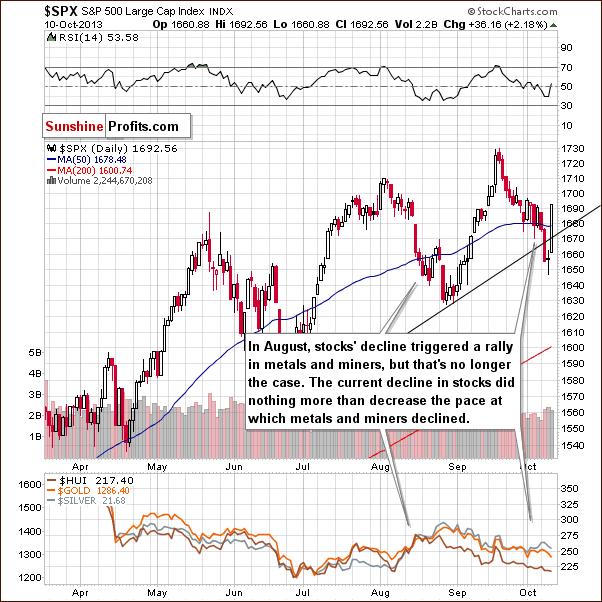 The invalidation of the breakdown is quite clear on the above chart, but since we already covered it above, we will now focus on something else.
Another important thing to be noticed here is that declining stock prices didn’t trigger a rally in the precious metal market. The only way in which the declining stocks managed to impact the precious metal market was to decrease the pace of the metals’ and miners’ decline. On a side note, our Stock Trading Alert subscribers remained updated throughout Thursday’s volatile session (4 alerts were published on Thursday; the first one is available publicly and its description in the list of alerts is accompanied by an arrow summarizing the outlook – it was green and pointing upward before Thursday’s session – for the first time in a week and a half).
Let’s turn now to the financial sector, which in the past used to lead the rest of the general stock market.
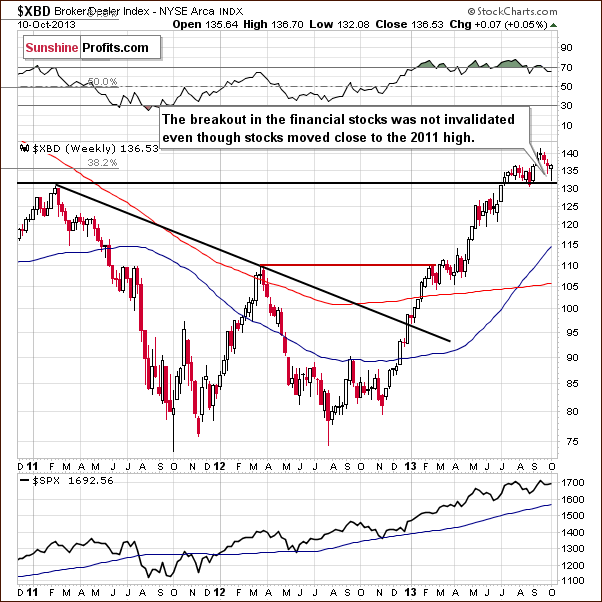 On the above chart we clearly see that, in spite of the recent downward move, the financial stocks didn’t invalidate the breakout above the level of 130. This was a subtle indication that a bigger decline would not be seen on the stock market.
Consequently, the medium-term outlook remains bullish. Please note that since the support created by the 2011 high is relatively close, we will likely not see another major decline.
With a bullish outlook for the stock market, it seems that the decline in the precious metals stock market can continue in the medium term.
But how are stocks performing relative to gold – particularly: gold stocks? Let’s move on to the gold stocks:gold ratio. We think that this is another interesting chart that may provide important clues about further movements in the precious metals.
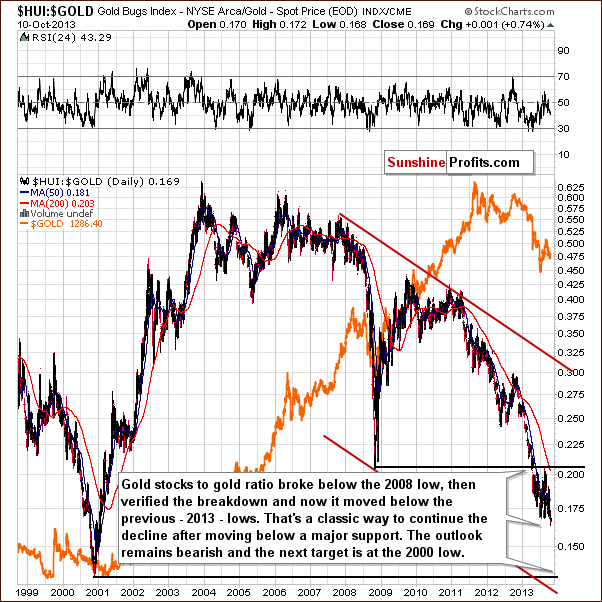
At the beginning of the previous week the HUI:gold ratio declined sharply and moved visibly below its 2013 lows. In other words, we saw a major breakdown in this important ratio and it seems that the ratio is on its way to the 2000 low at 0.133.
Please note that the significant underperformance of the ratio was the thing that preceded the April plunge earlier this year. Of course, it doesn’t mean that metals or miners have to move lower immediately, but in our view, it’s just a matter of time.
Summing up, the long-term, medium-term and short-term outlooks for the stock market are bullish, and the implications for the precious metals sector are bearish.
Thank you for reading. Have a great and profitable week!
Przemyslaw Radomski, CFA
Founder, Editor-in-chief
Gold Price Prediction Website – SunshineProfits.com
* * * * *
Disclaimer
All essays, research and information found above represent analyses and opinions of Przemyslaw Radomski, CFA and Sunshine Profits’ associates only. As such, it may prove wrong and be a subject to change without notice. Opinions and analyses were based on data available to authors of respective essays at the time of writing. Although the information provided above is based on careful research and sources that are believed to be accurate, Przemyslaw Radomski, CFA and his associates do not guarantee the accuracy or thoroughness of the data or information reported. The opinions published above are neither an offer nor a recommendation to purchase or sell any securities. Mr. Radomski is not a Registered Securities Advisor. By reading Przemyslaw Radomski’s, CFA reports you fully agree that he will not be held responsible or liable for any decisions you make regarding any information provided in these reports. Investing, trading and speculation in any financial markets may involve high risk of loss. Przemyslaw Radomski, CFA, Sunshine Profits’ employees and affiliates as well as members of their families may have a short or long position in any securities, including those mentioned in any of the reports or essays, and may make additional purchases and/or sales of those securities without notice.

 The popular take on the current debt ceiling stand-off is that the Tea Party wing of the Republican Party has a delusional belief that it can hit the brakes on new debt creation without bringing on an economic catastrophe. While Republicans are indeed kidding themselves if they believe that their actions will not unleash deep economic turmoil, there are much deeper and more significant delusions on the other side of the aisle. Democrats, and the President in particular, believe that continually taking on more debt to pay existing debt is a more responsible course of action. Even worse, they appear to believe that debt accumulation is the equivalent of economic growth.
If Republicans were to inexplicably prevail, and the federal government were to cut spending so that its expenditures matched its tax revenues (a truly radical idea) the country’s financial mess would be laid bare. The government would have to weigh the relative costs and benefits of making interest payments on Treasury debt (primarily to foreign creditors) or to trim entitlements promised to U.S. citizens. But those are choices we will have to make sooner or later anyway. In fact we should have dealt with these issues years ago. But generations of mechanistic debt ceiling increases have allowed us to perpetually kick the can down the road. What could possibly be gained by doing it again, particularly if it is done with no commitment to change course?
The Democrats’ argument that America needs to pay its bills is just hollow rhetoric. Paying off one’s Visa bill with a new and bigger MasterCard bill can’t be considered a legitimate payment of debt. At best it is a transfer. But in the government’s case, it doesn’t even qualify as that. Treasury debt is primarily bought by the Fed, foreign central banks, and major financial institutions. None of that will change with a debt ceiling increase. We will just go to the same people for greater quantities. So it’s like paying off your Visa card with a bigger Visa card.
According to modern economists, an elimination of deficit spending will immediately cause a dollar for dollar decrease in GDP. For example, if the government stopped sending food stamp payments to poor people, then grocery stores would lose business, employees would be laid off, and the economy would contract. But this one dimensional view fails to appreciate that the purchasing power of the food stamps had to come from somewhere. The government can’t create something from nothing. Taxation transfers purchasing power from people living in the present to other people living in the present. In contrast, borrowing transfers purchasing power from people living in the future to people living in the present. The good news for politicians is that future people don’t vote in current elections (and current voters don’t seem to appreciate the cost to their future selves of current policy).
The Obama Administration has congratulated itself for turning around the contracting economy that it inherited from President Bush. But even if you take the obscenely low official inflation statistics at face value, we only grew at an anemic 1.075% annual pace from 2009 to 2012 (far below the between 3% and 4% that the U.S. averaged post World War II). Sadly, this growth pales in comparison to the accumulation of new debt that we are borrowing from the future.
U.S. GDP is measured at roughly $15 trillion per year. 2% growth means that each year the GDP is approximately $300 billion larger than the prior year. But in the less than five years since Obama took office, the federal government has added, on average, about $1.3 trillion per year in new debt, a pace that is four times higher than the growth. If the deficit were subtracted from GDP, America would be shown to be stuck in a severe recession that Washington can’t acknowledge. But such a reality is more consistent with the dismal job prospects and stagnant incomes experienced by most Americans.
The belief that deficits add to the economy, and that debt can be dealt with in an imaginary future (that never seems to arrive) is the foundation upon which the President can chastise the Republicans as irresponsible suicide bombers. Using this logic, he can argue (with a straight face) that borrowing is the equivalent of paying. That the President can make this delusional argument is not so surprising (no lie too great for the typical politician to attempt). What is alarming is that the media and the public have swallowed it so willingly. As they call for limitless increases in borrowing, Democrats have offered no plan to reduce the current debt and they are unwilling to negotiate with Republicans on that topic. Yet somehow they have been perceived as the party of fiscal responsibility.
While the Republicans have a dismal track record of their own when it comes to budgetary management, it can’t be disputed that the minor dip in that rate of increase in spending that resulted from the recent Sequester, happened only because they dug in on the issue. Without the 2011 debt ceiling drama, there is no chance that any spending would have been touched.
Democrats had warned that the $85 billion in sequestration cuts slated for fiscal year 2013 (about 2% of the Federal budget) would be sufficient to bring on economic Armageddon. But guess what? We survived. Recently, Senate Majority Leader Harry Reid continued with such rhetoric by declaring that there are no more cuts to be found anywhere in the $3.8 Trillion dollar federal budget. (Apparently he missed last week’s 60 Minutes piece on the spreading epidemic of federal disability fraud.)
We have to acknowledge what even the Republicans haven’t fully grasped. We are in such a deep debt hole that there is no solution that does not involve serious economic pain. Tea Party Republicans rightly believe that government spending is a drag on economic growth. As a result, they conclude that immediate spending cuts will help with the “recovery”. But they are confusing real economic growth with the delusional expansion created by deficit spending (which is actually damaging the real economy). If they cut the deficit, this phony economy may likely implode and cause widespread distress.
So even though a reduction in government borrowing and spending does help the economy, it won’t feel very helpful tomorrow. The more we borrow and spend today, the more we will suffer tomorrow when the bills come due. Ironically, cutting government spending now helps the economy by allowing the economic adjustment to happen sooner rather than later. But this type of long-term thinking is very difficult for politicians to consider.
Unfortunately our debts don’t leave us much in the way of choices. We can choose to pay now or try to pay later. But the longer we wait the steeper the bill.
Peter Schiff is the CEO and Chief Global Strategist of Euro Pacific Capital, best-selling author and host of syndicated Peter Schiff Show.
Subscribe to Euro Pacific’s Weekly Digest: Receive all commentaries by Peter Schiff, John Browne, and other Euro Pacific commentators delivered to your inbox every Monday!
To order your copy of Peter Schiff’s latest book, The Real Crash: America’s Coming Bankruptcy – How to Save Yourself and Your Country, click here.
For in-depth analysis of this and other investment topics, subscribe to Peter Schiff’s Global Investor newsletter. CLICK HERE for your free subscription.


-
I know Mike is a very solid investor and respect his opinions very much. So if he says pay attention to this or that - I will.
~ Dale G.
-
I've started managing my own investments so view Michael's site as a one-stop shop from which to get information and perspectives.
~ Dave E.
-
Michael offers easy reading, honest, common sense information that anyone can use in a practical manner.
~ der_al.
-
A sane voice in a scrambled investment world.
~ Ed R.
Inside Edge Pro Contributors

Greg Weldon

Josef Schachter

Tyler Bollhorn

Ryan Irvine

Paul Beattie

Martin Straith

Patrick Ceresna

Mark Leibovit

James Thorne

Victor Adair