
Stocks & Equities

Barring a last minute fly in the ointment, it appears that there will be some sort of Debt Ceiling deal in the U.S. Equity markets over the last week have already discounted this outcome by bidding up prices.
So, clear sailing ahead?
Not really.
In fact, from an investment perspective, the whole Debt Ceiling / Government Shutdown debate has been a red herring. There has been almost no surprise element or unknown factors with respect to these debates. We have had a dozen networks literally giving us play-by-play coverage over the last three weeks. The markets tend to hate real surprises, not slow-motion train wrecks that we can see from miles away.
What IS more important to equity markets over the next month is the level of corporate earnings; specifically corporate earnings for the 3rd quarter. It is not as racy and dramatic as political warfare, but the earnings have a greater bearing on the long-term direction of stock prices.
And how are 3rd quarter earnings looking? On the surface, they are not bad. However, companies have been warning of earnings that would be less than initial analysts’ expectations for a couple of months now. As a result, the hurdle is not that high. With expectations lowered, it may appear to be a reasonable “earnings season.”
Unfortunately, that does not change the fact that U.S. corporate earnings are almost unchanged over the last year while the U.S. equity markets are up about 15% over the same period!
The Price-Earnings graph for the S&P 500 almost perfectly overlays the actual graph of the S&P 500, clearly indicating that earnings have been stuck in neutral for the entire year.
The longer that equity markets remain elevated without an eventual corresponding increase in earnings, the greater the chance that prices will come down.
And, the best way to avoid going out with the tide in that scenario is to find individual companies with better-than-average earnings results and earnings growth, or defensive stocks that can maintain their profit margins and may attract a safety premium as a result.
The opinions expressed in this report are the opinions of the author and readers should not assume they reflect the opinions or recommendations of Richardson GMP Limited or its affiliates. Assumptions, opinions and estimates constitute the author’s judgment as of the date of this material and are subject to change without notice. We do not warrant the completeness or accuracy of this material, and it should not be relied upon as such. Before acting on any recommendation, you should consider whether it is suitable for your particular circumstances and, if necessary, seek professional advice. Past performance is not indicative of future results.
Richardson GMP Limited, Member Canadian Investor Protection Fund.
Richardson is a trade-mark of James Richardson & Sons, Limited. GMP is a registered trade-mark of GMP Securities L.P. Both used under license by Richardson GMP Limited.

Personally, I think even attempting to call a top on this character of an equity market is an exercise in the self-infliction of pain for now. It has been a long time since I’ve seen this type of speculation, but it’s been never since I’ve seen this type of monetary largesse. Moreover, when was the last time both the Fed and politicians have meaningfully attempted to “shape” societal perceptions, let alone hoped for economic outcomes, via manipulation of the financial markets? We know capital is “concentrating” right now, and the repository is US and large global equities. The Fed has been 100% successful in forcing capital into equities and real estate, exactly as their years ago game plan detailed. Likewise, with the tapering genie now out of the bottle, we are watching a rescission of global capital that originally spread out across planet Earth as QE went to ever greater heights since 2009. The outgoing tide is now coming in. These two forces, domestic investment concentration in one asset class and an incoming tide of liquidity from broader global risk assets (think emerging markets, commodities and the metals) characterizes the moment. And for now, liquidity and the weight and movement of global capital trump strict fundamentals. Nothing new, we’ve been here before.
But a funny thing happened on the way to new equity highs recently, for the first time in many a moon we’ve begun to see more than a few noticeable technical divergences. Remember, technical analysis is a suggestion, not a hard and fast mandate. It suggests to us what might be, as opposed to definitively speaking to what will. Technical signals, especially in this character of a market, can change meaningfully and fast in both directions. A lot of tried and true historical “systems” have simply broken down for now. After all, technical analysis is tough enough in a free market environment, let alone the type of one in which we now find ourselves. As always, adaptability is essential for survival.
I promise, the last thing I’m trying to do in this discussion is call a top. This is merely an attempt to provide perspective. I’ve seen many a market that was a “no lose” environment…until the losses started. I’ve seen markets where complacency reigned for an extended period…until it didn’t. You know the routine. So rather than pontificate about where equities are headed next, primarily because I have no idea (and neither does anyone else), I thought I’d simply let a number of charts do the talking. Again, perspective, not predictions.
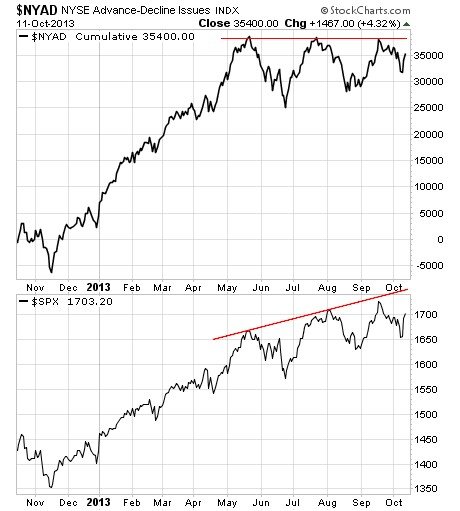
One very apparent divergence we’re seeing right now is the NYSE advance/decline line relative to the S&P itself. The cumulative AD line has been in a range since mid-May, while equities have journeyed to recent new high territory.
….read more and view 8 more charts HERE
 Sometimes the most attractive energy assets aren’t found in the ground. Rather, at times like today, they are listed on the stock exchange.
Billionaire businessman Carl Icahn is one investor seeing value in energy companies. The hedge fund manager recently announced his purchase of 60 million shares in the Canadian oil and gas producer, Talisman Energy. Icahn has built up a nearly 6% stake in the Calgary-based energy producer, worth a whopping $300 million. Even though the company has been a perennial underperformer, after Icahn’s tweet, the stock climbed to the highest level in more than a year.
According to Forbes, analysts figure if Icahn and the CEO can successfully turn the company around, “The gain on the legendary raider’s 6% could be more than $500 million.”
I believe this “raider’s” deal represents one of the many potentially lucrative energy plays that savvy investors are getting excited about. Whereas last summer, Chinese companies werescooping up valuable resource assets, now a different phenomenon is taking place.
For example, I recently talked to Martin Soong on CNBC Asia about Petrominerales being purchased for about $900 million in cash by Bogota-based major oil producer Pacific Rubiales. Petrominerales’ stock popped an incredible 42% on Sept. 27 before trading on the stock was halted.
….read page 2 HERE

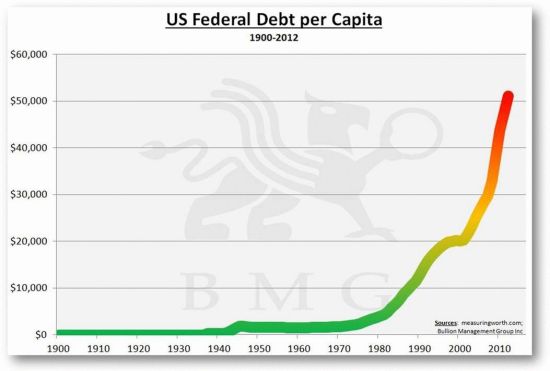
 Michael discusses the days this week and in weeks to come that the US will have big debt payments to make if the debt ceiling debt ceiling debate isn’t resolved. Also some of the utter nonsense going on surrounding the debate.
{mp3}mcbuscomoct16fp{/mp3}
 This week’s BullionBuzz includes:
- Gold’s Plunge: One Massive Sell Order
- Gold and Western Economic Policy
- Gold Is Not a Slam-Dunk Sell
- China Enjoys Gold Clearance Sale
- When the Dollar Fails
- Same Old Fed Boss
….read the: BullionBuzz eNewsletter – October 16, 2013 HERE
Nick Barisheff
Bullion Management Group Inc.
For purchase information on BMG Bullion Products


-
I know Mike is a very solid investor and respect his opinions very much. So if he says pay attention to this or that - I will.
~ Dale G.
-
I've started managing my own investments so view Michael's site as a one-stop shop from which to get information and perspectives.
~ Dave E.
-
Michael offers easy reading, honest, common sense information that anyone can use in a practical manner.
~ der_al.
-
A sane voice in a scrambled investment world.
~ Ed R.
Inside Edge Pro Contributors

Greg Weldon

Josef Schachter

Tyler Bollhorn

Ryan Irvine

Paul Beattie

Martin Straith

Patrick Ceresna

Mark Leibovit

James Thorne

Victor Adair